Showing posts with label hipsters. Show all posts

Tuesday, May 18, 2010

Thoughts on lesbian hipsters

The Threadbared crew tweeted that I should take a look at this article on Autostraddle, a girl-on-girl culture website, about "lesbian hipsters". Well, I feel rather out of my depth talking about lesbian culture, in which I've hardly been immersed, but let's have a look at what author "Katrina" (is she like Cher or Madonna?) has to say about hipsterism.

Well, first of all I think the article is really confused about what a lesbian hipster is and does. At points Katrina doesn't sound convinced that there even is such a thing. But for the sake of argument, they're gamine girls who are just a little bit too femme to be butch, but who are still recognisably dykey, but also, not quite recognisably enough, since straight dudes still hit on them. They wear the "lesbian three-piece suit" of flannie shirt, bandanna and skinny jeans.

It's such a temptation, but ultimately quite unhelpful and non-illuminating, to create 'definitive' taxonomies ("they wear this; they like this") of a chimerical cultural figure that means a slightly different thing to each different person. It's probably more useful to talk about what hipsterism does than what it definitively is or isn't. What discussions does the term 'hipster' enable about the contemporary uses of culture?

I found Katrina's attempt to ground the lesbian hipster in subculture, and to talk about it in Dick Hebdigean terms of subcultural incorporation, to be pretty misguided, because I feel that hipsterism isn't about incorporating elements of subcultural style, but rather it's a display of aesthetic singularity and cultural capital. The irony of hipsterism is not on its T-shirts; rather, it's that people strive to show their individuality, to reject the category of 'hipster', and end up looking generically 'hip'.

Also, what we often think of as the hipster aesthetic – the ironic sloganeering; the skinny silhouette; the self-consciously whimsical or nostalgic flourishes – has never been an underground one, but rather draws on and requires a mainstream cultural machinery, whether that's textile mills to produce de-branded plain cotton separates; old movies and TV shows to invoke or plastic toys and ephemera to transform into cute jewellery and other objets de craft.

Now let's look at the 'lesbian' part of the lesbian hipster. For me, the most confused part of the article is this:
Hipsterdom may be viewed as somewhere in between genders, but identifying yourself as a lesbian means not only identifying yourself as a woman but also identifying yourself based on sexuality. Therefore, the lesbian hipster has universal appeal. Her style is just new enough to be trendy and sexy, while the items in her wardrobe are familiar enough to be safe.
There are so many nonsequiturs and assumptions here that it's difficult to know where to start teasing them out. How is the "universal appeal" bit related to self-identification? Is her appeal only universal among other hipsters, or does the lesbian hipster appeal to everyone: gay, straight, male, female, hip, unhip…? What's new about her style, and what's familiar about it? Katrina doesn't say.

I want to dispute the claim that hipsters constitute a 'third gender'. It's interesting in fashion terms, considering that perhaps androgyny is a deliberate marketing strategy – aka, the CK One effect. But androgynous dress is really not enough on which to build the foundation of gender identity, which is a wider socialised role, a way of being in the world.

I'd also argue that Katrina's example of straight hipster boys hitting on her even though she's gay says much less about a 'third gender' than it reveals how hipsterism tends to gesture towards transgressive sexuality while ultimately retreating into sexual conservatism (as the various parodies of American Apparel's ads reveal).

Perhaps the in-between-ness of the lesbian hipster inheres in being what Katrina depicts as some kind of subcultural double agent: she can enjoy the coolness of being a hipster as well as the acceptance of the wider lesbian community. But here we have to think about the difference between a pose and an identity. Is being a lesbian an immutable part of who you are, or is it something to be donned and doffed like skinny jeans?

Bah! I feel that I've waded into some identity politics that I'm not really equipped to talk about. But I do have to admit that naming your cat Jane Lynch or Shane Jr. is an unbearably 'hipster' thing to do.

Monday, September 15, 2008

The Golden Plimsoll


It sounds like some kind of award for hipsterism. (Ceremony to be held at McCarren Park Pool, hosted by Steve Aoki. How many Plimmys did Agyness Deyn win this year? Best New Hipster Plimmy for MGMT. Lifetime Achievement Plimmy for Dave Eggers.)

Anyway, as you can see, back in August I bought a pair of hipster plimsolls, the silliest Big Dubs had to offer. I had to splash out on a pair of insoles because it was like walking around on pancakes. Still, I am enjoying them.

Friday, May 30, 2008

Here we go again

It's fascinating that after years and years of determinedly ignoring the political connotations of the keffiyeh, certain idiotic sections of the media have decided to have a "kerfuffle" about it, thanks to American TV chef Rachael Ray's wearing a keffiyeh-like scarf in, of all things, a Dunkin Donuts ad.


My own immediate thought was that it is way too late to start getting high and mighty about how ignorant people are of this garment's political connotations. Conservative US commentator Michelle Malkin's characterisation of the mainstreamed keffiyeh as some kind of unAmericanism is tediously disingenuous. It's a total nonsense to argue that chirpy, smug Rachael, who loves to groan with pleasure as she ingests various foodstuffs, endorses terrorism, cares about the Palestinian cause, or indeed was even wearing a keffiyeh. It is even doubtful that she endorses Dunkin Donuts.

But this stoopid manufactured media panic (check out how my blog post on this subject from two years ago briefly flashes up on the screen during this fish-in-a-barrel audio story from the Sydney Morning Herald) is at least informative, because it acts as a foil to the way people actually view these scarves: as floating signifiers of cool. It is deeply comical to see the bewilderment of kids who bought these scarves from mainstream shops without any thought of political connotations – even ironic ones. These doofuses just wanted to be cool, and now they are being punished?

"I thought it was a nice scarf, a cowboy scarf," wails 20-year-old uni student Sandra Tieger of the black-and-white patterned scarf she bought from corporate-hippie chain Tree Of Life and which got her in trouble at her part-time job as a bottle shop attendant.

(As an aside, I find it really interesting that these 'ethnic' shops, like Ishka, seem to have lost any subcultural or political connotations their wares might previously have had. Now, they are just 'exotic'. It seems odd to me that someone who bought a garment from Tree Of Life would be surprised that it might hold meanings other than a generalised hipness; but that must say more about the shop's mainstreaming than anything else. Let's not forget that Starbucks was once a countercultural coffee shop.)

But back to Sandra: "I thought: 'It's black and white, no-one will say anything to me because that's all we can wear [with our work uniform]'." Poor Sandra doesn't understand why customers started complaining, and started crying when her boss told her not to wear the scarf to work any more. Now she won't even wear it out of the house: "It's in my drawer, I feel very uncomfortable wearing it now, I don't wear it on the street anymore [sic]."

Wednesday, December 05, 2007

Canvas shoes - the not-so-new frontier of hipsterism


It's extremely annoying that my day job has taken up so much of my time that I rarely get to blog about things when I first notice them. I've been meaning to write about the hipster plimsoll since at least August, and it's been on my radar for far longer. You know the look I'm talking about - skinny jeans on both men and women, with these dainty little canvas sneakers - usually in snowy white (or, more commonly, in scungy white).

The term plimsoll is British - I first remember encountering it in a picture story book about a street football match between neighbourhood children, where one character laments that he could have performed better if he hadn't forgotten his plimsolls. (If anyone can tell me the name of this book, I'd be very pleased.) The shoe was invented as beachwear, and is better known in Australia as a 'sandshoe'. Hilariously, I've discovered a British dotcom called White Plimsolls: "Purveyors of the finest white canvas plimsolls delivered directly to your door. An essential fashion items (sic), worn by style warriors, indie kids, emo-s (sic) and haircuts." Haircuts! ha! ha! ha! I love how they nail their target market.


The trend has been to wear them with short skinny jeans and no socks, so you'll see these hipsters' bony little ankles. Even through bitterest winter. Chicks can also wear them with tights or with bare legs and a skirt, in the manner of Mischa Barton, who popularised this look in 2005 when she became spokesmodel for Keds, a formerly old and daggy shoe company established in 1916. I always associated Keds with old-school hip-hop, but they're better known for these preppy shoes - they do a range of ballet flats as well. Another variation on the trend is to wear the sneakers without laces - as Mischa obligingly demonstrates:


Price-wise, these shoes are at the absolute bottom end of the market - at $60, Keds are massively marked up for what they are. I'm well aware of the unethical reasons why such shoes are so cheap; I'm picturing teenagers in Chinese factories sewing and gluing them together. Still, I don't want to get into an ethical debate specific to these sneakers, because with rare exceptions, hipsters don't care about ethics.


So what do they care about? In early September, I discussed hipster plimsolls with Tait (above). (Customary apologies for the shaky hands.) Tait bought these ones from an Asian import store on Smith Street, Fitzroy. I forget how much they cost, but it's significantly less than the plimsolls at Welcome To Alphaville; Tait alleged that Alex from Alpha60 buys the shoes from the same import store he did, and marks them up for sale at Alphaville.

"No, I didn't buy them from Big W like everyone else," said Tait, "but these are better quality."


Here are the ones at Big W. They're $9.82, and I thought that represented fairly good value. They're the sort with decorative threaded eyelets along the sides. But they're not, in fact, the cheapest plimsolls around. That honour goes to Kmart.


Eight bucks! And check out their range... All this plus white! (The white ones had nearly sold out; only two pairs remaining.)


The extreme cheapness and ubiquity of these shoes seem to speak to the mainstreaming of hipsterism I've written about before (and that a commenter on my previous post also mentioned in reference to Australian Idol's Matt Corby). Although last night I learned about an alleged evolution in hipsterism - "new authenticism" - that I found absolutely fascinating and would like to write about at length.

The other interesting thing is that this is quite a genteel preppie look that isn't immediately homologous with the tough-edged '50s-via-'80s pastiche hipsters tend to favour (the high waists; the rolled T-shirt sleeves, the Wayfarer sunglasses). Still, another trend I've observed lately is an old-fashioned casual style - white lace trim on black garments, the return of the tucked-in top - and there is a definite semiotic slippage between toughness and primness - Fred Perry, for example, shifts uncomfortably between being the preppie brand and the bovver-boy brand.

Sunday, October 07, 2007

Keffiyehs - they refuse to die


Keffiyeh-style scarves for sale in The Basement, Myer Melbourne.

Recently I was contacted by Dewi Cooke from The Age, who'd read my post about the keffiyeh. She's writing a story about the proliferation of this item in mainstream (not hipster) fashion. I've been meaning to do the same thing for months now, because it troubles two different ideas: that a) hipster style exists parallel to 'mainstream' style, sharing some of its motifs but remaining identifiable in itself; b) hipster style can be distinguished by its rapid-moving logic of early adoption and obsolescence.

I used to imagine a person inhabiting a 'hipster' cultural logic in a relatively stable way. I should add that I use 'inhabiting', rather than 'identifying with', because people don't tend to identify as hipsters, or admit a desire to be hip, except in self-deprecating ways (Indeed, you could argue that you instantly lose any hipness or coolness when you believe it of yourself or consciously realise you aspire to it; hipness is about insouciance), and I want to highlight a Bourdieuian concept of 'habitus' - a coherent set of knowledges and practices that produce one as a hipster.

Under this logic, you'd imagine that keffiyehs would be incredibly played out by now, and that if they're still around, they've lost their pseudo-subcultural hipness and are a mainstream accessory like any other. The fact that I spotted them yesterday in the Myer basement seems to support that "bubble-up" theory, as does the label on the scarf in question (apologies for my shaky hands):


It is hardly a Middle Eastern scarf now.

Thing is, I can't really endorse this "bubble-up" theory. The keffiyeh is now patently unconvincing as an authentic product of cosmopolitanism or politics (bought while travelling overseas, or in the knowledge of its political connotations - however abstracted or ironised). I'd like to raise the possibility that, rather than being cut loose and despised as a 'played' or uncool signifier, its continued popularity stems from its deployment by hipsters, and hence marks the mainstreaming of hipsterism.

I've always thought of hipsterism as a kind of gestalt organism that picked up and discarded tropes, and that if you were new to it, you had to be aware of the 'playedness' of particular things so you could avoid looking like a rube. But now I'm thinking about hipster generationism. Isn't it likely that people go through a 'phase' of hipsterism (from, say, age 16-25) and then other things in their lives take priority over the search for distinction? For one thing, hipsterism demands time, hedonism and research into the 'next thing', so it's well suited to students, whose habitus is already geared towards leisure, partying and information accumulation.

So, perhaps the continued run of the keffiyeh is simply its discovery by a new generation of hipsters. Perhaps hipster signifiers don't fall by the wayside in the manner I've imagined (picture a sad, sunbleached trucker hat lying in a ditch along with back issues of Vice magazine and albums by The Bravery and Clap Your Hands Say Yeah), but contribute to a cumulative hipster 'culture' to which young people want to aspire in and of itself? Maybe people no longer say "I want to be cool!" - they say, "I want to be a hipster!"

I don't know; I'm still thinking this through.

Wednesday, June 20, 2007

Read my tits and take dictation


I am always fascinated by hipster trends. These are short-lived style motifs seen among tastemakers around town. My original observation on these was they operate parallel to the trends espoused by regular fashion trend cycles because you tend to see them only on hipsters, and indeed that you can identify a hipster by the fact that they are wearing one of these motifs.

Some examples are the bandanna worn with the point at the front (and worn over the face in party pics) and the keffiyeh scarf, which refuses to die even though it seems tremendously played to me now. This does trouble what I had always taken as a central tenet of hipsterism: its cyclical logic of early adoption and obsolescence. I'll return to that later.

Anyway, I was getting my light dose of entertainment at Blue States Lose when the writer sarcastically pointed out the "originality" of the hipsters photographed at Misshapes because three of them were wearing nearly identical t-shirts:


As for where the t-shirts come from... I can't see the black one completely - it looks like a transcript from an interview with someone who has Tourette's Syndrome. The red one in the middle is from the "Fashion Groupies" collection by House of Holland and they have been around since at least last September. You have to know your fashion designers to get some of the references. And the aqua one is a lyric from the song "Close to You" by DJ Tiesto.

None is particularly clever or meaningful, and they certainly are not new:


But my point is that they share an aesthetic. They are baggy (designed to be worn with 80s-style rolled sleeves) with the sans-serif text covering the entire front of the shirt rather than just the chest. They are also long enough for No Pants 2007 - the terrifying 90s-throwback trend that I shall write about in another post, in which you wear just a t-shirt or shirt and leggings.

But the best thing is - the chain stores are all over them like a rash. The image at the top of this post is from Supre, where you can buy a variety of retarded versions of this t-shirt style. You can get "I heart my boyfriend", "I heart my hubby" (!!! - surely worn for irony by Supre's 13-year-old target market) and "I crossed-out heart my ex". But my favourite is if you are a computer nerd:


These shirts come with pre-rolled sleeves (sewn in place so they won't unroll). Also note that they are directly ripping off the House of Holland t-shirts in that the negative spaces of the letters are filled in. When I saw some in the flagship Sydney store last Friday I went into a kind of frenzy and determined to buy one, but none of the slogans interpellated me (fun fact: my very first experience at Supre involved trying on a t-shirt that said "Mel" in diamante-studded letters. It did not fit).

But the shenanigans continue at that dreadful Swanston Street store called Ice, where I saw a take on this trend so pitiful that I laughed raucously in the street:


AHAHAHAHAHHHAAAAHH! Mr Sex Pot! It's even more tragic when you realise that they are trying for the same rhyming pattern as the House of Holland collection. As another aside, I am more interested in the poster behind the mannequin where you can see a chick wearing a t-shirt that says "Save the Rave". Again, a 90s nostalgia from people not old enough to remember a time when raves required saving.

For me, the most interesting thing about this trend is that if local hipsters do cotton on to it, they're just as likely to get their t-shirt from one of these chain stores as get one from some more exclusive place. The trend is so samey that it disrupts what you might imagine to be hip patterns of consumption. In a similar way, we can see the keffiyeh still around because lately you can buy it in army disposal stores rather than actually having to travel. Isn't that a fascinating paradox, that the increasing availability of an item only prolongs its hipness rather than destroying it?

It's a similar situation to the way that Misshapes is always claimed to be tired and 'over', and yet it's survived a number of venue shifts to maintain its iconic status among hipster club nights. In the past I would have put that down to hipster generationalism, much as Streetparty has a reputation in Melbourne for attracting an extremely young crowd that grows out of the scene before they even have real IDs, to be replaced with more indie infants. The upshot is that now I really don't think people abandon stylistic motifs with quite as much alacrity as I used to suppose.

Moreover, if hipster motifs are cheaply available in chain stores, how can hipsters preserve a logic of individualism and tastemaking in their dress? I think this has to do with the baroqueness of hipsterism and its privileging of detail. People carve out a hip space within a mainstream look by making it their own in infinitesimal ways. In this case, this means we'll see more variety in the t-shirt slogans, and probably an semi-amusing parodic phase, before people get bored of them. I will be particularly interested to see if a hand-drawn felt-pen version takes off.

Wednesday, November 29, 2006

The nostalgia of the street


ThreeThousand is advertising its Christmas party using a doctored image from The Breakfast Club. I couldn't help noticing the startlingly contemporary way Molly Ringwald is dressed in that film. She wears a white lace neckerchief, a loose-fitting pink V-necked t-shirt with the sleeves rolled up, tucked into a high-waisted chocolate brown knee-length skirt, and brown knee boots. You can see fashionably dressed women wearing variations on this outfit right now. I guess I found this particularly striking today, given that I'm wearing a neckerchief, a high-waisted knee-length skirt, and knee boots.

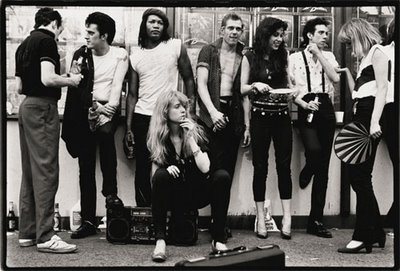
Around the same time ThreeThousand began advertising its party, I was sent a link to a marvellous slide show based on Amy Arbus's book On the Street, a collection of photographs from 1980-1990, which ran in Arbus's column of the same name in The Village Voice. Again, I was struck by the contemporaneity of the image of The Clash in 1981. You could find people in Melbourne right now dressed just like those people from 1981. It looks like an ad for jeans, except they'd never have allowed the non-jeans-wearing dude on the far left into the frame.

Why do these clothes look contemporary? I'm troubled by the distinct possibility that an ironic nostalgia is what's inspiring contemporary kids to dress like the ones in the photos, and what inspires companies to sell that nostalgia to us as lost authenticity. Because let's face it; we're talking about hipsters, and so we must tackle irony. And where there are hipsters, there are clothing manufacturers who believe in the authenticity of these hipsters' cultural activities, and want to jump on their bandwagon in order to market their clothes successfully to people who want the feeling of cool that self-perceived authenticity imparts.

Coined in the seventeenth century to describe a pathological homesickness, nostalgia has come to denote the pang that accompanies the impossibility of returning to an idealised past. In her book On Longing, Susan Stewart argues that nostalgia devalues the lived present, making the idealised past the site of authenticity. She defines nostalgia as "the repetition that mourns the inauthenticity of all repetition". Looks like she's getting all Jamesonian on our arses.

In his oft-cited Postmodernism, or the Cultural Logic of Late Capitalism, Fredric Jameson writes that the nostalgic turn arises from "the enormity of a situation in which we seem increasingly incapable of fashioning representations of our own current experience". What Jameson calls "the nostalgia form" of postmodern culture "approaches the 'past' through stylistic connotation, conveying 'pastness' by the glossy qualities of the image, and ... by the attributes of fashion". So here, we're talking about "80s-ness".

For Stewart, its utopianism gives nostalgia an innocence very unlike the self-awareness of irony, while Jameson conflates nostalgia and irony (in the form of pastiche) as equally self-aware and destructive products of the postmodern condition. But Linda Hutcheon argues that nostalgia and irony are strikingly similar, because both have doubled meanings. Nostalgia reveals both an unsatisfying present and an idealised past, while irony offers both said and unsaid meanings.

"What irony and nostalgia share, therefore, is a perhaps unexpected twin evocation of both affect and agency", writes Hutcheon. Neither inheres in a text – they’re something that the body makes happen.

As a sense of real time and history becomes lost in the postmodern morass, Jameson argues that the unified modern subject becomes fragmented and loses the capacity truly to feel -- his famous "waning of affect". Jameson doesn't, however, suggest that feelings are altogether absent from postmodern culture: rather, they become "intensities" that are "free-floating and impersonal ... dominated by a peculiar kind of euphoria" and anxiety that Jameson likens to the sublime.

But for Hutcheon, nostalgia doesn't destroy affect -- it is an affect.
... nostalgia is not something you "perceive" in an object; it is what you "feel" when two different temporal moments, past and present, come together for you and, often, carry considerable emotional weight. ... it is the element of response -- of active participation, both intellectual and affective -- that makes for the power.

So first imagine you're a hipster. You look at these images and you get excited. You're meshing these images of the past with the contemporary trends you see around you. You're imagining how you'll harness the past, how you'll look wearing these clothes. You'll imagine yourself being Molly as she gives generationalism the finger on one special Saturday. You'll imagine yourself lounging suavely like The Clash. But you'll be doing this now. Then imagine you're a marketer or a fashion designer looking for the next source of inspiration. And you trawl backwards, looking for that thing that'll get you excited. Because making the past seem fresh is your job.

Are you doing this in a thoughtless and facetious way? No, argues Hutcheon. "The ironizing of nostalgia, in the very act of its invoking, may be one way the postmodern has of taking responsibility for such responses by creating a small part of the distance necessary for reflective thought about the present as well as the past."

But it seems to me as though these are two kinds of nostalgia at play here: The Breakfast Club speaks to a mediatised nostalgia; what Hutcheon delightfully calls "commercialized luxuriating in the culture of the past". But On the Street, while also mediatised, speaks to something different -- a spatial nostalgia; a nostalgia of the street. I'm intrigued by Jameson's contention that, since the postmodern subject has lost track of temporality, "I think it is at least empirically arguable that our daily life, our psychic experience, our cultural languages, are today dominated by categories of space rather than by categories of time, as in the preceding period of high modernism".

I want to envisage "the street" as one of these categories of space. It's worthwhile remembering that nostalgia in its original sense was a longing for place. Perhaps when nostalgia seeks authenticity, it's discursively creating the street as that authentic space. And perhaps that's why marketers still look to "the street" in their quest to render the old new again. And perhaps that's why people collapse images of the past onto spaces of the present in order to create their personal styles.

This post is part of my thinking-through the paper I'm writing. I welcome your thoughts, because I am really cutting it fine now. I leave town on Tuesday morning...

Thursday, October 26, 2006

Perhaps the best hipsterism resource ever!

Jeremy just sent me this - it's a self-described preppie guy wanting suggestions for putting together a Halloween costume as a "hipster".

I want to return to this (and also, just to bookmark it with this post), but my initial thoughts are that this is a really rich resource for articulating the discursive figure of the 'hipster'; that is, the imaginary person who comes to mind when you think of hipsters, regardless of the tastes and activities of real people.

Second, it's notable as a survey of the style motifs that are most commonly associated with hipsterism. Many of these things (for example, the idea that a hipster's clothes must be much tighter than a preppie's) might seem simple and self-explanatory, but the fact that they're offered here in a pedagogical context highlights that they actually require cultural capital to make them that way.

Third, it reveals the hazy space between trends and stereotypes. When, for example, does wearing a bandanna around your neck stop being 'in fashion' (something that signifies only 'in-the-momentness') and start saying wider things about the person wearing it, for example that they are the sort of person who pays close attention to fleeting and arbitrary fashions? To put it more bluntly, when do style motifs begin to do their discursive work to create the figure of the 'hipster'? Are they always-already signs of hipsterdom, or do they become that way through the passage of time, or the processes of irony?

Tuesday, October 10, 2006

No need for ethnography

About a month ago I received the following comment on my post about hipsters and keffiyeh. It was just way too good to leave in the comments, and I'd love to incorporate it into my upcoming CSAA conference paper. But even as I considered that possibility, I couldn't help smiling at my autodidactic research methodologies – blog comments are the new ethnography, doncha know...
Who named them "hipsters" they certainly don't refer to one another as "hipsters' it's a name given to them by the media or overlookers. These people dress differently and look for the next trend to push the boundries of fashion. It's like a celebration of design. Deeper thought goes into their clothing then slammin on a pair of clarks finest lace ups, BHS trousers and berghaus pull-overs (I'm guessing you people roll along these lines as you strongly frown upon others with a side of creativeness). Maybe some people do find Keffiyeh's strange to wear if you don't live in the middle east, but it's not always about politics and religoun as people adamently associate with it and fashion in general. If your so interested in why people wear such things just think why you don't. Obviously you don't know or care about sub-culture or fashion. So leave it that way. Also I think boring un-original people like your negative selves, are part of the reason "hipsters" dress differently. If it offends you so badly and deeply confuse's you as to why these kids are doing this......it means FUCK YOU
There are so many wonderful things written here that deserve further examination. First, let's look at the first question - and it's a very good one: "who named them 'hipsters'?" It's a question of self-identification versus external identification, and it's one that subcultural theory has been grappling with since the Birmingham School days. In my extremely anecdotal travels, I've heard people that I would call hipsters use the word to deride others, or to refer to themselves self-deprecatingly. So, then, 'hipster' becomes a way of othering the self - of quarantining ourselves from aspects of our tastes and habits with which we're uncomfortable.

You could call this the 'hipster discourse'. And while we often 'identify' hipsters in an informal, everyday (Foucault would say "capillary") way, it's the media that really drives the creation of a discursive figure which we could call the 'hipster'. My MA thesis, while flawed in many ways, at least makes me familiar with the idea that a figure like the hipster (or in my example, the bogan) can appear 'real' and objectively observable, but yet nevertheless this figure is the product of a very specific ideology.

Another possibility of "who calls them hipsters" is more commercial. On my recent trip to Newcastle for This Is Not Art, where I was on panels, or in the audience for panels, with a number of people from media outlets often identified with hipsterism), there was a real reluctance to use the term, or to be associated with the term. Instead there was lots of marketingspeak of "tastemakers" and "innovators" and "peer leaders" and "early adopters", used both ironically and unconsciously. And Barrie Barton from Right Angle Publishing made the obvious but genius point that his advertisers target the 10% of his readership who are hipsters in order to appeal to the other 90% who actually buy the advertisers' products.

But anyway. The second thing I see about this comment is its affirmation of a particular philosophy of stylistic individualism that I have always associated with hipsterism. It is absurd to claim that this blog isn't interested in individuality, fashion, subculture or design, so I'll just ignore that criticism. But it does seem as though the key aspect of hipsterism that I'd like to investigate is its tension between individualism and conformity, between 'subculture' and 'mainstream'. It does seem very important to people who invest in this individualism that they be recognised as innovators, and it also suits marketers who look to them for ideas, but I don't think that's the whole picture. I think the processes of appropriation and originality are far more even-handed, given that fashion always raids the popular cultural archive. More on this in an upcoming post.

Finally, and most intriguingly, the arguments here are framed affectively, from the aggressive and dismissive second-person address to the triumphant "FUCK YOU" at the end, and especially the commenter's imagining me as a resentful dork who criticises because I am jealous of the hipster creativity I don't possess myself. The key sentence is: "If your [sic] so interested in why people wear such things just think why you don't." This seems like a non-sequitur (whether or not I wear a keffiyeh has nothing to do with the reasons other people do), but it does suggest that the strong affective states attached to the clothes people wear are largely dependent on interpersonal relationships. One wears certain clothes because there are certain emotional states linked with the observation of other people wearing and not wearing the same things. Again, I want to look at this some more, because it seems to be important.

Let's also consider the comment as an event. This person finds the post - I'd love to know precisely how, although someone from London recently Googled "keffiyah craze" to get here, and the language in the comment suggests it's written by someone from the UK ("pullovers", anyone?). Then he or she writes the comment, filled with righteous anger at the stupidity and lack of fashion sense of the blogger and previous comments. And strangely, I don't feel angry or crushed myself. Instead I am filled with delight imagining the anonymous author typing the immensely satisfying FUCK YOU. Who hasn't smacked down someone on the internet? Doesn't it make you feel awesome?

Again, this makes me wonder about the role of media in facilitating this event and creating the dissonance that foments it. So often I read over my own posts, imagining how specific people might interpret them, or research a product I've just bought to find out if it was a good buy (in cultural as well as economic terms). But at the same time, I don't agree that the internet, or magazines, or TV, or whatever else, is the major facilitator of hipsterism. Sure, someone from the UK can flame me semi-literately on my own blog, but it hasn't made the same impact as if they had done it to my face. I think that corporeal, real-time encounters are much more interesting and reveal much more about the way we use clothes to define ourselves.

Tuesday, June 27, 2006

The dandy is in the detail


Meccanoid website launch, Melbourne, 9 June 2006. Image from NowNow Pics.

Last week I was catching up on my reading and noticed that Roland Barthes was not in fact killed by a laundry truck in 1980, because he had written this article for The Age. But it turns out Barthes is freelancing from beyond the grave, as this is an extract from a new collected volume of essays entitled Roland Barthes: The Language of Fashion. I find it compelling and heartening that Barthes, the godfather of semiotics, was overwhelmed by the prospect of studying street style. As The Australian remarks:

Said Barthes: "Originally I had planned to study real clothing, worn by everyone in the street. I gave up." He protested that fashion was too complex - "it deploys a number of 'substances': the material, photography, language" - and the science of its analysis was too young.

And so this pioneer had decided to confine himself to the study of a single, pure substance: "fashion clothing as it is refracted through the written language of specialist magazines".

But I am interested in the subject of the Age extract: Barthes's thoughts on the phenomenon of the dandy art of dress. When we think of dandies, we think of a historical yet strangely a-historicised phenomenon. It's historical because there is a commonsense understanding that dandies are supposed to look 'old-fashioned'; yet it's a-historicised because people tend to associate dandyishness with an over the top, camp fashion aesthetic, when during the height of the dandy phenomenon in the late 18th and early 19th century, these OTT fellas were more likely to be fops.

But it's deliberate that I've including this picture of the spastic hipster looking what many people would call "dandyish". Because I want to mull over whether there is something dandyish about hipsters: in the way they fetishise aesthetic individualism; in the way the dandy was said to cultivate a detached and sceptical manner, much as hipsters are identified with a relentless irony. I was struck by the observation made by the novelist George Meredith, who once defined cynicism as "intellectual dandyism".

However, Barthes makes it clear that he is bracketing the rest of dandy culture and concentrating solely on the clothes. First, he talks about the notion of distinction and what it implies for the 'reading' of clothes.

A distinguished man is a man who marks himself off from the crowd using modest means, but it is a means whose power, which is a kind of energy, is immense. Since, on the one hand, his aim is to be recognised only by his peers, and on the other, this recognition relies essentially on details, the distinguished man adds to the uniform of his century a number of discreet signs (that is, those that are both barely visible and yet not in keeping with the outfit), which are no longer spectacular signs of a condition that is openly adopted but the simple signs of a tacit agreement. Indeed, distinction takes the signalling aspect of clothes down a semi-clandestine path: for, on the one hand, the group that reads its signs is a limited one, on the other the signs necessary for this reading are rare and, without a particular knowledge of the new vestimentary language, perceptible only with difficulty.
At first this reads like a very straightforward, Bourdieuian analysis (and bear in mind that Bourdieu was probably conducting his first Parisian fieldwork while Barthes was writing): a distinguished man distinguishes himself through the cultural capital that determines his tastes. But Barthes is gesturing towards a distinction that is a relation between insiders: one that "classifies the classifier" in the sense that only insiders can recognise the process of classification itself.

The dandy [...] is a man who has decided to radicalise the distinction in men's clothing by subjecting it to an absolute logic. Dandyism is not only an ethos but also a technique. The dandy is condemned to invent continually distinctive traits that are ever novel: sometimes he relies on wealth to distance himself from the poor, other times he wants his clothes to look worn out to distance himself from the rich - this is precisely the job of the "detail", which is to allow the dandy to escape the masses and never to be engulfed by them; his singularity is absolute in essence, but limited in substance, as he must never fall into eccentricity, for that is an eminently copyable form.

The dandy's clothes are based around a semiotic building block that Barthes calls the "detail". For the dandy continually strives not only to be "other" but also to be alone in his otherness (unlike a subculture, which aims for collective otherness). It is this "detail" that enables such pure distinction. And it is in the (at least theoretical) infinity of singularity that dandies can identify each other. They are recognising each other's thoughtful originality: the precision and subtlety of each other's sartorial signatures. They are not identifying with the other's stylistic similarities, but with the other's stylistic differences.

But in practice, writes Barthes, the "detail" was not absolutely singular, and the rise of ready-to-wear clothing struck dandyism a fatal blow.

But, more subtly, what ruined dandyism for good, was the birth of "original" boutiques; these boutiques sold clothes and accessories that were not part of mass culture; but because this exclusivity was part of commerce, albeit within the luxury sector, it become itself normative: by buying a shirt, a tie or cufflinks at X or at Z, one was conforming to a certain style, and abdicating all personal (one might say narcissistic) invention of singularity.
I am interested in Barthes's insistence that "once limited to the freedom to buy (but not to create), dandyism could not but suffocate and die". He's suggesting that the creativity in consumption is not sufficient to sustain the extreme singularity required by dandyism.

What really interests me is Barthes's specific example of the boutique. Boutiques perform a weird balancing act between originality and homogeneity. There are the high-end boutiques specialising in prestigious ready-to-wear labels, like Le Louvre in Melbourne. The advantage of going to such places is the personalised service and the access to exclusive high-end merchandise not available elsewhere. Then there are 'branded' boutiques that sell an idiosyncratic house style or label, like Biba and SEX/World's End, or to give some Melbourne examples, Quick Brown Fox and Frauhaus. These seem to have their own signature: a certain kind of 'look' that is homogenous.

Then there are the most interesting sort (and the most relevant to hipsters), which are effectively a collection of niches: they source small-run artisanal labels that would otherwise be hard to buy unless you went straight to the designer. Melbourne examples include Fat, Alice Euphemia and Bobby's Cuts. Now these places also offer a kind of stylistic consonance: in the past I've condemned Alice Euphemia for selling "sheltered workshop clothes"; and Bobby's Cuts specialises in a more tailored kind of rock-star wear featuring skinny ties, vests, what have you.

So, does this mean that someone who shops at such boutiques is not a dandy? Well, yes and no. Of course more than one hipster will take a liking to the same "detail", and they might even (quelle horreur!) spot each other at a record label launch wearing the same "detail". But I think that, rather than destroy originality, this inevitability creates a baroque style. When I talk about the 'baroque', I mean the intricate and detailed repetition of a particular stylistic motif such that it becomes something distinct from the original. And I think it's this baroqueness, rather than the absolute singularity of his or her clothing, that marks a hipster.


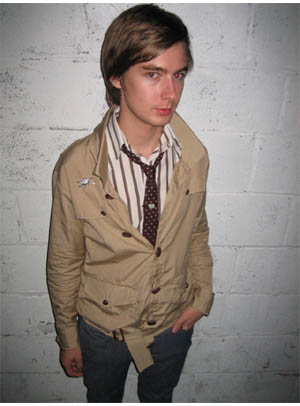
These two fellows were photographed at Misshapes in New York on 10 and 17 June 2006. They are wearing essentially the same outfit: boxy casual jacket; dress shirt; skinny tie; subtle jewellery (badges, necklaces); skinny jeans. But they've managed enough variations on the outfit to make the look their own. And importantly, the constituent elements of the look are not stylistically consonant. There is no way they can have obtained the entire outfit from the one store: it requires bricolage.


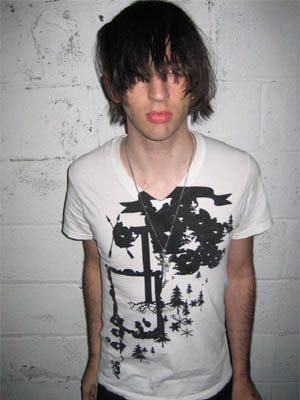
I included these two because of the startling similarity of their outfits. Fitted V-necked t-shirt in which the neckline cuts into the print; necklace on a long dangly chain; Mick Jagger rock hair and stagey posing. Their baroqueness is of the crudest and laziest kind; but nevertheless they are performing the same process of subcultural distinction that Barthes describes. The tiny differences between their outfits and those of a man who's bought his entire outfit from a high-street chain like Industrie or General Pants "are both barely visible and yet not in keeping with the outfit". There is just enough detail (the necklaces, the t-shirt prints) to mark them as hipsters, and to enable them to recognise each other as hipsters.

Ultimately, I don't think this post answers the question of whether hipsters are contemporary dandies. But I think it's valuable to be able to identify what it is about someone's clothing -- someone who isn't necessarily dressed in a spectacular, subcultural way -- that nevertheless allows us to categorise them. I also think Barthes's theory of the detail gives us a point of access into the processes by which we all assert our individuality. Perhaps the hipster has more perceived individuality at stake than most of us. And perhaps that's an interesting perspective itself: the idea of the hipster as a person disaffected with the death of dandyism, and attempting to reassert its lost singularity in the baroque ways that are enabled by contemporary consumer culture.

Thursday, May 04, 2006

Free your signifier and the rest will follow


For some months now, I've been reading about the hipster trend of wearing Palestinian headdresses or keffiyeh as neck scarves. It's only recently that I've begun to see kids in Melbourne doing it too.

Let's set aside the well-known debates over cultural and political appropriation, because they've been rehearsed so many times before when it comes to hip-hop apparel, bindis, dreadlocks, Thai fisherman pants and any number of other 'ethnicised' forms of clothing. I mean, I have always been a little shocked when I saw non-Palestinians wearing keffiyeh because I've always thought of it as a religious as well as an ethnic and political thing. But who am I to talk? I was at a tiki party last Sunday wearing a tropical print 50s-style dress and a lei, drinking rum punch out of a coconut and watching my friends' pitiful attempts at hula dancing.

No: here I am more interested in the transnational flows of hipster cultural capital. Blue States Lose has wondered many times, in its usual tone of laconic despair, how it happens that hipsters somehow 'know' how to be hipsters without ever 'learning' it. I began thinking about this after reading this blog post about a magazine series on the 'flashmobbing' fad, and the ensuing comments.

As Bill Wasik writes in the article,
hipsters, our supposed cultural avant-garde, are in fact a transcontinental society of cultural receptors, straining to perceive which shifts to follow. I must hasten to add that this is not entirely their fault: the Internet can propagate any flashy notion, whether it be a style of eyewear or a presidential candidacy, with such instantaneity that a convergence on the “hip” tends now to happen unself-consciously, as a simple matter of course.
For Wasik, this is the essential paradox of hipsterism: that a culture predicated on aesthetic individualism could be so homogenous and susceptible to fads. And according to Wasik's logic, the Palestinian keffiyah craze, like the popularity of McSweeney's, Interpol and black stovepipe jeans, is all about the internet.

But I am not about to celebrate the transnational information flows enabled by technology. Rather, I am interested in a rather more low-tech idea: that hipsters work out what to do next using their general worship of that altar of cool, "the street". I am interested in the physical congregation of people, the ways their bodies occupy physical space, and the strategies they have of displaying themselves and of observing and interacting with others. If the internet is involved, it's using blogs, email, MySpace and messageboards - technologies that play off and replicate face-to-face networks.

And, importantly, I think these events and technologies are governed by affective relations. In his comments, Doug reflects the commonsense understanding of what it means to be 'cool':
But are hipsters permitted to 'feel' anything? Isn't it a bit twee to feel? [...] how, then, do hipsters manage to be simultaneously 'cool' - universally depicted as being slightly detached from normal worries and concerns - and yet be affected by their cultural consumption?
I blame Fredric Jameson and his famous essay on postmodernism for the 'commonsenseness' of the equation: "irony = lack of affect". Detachment isn't a lack of affect: it is an affect; and it requires a certain repertoire of performances and knowledges. Hipster irony generates a variety of affective registers including the pleasure of feeling 'cool', the humiliation of exclusion and the outrage of moral violation.

Importantly, hipsterism is private yet public, just as irony relies for its meaning on a privately understood but publicly unacknowledged other meaning. I think that this, and not the nihilism that is often ascribed to hipsterism, is why it is incapable of politicisation. Politics relies on convincing an ignorant or uncaring audience of the importance of a topic: it's insiders talking to outsiders. Hipsterism is insiders talking to insiders, and that's why its aesthetics are apolitical.

Or rather, hipsterism has only a base, brain-stem politics: it delights in the event, in the idea of togetherness, even if that togetherness serves only hedonistic purposes. There is a primitive kinship in the idea of seeing someone wearing a keffiyeh, identifying them as 'cool', and deciding that you want to be cool, too.

Thursday, October 27, 2005

Industrious


Some time ago, I wrote about Industrie, the menswear chain that has a similar logic to Sportsgirl (in the women's mass fashion retail market) as a signifier of 'fashionability'. That is, the clothes appeal to young men who don't really know what's in fashion, but want to look as though they do.

But it's not just about 'fashion', but 'style', which I have previously defined as "a more permanent and idiosyncratic dress sense that works aesthetically in a variety of contexts and fashion cycles". Sportsgirl's elaborate boho clothes are designed to generate individual 'looks' through multi-layering and mismatching mass-produced garments and accessories. Likewise, Industrie makes stylistic gestures towards 'individuality' - deconstructed shapes, torn edges, prints and embroidery that are designed to make the garments look customised, even though they are mass-produced.


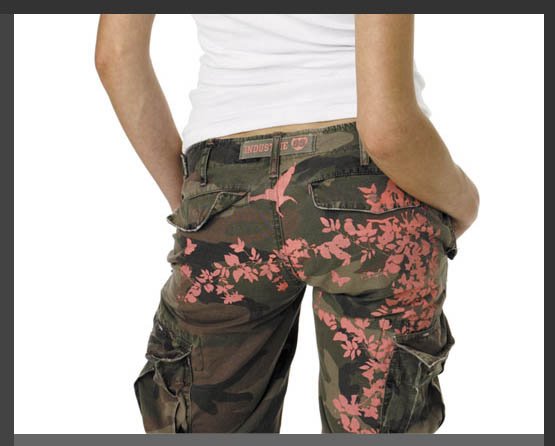
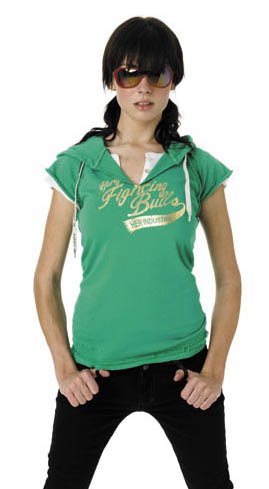
The company has diversified into womenswear with a line called Her Industrie, which has been out for about a year now. As you can see from these images, Her Industrie carries the same streetwear-influenced logic of 'individuality' as the men's line. Look at the stencils on the cargo pants, and the stencilled version of the black stovepipes that, by now, are everywhere in high street fashion stores. There are also layered t-shirts and singlet tops, and raw-edged, printed hoodies.


(As an aside, it's worthwhile mentioning that these hoodies are called "Harajuku". Since Gwen Stefani introduced this word into mainstream parlance, it's become completely disassociated from the specific geographic, aesthetic and cultural context of the Harajuku district in Tokyo, and now seems to mean something closer to "crazy-hip".)

Industrie seems very unstylish indeed to people who have a strongly defined personal aesthetic. And it seems very uncool to people who thrive on the affect of exclusivity that comes with being a style innovator or early adopter. As Will pointed out in the comments to my 'deconstructed hoodie' post: "Industrie is the kind of stuff where, if you wore it to an extended family barbeque, your family might think you were hip." And the hipster kids over at ThreeThousand are "so over" this style they wish to be woken when its moment is over.

For me, the most fascinating thing about brands like Her Industrie is that they relate only tenuously to the standard 'bubble-up' and 'trickle-down' models of fashion adoption. There was a really stupid and unsophisticated article recently in the Sydney Morning Herald which espoused the 'bubble-up' model:
Sportsgirl and the like may have finally discovered the skirts of India swirling around the ankles of nerdy girls in high schools across the land. Market research is all about youth, hunting for the next big thing. Business pays market research companies big bucks to observe young people and predict which of their angst-ridden outpourings will inspire the next Witchcraft [does the writer mean Witchery?] spin-off or be-labelled beanie.
Using this (unhelpfully crude) logic, whatever styles these trendspotters see subculturally affiliated kids (or, in this example, any kids at all!) will show up, blanded out and priced up for the masses, in chain stores. But this model breaks down when the subcultures and the hipsters don't even like the style to begin with.

So, why develop fashion lines like Her Industrie? Not because they are innovative, and not because they're associated with subcultures, but because they're just versatile and customisable enough to reassure most shoppers that by purchasing and wearing these garments, they're exercising their individuality and staying 'in fashion'.

As mainstream New Zealand women's lifestyle portal NZGirl opines:
The best way to inject a taste of ‘army girl’ into your wardrobe is with a pair of army print pants or shorts. Available from most chain stores, these will be a summer staple which will be worn year after year. We love the pictured Rose Bud combats from her industrie. These funky combat pants mix the masculine army print with girly accents by using print detail and feminine ties. Wear them longer on a cooler day or hitched up over your bikini at the beach – sweet and casual.
I did a bit of Googling to work out who's talking about Her Industrie, and the answer seems to be semi-articulate teenage girls:
went to myer, and omgsh i want these 'her industrie' pants.. but they 100$ and i didnt like the printing on the ass part of it.. hahaa so i derno if i'll get them or not.. may just look arnd first at city or something..
Here's another one:
my mother wont let me buy my Her Industrie three quarter pants thing.. she sed its army and its baggy. i guess it makes me look tom boyish x, x MY MOTHER!
This is a case for real market research - interviewing people to ask them what they like and dislike about the clothes. But from what's written on blogs and forums, it seems that people think about how the pants fit (are they in my size? are they comfortable?), how much they cost (young shoppers rely on allowances, part-time income, and parental permission), and where they can wear them (good for the beach, for going out, etc).

Intriguingly, there seems to be a backlash against the 'sameness' of Industrie clothing, particularly the prominent screen-printed branding. People posting to this bulletin board laugh at men (and women) who wear exclusively Industrie. Rather than making them seem fashionable, it makes them seem like dull-witted fashion followers. Still, I do think this is an exception. It might pain me, and it might pain the ThreeThousand kids, but stencilled army pants probably are going to come back in this summer.

Wednesday, August 17, 2005

Starter kits for hipsters

Awww, how cute! Supre is selling the yoof of today everything they need to dress like a real hipster! I was in there today and they were bigging up black stovepipe jeans...


And only $60 - all the more to spend at Ding Dong! They had them displayed on a rack with stripey t-shirts in different colours - pink, blue, yellow... Now all they require is a blazer with a few button badges on the lapel, some scuffed-up Chuck Taylors, a chunky studded belt and some black eyeliner. And voila! instant hipster.

Sometimes I think I am too critical of hipsters. After all, in Melbourne there is not much difference between hipster style and mainstream fashion. The picture below was taken at the second birthday party of Australian Vice magazine. I was there earlier in the evening and couldn't move for all the posing. My friends who worked the bar said it got much worse. People were spewing and passing out and you had to wade through rivers of spilled alcohol. As you can imagine, the wooden floor kinda suffered. Hipsters scaled the outside of the building and broke the lift. The building owners now will not hire the venue out for parties because of the expense involved in restoring it to normality.


I quite like her little bow. Very Jaunty Pussy. Please also note the vintage Nike sneakers worn with the regulation black stovepipes and blazer, ugly op-shop 80s footwear such as grey pumps and red Rumpelstiltskin boots, and that chick with the blonde bowl haircut who I've seen before at these kind of events. I like to subject hipsters to Mel's patented "Would this person look odd walking down the street?" test, and Melburnian hipsters generally pass.

By contrast, here are a couple of examples of how they play things in the States (pictures via the always-hilarious Tale of Two Cities):


Thursday, February 10, 2005

Welcome to the zeitgeist!

Melbourne is a style city, and you don't always know the zeitgeist is coming until it brushes past you on the street. It's belittled by comparison. Melbourne isn't Harajuku. Melbourne isn't the Lower East Side. Melbourne isn't Soho. Melbourne isn't South Central. Melbourne isn't the Marais. Most of all, Melbourne is not Sydney.

I shop. I socialise. I observe. I ponder. I notice global trends in clothing, nightlife and music, and analyse how they play out on the streets of Melbourne. Footpath Zeitgeist will be a mixture of photos and sketches, chain-store odysseys and boutique missions, academic essays and cafe small-talk. It's a blog dedicated to the research and enjoyment of street style.

But I don't want to fetishise street style for its kooky originality, bitch about ugly clothing, gush about the latest designers, or celebrate hipster irony. Nor do I want to treat the street as a resource for marketers to plunder. Instead, I want to write intelligently about how style moulds identity, how clothing shapes the body and the emotions, and how all this reflects the city around me.