Friday, March 08, 2013

Interview: Kate Millett of Bombshell Vintage

Kate Millett runs Bombshell Vintage, a Melbourne store specialising in plus-size vintage clothing. I discovered it when Fashion Hayley blogged about the launch of Bombshell's first shopfront in Clifton Hill.

A year later, Bombshell Vintage now operates from the Lost and Found Market in Collingwood. And Kate is celebrating its first birthday on Saturday 9 March at the LuWow, 162 Johnston Street Fitzroy from 7:30pm. There'll be delicious tiki cocktails, curvaceous go-go dancers, and a catwalk show featuring Bombshell's wares as well as clothes from local designer Fox Parse and fellow plus-size vintage sellers, Hey Fatty.


Kate models her favourite festive vintage outfit. Image: Bombshell Vintage

Mel Campbell: How did you get into the vintage retail business?

Kate Millett: I was a vintage aficionado for a long time before I ever thought of starting a business. I always wanted someone else to do it so I could just take advantage of their effort! I was the one telling vintage store owners to sort their clothes by size so I wouldn’t have to waste my time pawing through clothes that never went higher than a size 12…

And then I went through six months of being unemployed and I thought to myself, "Well, I’ve got the time on my hands. Just start doing it. Keep it small and so if it fails, you won’t have lost much." And then it just grew from there!

And what's your approach to vintage now – do you see yourself as a collector, or a savvy shopper and trader, or an advocate for plus-size fashion… or something else?

I see myself as something of a collector, a bit of a hunter, and definitely an advocate for plus size fashion! I love finding new designers to show people that it is possible to be larger and dress beautifully! I love hunting for new bargains. I will spend the extra hours going through multiple op shops to find those little hidden treasures.

What do your clients or shoppers tell you they value most about a shop like Bombshell Vintage?

All the clothes I stock are interesting, either because of the colour, embellishment, texture or the shape. I help people find clothes that reflect their personality and rediscover the joy in fashion – the fun in playing dress-up every day! My customers use my store to find one-off special pieces they can then integrate with the rest of their wardrobe to make it a little quirky, a little bit more interesting.

I guess the main thing about my store is that it gives them the freedom to explore fashion without judgement, a place where they know they can find clothes that are gorgeous just for them!

I've always been fascinated by how much plus-size vintage is still out there, and how easy or difficult it is to find. (In its early stages, my book had the working title 'What Fat Chicks Used To Wear'.) Where do you get your stock?

It’s not the easiest thing of all time. You have to be willing to scrimmage through warehouses of clothes to find awesome stuff that’s also plus size. Now that we can search via the internet, that search is getting a little easier, although that does mean you can’t personally inspect the stock for things like poorly stitched seams, stains or tell if it’s a reproduction rather than the real deal. You have to build relationships and trust between yourself and suppliers to ensure you get the best stock possible. These days most of my stock is from a few second-hand warehouses, with a few special items bought over the internet.

I found most of [my suppliers] by exploring every op shop/second-hand store in my area, thanks to this website. The others I found by driving past them every day on my way to work and then finally deciding to check them out. Second-hand stores can look pretty dirty from the outside!

Does plus-size vintage have much of a presence here in Australia compared to straight-size vintage? I understand it's quite a thriving vintage segment overseas – I've heard fabulous tales of giant plus-size vintage warehouses in Brooklyn…

In Australia, plus size vintage pretty much doesn’t exist by itself. One or two places do stock it alongside straight sizes, but even then it’s only a few pieces. As far as I know, there’s only myself and Hey Fatty who are specialising in plus size vintage full time. There are a few Facebook groups popping up to help plus size women clothes swap, et cetera, and a few people have started doing market stalls, but it’s still a rarity.

I’m travelling to the US and Canada later this year… I really hope those tales are accurate!


Fancy wares at Bombshell Vintage's stall at Lost and Found Market. (May I draw your attention to that covetably Stam-like handbag on the wall?) Image: Bombshell Vintage

What kinds of items do you find a lot of when you're sourcing stock? Do you find certain labels or brands are well represented in plus-size vintage?

Thankfully, most types of clothes are available in plus size vintage if you look hard enough. The only thing that’s really missing are pants that aren’t awful!

In terms of labels, there are a few that keep popping up and are indicators of good quality clothes – Lane Bryant and Diane Freis come to mind. Diane Freis’ dresses are almost more artwork than clothing… I love her clashing prints and amazing pleats!

What proportion of your stock would be home-made?

Quite a bit of it. Especially when you’re talking about clothes from before the '60s. We also get a lot of stock that has been altered again and again. Something that may have started out as a store bought frock ends up looking like something homemade because practically every seam has been changed!

What are the idiosyncrasies of vintage sizing that shoppers might not be familiar with from contemporary garment labels? Do you see much of the old half-sizes and OSW, EOS and XOS sizes, or European numbered sizes?

We don’t get a lot of the European numbered sizing. The OSW, EOS, etc only really shows up in a few styles of clothing – it’s not very common. The half sizing is everywhere! I tend to ignore vintage sizes… They seem to change from brand to brand!

It's kind of a truism of vintage shopping that older sizes are much smaller than their contemporary equivalents. Personally I disagree that this is 'vanity sizing' at work – I see it as more a 'sizing evolution' as the population has got older, taller and heavier – but what do you think, based on your experience?

Vintage sizing is very different from modern sizes… I think the change comes from evolution, like you said, but also maybe from trying to combine two or three different methods of sizing.

I think it's about the sizing systems changing. Companies were starting up who didn't want to use the old systems of sizing - the half sizes, the XW method - and needed something to use. I think the sizes have also grown as the population has. We are now taller and broader than we used to be. It's a different way of looking at sizing. I don't think it's a vanity thing, I think it's a natural growth out of the old systems. The next step is for them to all be standardised...


More colourful merch at Bombshell Vintage's stall in Lost and Found Market. Image: Bombshell Vintage

Friday, February 08, 2013

"Look at this guy and know…"

Today I found this article about New Jersey Governor and Republican presidential hopeful Chris Christie, who's being publicly shamed about being too fat to run for US president in 2016.


Chris Christie on The Late Show with David Letterman. Image: Telegraph (UK)

Basically, he went on Letterman and good-naturedly joined in the host's fat jokes. It's odd, but no commentators yet seem to have situated this donut-chomping incident in the context of talk-show guests always being encouraged to join the hosts in silly jokes and stunts of this nature, often at their own expense.

But because Christie is fat, commentators have interpreted his participation as his not taking his health seriously. He had to address the issue in a press conference: "The idea that somehow I don't care about this – of course I care about it, and I'm making the best effort I can," the governor told reporters.

The drama was stoked by comments made by Dr Connie Mariano, who was the White House physician to George HW Bush, Bill Clinton and George W Bush. Mariano told CNN, "I'm worried about this man dying in office."

However, at the press conference Christie hit back: "I find it fascinating that a doctor in Arizona who has never met me, never examined me, never reviewed my medical history or records, knows nothing about my family history, could make a diagnosis from 2400 miles away … [P]eople who have a medical license, who have the privilege of having a medical license, should in my view conduct themselves more responsibly than that. If she wants to get on a plane and come here to New Jersey and asks me if she wants to examine me and review my medical history, I’ll have a conversation with her about that. Until that time she should shut up."

Christie is absolutely right. His appearance has nothing whatsoever to do with his ability to do his job, and his health is not the business of anyone but him and his doctor. But when a fat person reaches a position of public prominence or authority, our responses are often limited to moral panic about 'obesity'.

In a culture obsessed with outward appearances, someone's fitness for public office dovetails with their physical fitness. We find it really difficult to believe that someone who looks fat on the outside could be fit on the inside. And we worry that even tolerating fatness in public sends an unwelcome message that it's acceptable to be fat.

I think it's interesting to see this happening to Chris Christie, because we often associate fat-shaming with misogyny. But clearly it happens to fat men as well as fat women.

In my book, I spend a lot of time on two key concepts: orthovestia and scienciness. Orthovestia, a term I've coined from the Latin for 'correct' and 'clothing', is the cultural notion that only ideal bodies are allowed to be seen in public. We learn what is and isn't ideal through pop culture, and are taught it's our job to use diet, exercise and 'flattering' clothing to maintain an ideal figure, to make ourselves more like the ideal, or camouflage that we aren't.

Orthovestia works through the act of looking. From an early age, we are trained to gaze and judge: at our own bodies; at the bodies of celebrities; at the bodies of strangers. The negative judgments we make about fat people, very skinny people, or people whose clothes we believe are too tight or baggy, too skimpy or see-through, are expressing our belief that they're unsightly. We don't like looking at these bodies, so we demand that they discreetly withdraw from view.

Scienciness, meanwhile, is a mode of rhetoric in journalism that uses scientific language, and strategically deployed quotes from actual scientists, in order to police cultural ideals. Sciency journalism is different to scientific journalism, which is the reporting of scientific research to a general audience. Rather, sciency writing is a technique for making orthovestic judgments seem indisputably correct. Think of it as being similar to 'truthiness', which is something that feels intuitively true without requiring any evidence.


I mean check him out! He's, like, twice the size of Obama, so he's, like, half as likely to be president! It's true because science!

So, we subject Christie to our gaze. And because his fatness is undeniable, and because doctors and researchers are constantly telling us obesity is unhealthy, we 'diagnose' him from afar the same way Dr Mariano did.

As commenter Raphaela V wrote at ABC News (with my emphasis):
"…it doesn’t take even a medical license to look at this guy and know all the things the doctor said are true. If he’s that irresponsible with what goes in his mouth, he’s going to be that irresponsible with any responsibility given to him."
Fat people are held to much more rigorous standards of health than thin people. This is because we can't 'see' unhealthiness in thin people the same way, so we don't fret about their fitness to hold public office. Fat people, however, have to perform their fitness in public.

This is why Christie was under such pressure to tell journalists his "plan" to lose weight – he has to be seen to be doing something to become less unpleasant to look at. Under orthovestia, it's simply unthinkable that someone has better things to do than change the appearance of their body. So along with being told we look bad, we're fed imagery of makeovers, weight-loss successes, and how to 'dress for our shape'.

Monday, February 04, 2013

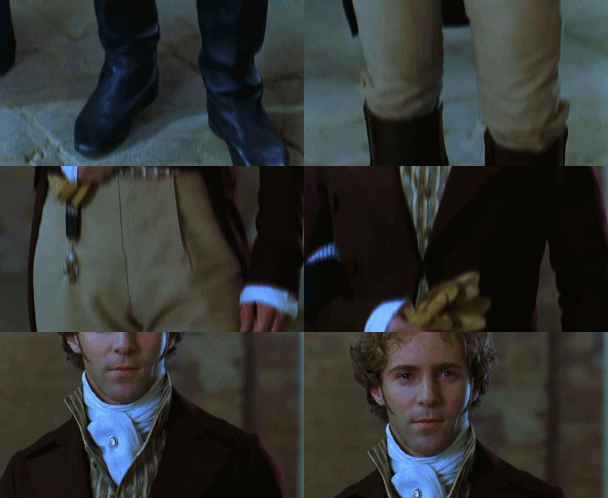
Regency camel toe

Further to my previous post about men's trousers in the early 19th century, I have discovered a genius blog. It's called Regency Camel Toe.


What I love about the blog is the collision between sartorial history and what we now think of as a sexualised wardrobe malfunction: the camel toe. Although 'camel toe' (sometimes spelled 'cameltoe') is usually understood as something that only happens to women; in the book I primly distinguish between "‘cameltoes’ (clothes wedging in the crotch to reveal the outlines of a woman’s labia) and ‘moose knuckles’ (the equivalent reveal of a man’s penis and testicles)."

But the joke of Regency Camel Toes is that what looks like a camel toe is sometimes just the loose, bunchy material of the trousers. You can see that back in the day, men's trousers weren't at all snugly tailored over the torso; they were really quite drapey.

In a lot of the Regency period drama productions featured on the blog, the baggy pants look different to the illustrations of the period itself. That is, the pants drape like today's tracky dacks, their bagginess revealing the merch in silhouette.

This reminds me of the men's drop-crotch pants that are quite popular with a certain kind of fashion-forward young dude – I've seen African teenagers and Asian international students wearing them. Yesterday on the tram there was a guy whose crotch was so dropped that he could sit down and rest his hands on his lap as if he was wearing a skirt.

Anyway, 18th and 19th-century pants didn't have a vertical fly; rather, the fly was a horizontally attached flap that buttoned closed at the waist, which evolved from the earlier codpiece. This is known as a 'broad fall' or 'fall front'. Later in the 19th century the hybrid 'split fall' emerged, and finally the vertical fly.

In erotic prints of the time you can see the flap hanging open for the dude to access his junk.


This is a reproduction – it's painted on the men's toilet wall at LMNT in Hackney, which bills itself as "London's most eccentric dining room". I have pixelated out the dude's junk.


This is a French lithograph, possibly by Achille Devaria (1800-1857), dated from somewhere between 1830 and 1849. I think this guy is trying to take a leak in the bushes and discovers that lady checking out his sugalumps.

Lederhosen and some traditional military uniforms still use fall-front fastenings.


Those 'sailor-style' pants with the two rows of vertical buttons on the front are references to this style of pants.

Thursday, December 27, 2012

Beau Brummell: Lord of the pants

The widespread adoption of trousers – or 'pantaloons', after the commedia dell'arte character Pantalone – was literally revolutionary. For centuries, wealthy men had worn draped robes, or breeches and hose; trousers were a peasant garment. But they became the sartorial emblem of the militant working-class sans-culottes ('without knee-breeches') who had acted as French Revolution footsoldiers.


A sketch of a sans-culotte. They were often depicted in red, white and blue striped pants, with red caps and tricolour sashes.

After the Revolution, trousers (along with unpowdered hair cropped short in the 'Roman' style) became the mark of wholesome republican masculinity in France, as opposed to the decadent royalist effeminacy implied by breeches. Cut so slimly they almost resembled leggings, they were sometimes worn with a stirrup strap under the foot to achieve a fashionably 'classical' tautness.


"You could really be a Beau Brummell baby if you just gave it half a chance" – Billy Joel

More than any other individual, George Bryan 'Beau' Brummell was responsible for transforming this look into the uniform of the English dandy. Like Coco Chanel, Brummell was a self-made social climber in deliberately simple clothing; this middle-class lad eventually became close to the Prince Regent, the future George IV.

He stood out from and fascinated the Georgian aristocracy with his fastidious attention to personal hygiene and his taste for unadorned, fitted dark coats, pale buckskin trousers, crisp white shirts, carefully knotted cravats and shiny boots (which he recommended polishing with champagne).

Despite spending fabulous sums on a relatively unassuming wardrobe (Brummell reckoned someone could be tolerably well dressed on an annual budget of around £800, or around $162,400 in today's money), his consumerism was never splashy or hedonistic. Rather, Brummell was soberly devoted to the pursuit of subtlety and distinction in dress and manners.

However, Brummell's decline began when he turned his ever-impertinent wit on his patron. Snubbed by the future monarch at an 1811 ball, he retaliated: "I say, Alvanley – who's your fat friend?"

Surprisingly, he maintained his popularity even after falling from royal favour, but his finances had never quite covered his exorbitant lifestyle. His dad William died in 1794, leaving Beau a £30,000 fortune (£2.69 million in today's money) that his expensive lifestyle completely frittered away in just over 20 years. In 1816 he fled England to escape his creditors, dying in poverty in France in 1840.

This was a most ironic fate indeed for someone who had made dandyism such a decidedly English masculine ideal. Dandies situated themselves in opposition to an earlier kind of Georgian hipster – the macaroni, a term that had arisen in the 1760s when wealthy young men who'd tasted Italian food on their travels abroad adopted ostentatiously 'European' dress and manners once they got back home. (The song 'Yankee Doodle Dandy', written around 1755, makes fun of trashy Americans who thought all it took to be cool was to stick feathers in their hats.) Anything elaborate became very bad taste in England after the French Revolution.

The 19th century is often understood as the era of wasp waists for women, but a cinched waist was also considered the height of manly beauty. Perhaps Brummell's 'fat friend' resorted to a corset or girdle to look good in his clothes, as a significant minority of Regency men did. The rich fabrics and stiffly upholstered layers of 18th-century menswear had made pretty much everyone look stout, but Brummell's favoured silhouette was svelte and body-hugging.


During an 1808 battle against Tom Cribb, future publican Bob Gregson "refreshed himself with a tumbler of brandy".

Perhaps one reason their pants were so tight was that dandies celebrated the physical body and considered prize-fighters or 'pugilists' to be prime specimens of manhood. As we've seen, the outfits boxers fight in have had a profound influence on menswear silhouettes.

One favourite, the Lancashire giant Bob Gregson, retired in 1810 and became the publican at the Castle Tavern in Holborn, where dandies loved to drink. It would be like today's hipsters hanging out at a pub owned by a retired indie singer-songwriter.

Cool dudes in skinny jeans, sometimes even in women's jeans, are the cultural heirs of Romantic heroes in tight pants, from Mr Darcy to Lord Byron to Prince Albert. Indeed, pop and rock stars beloved of teenage girls often wear tight clothing to make spectacles of their youthful bodies. In a reversal of John Berger's theory that men look while women merely appear, the boys are the ones being ogled and objectified by lusty female fans whose behaviour is unruly and unpredictable.

A contemporary observer will notice that in the 19th century, tight pants were actually quite baggy in the crotch. The folk mythology invented for the Prince Albert genital piercing (that it tucked his tackle neatly away in order not to spoil the line of his pants) isn't at all true.

Fascinatingly, current boy band sensation One Direction wear their skin-tight jeans just as baggy in the crotch. But while Regency pants were high-waisted, young men these days (and don't I sound a thousand years old as I write that) will wear their tight pants very low on the hips so that the putative 'crotch' of the pants actually sits more over the upper thigh. The waistband of their underpants is exposed, and sometimes large portions of the undies themselves. The look creates an optical illusion of elongated torsos and truncated legs.


Compare this look to the Ramones, whose tight pants are body-conscious in a way that looks almost feminine. Maybe it's because they were such unbelievable poseurs, standing with spread legs, cocked hips and thumbs in pockets in the way we're used to seeing women pose for men's magazines.

Monday, December 17, 2012

The pop culture of men's underwear

For centuries, men wore knee-length flannel, linen or wool drawers with drawstring waists. Long flannel one-piece affairs with button-up flies and rear flaps, known as union suits or combinations, were first patented in 1868 and marketed to men, women and children alike; they evolved from women's reform dress.


Men's underwear gets its superheroic connotations from the heroism of sports. Two-piece long johns are likely named after boxer John L Sullivan, the Irish-American heavyweight champion from 1881-92. Sullivan competed in long white leggings, as was customary in his sport at the time.

By 1925, boxers were wearing shorts held up by sashes or leather belts; but boxing equipment impresario Jacob Golomb, whose New York company Everlast had begun in 1910 as a maker of durable swimwear, had the bright idea of making the shorts elastic-waisted instead.

The design became popular as underpants, especially after WWII, where they had been standard issue underwear. Quite apart from the loose, airy sensation they offer – "there's nothing like running upstairs in silk boxers!" my friend Keith once swore – perhaps boxer shorts' original appeal lay in the possibility of feeling tough and strong like a pugilist or a soldier, but keeping this toughness hidden under one's clothes like Clark Kent, who made his DC Comics debut in 1938.


An image from Syd Miller's original Chesty Bond cartoon strip.

Australia's very own comic-strip superhero was Chesty Bond, who first pulled on his iconic singlet in 1940 to battle Hitler, Hirohito, enemy submarines, planes and spies. By 1942 he was appearing in Sydney's Sun five days a week. Cartoonist Syd Miller later told the Sydney Morning Herald that he'd envisioned Chesty as "an Australian strong man in deed and made super by or when he was wearing his Bonds singlet."

Chesty's famous lantern jaw was modelled on former NSW premier Jack Lang. Rugby league player and pro wrestler Max Whitehead modelled as Chesty from 1951, although he had to wear a prosthetic chin as nobody – with the possible exception of TV's Bondi Vet, Dr Chris Brown – looks like Chesty in real life.


Chris Brown: Chesty Bondi?

Superman also battled WWII-era villains in his trademark red briefs. Comic-book superheroes' outfits were modelled on the costumes of circus strongmen and acrobats; Jules Léotard, the French aerialist who first wowed London crowds in 1861, famously wore knitted tights to show off his athletic body and avoid getting tangled in trapezes. The contrasting-coloured trunks worn over the tights offered a degree of modesty as well as crotch support.


Hubba hubba: Jules Léotard.

Y-front briefs were innovated by Arthur Kneibler, who worked in sales and marketing for Michigan-based Cooper's Underwear. In 1934, when sleeveless, short-legged union suits already resembled swimwear, Kneibler received a postcard from the French Riviera depicting a very brief, topless bathing costume.

His version: snug-fitting underpants with no legs at all, and an overlapping front fly offering so much crotch support it resembled athletes' jockstraps‚ which themselves had been patented in 1874 for 'bicycle jockeys'. Hence Cooper's new brand name: Jockey.

'Tighty-whities' were so popular in the mid-20th century that they still hold that era's associations with clean-cut conservatism and hidden sexual perversity. A young Tom Cruise in Risky Business created an iconic image when he danced in his shirt, socks and underpants to Bob Seger's 'Old Time Rock'n'Roll'. As in many 1980s teen sex comedies, Cruise's undies signal dorky sexual inexperience.


Kevin Bacon wears them in the film National Lampoon's Animal House, set in 1962, as he's spanked with a paddle during a hazing ritual for an uptight college fraternity. "Thank you sir, may I have another?" he squawks absurdly between each stroke. Playing a conservative 1980s Los Angeles mayor in Rock of Ages, Bryan Cranston also gets paddled in his undies.


Cranston had already donned tighty-whities in a much-circulated publicity image from TV series Breaking Bad, in which he plays a mild-mannered chemistry teacher-turned-increasingly ruthless drug dealer. It's appropriate that 'breaking bad' means letting loose and challenging conventions, because more recently, pop culture depicts Y-fronts as undies for feckless slobs. Russell Brand wore them in Arthur, as did Will Ferrell in Talladega Nights; Jack Black has made them a signature garment.

However, pop culture still thinks of skimpy briefs as 'European', even more so now that boxer briefs have become a popular choice for men. Bikini briefs are associated with sleazebags and strutting Casanovas, especially in bright colours and animal prints. The Wedding Singer's oily villain Glen Guglia wears a leopard-print pair; Kazakh caricature Borat cheerfully dons a lime-green mankini.


Niiiiiice.

Wednesday, December 12, 2012

The circular logic of online DIY tutorials

Today at the op-shop I continued Seven Sisters Summer by purchasing a circular tablecloth in a seersucker-ish blue gingham, which I plan to make into a circle skirt.


You can see it already has a hole in the middle. I was sure this was going to earn me a discount off the price, but the op-shop lady told me the hole was intentional because the cloth was meant to be used on an outdoor table with a central umbrella.

I still tried to haggle because c'mon, look how crappily cut out the hole is!


But ultimately I gave up because it is a charity, and because $5 is still an okay deal for a large amount of fabric, ready-hemmed and already in a circle so I don't have to do that bit myself.

I remember a few years ago Lady Melbourne had a circle skirt DIY (here's part 1 and part 2) but I'm not sure I can be bothered with a proper waistband and zipper, since I haven't got a sewing machine (though my mother's always like "You can always borrow mine; I never use it") and my sewing skills are really not that advanced.

From some of the DIYs I've looked up, I think the way to finish the skirt will be to fold the tablecloth in half, then in half again, and then measure the waist (the 'circumference' of a small circle in the middle of the skirt) by measuring the radius of that smaller circle from the narrow end of the fold.

But how to calculate the radius? Lady Melbourne reckons you take your waist measurement, add on "an inch or two" for seam allowance, then divide by 3.14 (pi), then again by 2.

Another DIY says the correct radius is your waist measurement plus two inches, divided by 6.28 (pi times two).

This DIY (admittedly, for stretchy fabric) reckons the correct radius is your waist measurement minus two inches. ("Do not add 2"!")

One DIY says the correct radius is your hip measurement, minus four inches, divided by 6.28.

This DIY reckons the correct radius is your hip measurement plus two inches, divided by 3.14, then divided by 2.

But this DIY reckons the radius is simply 1/6 of your waist measurement.

WHAT IS THE RADIUS, PEOPLE?

While researching my chapters on sizing I developed a lot of respect for patternmakers and the ways they come at the industrial problem of having to develop good fits for bodies in a wide range of shapes and sizes, within commercial limits.

By contrast, online DIY tutorials are personalised and amateurised. They are even a step below home dressmaking patterns (which I've also researched for the book) in that the process of creating the garment is flexible and intuitive, like cooking from a description rather than a strict recipe. They are often ad-hoc, based on repurposing existing materials rather than working from scratch, and making calculations on the fly that can then be fixed later in the process if they turn out to be wrong.

This suits my way of working with clothes. I should probably do a future blog post about my crappy customised clothes; I did one back in 2009 and I should let you know that the pink dress was a complete failure. I think I crumpled up the fabric in rage and despair and threw it in the corner of my room, because I found it there last Saturday while searching for some Christmas wrapping paper.

Tuesday, December 11, 2012

Riches to rags: the long life of clothing


Shoppers at a secondhand clothing market in Harare, Zimbabwe. Image: The Zimbabwean

We like to think that the secondhand clothing market is all about exercising creativity, or rescuing the past. But what happens to the clothes that don't meet the vintage industry's criteria of individual value?

Once bought, clothing progresses through a chain of degradation. It can be resold several more times, especially as bulk exports to developing countries. Many of the old clothes we donate to charity end up being sold in secondhand markets in Africa. As much as 80 per cent of donations don't even make it into op-shops.

Instead, charity organisations on-sell them to textile recycling factories, which sort and repackage them into bales to be sold abroad in bulk. As of 2004, the United States both exported the largest volume of second-hand clothes and derived the most money from the export, followed by the United Kingdom, Germany and the Netherlands.

Stacked on pallets, shrink-wrapped in plastic, the bales look unnervingly like lozenges of chewing gum – poised to deliver refreshment. Those graded as 'Premium' are destined for Asia, Central America and Europe; in 2004, Europe accounted for about a quarter of all second-hand clothes imports.

However, sub-Saharan African is the most popular destination for second-hand clothing. Clothes designated 'Africa A' go to wealthier countries and 'Africa B' to the poorest ones. In Ghana and Togo, they're jocularly known as 'dead white man's clothing', while Tanzanians call them 'dyed in America' and in Somalia it's 'huudhaydh', the phonetic spelling of "Who died?"

In Rwanda, used clothing goes by the local word for 'choose'. And in Zambia, the market stalls where locals come to rummage through piles of Western cast-offs are called 'bend-down boutiques'. Everyone shops for clothes this way, from government ministers to the poorest subsistence fishermen.

In debt-crippled Zambia, the domestic clothing industry was entirely snuffed out during the 1990s by the free trade that was conditional on loans from foreign donor countries. Endless container-loads of foreign second-hand clothing fatally flooded the local textile market. Even used, these garments were often better made than locally made equivalents; manufacturers simply couldn't produce the same quality at the same volume and low cost.

Now, everyone in Zambia wears second-hand clothes. Wholesalers import them duty free, and then onsell to an ecosystem of progressively smaller-scale dealers who fan out into their own districts. Many of them are teenagers who've been locked out of an unaffordable education system, or former teachers, public servants and nurses who've turned to entrepreneurship after losing their jobs.


A secondhand clothes dealer transports his merchandise. Image: Africa Review

When American essayist David Rakoff travelled to a Playboy TV shoot at Cayo Espanto, a hyper-luxurious private resort island off the coast of Belize, he was troubled not just by the contrast between the decadent pampering he received there and the poverty of neighbouring town San Pedro, but also by his knowing, guilty surrender to indulgence.

As Rakoff boards his departing plane, he notices that the baggage handler is wearing "a tight, faded yellow T-shirt with Daffy Duck on it, bearing the slogan, 'I was Loony as a Toon at Samantha's Bat Mitzvah'":
It would be nice to think that this T-shirt was his from the start, that he was at Samantha's bat mitzvah, sharing in her family's joy as she came into Jewish womanhood, and came away with this souvenir of his time there. But … I kind of doubt it.
For Rakoff, the tightness, the fadedness, and most of all the cross-cultural incongruity of the T-shirt mark it not as a prized heirloom, nor even an ironic gesture, but as sartorial imperialism.

If you think that's abject, I haven't even begun to talk about rags. In the past, old clothes were once collected by rag-and-bone men and sold to dealers, the original rag-traders. Whatever they couldn't sell as a finished garment was shredded and put to other uses.

Linen and cotton rags are used to make paper – the fancy sort that's coveted for business cards and wedding invitations. Other clothes go to industrial workplaces for cleaning machinery and wiping workers' hands; they're cheaper and more absorbent than paper towels. Jeans end up soaking up oil spills on factory floors; T-shirts are used in polishing and car detailing.

Fibre from rags can fill car doors to weight them for that satisfying clunk, be used in home insulation, soundproofing tiles, furniture stuffing and upholstery, carpet underlay and movers' blankets, and even mixed into asphalt. Some clothing is broken down into its original fibres, which are re-woven, or its synthetic components, which are melted down and reconstituted.


A worker sorts rags by fabric and colour and removes buttons at Eastern Outsource, a sheltered workshop in Mt Evelyn, Victoria.

There's something overwhelming about this ultimate disintegration, this annihilation of everything clothing represents – its design, its aesthetic, its function and its cultural significance. You see, every garment begins its life meaning something. It's designed, made and bought for a specific purpose, coveted, cherished, and worn with feelings of pride and shame. It snowballs in significance as it moves through history, becoming totemic of the time and place it was made.

As New York Times reporter George Packer observes, the pitilessly industrial logic of clothes recycling plants strips this significance away. "Whatever charming idiosyncrasy a pair of trousers might have once possessed is annihilated in the mass and crush. Not only does the clothing cease to be personal, it ceases to be clothing."

Yet once he travels to Africa, Packer is in awe of how good these same clothes look once they're displayed on a Kampala market stall. They "undergo a transformation like inanimate objects coming to life in a fairy tale. Human effort and human desire work the necessary magic."

It's kind of patronising to clothing consumers in the developing world to suggest they dress naively or thoughtlessly. Zambian 'bend-down boutiques' are every bit as thoughtfully arranged as an inner-city Australian vintage salon, with their latest and best acquisitions prominently displayed on hangers and racks to attract customers, while older, discounted items languish in piles on the ground. Younger boutique vendors, especially, curate their stock with a shrewd eye for visual flair and saleability.

In Zambia, young men covet business suits for their connotations of wealth and upward mobility, and American sports jerseys for their associations with US hip-hop stars. Really, how different is that to the way my friends and I used to buy second-hand Levi's 501 jeans when we were 15 from Dangerfield, American Rag and army disposal stores? They often had holes and worn patches, but that only added to their glamour in our eyes. What we loved about them was their patina of Americanness – the feeling that by wearing them, we could magically travel somewhere more exotic than Melbourne.

The vintage industry celebrates the clothing of the past by fetishising particular, wonderful, individual garments, which it goes on to invest with new retail value because they're now unique. But the fate of rags should warn us of the destructive power of not-wanting. When a garment is no longer desirable, it loses its value and purpose entirely.

Thursday, December 06, 2012

Seven Sisters Summer

Please indulge me as I explain my vision for how I plan to dress this summer. Basically, I'm aiming for a midcentury New England college campus look of the sort that is called Ivy League style in menswear.

Ivy style is the subject of a fascinating-looking exhibition on now at the Museum of the Fashion Institute of Technology in New York. (Here are pics, and an interesting critique.) I'd love to have been able to see it, especially as I'm currently reading F Scott Fitzgerald's debut novel This Side of Paradise, which is set partly at Princeton and was hailed as the quintessential portrait of post-WWI youth.

When I first discovered the iconic Japanese photography book Take Ivy, I was kind of shocked to realise that it was basically devoid of women. It's troubling that so many men who are into this aesthetic are drawing sartorial inspiration from such a hermetically sealed homosocial vision.

While men were at the Ivy League, their female peers were at the Seven Sisters: Barnard (associated with Columbia); Bryn Mawr (associated with Princeton); Mount Holyoake (associated with Dartmouth); Radcliffe (associated with Harvard); Smith (associated with Yale); Vassar (also associated with Yale) and Wellesley (associated with Harvard and MIT).

I have become quite absorbed in a Tumblr called Vintage Seven Sisters that features archival photos of student life at these colleges.

I find the idea of a women-only college campus as weird as an men-only one (and I speak as someone who went to an all-girls' high school), but perhaps historically these campuses offered young women a certain freedom from the expectations of 'ladylike' comportment, while cherishing sporting and intellectual endeavour for women in a way the outside world didn't.

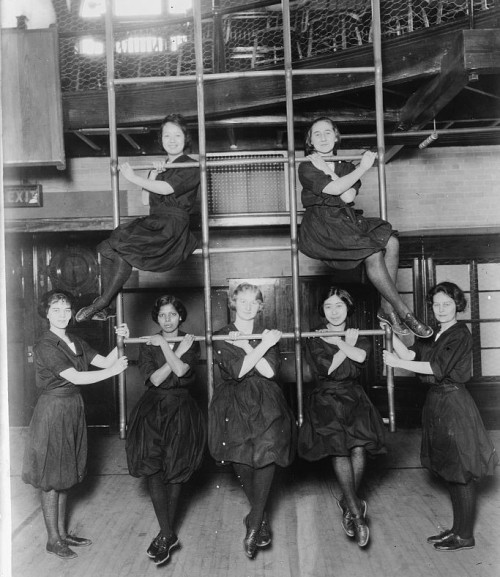
Despite the fact that the whole 'Seven Sisters' idea came about as a way to rebrand Barnard and Radcliffe as elite WASP schools (they had large numbers of Jewish students), these campuses also seem to have been surprisingly cosmopolitan places. Check out the ethnic makeup of this Mt Holyoake PE class in 1912:


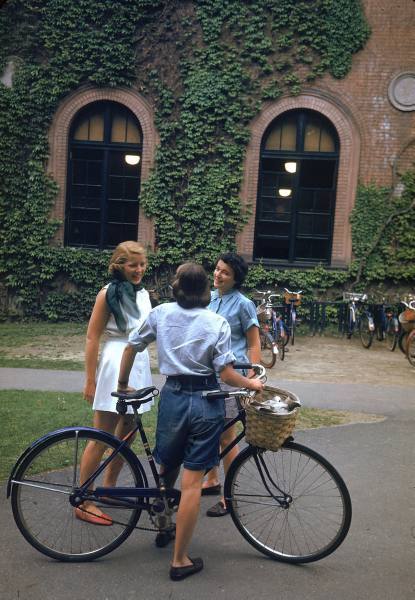
However, this image of Smith College students has really inspired my Seven Sisters Summer:


It began as merely a Summer of Denim. Right now I have an antipathy to jeans, and denim skirts seem a bit too 'sister-wifey' to me:


But I haven't owned a blue denim jacket since my beloved jacket was stolen from a bar a few years ago, and I like the way it can instantly make an outfit look more insouciant. I recently invested in both a denim jacket and a denim shirt in roughly similar shades of blue.

I am particularly into the combination of blue denim and yellow. I have a bright daffodil-yellow high-waisted skirt, so I can do this look:


(Aside: I would also like a large, chunky gold men's watch.) Today I went to Savers and was looking at various navy and white gingham shirts so that I could achieve something similar to this:


(Although I would never wear a full skirt so grotesquely short. I am a grown woman, not a five-year-old. I think they look nicest at knee-length.)

I really like the idea of wearing clashing prints in similar shades:


However, none of the gingham shirts I saw today was quite right. However, I am immensely proud of today's turbo-charged Ivy-style purchase: a SEERSUCKER MADRAS SHIRT FOR $4!


It is from the embarrassingly dorky grandma brand Miller's, but I guess that's where you would logically expect to find this conservative stuff. Well, there or American Apparel.

I have rolled the sleeves up. I think it could look good worn untucked over my black ankle-freezer cigarette-leg pants, or tucked into a high-waisted skirt. I am going to wear the hell out of it this Seven Sisters Summer.

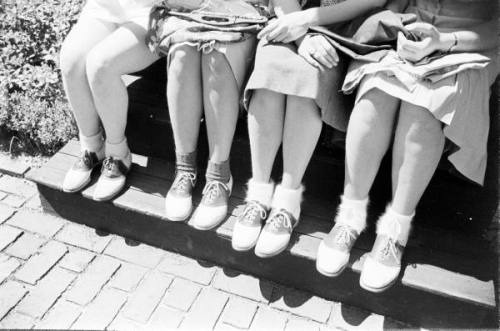
The other essential element of my Seven Sisters Summer is bobby socks.


Luckily, this time last year I invested in a bazillion pairs of colourful ankle socks.


If you'd like to follow my jaunty tastes in clothes, I have a Pinterest board dedicated to them. That's where most of these pics are from. I also have a Pinterest board specifically for Out of Shape source images – feel free to follow that too, or, hell, why not follow them all?

Monday, December 03, 2012

Berlei's dodgy survey boss

Professor Henry Chapman in 1928. 
Berlei might have employed some rad ladies, but the man in charge of the sizing survey was Professor Henry Chapman, of the University of Sydney's Medical School. The university's involvement – for which it was paid in £10,000 worth of Berlei shares – lent the enterprise a ring of reassuring medical authority.

Tall, imposing and with a forceful, charismatic manner, at the age of 47 the British-born Professor Chapman had already enjoyed a glittering academic career at the universities of Melbourne, Adelaide and Sydney, distinguishing himself in physiology, pathology and pharmacology.

Anthropometry wasn't really his bag… but more pertinently, he relished public attention and had an excellent reputation for working with industry. Chapman would have been a model scholar in today's corporatised, publicity-obsessed universities.

In the earliest of his many consulting roles, in 1908 Chapman testified before a Western Australian Royal Commission on the use of the preservative sulphur dioxide in meat processing. Thanks to his knowledge of yeast, in 1916 he helped found Sydney Technical College's first school of baking technology.

When he chaired a 1919-20 inquiry into lung diseases in the Broken Hill mines that recommended compensation for miners affected by phthisis and pneumoconiosis, Chapman also managed the impressive feat of being respected by both mining companies and union leaders.

For the Berlei sizing survey, he recruited his anatomy colleague, Dr Stewart Arthur Smith, plus two undergraduate science students, Mr R Tannahill and (the aforementioned rad lady) Della Lytton Pratt, as research assistants. While Chapman and Smith supervised, the students were in charge of collecting, classifying and correlating data from 23 different body measurements per participant, using specially designed calipers and rulers.

The Berlei survey was the high point of Chapman's career. In 1928 he was appointed as the university's Director of Cancer Research. Then, as now, cancer research was a prestigious gig, and Chapman's lack of experience in the field bitterly divided his colleagues. A 1930 series of media exposés painted him as a publicity-seeker with dubious research methods.

It seems his work took a toll on his family life. In 1916 Chapman separated from his wife Julie (with whom he had a son and two daughters), and maintained a glamorous bachelor lifestyle at the University Club in Sydney. He also kept apartments in the city and Bondi, and by the time of his cancer research appointment, he was living way beyond his means.

In May 1934, Chapman was caught embezzling cancer research funds and committed suicide by taking a cocktail of poisons. His estate was divvied up among his creditors. Unfortunately, today he's best remembered for this final disgrace, rather than his contributions to public health.

Thursday, November 29, 2012

The rad ladies of Berlei: part 3

Man, when I started this post I was only going to tell you about two rad ladies, but it seems that Arthur and Fred Burley employed lots of women in leadership roles that let them, if you will pardon another one of my trademark corny puns, shape Australian public life.


Clare Stevenson, by Nora Heysen, 1943.

Clare Stevenson was born in Wangaratta, Victoria and raised in Essendon. She studied science at the University of Melbourne but graduated in education in 1925, and when WWII broke out she was a senior executive at Berlei in charge of corporate training and product development, travelling between London and Sydney and around Australia.

"The interest in national fitness here amongst the older women will … help them keep the natural good posture and good looks of Australian youth till much later in life," Stevenson told the Perth Daily News in 1940, when she was visiting the city to deliver a very interesting-sounding lecture, 'The Care of the Bustline'.

Due to her management and training experience (and also, apparently, because she wasn't a "socialite"), Stevenson was appointed the Director of the Women's Auxiliary Australian Air Force (WAAAF) in 1940, rising to the rank of Group Officer (the equivalent to Group Captain in the regular air force, or to a captain in the Royal Navy or general in the British Army) in 1942.

The WAAAF was the first and the largest uniformed women's military service in Australia during WWII. By 1944 it had more than 18,000 members and made up roughly a third of the RAAF's ground force. A wonderful Sydney Morning Herald headline in 1941 marvelled, "Director of WAAAFs approves lipstick. Smokes, too."

"Women look more attractive with lipstick, even in uniform," she said, accepting the reporter's offer of a cigarette. "Lacquered nails? It's largely a matter of taste." Seriously, though, she spent the war fighting for equal pay and respect for her enlistees, and against the sentiment from government authorities that women's best contribution to the war effort was to maintain the home.

After the war, Stevenson returned to her previous job at Berlei. She retired in 1960. Never having married, she died in 1988, aged 85.

Desolie Richardson (who became Lady Desolie Hurley on her marriage to Sir John Garling Hurley in 1976) was Berlei's Chief Executive Designer from 1954 until her retirement in 1970. (Here's a photo of her in 1969.) During the 1950s she successfully licensed one of Berlei's flagship designs, the Sarong Girdle, from its American designer Constance Fridolph. (The correspondence between Richardson and Fridolph, thrashing out the details of this deal and sending sample garments back and forth, is now part of the Berlei Collection in the Powerhouse Museum in Sydney.)


The Sarong was advertised in the Australian Women's Weekly until the early 1980s. It featured two overlapping diagonal elastic panels in the front, which purportedly allowed more 'control' with greater freedom of movement. Early ads showed women dancing, walking a dog and playing golf in the garment. Another selling point was that it apparently didn't ride up.

As a side note, when I see historical ads posted online, in blogs or on Pinterest and Tumblr, I often see people taking the imagery quite literally. As I write in the book, advertising is an archive of desire: it says much more about how people wanted to live than how they actually lived. This is valuable, because it's a way of capturing ephemeral social attitudes.

You can tell what it might actually have been like to wear historical underwear by paying attention to what the ads say their products won't do, or that their competitors do badly. For instance, if an ad says, "Our corset bones are unbreakable!" you conclude that corset bones often used to break.

Richardson also designed the luxurious Mink Bra. As its name suggests, it was a strapless long-line bra made out of fur, which retailed for 50 guineas in 1962 (around $650 in today's money). Check out a photo of this hilarious novelty garment here.

"Unlike ordinary fashion designing," Richardson told the Australian Women's Weekly in 1961, "foundations have to be essentially practical and exact. The job's rather like accountancy and engineering with a dash of fashion thrown in."

Wednesday, November 28, 2012

The rad ladies of Berlei: part 2

It was Fred Burley's idea to undertake a sizing survey, in partnership with the University of Sydney Medical School, which dovetailed perfectly with Berlei's pre-existing principles of scientifically precise fit and public showmanship. Public tents were set up on Bondi Beach over the summer of 1926-27, as well as at factories, seaside resorts and Turkish baths around Australia. Berlei's surveyors measured 6000 female volunteers aged between 15 and 65.


The Berlei Figure Type Indicator, invented by Della Lytton Pratt

Della Lytton Pratt was one of two undergraduate USyd science students recruited as research assistants. The students were in charge of collecting, classifying and correlating data from 23 different body measurements per participant, using specially designed calipers and rulers.

The data revealed a strong relationship between hip and waist measurements. Working from this, in 1928 Pratt developed a diagram that became known as the Berlei Figure Type Indicator. This was a cardboard (and, later, plastic) chart designed for corsetières to help fit their customers. It featured a moveable disc printed with bust measurements, and a moveable pointer printed with waist measurements. The hip sizes were printed around the edge of the opening in the base.

So, for instance, if your bust was 35 inches, waist was 28 inches and hips 37 inches (this is the example given in the patent description – I wonder if these were actually Della Pratt's own vital statistics), you'd spin the disc until the '35' printed on it aligned with the '37' printed around the edge. Then you'd slide the pointer so that the little notch on the end aligned with the same spot. And you'd look through the little circular holes on the pointer (in later designs, the whole pointer was see-through) designating waist measurements, and whatever colour peeped through at '28' was the figure type Berlei reckoned you had.


Here are the five colour-coded figure types, as displayed on a 1930s-era Indicator. I think I am Type Ab (Abdomen). Note that these types are all framed as things that are 'wrong' with a woman's body, that the corset can then step in and 'fix'.

Della Lytton Pratt is listed as the owner of the patents for this device in Australia, New Zealand, South Africa, Great Britain, Canada and the US. Because Della was only 20 and so still a minor at the time, her dad, Major William Pratt of the Royal Australian Engineers, had to sign the deed of 'indenture' that transferred the rights to Della's invention to Berlei.

For her idea – from which Berlei went on to profit handsomely, and which figured prominently in the company's marketing – Della was paid five shillings. It's hard to figure out precisely how much that would be today. There are many ways of calculating historical value – the value of a commodity; of income or wealth; or the cost of a project. Many calculators work off the main currency unit at the time; the only specifically Australian historical value calculator I can find seems to work only in dollars.

This gets tricky if your sources mention shillings, half-crowns and guineas. There were 12 pence to a shilling and 12 shillings to a pound. When Australia switched over to decimal currency in 1966, the conversion was two dollars to a pound, and ten shillings to a dollar.

The Australian pound was introduced in 1910 and was roughly the same value as the UK pound sterling until 1931, so I used the UK values to figure out how much Della got paid. Anyway, Della's measly five shillings would have had the same purchasing power as about $18 today.

When I was researching this stuff earlier in the year I became obsessed with finding out what became of Della Pratt after this. For someone who invented something so clever, she seems to have just given it up and gone on to lead a completely ordinary, unexceptional life.

She graduated in 1928, and I tracked her through newspaper family notices as she married a Philip Oakley in 1930, and moved from Sydney to Gilmore, near Tumut in the NSW Riverina, and then – I think! – further west to Finley, near Deniliquin. Their first child, a daughter, was born in 1931. The Major died in 1932. :-( And from there, the trail goes cold and she vanishes into history.

Sunday, November 25, 2012

The rad ladies of Berlei: part 1

Australian lingerie label Berlei has its origins in a small made-to-measure Sydney corset company purchased by brothers Fred and Arthur Burley. Arthur came up with the idea of a Frenchified version of their surname to capitalise on the glamour of continental lingerie, and the company was renamed Berlei Limited in 1919 and incorporated in 1920.

The company grew into a transnational empire with branch offices in Melbourne, Brisbane,  Auckland, Adelaide and Perth. The Burleys believed strongly in scientific fitting principles. They ran annual training seminars for corsetry fitters, and between 1923 and 1926 they employed as Berlei's medical director Dr Grace Fairley Boelke. 

I'm not sure if she was fairly bulky, but she was intellectually brilliant; in 1893 she was one of Sydney Medical School's first two female graduates. In her youth she was also a total babe, with dark hair and striking blue eyes. But her early career suffered due to prejudice against female doctors, and anti-German sentiment during WWI, since she had married a German-born fellow medical graduate, Paul Wilhelm Rudolph Boelke.

Boelke was active in women's suffrage organisations, and in public health policy. She believed alcoholism was a social equity and mental health issue, not a moral failing. In 1919 she presented a research paper on the history and effects of alcohol consumption, noting that French soldiers in Gallipoli were "well supplied with the light wines of their country" and suffered less from dysentery than the British. In 1924 she went to the United States to study the effects of its prohibition of alcohol. As the press reported, she came back "a rabid anti-prohibitionist", determined "to save her country from such a curse"!

Yet I was dispirited to discover that in 1928, Boelke was widely reported as saying the White Australia policy didn't go far enough! She insisted, "Australia will be swamped by the East if she doesn't speedily accept a complete European civilisation." At this time she was living in London, and hopefully not mixing with Oswald Mosley, Diana Mitford and the other British fascists.

Her job at Berlei was partly an OH&S role – she was responsible for the health and welfare of Berlei's 600 (mainly female) employees. On her 1924 US tour she also visited eight factories to observe their workplace safety practices.

But she was also a public face for the pseudo-medical claims the Burleys made for their products. Part of her job was to ensure Berlei's corsets were "anatomically correct". I suspect that she just took their money and said, "Oh, yes, very correct."

In a 1924 lecture on "The Philosophy of Clothes", Boelke said: "If women become slaves to fashion, then it should not be at the cost of health. Men are such 'timid animals', however, that they refuse to see the hygienic value of dressing for their comfort, and stick to high, stiff collars, wearing suits that hold dust and germs."

What a fascinating reversal of the widespread belief that in the past, women were the ones suffering in their stiff, formal clothes!

In the company's trade journal, Berlei Review, the brothers urged willowy flappers to "corset for the future" in order to prevent irreparable damage to "muscles and vital organs", or "excessive figure development in the middle years". This use of corsetry to train, rather than constrain, the female body would have been familiar to women whose mothers and grandmothers had encouraged them to cultivate their figures by corseting early and often.

However, by the 1920s corsets were already past their heyday. Since at least the 1890s, a growing cultural shift encouraged people to sculpt their bodies from the inside, via diet and exercise, rather than from outside by squeezing them with corsetry.

It was a tricky time for Berlei, whose 1920s marketing did reflect the prevailing cultural worship of youthful, sporty silhouettes. Its products had dainty, diminutive product names such as "Corselette" corsets and "Berlette" bras. The implied athleticism of its wrap-on "Dance Girdle" was continued in the annual touring musical revues Berlei staged in theatres and department stores to promote its merchandise; the 1924 revue was titled Youth Triumphant.

In charge of these spectacles was another rad lady: Mary Craven. Her father owned an undergarment factory, which Mary managed before joining Unique Corsets – the company that would become Berlei – in 1915, as a designer.

As part of Berlei's corporate strategy, Mary was regularly sent overseas on study tours to learn the most up-to-date industry trends. She then returned to art-direct and compere the annual revues, which were probably much like today's runway shows in the visually spectacular way they presented clothes, but at the time were absolutely novel.


In 1929, when the revue was titled Lady, Be Beautiful, the Advertiser reported excitedly that: "In Brisbane women held up the traffic in their anxiety to get into the theatre to view this unique corset parade." The Sydney Morning Herald described that show as follows:
The stage setting was attractive and beautiful. The four acts Happiness, Hope, Health, and Triumph symbolised youth, the possibilities of attaining a beautiful figure for the maturer woman; corsetry after surgical treatment; and the importance of correct foundation garments to successful dressing. Each act was supported by a ballet and orchestra. Miss Mary Craven spoke briefly on the features of each model as it was shown.
Interviewed by the Brisbane Courier in 1925, Craven said, "Only the woman who has a perfect digestion, never eats a scrap more food than she actually requires, and takes any amount of exercise can afford to discard corsets, and their absence mars the effect of even the best cut and most garçon-like gown. There was a period, after the war, when there was a craze for no corsets, but the well-dressed woman of to-day realises that they are a necessity."

Friday, September 28, 2012

On abundance

Today I had a house inspection, so last night I had to tidy my bedroom. This made me feel about 15 years old, and let me tell you it hasn't got any more pleasant in the intervening years.

Because I've been frantically working towards my draft manuscript deadline (MONDAY!!!!) I have not been prioritising such minor things as housework, and it took me basically an hour just to put my clothes back on hangers rather than leaving them in a giant pile on the floor of my wardrobe.

Once I did, the scope of my sick addiction to clothes became clear.

Forgive me, Carson, for I have sinned. It has been two years since my last wardrobe cull. Since then, my clothes collection has metastasised to the point where I now own a second chest of drawers, solely for my singlets and T-shirts.

There's a lot of talk about how wasteful cheap clothes are because they 'fall apart' and are 'thrown away after just a few wears'. We are encouraged to spend big bucks on 'investment pieces' from well-known or designer brands. Fuck that. I get excellent value for money from my really, really cheap clothes. I get them from several places:

– Discount department stores such as Target, Kmart and Big W
– Cheap fast-fashion stores such as Femme Connection, Valley Girl, Cocolatte and Cotton On
– Op-shops, garage sales, school fetes and open-air markets
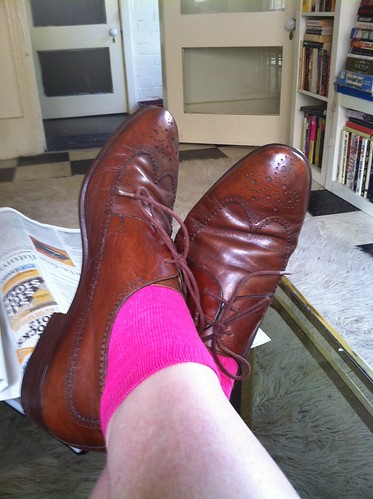
Honestly, I struggle to think of the last time I bought clothes at any other kind of store. Today I'm wearing an American eagle print T-shirt I bought at a $2 shop, a faux-Chanel houndstooth cardigan I got at Savers, a pair of Target pants and Dunlop canvas ballet flats bought from Big W. My earrings are from Valley Girl.

And I wear this shit. The black cardigan I bought in 2007 at Femme Connection for $30 is still a wardrobe staple; I wore it just yesterday. The shoes I'm wearing today date from perhaps 2004. The usual rule – discard anything you haven't worn for a year – simply doesn't work for me, because I cycle between almost all my clothes. And perhaps that's why they are relatively lightly worn.

Last night I decided to be ruthless and donate anything that no longer fits, things I try on but never seem to actually end up wearing out of the house, damaged stuff I've planned to fix but never have, and even the things I've been hoarding 'to sell on eBay'. (The process of selling clothes on eBay – photographing, measuring, writing detailed descriptions, packing and posting – is so labour-intensive it's pretty much not worth it.)

In the past I might have hesitated to donate stained or torn clothing, but my research into the arse-end of the second-hand rag trade has shown me that it's better to put this stuff into the food chain than put it straight into landfill. (There's a blog post in that.)

Five bags of clothes and shoes later, I was aghast at how many things I still had. The sheer abundance of it seemed really disgusting… but on the other hand, I couldn't justify throwing away things I actually like and wear.

It occurred to me that my shopping is about building a collection. I shop with the idea of adding to a repertoire of only very subtly different garments. Often I will become obsessed with a particular style, and decide to collect it in various colours. For instance, I own five flannies in different plaids, four long-sleeved pussy-bow blouses, and seven high-waisted, knee-length full skirts.

Sometimes it can get even more insane: for instance, I own ten striped T-shirts of various stripe widths, sleeve lengths, collar shapes, body lengths and tightnesses… but the colours are only black/red, black/white, red/white and navy/white. I've also mentioned my weakness for cardigans before. Well, in 2010 I had 16 cardigans. Today I have 20… and that's after donating three.

This abundance gives me more to work with when getting dressed each day. It's like composing for an orchestra rather than a quartet. But importantly, it also structures my shopping and makes it seem logical and analytical rather than irrational and emotional. It's about engaging with 'the collection' rather than engaging with 'the body'.

This excellent article about fashion journalism made the point that the Ivy Style phenomenon – currently the subject of a fabulous-looking exhibition at FIT – is about introducing blokey nerd-outs and cultural-capital dick-swinging into the feminised sphere of clothing. Do you know how to fold a pocket square? Do you know how much cuff should peep from your jacket sleeve?

I've been trying to think more critically about gendered ideas of intellectual worth, and more creatively about the extent to which I should buy into them. For instance, I've noticed that I tend to 'masculinise' my thinking about clothes and fashion as a way to combat the widespread perception that fashion is a devalued, 'feminised' sphere. This extends to the detached, intellectual writing style I tend to default to, anticipating a hostile reader ready to criticise me for superficiality or self-indulgence.

But perhaps it's a more radical move to embrace my feelpinions about clothes, to inhabit my writing in recognition of the way that culture is lived and embodied. I'm hoping that perhaps one way around this is to intellectualise my writing on a formal level – on the level of structure and the juxtaposition of ideas – rather than on a content level – the level of writerly tone.

So I can be 'feminine' in admitting the pleasure that my abundant wardrobe brings, but not get bogged down in self-indulgent anecdotes about how I bought all my clothes. Let me assure you, I could totally wallow in that! But it wouldn't be very interesting for the reader.

Thursday, September 27, 2012

Interview: Stephanie Trigg on medieval wardrobe malfunctions

Stephanie Trigg is a Professor of English at the University of Melbourne. This was my department when I was a postgrad, and as I walked through the corridors of the John Medley building I could sometimes peek into Stephanie's office and see her at work.

These days I sort of do the same thing in a digital fashion by following her blog, Humanities Researcher. I got really excited when I realised that her work tracing medievalist themes to the present day, and particularly her latest book Shame and Honor: A Vulgar History of the Order of the Garter, resonates with the ideas I'm exploring in my own writing.

I'm delighted that Stephanie so graciously answered my decidedly non-expert questions, and I'll be including parts of this interview in my book.

The Order of the Garter is England's highest chivalric honour – an institution whose pageantry persists today. Intriguingly, it has an origin myth both as populist and as persistent as any superhero's. Here's how Stephanie describes it:

King Edward III was dancing at a ball with a girl, possibly Joan, Countess of Salisbury, possibly his mistress, when her garter falls off so her stocking crumples to the ground. All the courtiers laugh — "Ho ho ho! What an embarrassing thing!" — but the king very chivalrously bends down, picks up that garter, ties it around his own knee and says (in French, of course), "Honi soit qui mal y pense" — "Shamed be he who thinks evil of this." And he says: "I will found a chivalric order in honour of this event that will be so great, all you who now laugh will want to join it!"


Check out this very hammy painting of the scene: Ceremony of the Garter, by Albert Chevallier Tayler, 1901. I love the way Joan's silhouette is much more typical of a corseted Edwardian lady.

Mel Campbell: I was struck by the vulgar 'origin story' of the Order of the Garter basically being a wardrobe malfunction. Today we shame celebrities (and ordinary people) whose clothing goes awry in public – do you see this as a continuation of older attitudes, or as a different, modern phenomenon?

Stephanie Trigg: I think this is a continuation: it’s the collapse of a carefully-controlled public presentation of self, and so this is always intriguing. These ‘malfunctions’ usually remind us of the body beneath the clothing, so they are reminders of our physical mortality, and the sheer animality of our bodies we share beneath the differences of age, beauty, class, et cetera…

It's true we shame celebrities in this way, but we also take pleasure in circulating and re-circulating those images. In that respect it's like the laughter of the crowds in the story of The Emperor's New Clothes. The Emperor is duped into thinking he is wearing magnificent garments but in fact is walking naked, or in his underwear. A small child points this out and everyone laughs. Nevertheless, the Emperor keeps walking, holding his head up high, as the sheer formality of the ritual procession keeps him going, and must be maintained.

I'm so pleased you mention this, because I'm using The Emperor's New Clothes in my book! To me it seems like the origin story of the lady dropping the garter and the king picking it up is gendered, with the female as shameful and the male as the restorer of honour. Have you found in your research that shame is something more often ascribed to women?

It depends very much on the context. In courtly and chivalric literature, the knight who retreats from battle or attacks a woman is publicly shamed. He can be stripped of his knighthood and lose his courtly reputation. And the story of the Garter ostensibly makes a distinction between those men who can appreciate the king's gallantry and those who cannot, who are shamed (according to the Garter motto – honi soit qui mal y pense) if they see anything untoward in the king's behaviour.

But yes, a woman’s body is seen as more shameful than a man’s, in medieval culture. In humoral terms, it’s seen as moist and cold, as compared to the hot and dry male body, so it’s closer to the earth, more physical than spiritual. And in general terms, women are associated more with sexuality, which in Christian culture is often seen as inherently shameful. There is a very vague hint in a nineteenth-century commentary on the Garter story that the offending dropped garter wasn't so much a garter as underwear stained with menstrual blood, so that's an indication that the story was being read then as about women's shameful bodies.

I've been influenced by William Ian Miller's writing on shame and honour in medieval Icelandic epics. He argues that the Icelanders had no concept of internally motivated self-esteem; their sense of honour was entirely bestowed by the community, and so taking away your honour ('shaming' you) was the ultimate punishment. Do you reckon that in England and France, honour and shame were external states like this, or were they internal, deeply felt emotions?

This is a really fascinating question. Conventionally, yes, in heroic and chivalric culture, collective or communal reputation is pre-eminent; and I think shame is usually experienced in a social sense: one is shamed by, or in relation to others. But there is also a deep interest, especially in the later middle ages, on the individual’s relationship with God, and shame sometimes features here. By the later middle ages, I think we are starting to see indications of a more internally experienced sense of shame. Margery Kempe, for example, a fifteenth-century woman who experienced many visions of Christ, opens her narrative saying she had a sin she was too ashamed to confess. We never find out what that is.

What do you think is the difference between shame, humiliation and embarrassment?

I guess embarrassment is the most ephemeral, and the least serious of the three. Humiliation need not have an ethical component. You can be humiliated by defeat in a sporting contest or in battle, or in debate, or by a partner's infidelity, for example. This can feel devastating, but it's just as likely to lead to anger, or determination to do better next time. Shame, on other hand, brings us down very low, because it really implies social judgment not just on particular actions, but on our very personhood, in relation to our infringement of social norms.

Have you done much research into medieval clothing – and medieval underwear – more generally? And if so, what have been your impressions?

Yes, a little. The medieval period, especially the fourteenth century in England, was a time of great anxiety about social instability and economic growth. Clothes became a less reliable indicator of social status, and so sumptuary laws were passed attempting to restrict the wearing of various colours, fabrics and types of fur to particular classes. Clothing was often the subject of satirical commentary or stern critique: Chaucer's Parson in the Canterbury Tales, for example, complains about contemporary fashion for short tunics, and tight-fitting pants.

I don't think underwear was regulated by the sumptuary laws or subject to this kind of critique in this way because it's not normally visible. There would have been great degrees in the quality and fineness of the fabric used. The fourteenth century marks a big shift in clothing, generally, as they started to tailor clothes to the shape of the body, not just holding things in with belts and pins. Not very much underwear survives, and we have to guess a little bit from pictures.

Have you heard much about the so-called 'medieval bra'? Has this discovery caused much discussion among your colleagues?

Yes there was a bit of a flurry on Facebook! We really don’t have much surviving evidence of medieval underwear, so this is an astonishing find: I think it’s the first medieval bra to be found, and it’s remarkably similar in design to modern bras. I think there is also something quite moving about a garment that has been so obviously worn, that bears the traces of intimate touch with a medieval body. It's really quite uncanny to see something that is both historically alien and yet also so ordinary, so familiar to us.

I'm writing about 'retro' cultures, which many people seem to identify with the 20th century, but it could equally be about cherishing older aesthetics and values too. How do you see medievalism used in today's fashions and pop culture, as an aesthetic or as a set of values or ideals?

This can take a number of forms, from the long embroidered dresses of hippie and Indian culture, to some aspects of gothic fashion. Sometimes you see high-end fashion return to a kind of fantastic medievalism: fine metallic meshes that are reminiscent of chain mail, or metallic breastplates and bras that evoke armour plates.


Lena Headey as the villainous queen regent Cersei Lannister in the TV series Game of Thrones. She's wearing an armoured breastplate during a battle scene.


And here's Lucy Liu at this week's Emmy Awards, wearing a Versace gown influenced by armour and chain mail.

Often the medievalism of fashion is mediated by pre-Raphaelite nostalgia for long dresses, rich fabrics, on models with long wavy tresses and big dark eyes like the models of William Morris and Holman Hunt in the nineteenth century.


Medievalist film plays an important role here: think of Helen Mirren's metalllic costumes in John Boorman’s Excalibur; Milla Jovovich as Joan of Arc in The Messenger; or the popularity of pre-Raphaelite paintings, e.g. John Waterhouse’s Ophelia. This is a model of femininity that tends to show women as rather passive, if not doomed to tragic deaths like the Lady of Shalott. The costumes for the heroine in Brian Helgeland’s Knight’s Tale, on the other hand, are a fantastic example of the way something can be both vaguely medieval and also very stylish and avant-garde.


Shannyn Sossamon as Jocelyn in A Knight's Tale.

Tuesday, September 25, 2012

On the subjective address in non-fiction writing

I've got just over a week to hand in a full draft to my editor, and I've really been struggling with the issue of writerly voice. I've done so much research, in so many broad fields, and it frustrates me that rather than this fascinating stuff about the histories and cultures of size and fit, my editor wants more of my own experiences and anecdotes.

There's so much gold I'm having to summarise or cut out, but luckily I plan to showcase that stuff here on the blog.

I've also written a little essay for the Wheeler Centre about how I fret that adopting a subjective voice simply plays into the prejudices that people already have about the topic of clothes. Here's an extract:

My book needs to embrace subjectivity and embodiment, because it’s about clothing size and fit. I want to celebrate the sensuous pleasures of a garment that hangs, clings and moves in all the right ways, making us feel powerful, relaxed or sexually alluring. I also want to explore the excoriating shame we endure when our clothing doesn’t fit. Those soul-crushing change-room experiences. The public disgust and ridicule that greets wardrobe malfunctions.

But from the beginning of my project, I’ve struggled with the perception that what I’m doing isn’t ‘proper’ journalism. My book is no hard-hitting exposé, no barbecue-stopper that will land me on Q&A. (Well, okay, perhaps my absolute loathing of Q&A might have ruled that one out.)

It’s, like, about fashion, LOL!

‘Fashion has often been relegated to being a woman’s domain, something historically not deemed worthy of critical thought,’ says Serah-Marie McMahon, founding editor of Worn Fashion Journal. Fashion historian Valerie Steele, director of the Museum of the Fashion Institute of Technology in New York, adds that most people think of ‘fashion’ as a remote, superficial fairyland of runway shows and red carpet gowns: ‘They don’t identify it with what they are wearing.’

Read the rest at the Wheeler Centre website