Showing posts with label customisation. Show all posts

Wednesday, December 12, 2012

The circular logic of online DIY tutorials

Today at the op-shop I continued Seven Sisters Summer by purchasing a circular tablecloth in a seersucker-ish blue gingham, which I plan to make into a circle skirt.


You can see it already has a hole in the middle. I was sure this was going to earn me a discount off the price, but the op-shop lady told me the hole was intentional because the cloth was meant to be used on an outdoor table with a central umbrella.

I still tried to haggle because c'mon, look how crappily cut out the hole is!


But ultimately I gave up because it is a charity, and because $5 is still an okay deal for a large amount of fabric, ready-hemmed and already in a circle so I don't have to do that bit myself.

I remember a few years ago Lady Melbourne had a circle skirt DIY (here's part 1 and part 2) but I'm not sure I can be bothered with a proper waistband and zipper, since I haven't got a sewing machine (though my mother's always like "You can always borrow mine; I never use it") and my sewing skills are really not that advanced.

From some of the DIYs I've looked up, I think the way to finish the skirt will be to fold the tablecloth in half, then in half again, and then measure the waist (the 'circumference' of a small circle in the middle of the skirt) by measuring the radius of that smaller circle from the narrow end of the fold.

But how to calculate the radius? Lady Melbourne reckons you take your waist measurement, add on "an inch or two" for seam allowance, then divide by 3.14 (pi), then again by 2.

Another DIY says the correct radius is your waist measurement plus two inches, divided by 6.28 (pi times two).

This DIY (admittedly, for stretchy fabric) reckons the correct radius is your waist measurement minus two inches. ("Do not add 2"!")

One DIY says the correct radius is your hip measurement, minus four inches, divided by 6.28.

This DIY reckons the correct radius is your hip measurement plus two inches, divided by 3.14, then divided by 2.

But this DIY reckons the radius is simply 1/6 of your waist measurement.

WHAT IS THE RADIUS, PEOPLE?

While researching my chapters on sizing I developed a lot of respect for patternmakers and the ways they come at the industrial problem of having to develop good fits for bodies in a wide range of shapes and sizes, within commercial limits.

By contrast, online DIY tutorials are personalised and amateurised. They are even a step below home dressmaking patterns (which I've also researched for the book) in that the process of creating the garment is flexible and intuitive, like cooking from a description rather than a strict recipe. They are often ad-hoc, based on repurposing existing materials rather than working from scratch, and making calculations on the fly that can then be fixed later in the process if they turn out to be wrong.

This suits my way of working with clothes. I should probably do a future blog post about my crappy customised clothes; I did one back in 2009 and I should let you know that the pink dress was a complete failure. I think I crumpled up the fabric in rage and despair and threw it in the corner of my room, because I found it there last Saturday while searching for some Christmas wrapping paper.

Wednesday, October 28, 2009

Amateur hour

I have no training in garment design or patternmaking, but some idiotic impulse in me fills me with the confidence that, when it comes to it, I can totally make my own clothes without using patterns. Sometimes this works really well. Most of the time it works okay. Sometimes, I fail miserably.

Of course, things would be much easier for me if I simply bought a dress pattern. But for some reason this seems much more difficult to me than quickly cutting and resewing sleeves and hems, or pinning a garment on me and then resewing it. Also, I use clothes I already own as templates, modifying the lines to suit what I'm making.

My biggest triumph in this way was probably my Collingwood Boxing Club T-shirt, which was an enormous baggy thing I bought from Savers. I unpicked the sleeves, recut them and the body to match the shape of a T-shirt of mine whose fit I liked, and then sewed them back together.


Oh god, my hair looks like Bret Michaels or something. That pic was from early in 2005.

I also made a dress to wear to my undergraduate valedictory dinner. It was long and bias-cut with spaghetti straps and a cowl neckline; I remember that I made it by laying the fabric on the floor and placing a dress of roughly the same length and shape over the top at a 45-degree angle to act as the template. I made the cowl neck by allowing a generous semicircle of fabric at the top of the dress, which then hung loosely inside the neckline.

There was also my Donatella Versace costume, which I made for my 26th birthday party (the theme was "More dollars than sense"). It was beyond my limited abilities to make a Versace evening dress (like this one Donatella is wearing, left; Saturday Night Live comedian Maya Rudolph is at right), but I wanted to look a bit fancy, so I found an apricot-coloured satin slip/nightgown and an apricot-and-bronze patterned chiffon scarf in an op-shop.

I cut the neckline very low and added a border of the chiffon scarf material, which continued as shoulder straps that fastened in the back. I also cut out triangular panels in the nightgown over the ribs and under the bust and filled them in with panels of the scarf material. It was a real challenge to match the bias cut of the dress with the replacement fabric. I cut a big slit in the skirt over one thigh, and made the skirt longer by adding an edging of the chiffon.


At the party I wore the dress with my skin painted nugget brown and a long white wig. I later wore the dress for an Incredible Melk photo shoot. You can see my hand protectively on my boob to stop it falling out of the dress.

I also don't own a sewing machine or a dressmaker's dummy, so all these things are sewn by hand and I adjust the garment as I am wearing it in front of a mirror.

This week I am attempting another ambitious dressmaking project. It's doubly ambitious because it's an attempt to rescue a failed dressmaking project from last July, when I tried to make a '70s-style 'Grecian goddess' prom dress from some vintage hot-pink gauzy fabric I found at Savers. It's some synthetic fabric – rayon, probably.

It was meant to come out looking similar to this:


But I really screwed up because this was the first time I had attempted to make a dress from scratch without a pattern. I can't quite explain it, but I had imagined very clearly how the dress was going to come together. I could picture the dress in 3D and mentally turn the image around as if it were a Rubik's cube, imagining how I would need to cut and pin and drape the fabric to create this image.

Anyway, I was very rushed and tired and it got to 3am on the night before the prom. I had the dress pinned on me and I was cutting it at the same time, but I accidentally cut it on an angle rather than straight, totally ruining the dress.

But I have decided to attempt to turn it into a '60s-style cocktail dress. Here is a crappy diagram of the way I would like the dress to look. I have drawn the skirt too short; it sits just below the knee.


I have cut out the pieces of the bodice, which looks the same in front and behind. The band goes around the ribs and the skirt begins at the true waist. It is gathered finely at the shoulder, bust and waist – doing this by hand will be the tricky part. Because of the semi-sheer fabric I have allowed two layers in the bodice.

At this stage I'm thinking I'll begin by gathering the shoulder pieces, then sewing the front and back pieces together at the shoulders. Then I will pin the band in place on me and tack it in the front so it sits properly. Once I've put the bodice together I'll attach the skirt. I think there's enough fabric from the old prom dress for more layers in the skirt; I'm thinking about creating a 'self-petticoat' edged in tulle to make the skirt stick out. Then I'll add a side zip.

Time will tell if this project is a success or an abject failure.

Friday, December 22, 2006

The uses of customisation


At the start of December I went to the CSAA conference in Canberra. One of the highlights for me was the fashion stream. I had decided not to participate because I was afraid that it would be ghettoised - it was referred to as a "fashion workshop" and I was worried that it would just be a bunch of self-identified 'fashion researchers' speaking to each other's papers, rather than forming a dialogue with the other delegates. As it turned out, the fashion papers were all held in the same lecture theatre but simply formed one of the parallel sessions, so I needn't have worried.

Many of them were frustrating because they were expository rather than analytical. They set out to describe a particular phenomenon, which many of them did in a lively and entertaining way, kind of like an interesting TV documentary. But some papers spent too much time introducing the material and not enough time situating it in a theoretical or social context. And some presenters didn't seem to have asked themselves, "What are the larger ramifications of my topic? What's at stake here?"

But one of the most exciting papers I saw was Miriam Silvester's, which focused on how strategies of customisation can extend the life of a garment beyond the traditional consumer logic of 'fast fashion'. Indeed, she spoke of the "rhythms" of clothing. Silvester is a Wellington-based designer and researcher, and a lovely person to boot. It was truly a pleasure to meet her. Perhaps it's my own impetus towards keeping lists and delineating categories, but I love the way she keeps a visual diary of all her clothes, tracking the time, energy and money she's spent on maintaining them.

Indeed, what I really liked about Silvester's research is the way that customisation isn't presented as a purely stylistic gesture or as mark of singularity for its own sake. Instead, it is a pragmatic acknowledgement of the relationships that people form with their clothing, and the way those relationships change over time. For example, you might have a favourite windcheater that you want to salvage even when it becomes torn or stained; or you might get bored with it, but it's too good to throw away. Silvester is interested in how these processes of salvage are entwined with the creativity expressed through customisation.


Look at that; isn't it beautiful the way the damaged cuffs are reworked into a design feature? For a major project, Silvester designed garments that actually anticipate and incorporate their own ruin. Her "Spill" range contains drawstrings that can be pulled to create ruched sections that disguise tea, wine or cigarette marks.


For me this seems the very opposite of those pre-distressed garments you can buy new in shops, which, ironically, by employing signifiers of 'use' and 'customisation', actually lock users out of the opportunity to form their own relationships with the garments. That is, they deter customisation.

Silvester sketched a useful model of clothing rhythms (the speed at which garments are replaced) and what she called "fashion levels" (the degree to which people respond to trends). People with low levels of fashionability, who buy purely for utility, and those with high fashionability, who can make current trends work with the minimum of new purchases, both have sustainable consuming practices. It's those with medium fashionability who are the worst consumers, because they buy and quickly discard garments in order to stay 'in fashion'. (And, I'd add, the pre-distressed garments are largely targeted to this segment.)

This begs the question of whether fashionability can be taught, and whether it even ought to be. I mean, who am I, or anyone else, to assume a position of expert knowledge and impose on other people my own ways of placing myself within current trends? All the same, there are many ways to teach people how to be fashionable - magazines, copying celebrities, observing people in the street, and the 'styling tips' that so many retail chains provide via their catalogues, their visual merchandising and their staff. I'm interested in this, and I'll return to it.

But Silvester has come up with a really interesting experiment in encouraging people to customise. It's called Wellytown. Silvester produced a lovely line art illustration of a Wellington streetscape as seen from Mt Victoria. She printed this on t-shirts which she distributed to friends and acquaintances, telling them they were free to customise the t-shirt however they liked - drawing, painting, embroidering, appliquing, etc. Some of the results were really beautiful. She's also begun selling the t-shirts in stores, together with art materials and some basic suggestions for customising. And she encourages people to photograph their work and send it to the site.

That last idea really excites me. It's as if the t-shirts are a way to join a community of creatively engaged Wellingtonians. It's a club whose members recognise each other, not only by the original image, but also by the singular ways in which they've adapted that image. It's a really smart idea. Silvester has also produced Wellytown posters which, hopefully, will lead people to the site and expand the communal idea into virtual space. There are so many wonderful possibilities.

What really interested me is that Silvester found many participants in her initial project were afraid of 'ruining' their t-shirt. Her theory is that this is because the garment is worn close to the body (as opposed to people not worrying so much about altering a collaborative artwork, for instance). But this tells me that there's a fine line between successful and unsuccessful customisation. Perhaps it's about the process - you don't quite know what the results will be until you've arrived at them, and this uncertainty deters you from even beginning. Or perhaps it's about the finish - you have an uncompromisable vision of what you want the garment to look like, and you're worried that you don't have the skills to produce this vision so you'd rather leave it to 'professionals'.

Tuesday, February 28, 2006

Things to do with t-shirts

Back in 2004, I wrote an article about t-shirts for The Age. I wanted to explore the growth of t-shirts as design objects; the ways they were being turned into a fashion fetish and every second graphic designer seemed to be putting out a t-shirt line. But only the final three paragraphs of the final article are about this idea. The week I submitted it, there was a media panic about a provocative t-shirt that Westco made its retail staff wear, and so my editor changed the focus to be mainly about t-shirt slogans. This really annoyed me, but you have to respond to these news cycles.

Today I was reminded of my lost article when reading this piece about innovations in the t-shirt market. I was particularly struck by its entrepreneurial streak: the point seems to be to identify trends to rip off in other markets. But I am interested in the closing section: "Blurring the lines between conventional displays and selling methods may well mirror your customers' blurring perceptions of what constitutes value, or experience."

But as I see it, the success of the brands mentioned in the article doesn't just suggest a blurring of retail convention. It's about changing the basic relationship between product, seller and buyer. As Meaghan Morris writes in her classic essay "Things to Do With Shopping Centres", "it isn't necessarily or always the objects consumed that count in the act of consumption, but rather that unique sense of place"; and I guess what I want to do with this post is to use these examples of new t-shirt marketing as a sort of "place-making" - and as an antidote to the idea of t-shirts as "designer fashion".

The paradox of the "t-shirt label" is that a generic, banal, mass-produced garment takes on what Walter Benjamin would call an 'aura'. In my favourite part of Morris's essay, she dismantles this possibility:

The commodities in a discount house boast no halo, no aura. On the contrary, they promote a lived aesthetic of the serial, the machinic, the massreproduced: as one pair of thongs wears out, it is replaced by an identical pair, the same sweatshirt is bought in four different colours, or two different and two the same; a macrame planter defies all middle-class whole-earth naturalness connotations in its dyes of lurid chemical mustard and killer neon pink. Second, commodity boudoir-talk gathers up into the single and class-specific image of the elite courtesan a number of different relations women and men may invent both to actual commodities, the activity of combining them and, above all, to the changing discursive frames (like shopping centres) that invest the practices of buying, trafficking with and using commodities with their variable local meanings.

So, taking my cue from Morris, I want to sketch several "things to do with t-shirts". And importantly, the new "things" being done with t-shirts are succeeding because they create new spaces that manage to make the t-shirt simultaneously special and generic. First, there's customisation, in which the buyer alters the structure and look of the t-shirt in various ways. Then there's merchandising, in which the t-shirt itself remains unchanged; it's how the buyer interacts with its retail environment that constitutes innovation. Such merchandising techniques are what Morris would call a "discursive frame" - they infuse shopping with meaning.

Clothing customisation has long been understood as a grassroots practice of bricolage - changing the meanings of clothes through a judicious and unexpected alteration of pre-existing items. Journalists still tend to get excited about its possibilities for creativity and individuality. I think the absurdity of such a stance is encapsulated in this phrase from NZGirl: "The only way to achieve individuality is by customising, and we're going to show you how..."

But I'm more interested in the place customisation occupies in the market. For instance, I have customised a number of my old Bonds t-shirts by cutting off the sleeve bands, altering the necklines, ruching the sleeves and reattaching the sleeve bands in different places. But were I to try and sell them, Bonds would get up in my grill about it. When I interviewed Dylan Martorell, who in March 2004 was running Outskirts T-Shirt Gallery, he had this to say:

Mel: What would you do if someone came in with a seriously ordinary t-shirt that looked like they’d just taken a texta to a Bonds t-shirt in their bedroom?
Dylan: And it was good or bad?
Mel: And it was really bad.
Dylan: Well, for a start we wouldn’t stock it because it was Bonds. Um, Bonds are about the only brand that actively, uh, go out of their way to stop people using their t-shirts.
Mel: Oh really?
Dylan: Yeah, I think every other t-shirt brand is happy for their t-shirts to be used, but not Bonds. We’d just tell them we weren’t interested, I guess. That it wasn’t right for the store.

Contrast the attitude of Bonds, a company that seeks to protect its brand from being 'ruined' by customisation, with American Apparel, a company that makes being generic its major selling point. American Apparel began as a wholesale business, selling t-shirts to artists, designers, bands and anyone else who needed a wearable canvas to print on. The company's selling points are quality, fit (slim fit - is it any surprise its biggest customers are hipsters?) and a rainbow of colours.

But I do want to get away from the 'wearable canvas' idea, because it perpetuates the t-shirt label mentality that t-shirts are 'works of art in the age of mechanical reproduction'. Instead, let's look at two ideas that treat t-shirts as commodities in the most obvious way: by inserting them into the retail logics of entirely separate industries.

In Chicago, patrons at the Windy City's own T-Shirt Deli can order fully customised American Apparel t-shirts as easily as picking out sandwich ingredients. Indeed, the company's tagline is "T-shirts made fresh daily". Pick your desired size, colour and style out of a glass-fronted deli cabinet, then spell out a witty slogan in iron-on letters of a variety of typefaces (at US$1 per letter). You can also provide your own design. The final t-shirt is wrapped up in butcher's paper. The concept is similar to Neighborhoodies, which I previously discussed here.

But while Neighborhoodies is a customising shop, plain and simple, I'm more interested by the food/fashion pun on 'freshness' employed by the T-Shirt Deli. Here, customising is a ritual of performing the 'fresh'. Rather than making your own sandwich at home, you go to a deli, and you feel more virtuous for resisting the temptations of the bain-marie. Moreover, you verify the freshness and healthiness of your lunch (and thus, your virtue) by seeing it made before your eyes. In a similar way, you go to the T-Shirt Deli because you want a product that could have been made by you. You feel better about yourself (more original, individual - more like a bricoleur) because you didn't just buy a pre-sloganed t-shirt. You thought up a witty catchphrase yourself. And the slogan looks especially good to you because it's being assembled right in front of you.



Brazilian store Banca de Camisetas(translation: T-Shirt Stand) is a kind of t-shirt newsagent. There are currently five ‘bancas’ in Sao Paulo. The merchandise is arranged in racks like magazines, the stock is changed weekly, and the store only carries three of each design. The ‘publishers’ are freelance graphic designers; from these photos, the shirts look a lot like the sort of stuff you can find at the T-Shirt Barn in Newtown, Sydney.

But the intriguing thing about Banca de Camisetas is that, while its merchandise fits squarely into the 'art' aesthetic of the 't-shirt line', it isn't sold in a 'gallery' environment and the t-shirts are packed into squares. Instead, there's an accessible, 'convenience' mentality - just as you would in a magazine shop, you're encouraged to 'drop in', to browse, to choose quickly and to return often. I really like the way it refuses to treat the t-shirts as fetishes.

However. Another thing that struck me is that the packaged shirts look almost like records, which in turn connotes another kind of retail fetishism - that of the hip, intense, mostly male vinyl hound spending hours browsing in music stores for rare discs. In every city there's a cartography of subcultural space marked out by spaces like these, and continually reinscribed by DJs and record enthusiasts. For example, in his article on death metal, "It'll All Come Out in the Mosh", Dominic Pettman refers to certain Melbourne metal record shops as the "Devil's Triangle".

The good people at Springwise "can't really think of any big city where this would NOT work!" I agree. It's a great idea. But my contention is that a 'banca' would work in different, locally specific ways in different cities, because people would incorporate it into their existing repertoire of retail techniques. As Morris writes, if a company can create a sense of place, they can market a very banal product with great success.

Thursday, October 27, 2005

Industrious


Some time ago, I wrote about Industrie, the menswear chain that has a similar logic to Sportsgirl (in the women's mass fashion retail market) as a signifier of 'fashionability'. That is, the clothes appeal to young men who don't really know what's in fashion, but want to look as though they do.

But it's not just about 'fashion', but 'style', which I have previously defined as "a more permanent and idiosyncratic dress sense that works aesthetically in a variety of contexts and fashion cycles". Sportsgirl's elaborate boho clothes are designed to generate individual 'looks' through multi-layering and mismatching mass-produced garments and accessories. Likewise, Industrie makes stylistic gestures towards 'individuality' - deconstructed shapes, torn edges, prints and embroidery that are designed to make the garments look customised, even though they are mass-produced.


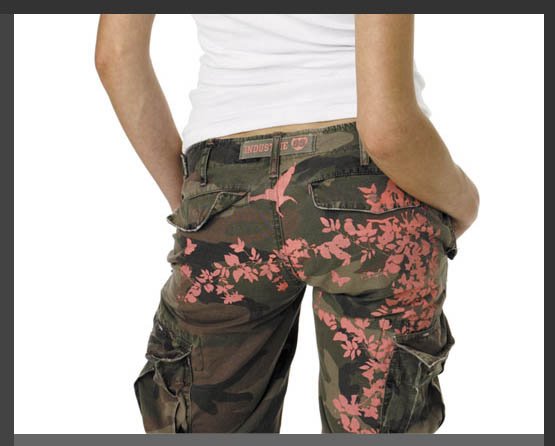
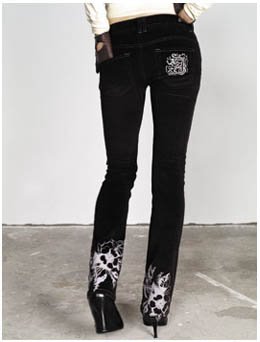
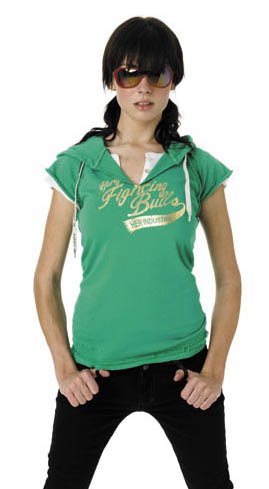
The company has diversified into womenswear with a line called Her Industrie, which has been out for about a year now. As you can see from these images, Her Industrie carries the same streetwear-influenced logic of 'individuality' as the men's line. Look at the stencils on the cargo pants, and the stencilled version of the black stovepipes that, by now, are everywhere in high street fashion stores. There are also layered t-shirts and singlet tops, and raw-edged, printed hoodies.


(As an aside, it's worthwhile mentioning that these hoodies are called "Harajuku". Since Gwen Stefani introduced this word into mainstream parlance, it's become completely disassociated from the specific geographic, aesthetic and cultural context of the Harajuku district in Tokyo, and now seems to mean something closer to "crazy-hip".)

Industrie seems very unstylish indeed to people who have a strongly defined personal aesthetic. And it seems very uncool to people who thrive on the affect of exclusivity that comes with being a style innovator or early adopter. As Will pointed out in the comments to my 'deconstructed hoodie' post: "Industrie is the kind of stuff where, if you wore it to an extended family barbeque, your family might think you were hip." And the hipster kids over at ThreeThousand are "so over" this style they wish to be woken when its moment is over.

For me, the most fascinating thing about brands like Her Industrie is that they relate only tenuously to the standard 'bubble-up' and 'trickle-down' models of fashion adoption. There was a really stupid and unsophisticated article recently in the Sydney Morning Herald which espoused the 'bubble-up' model:
Sportsgirl and the like may have finally discovered the skirts of India swirling around the ankles of nerdy girls in high schools across the land. Market research is all about youth, hunting for the next big thing. Business pays market research companies big bucks to observe young people and predict which of their angst-ridden outpourings will inspire the next Witchcraft [does the writer mean Witchery?] spin-off or be-labelled beanie.
Using this (unhelpfully crude) logic, whatever styles these trendspotters see subculturally affiliated kids (or, in this example, any kids at all!) will show up, blanded out and priced up for the masses, in chain stores. But this model breaks down when the subcultures and the hipsters don't even like the style to begin with.

So, why develop fashion lines like Her Industrie? Not because they are innovative, and not because they're associated with subcultures, but because they're just versatile and customisable enough to reassure most shoppers that by purchasing and wearing these garments, they're exercising their individuality and staying 'in fashion'.

As mainstream New Zealand women's lifestyle portal NZGirl opines:
The best way to inject a taste of ‘army girl’ into your wardrobe is with a pair of army print pants or shorts. Available from most chain stores, these will be a summer staple which will be worn year after year. We love the pictured Rose Bud combats from her industrie. These funky combat pants mix the masculine army print with girly accents by using print detail and feminine ties. Wear them longer on a cooler day or hitched up over your bikini at the beach – sweet and casual.
I did a bit of Googling to work out who's talking about Her Industrie, and the answer seems to be semi-articulate teenage girls:
went to myer, and omgsh i want these 'her industrie' pants.. but they 100$ and i didnt like the printing on the ass part of it.. hahaa so i derno if i'll get them or not.. may just look arnd first at city or something..
Here's another one:
my mother wont let me buy my Her Industrie three quarter pants thing.. she sed its army and its baggy. i guess it makes me look tom boyish x, x MY MOTHER!
This is a case for real market research - interviewing people to ask them what they like and dislike about the clothes. But from what's written on blogs and forums, it seems that people think about how the pants fit (are they in my size? are they comfortable?), how much they cost (young shoppers rely on allowances, part-time income, and parental permission), and where they can wear them (good for the beach, for going out, etc).

Intriguingly, there seems to be a backlash against the 'sameness' of Industrie clothing, particularly the prominent screen-printed branding. People posting to this bulletin board laugh at men (and women) who wear exclusively Industrie. Rather than making them seem fashionable, it makes them seem like dull-witted fashion followers. Still, I do think this is an exception. It might pain me, and it might pain the ThreeThousand kids, but stencilled army pants probably are going to come back in this summer.

Saturday, July 02, 2005

The bag's the charm


(Picture: Vice magazine)

2005 really seems to be a charmed year, accessory-wise. (Haw haw.) Elaborate charm necklaces and earrings continue their reign, and probably will as long as people persist with the boho look. (As an aside, I am just astounded at how long this boho nonsense has persisted for. Surely people will get tired of it soon. Surely.) But lately I have been noticing that mainstream stores are getting into the idea of bag charms, something that only used to be popular with international students. (I've had a little decorative satin toy on my bag for the last couple of years - it was given to me by a Chinese postgrad in my department after a trip back to China, and I couldn't think what else to do with it.) But now you can buy leather bag tassels at Witchery, diamante initials at Portmans and beaded charms at Sportsgirl.

(Image from Sportsgirl.)

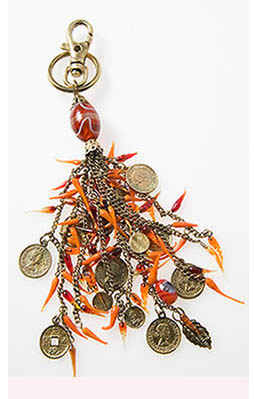
This object is billed as a "keyring", but you can tell by the size and the fact it also has a hook that you're also meant to use it as a bag charm. You can buy blinged-out versions of these at accessory shops like Diva. I was in there last week and asked the assistant about them. She said they were very popular, along with mobile phone chains.

At first, this seems to stem from a desire for individuality - making mass-produced accessories reflect your own taste and personality. But there are two problems with that. First, these accessories are just as mass-produced. You're equally likely to see someone with 'your' charm on their bag as you'd otherwise be to see 'your' bag on someone else. Second, when you mass them up as in the photo above, it loses coherence and just looks insane.

As the bag equivalent of wearing about a billion button badges on your jacket, I suppose you could call it 'punk'. But what is punk? Is it an anarchic philosophy? Is it a DIY style of cultural production? Is it an aesthetic of bricolage? Punk is such an elastic term that a recent BBC Radio 1 poll on the greatest punks of all time includes Che Guevara, Johnny Cash and Eminem. In turn, that makes me wonder whether the punkest thing you could do right now would be to defy any coherent semiotic reading of your clothes, like Dick Hebdige and a thousand other British academics performed on the original punks.

In that sense, the insane proliferation of charms on your bag doesn't make a statement about 'who you are' - it repels analysis, and obscures your tastes and identity. Instead, it's just a bowerbird mentality - a love of decorative 'shiny things'. Rather than a semiotic statement, it's an affective statement. It's saying "I wear these things because the way they look makes me feel good." And perhaps, like the bowerbird's collection, it's intended to draw admiring glances, thus drawing a kind of affective circle: "these objects make me feel good, and the attention of others also makes me feel good."

Wednesday, May 04, 2005

Business casual is back, mofo!


Rockin' the Chicago street. (Picture: WearWhatWhen)

As I pointed out on my other blog, the idea of wearing a tie with casual clothes was huge a couple of years ago when Avril Lavigne and a million teenage girls did it, but that it is probably considered "totally played" by hipsters. Well, it's funny how many people I see around actually wearing ties. Skinny ties, fat ties, ties pinned to the side and worn as kerchiefs (kerchiefs, if you'll recall, were one of my 2005 Fashion Predictions). Ties with shirts, polo shirts, t-shirts, singlets. Business casual is here to stay.

Now, when I say "business casual", I don't mean it in the Andrew G sense of "let me put on a blazer with the sleeves pushed up with my jeans, t-shirt and appalling Farrah Fawcett hair," nor in the pragmatic sense "clothing to wear to work when professional dress codes have been relaxed". Many companies have given up on their business casual codes because workers were confused by them or because they actually prefer to wear suits.

This ties into the careless luxe trend I identified several months ago - the mixing of signifiers. So, what is business casual all about? Is it a nostalgia for dressing up in an era when dressing casually is more widely accepted than ever? Well, you have to admit that the more prominent new-tie wearers are the usual artsy, creative types, who can afford to wear whatever they want. Perhaps they wear business casual as a declaration of their independence from the socioeconomic tyranny of 9-5 labour. As Dougie (my source on the ground for Japanese fashion) wrote recently:
Watching MTV, I realised that one of the reasons punk and rock bands dress bizarrely and let their hair shag out wildly is effectively telling the world that they've made it, because they're completely unemployable by any other industry.
This week, I've been doing my own version of business casual - cutting off old black or navy pantihose and turning them into sheer footless tights. I wear them ankle-length with my cut-down Dunlop Volleys, or hitch them up to mid-calf or just under the knee to wear with sneakers or cowboy boots. I was reading with interest an article (the link is to the cached version) about how business casual policies have meant that pantihose fall by the wayside as corporate wear. Most young people I see (even business types) wear opaque tights. So, I'm interested to see if my idea of sheer leggings takes off.

But I am not so much into the Tommy Hilfiger look of tucking the shirt into the jeans. No, Tommy, no!

Wednesday, April 27, 2005

Winter of the deconstructed hoodie


Photographed in Nolita district, New York. (Picture: Shannon Skillem, Nylon magazine)

At the risk of sounding like the Late Show parody of The Sharp, hoodies - are - back! Not that they ever went away. They're one of those things that instantly makes you look hipper, even if you aren't. But this year, we won't just see plain old hoodies. 2005 is going to be the Winter of the Deconstructed Hoodie.

I want to look at three ways of deconstructing the plain hoodie: adding words and images; cutting it up; and reconstructing it. The most obvious way to customise hoodies is to create slogan hoodies. Chris has a wonderful hoodie, which he created himself, that has "Baudrillard" appliqued across the front. Last year I was researching an article about the explosion of specialist t-shirt labels (that my editor butchered so it merely said "whoa, ain't slogan t-shirts subversive!") and I discovered Neighborhoodies. The idea is genius. You tell them what you want on your hoodie, t-shirt, etc, and they'll sew or print it on and deliver the finished garment with a personalised note. It's a business model that I plan to emulate, with modifications, when I finally get Melkwear off the ground.

Then there are cut-up hoodies. Everyone tells me that the Flashdance 80s look - raw-seamed sportswear - is 'over', and people are now wearing tailored or 'ethnic' clothes. But that's not what I see people wearing, and those aren't the hoodies you see in the shops. Industrie has some great 80s-style hoodies with ripped-off sleeves this season (they call them "Raging Bull"), which you can check out online if you can get over the Kevin Federline-esque model.

I think Industrie is the Sportsgirl of menswear. They do some great basic menswear with a slightly edgy quality that always looks quite sharp in the catalogues and the shop windows, but never looks as good on real men. Possibly this is because the layered, structured way that stylists (and hipsters!) construct outfits seems completely alien to the approach of your average dufus: "Duh, I will put some pants on. And then I will put on a top. And then some shoes. I dress me real good."

But Industrie possibly plays the same role for men as Sportsgirl does for women - as a signifier of "fashionability" (or "fashion-ability"!) for those who aren't otherwise adept at fashion semiotics. Just as any chick can go to Sportsgirl and know that she'll be "in fashion", men can go to Industrie, safe in the knowledge that whatever distressed garment they buy will be considered "fashionable".

Here it is worthwhile differentiating between several linked ideas: "fashionable", "cool", "stylish". I should perhaps devote an entire post to this. "Fashionable" implies being on the crest of a wave of deliberate obsolescence; knowing that what you're wearing now won't be acceptable within the symbolic and actual economies of fashion. "Cool" is an ephemeral, aloof form of affect that trades on exclusivity and otherness. The cool person is always the other, because it is fundamentally uncool to call yourself cool. "Stylish" implies a more permanent and idiosyncratic dress sense that works aesthetically in a variety of contexts and fashion cycles.

According to this brief and problematic schema that I've just sketched, Sportsgirl and Industrie are fashion stores. If you pick and choose garments to fit with your own aesthetic, they can also be stylish; but their ubiquity makes them uncool.

But anyway. I also saw a wonderful men's hoodie in a shop on Little Collins Street, which had large circular cut-out panels in the sides. It was designed to be worn with a singlet or something underneath. I was so excited by this look that I went to Savers to try and find a cheap hoodie to cut up and experiment with, but there weren't any I liked. I bought a spotted t-shirt instead.

The final winter hoodie trend I want to point out is the one illustrated by this New Yorker - reconstructed hoodies. I'm fascinated by his Frankenhoodie - it appears to be constructed from two separate garments sewn together. It makes me wonder whether he has a doppelganger wearing the opposite-coloured hoodie. Industrie is doing a version of this, too. Particularly, look out for the pink one that they somewhat alarmingly describe as the "savaged zip" hoodie.

The main characteristic of the reconstructed hoodie is that it toys with the basic hoodie construction. The cut-up hoodie pulls the familiar form apart and creates dynamic absences that are only enhanced by the small traumas of their curling, frayed edges. But the reconstructed hoodie draws its dynamism from the slightly askew way it puts the hoodie form back together - the things it adds, like extra colours and zips.

Saturday, February 26, 2005

Great scarves - DIY


Spotted in Dikanyama district, Tokyo, in week of 14-18 February. (Photo: style-arena.jp.)

Look at that scarf. I've never seen anything like it. In another close-up shot, you can see that it's a very chunky knit, embroidered with huge pearls. But from a distance, it looks crisp and prim.

It would be so easy to make. I wonder if you'll see stuff like that here soon, given the knitting craze that gripped Melbourne's young women about two years ago and still continues to get coverage as if it's something wildly novel. Here is an article that's more analytical about the entire DIY fashion phenomenon. It links it to various stages of industrialisation and feminism:
This generation doesn't worry about being mistaken for their mothers because mama didn't knit, sew or bake: She fought the gender wars, leaving these young women free to be glamorous - or whatever they want. [...] Just as the Industrial Age spawned the Arts & Crafts movement, so the Information Age is begetting the Creative movement, in which individuals take charge of their own lives.
The article also links the rise of handicrafts to Faith Popcorn's edict that post-9/11, we're all into 'cocooning' - comfort, the domestic sphere, the reassuring rituals and objects of home. It also reminds me of an anti-branding backlash I read about yesterday. Interestingly, staff at Faith Popcorn's consultancy, BrainReserve, are forbidden from wearing branded apparel. Popcorn herself dresses entirely in black Issey Miyake and Armani. I was wondering - if she's so anti-branding, why does she call her dog Miyake? Maybe she equates branded clothing with conspicuous branding, and her clothes are exempt because their branding isn't obvious.

But the idea of customising your clothes to remove any traces of branding seems to me to spring from the same impulse that drives people to make their own scarves. Perhaps these people want something that nobody else has, and their taste is about displaying exclusive aesthetics rather than conspicuous consumption of brands. But there are also brands like Hauser which prominently name themselves (large labels on the outside of the garments), yet are also exclusive (in this case, available at Frauhaus on Brunswick Street). Perhaps the brand is a subcultural item, in its broadest and least Marxist sense.

I wrote about this in 2003 in terms of Australian labels like Gwendolyne, Shem and Alannah Hill. You could also add newer labels like Claude Maus, Willow, One Teaspoon and Camilla + Marc.

Thursday, February 10, 2005

Welcome to the zeitgeist!

Melbourne is a style city, and you don't always know the zeitgeist is coming until it brushes past you on the street. It's belittled by comparison. Melbourne isn't Harajuku. Melbourne isn't the Lower East Side. Melbourne isn't Soho. Melbourne isn't South Central. Melbourne isn't the Marais. Most of all, Melbourne is not Sydney.

I shop. I socialise. I observe. I ponder. I notice global trends in clothing, nightlife and music, and analyse how they play out on the streets of Melbourne. Footpath Zeitgeist will be a mixture of photos and sketches, chain-store odysseys and boutique missions, academic essays and cafe small-talk. It's a blog dedicated to the research and enjoyment of street style.

But I don't want to fetishise street style for its kooky originality, bitch about ugly clothing, gush about the latest designers, or celebrate hipster irony. Nor do I want to treat the street as a resource for marketers to plunder. Instead, I want to write intelligently about how style moulds identity, how clothing shapes the body and the emotions, and how all this reflects the city around me.