Showing posts with label style education. Show all posts

Saturday, January 18, 2014

Why we're so grossed out by scungy old underpants

I have a whole section in Out of Shape about the history and pop culture of underwear – both men's and women's.

Aside from its practical comforts, underwear has a cultural purpose. It tames and transforms the unruly body into a socially cohesive figure – a body that’s appropriate to present to the world. Our culture has endowed physical heroism and worldly success with aesthetic qualities of smoothness and solidity. Think about the smooth, stylised shape of Oscar, the little gold man on the Academy Award statuette, or those gilded action figures that garnish school sports trophies. It’s no accident that superheroes wear ‘undies on the outside’, since we imagine these characters as beings whose enhanced bodies let them behave in the ordinary world with astounding, superhuman success.

Underwear aims to control and contain the naked human body so that it becomes inconspicuous and docile, and doesn’t call attention to itself through the textures of its hair and skin, its quiverings and bulgings as we breathe and move. All the different underwear silhouettes in different eras share the same invulnerable smoothness. In the right underwear, we can feel invincible – ready to take on the world.

I did so much more research on underwear than appears in the book, and so I wrote a feature last year for Junkee about our squeamishness surrounding worn-out underpants. It's as much about the history of cleanliness and modesty as about the garments themselves.

Last weekend, I did a load of laundry that will keep me in underpants for about six weeks. As I was folding the clean undies to put away, I wondered — as I always do at this point in the laundry cycle — if I should throw some of them out.

It is maybe a good idea to throw undies away when they have holes, crotch stains, transparent fabric, fabric gone shapeless and baggy, faded colours, whites gone grey or yellow, and elastic fraying, detaching or losing its elasticity. Some of these are practical concerns. Worn-out undies aren’t pleasant to wear — we’ve all known the bunchy discomfort as an old, saggy pair of underpants scrunches over the horizon of your butt-cheeks.

But mostly, old underpants gross us out for cultural reasons of hygiene or moral propriety. And that’s what I want to investigate.

Head to Junkee to read the rest.

Tuesday, December 11, 2012

Riches to rags: the long life of clothing


Shoppers at a secondhand clothing market in Harare, Zimbabwe. Image: The Zimbabwean

We like to think that the secondhand clothing market is all about exercising creativity, or rescuing the past. But what happens to the clothes that don't meet the vintage industry's criteria of individual value?

Once bought, clothing progresses through a chain of degradation. It can be resold several more times, especially as bulk exports to developing countries. Many of the old clothes we donate to charity end up being sold in secondhand markets in Africa. As much as 80 per cent of donations don't even make it into op-shops.

Instead, charity organisations on-sell them to textile recycling factories, which sort and repackage them into bales to be sold abroad in bulk. As of 2004, the United States both exported the largest volume of second-hand clothes and derived the most money from the export, followed by the United Kingdom, Germany and the Netherlands.

Stacked on pallets, shrink-wrapped in plastic, the bales look unnervingly like lozenges of chewing gum – poised to deliver refreshment. Those graded as 'Premium' are destined for Asia, Central America and Europe; in 2004, Europe accounted for about a quarter of all second-hand clothes imports.

However, sub-Saharan African is the most popular destination for second-hand clothing. Clothes designated 'Africa A' go to wealthier countries and 'Africa B' to the poorest ones. In Ghana and Togo, they're jocularly known as 'dead white man's clothing', while Tanzanians call them 'dyed in America' and in Somalia it's 'huudhaydh', the phonetic spelling of "Who died?"

In Rwanda, used clothing goes by the local word for 'choose'. And in Zambia, the market stalls where locals come to rummage through piles of Western cast-offs are called 'bend-down boutiques'. Everyone shops for clothes this way, from government ministers to the poorest subsistence fishermen.

In debt-crippled Zambia, the domestic clothing industry was entirely snuffed out during the 1990s by the free trade that was conditional on loans from foreign donor countries. Endless container-loads of foreign second-hand clothing fatally flooded the local textile market. Even used, these garments were often better made than locally made equivalents; manufacturers simply couldn't produce the same quality at the same volume and low cost.

Now, everyone in Zambia wears second-hand clothes. Wholesalers import them duty free, and then onsell to an ecosystem of progressively smaller-scale dealers who fan out into their own districts. Many of them are teenagers who've been locked out of an unaffordable education system, or former teachers, public servants and nurses who've turned to entrepreneurship after losing their jobs.


A secondhand clothes dealer transports his merchandise. Image: Africa Review

When American essayist David Rakoff travelled to a Playboy TV shoot at Cayo Espanto, a hyper-luxurious private resort island off the coast of Belize, he was troubled not just by the contrast between the decadent pampering he received there and the poverty of neighbouring town San Pedro, but also by his knowing, guilty surrender to indulgence.

As Rakoff boards his departing plane, he notices that the baggage handler is wearing "a tight, faded yellow T-shirt with Daffy Duck on it, bearing the slogan, 'I was Loony as a Toon at Samantha's Bat Mitzvah'":
It would be nice to think that this T-shirt was his from the start, that he was at Samantha's bat mitzvah, sharing in her family's joy as she came into Jewish womanhood, and came away with this souvenir of his time there. But … I kind of doubt it.
For Rakoff, the tightness, the fadedness, and most of all the cross-cultural incongruity of the T-shirt mark it not as a prized heirloom, nor even an ironic gesture, but as sartorial imperialism.

If you think that's abject, I haven't even begun to talk about rags. In the past, old clothes were once collected by rag-and-bone men and sold to dealers, the original rag-traders. Whatever they couldn't sell as a finished garment was shredded and put to other uses.

Linen and cotton rags are used to make paper – the fancy sort that's coveted for business cards and wedding invitations. Other clothes go to industrial workplaces for cleaning machinery and wiping workers' hands; they're cheaper and more absorbent than paper towels. Jeans end up soaking up oil spills on factory floors; T-shirts are used in polishing and car detailing.

Fibre from rags can fill car doors to weight them for that satisfying clunk, be used in home insulation, soundproofing tiles, furniture stuffing and upholstery, carpet underlay and movers' blankets, and even mixed into asphalt. Some clothing is broken down into its original fibres, which are re-woven, or its synthetic components, which are melted down and reconstituted.


A worker sorts rags by fabric and colour and removes buttons at Eastern Outsource, a sheltered workshop in Mt Evelyn, Victoria.

There's something overwhelming about this ultimate disintegration, this annihilation of everything clothing represents – its design, its aesthetic, its function and its cultural significance. You see, every garment begins its life meaning something. It's designed, made and bought for a specific purpose, coveted, cherished, and worn with feelings of pride and shame. It snowballs in significance as it moves through history, becoming totemic of the time and place it was made.

As New York Times reporter George Packer observes, the pitilessly industrial logic of clothes recycling plants strips this significance away. "Whatever charming idiosyncrasy a pair of trousers might have once possessed is annihilated in the mass and crush. Not only does the clothing cease to be personal, it ceases to be clothing."

Yet once he travels to Africa, Packer is in awe of how good these same clothes look once they're displayed on a Kampala market stall. They "undergo a transformation like inanimate objects coming to life in a fairy tale. Human effort and human desire work the necessary magic."

It's kind of patronising to clothing consumers in the developing world to suggest they dress naively or thoughtlessly. Zambian 'bend-down boutiques' are every bit as thoughtfully arranged as an inner-city Australian vintage salon, with their latest and best acquisitions prominently displayed on hangers and racks to attract customers, while older, discounted items languish in piles on the ground. Younger boutique vendors, especially, curate their stock with a shrewd eye for visual flair and saleability.

In Zambia, young men covet business suits for their connotations of wealth and upward mobility, and American sports jerseys for their associations with US hip-hop stars. Really, how different is that to the way my friends and I used to buy second-hand Levi's 501 jeans when we were 15 from Dangerfield, American Rag and army disposal stores? They often had holes and worn patches, but that only added to their glamour in our eyes. What we loved about them was their patina of Americanness – the feeling that by wearing them, we could magically travel somewhere more exotic than Melbourne.

The vintage industry celebrates the clothing of the past by fetishising particular, wonderful, individual garments, which it goes on to invest with new retail value because they're now unique. But the fate of rags should warn us of the destructive power of not-wanting. When a garment is no longer desirable, it loses its value and purpose entirely.

Thursday, May 03, 2012

Underwear in action

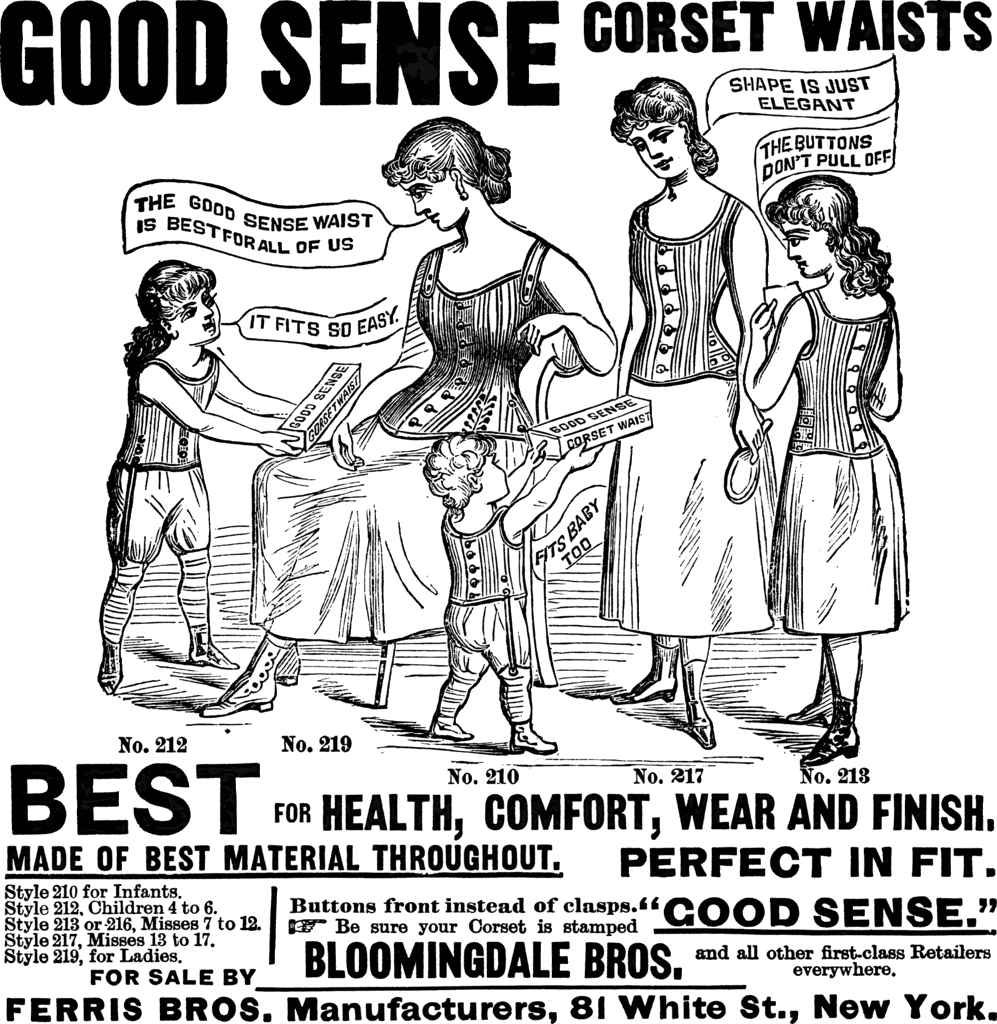
Historical underwear is usually fetishised. The garments themselves, in museums, as historical artefacts. Period advertisements for those garments, as consumer artefacts. Caricatures fetishise the wearing of the underwear as a ridiculous sign of vanity. Then, of course, historical erotica fetishises underwear sexually – that is, the form of fetishisation with which we're most familiar.

But when we fetishise historical underwear – that is, focus obsessively on it as an object and imbue it with an almost magical meaning – we lose perspective on what it was like to wear these garments on an everyday basis. It's very difficult to view images of the past without bringing our own fetishes to them (Indeed, our ideas of how to wear and comport ourselves in old-fashioned underwear often come from our own narratives set in the past and vintage fetish imagery), or misreading historical fetishes as objective truths about the past. We should aim to tread a middle path.

When we think of 'sexy underwear', for instance, it seems commonsensical to wear a garter belt over underpants, as Dita von Teese does here:


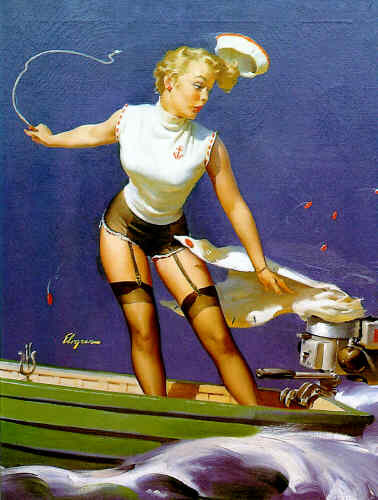
But in pinup illustrations and vintage 'naughty postcards', we often see the undies worn over the garter belt so the suspenders emerge from beneath, as in this 1969 Gil Elvgren illustration:


And this one, from 1954. Elvgren's girls always have such hilarious wardrobe malfunctions involving their skirts getting ripped off, stuck in machinery, or snagged on fences and nearby trees…

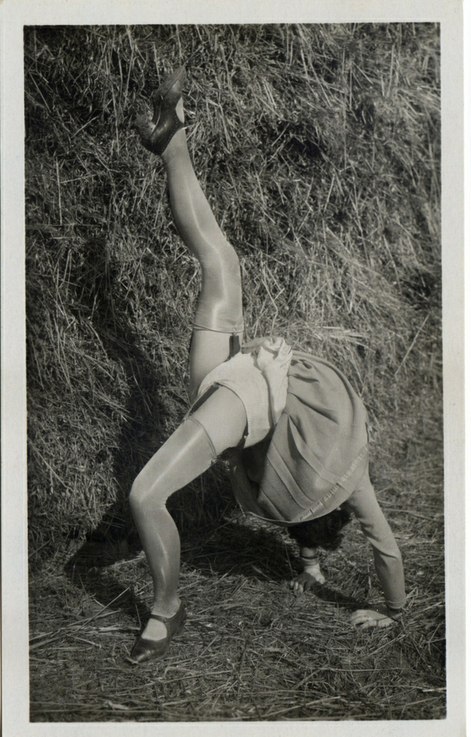
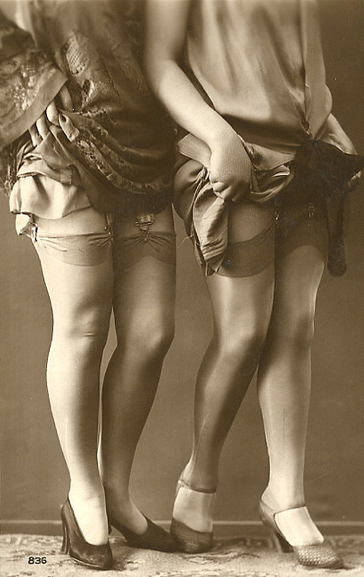
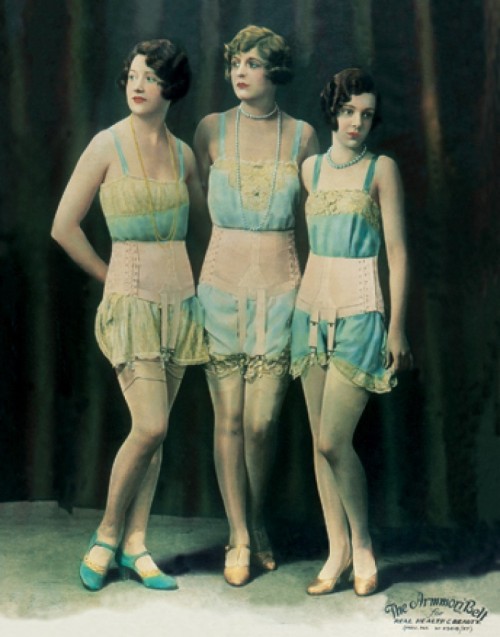
From the shoes, the images below seem to be from the 1920s or 1930s. Stockings from this era are also, apparently, quite recognisable for the sheen they give the legs; this is when semi-synthetic 'artificial silk' appeared; it was renamed Rayon in 1927. Nylon didn't come in until 1940.


Here, we see a corset modelled over the top of the chemise or camiknickers, with attached suspenders. Also, notice how the purpose of the corset is not to cinch the waist but to slim and smooth the abdomen and hips. Speaking of corsets, these days they tend to be worn as an alluring undermost garment:


…but back in the day, when corsets were everyday items, you wouldn't do that because you would sweat into your expensive corset or get chafing, even abrasions. A chemise was always worn underneath, as in this image from the 1900s.


Note how the suspenders attached to the corset bunch up the chemise.


Blogger and US Civil War re-enactor Scott B Lesch noticed that his female colleagues were wearing their drawers under their shifts, as we might wear underpants under a slip. But he unearthed quite a few archival references to the earlier practice of tucking one's shift into one's drawers (which had no crotch seam; they were only attached to the waistband, so ladies could relieve themselves without getting undressed).

If you weren't careful, or the chemise was too long, it poked out the back and your little brother laughed at you:


At this time, stockings were held up with leg garters rather than suspenders, which were hidden under the chemise and drawers.


The trouble with using naughty postcards as source material is that they probably do depict sexually fetishistic practices from the time they were photographed. Take this image, for instance:


Whether or not it has been airbrushed, it almost certainly depicts a participant in a tight-lacing fetish culture. We're tempted to claim that everyone in "the Victorian era" tight-laced – mainly because of the moral panic media coverage about it at the time – but it was only a niche practice. We marvel at the tiny waist dimensions of corsets in museums, but of course they were seldom worn completely closed. Besides, women's bodies were trained to wear corsets from a very early age.


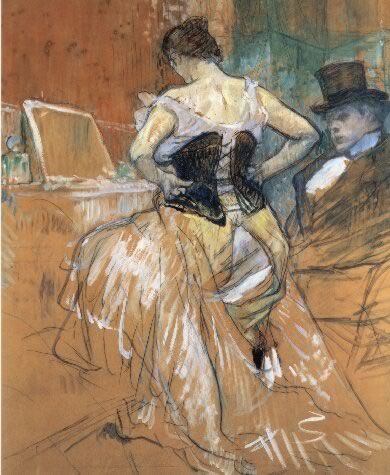
Meanwhile, advertisements for underwear speak so conspicuously of comfort and fit that we should be skeptical that they really depict the lived experience of wearing the underwear. A slightly different picture emerges when we look at the 'toilette' genre of art, which was basically an excuse for painters to depict women in attractive states of déshabillé.

While some of these paintings depict the fashion that began in pre-revolutionary France to invite people over to hang out and gossip with you while you got dressed, others depict women in a dreamy, vulnerable state somewhere between nudity and social visibility.


Woman at Her Toilette, Edgar Degas, 1876-77


Femme à la Toilette, Henri de Toulouse-Lautrec, 1896.


La Toilette, Georges Croegaert, 1891

They also offer information about how and in which order garments were donned. In Pietro Longhi's Lady at the Toilette (1736), we see the decorative petticoat, neckline and sleeves that will end up peeping from the pink outer dress her maid is holding out.


But if we are to believe Nicolas-René Jollain's La Toilette, the hat always went on first.

Monday, March 05, 2012

Take it easy

In garment construction, 'ease' (or easement) is the difference between garment measurements and body measurements. It determines how tightly the garment fits, and as the name implies, how easy it is to move in the garment.

There are two kinds of ease – 'wearing ease', which is the amount of ease you need to be comfortable in your clothes; and 'design ease', which is the creation of looseness as an aesthetic choice. According to this chart, wearing ease is generally 6.4 cm (2 1/2") in the bust, 2.5 cm (1") in the waist and 7.6 cm (3") in the hip.

Ease could also be part of various clothing brands' marketing strategies – for instance, sportswear and casual wear might allow more ease than a brand marketed as fashion-forward, whose customers will accept a certain restriction of movement as the trade-off for achieving a very fitted look. I still need to do more research to discover whether different manufacturers have different ideas of wearing ease.

I'll also need to figure out if ease is factored into online size charts, because online shoppers are entitled to expect that if they measure their bodies to decide which size to buy, they should get a good fit.

Online vintage dealer Maggie Wilds consulted her colleagues at the Vintage Fashion Guild on how much ease to allow when purchasing clothes. Nicole Jenkins of Circa Vintage Clothing recommended an ease of between one and two inches at the waist, with less for smaller sizes and more for larger. Anne Marie Cook of Vintage Baubles recommends that since most movements – walking, sitting, bending – are through the hips, ease is more important there.

Ease, like other size and fit issues, changes over time; for instance, a 1947 Simplicity sewing guide suggests, "About 4 inches larger than bust measurement is usual allowance." My chapter discussing shifts in ideal silhouettes over time will have to address this.


Ease is also a factor in vintage clothes, because these fabrics often don't behave in the same ways we expect of contemporary fabrics. Christina Hendricks' costumes on Mad Men have very little ease – look at how this dress pulls when she lifts her arm. They're also very tailored – look at all the vertical darts on the back of this dress – and made from woven, rather than knitted, fabric – although Joan does wear sweaters, and in season four of the show she begins to wear more jersey and other knitted fabrics.

The vintage dealers consulted by Wilds suggest that fabric is a key factor in ease. Amber of The Vintage Vortex said: “I think if I were wearing a much older item than 1950s I would want more ease for myself as thread and fabric deterioration would be a factor … I think that the age of the garment should also play a part in determining ease.” Meanwhile, Jody of Couture Allure Vintage Fashion added that it's easy to stress the seams of taffetas, satins, and loosely woven fabrics and pull the fabric along vertical seams.

I was thinking about Joan because on Friday night I went to the launch of Australian Modern magazine and decided to wear a dress I altered back in 2010 to wear to a Mad Men costume party. The dress is in a crepe fabric; I bought it from Savers in a very large size, and basically put it on inside-out, pinned it until it was tight enough to recall Joan's costumes, then took it in along the line of pins.

When doing this I allowed more ease through the waist and hips, because I'm self-conscious about this part of my body and wanted the dress to flatter me. But I made it very tight around the bust and turned the skirt from a straight shift to a tapered pencil silhouette.

The consequences of this are that I find it very difficult to walk quickly in the dress, and I have to turn sideways to walk up stairs. Wiggling my hips as I walk really does help me move better. Also, I can't wear it for an entire day or evening, because it quickly becomes uncomfortably tight across my ribs.

Hendricks told UK Glamour magazine that the costumes influence Joan's distinctive wiggly walk: "I think I was just trying to get across the room in that tight dress."

Now I know what she means! But another provocative thought regarding ease is that perhaps we, the contemporary wearers of 'old-fashioned' styles of clothing, have very little idea how to be comfortable in these clothes. We interpret the tightness, the physical discomfort, as markers of authenticity, because we have a teleological idea of history in which things always get better with time. For instance, we think of 19th-century corsets as cruel and oppressive, but what if the historical wearer of a properly fitted corset interpreted that garment's tightness as safe, civilised, 'put-together'?

Thursday, May 06, 2010

Sitting this one out


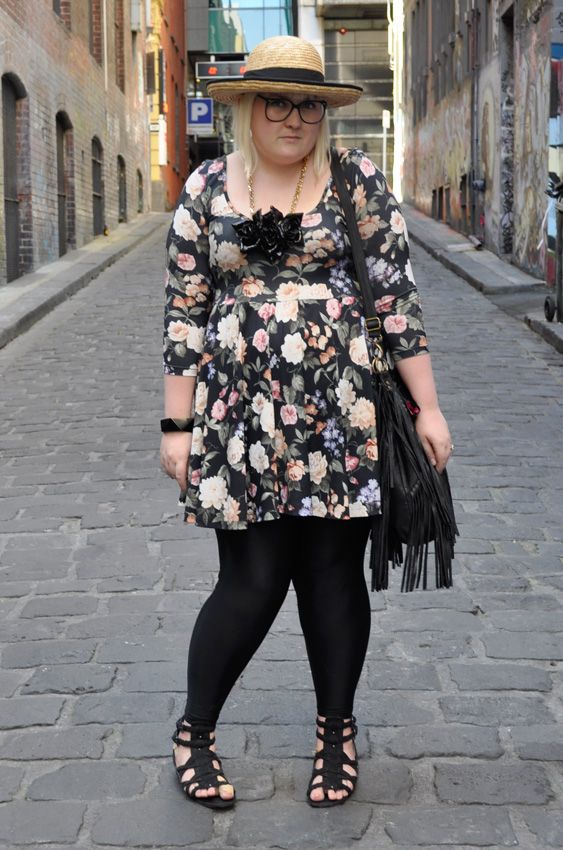
This is a "babydoll" dress currently being sold at one of my favourite places to shop, Big Dubs. Here is Fashion Hayley wearing the same dress (I'm sorry for reproducing a dodgy photo of you, Hayley!):


Here's another pic of Hayley wearing a very similar dress (that Big Dubs probably copied), which is a Topshop design for Incu.


When I saw the dress in Big Dubs I was quite excited because I love floral dresses (and paying as little as possible for my clothes). However, when I tried it on, it looked really terrible on me. As far as the waistline it fitted me well, but I was unhappy with the spot at which the waistline hovered: lower than the empire-line spot under the bust, yet higher than the true waist.

I also didn't like the shortness of the full skirt. I felt it made my body proportions look weird. Personally – and this is just my own taste – the only sort of short skirt I would wear is a straight or stretchy one. I like a full skirt to hit my knees; I think it looks better proportioned that way. I'm not a child, I don't find childlike whimsy appealing, and I don't want to dress in a doll-like or childlike way. A full short skirt just reminds me of retro-styled childrenswear, like something Sally Draper would wear in Mad Men:


When I saw Patty Huntington's pics from this year's Jayson Brunsdon show at Rosemount Australian Fashion Week, I was appalled at how short he has cut his full skirts. I don't even think they look good on the models with their coltish legs.


(Image: Patty Huntington)

But anyway. I know that Hayley does favour short skirts, and I'm not having a go at her sense of style. But it infuriates me that it's almost impossible to find a knee-length skirt in the shops at the moment; they're either these short babydoll styles or long maxidresses.

I also found it very difficult to warm to The Uniform Project because of how short the chosen dress was. It's definitely not a style that would look good on many people, although I can appreciate that it adds more versatility to the project because it can be worn as a long-line top as well as a dress.

(This is only tangentially related, but I'm fascinated by trends in the lengths of girls' school uniforms. When I was at school they tried their hardest to stamp out short skirts; the rule was that it had to touch the ground if you knelt. But now I see girls wearing ludicrously short skirts. Oddly, I also see the opposite, especially with winter uniforms: the skirts will be so long they're almost ankle-length.)

I'm using this dress as an example of the practice of "sitting this one out". This is a high-level stylistic knowledge pertaining to your own relationship with fashion cycles. You not only recognise that certain styles are 'fashionable' but also which styles suit you, and you make a tactical decision not to buy, to wait until fashion returns to the things that look good on you.

Right now I'm wearing a black babydoll dress with a cream-coloured 'doily' lace decoration across the bust. I bought it from Valleygirl perhaps three or four years ago now and have got a lot of wear out of it since, making a mockery of their 'fast fashion' ethos. I like it because it's elasticised directly under the bust and is gathered, so it glides flatteringly over my midsection. It falls to just on my knee.

Over the top I'm wearing a slouchy red cardigan from Jay Jays. I remember when I bought it at the start of last year, I just really wanted a red cardigan and settled for this one. I'd wanted a preppy, tailored style and was annoyed that it was long and loosely fitted, which happened to be the style at the time. So, I didn't sit that one out; instead I compromised. But now I'm enjoying wearing the cardigan, because this winter I've really got back into the grunge silhouette I used to favour in high school: leggings and short, tight skirts with oversized, slouchy T-shirts, flannel shirts and cardigans.

Saturday, October 06, 2007

On ethics

I've been sitting on this post for a while; I began it in July, when I got an interesting email from Rebecca, who writes:
I was recently perusing your very witty blog, "footpath zeitgeist". I've always loved your writing and your critique is excellent, from a cultural perspective, but I had a niggling feeling of discomfort as I read your descriptions of fashion trends and merchandising techniques. I got the impression that you accept that consumption, on the whole, is a good thing. Is this right? - please feel free to correct me if I'm wrong. :)

I see shopping and fashion as being about much more than self-expression. It is a process of moral decision making. Everything we buy has an effect on other people and on our natural resources. The fashion industry is notoriously bad at recognising this and promotes, I think, a very selfish mindset. Think about how clothing is made - mostly it is produced in appalling factories in developing countries or by (mostly migrant) outworkers here who can get paid only $2 an hour and work up to 18 hours a day, seven days a week. By buying this stuff, we are giving tacit approval to the perpetuation of these practices. There is also the environmental cost of subscribing to an essentially trend-based ideology that constantly requires the acquisition of new pieces. The energy and materials needed to make and transport the amount of clothing and accessories we currently consume is totally unsustainable.

Should we be considering these things as we window shop our way down Swanston St?
Yes, we probably should. But mostly we don't. I should say off the bat that this blog does not celebrate consumption in itself, and Rebecca is quite right that we need to consider its wasteful and exploitative aspects. My interest is in the ways in which people choose their clothes, and the ways that clothes make us feel. Sometimes people shop thoughtlessly, selfishly and with an eye to convenience, 'bargain-hunting', 'luxury' and distinction; and I tend to find these interesting in themselves (as opposed, I stress, to condoning the system that gives rise to them).

I also tend to emphasise the playful possibilities of dress, whereas Rebecca is saying that this play is a privilege that comes at the cost of the economically disadvantaged and the environment. Again, that's true. But her email did remind me of the idea of 'fashion levels' - the idea that some people buy their clothes purely for utilitarianism whereas others negotiate the fashion industry's cycles of novelty and obsolescence. You could add that the ability to shop ethically (choosing organic materials, non-sweatshop products, etc) is a very high-level fashion practice in that it requires knowledge and judgement.

There has been more and more mainstream media coverage lately about issues of ethics in fashion, which is giving consumers this kind of knowledge. Sue Thomas's opinion piece lays out most of the main things that consumers should consider, and there was a recent Sunday lifestyle story (which I can't seem to find online) directly comparing the environmental footprint of various fabrics (taking into account the water and energy needed to grow and/or process them into fabrics, the energy to transport them to factories and retail outlets, their durability (hence how often they'd need to be replaced) and the energy, water and detergents needed to launder them. I remember taking from this article that organic cotton used extravagant amounts of water and that polyester was surprisingly environmentally friendly because of its durability and the fact that old garments can be broken down and recycled into new synthetic fabric.

But the thing that strikes me is that all this still takes place inside the same consumer logic. For many people, ethical choices confer a positive range of affective states, but I'd argue that ethics is a still relatively small consideration when shopping for clothes. Even second-hand clothing exchange systems, as advocated by Sue Thomas, are shaped by similar decision-making processes to first-hand systems. Introducing their 2003 British study, Secondhand Cultures, Nicky Gregson and Louise Crewe write:
When we set up the research, we expected to encounter a lot of [ethical and environmental] talk (and practice), especially among certain facets of the 'critical' middle classes, and we anticipated that 'second hand' goods and their consumers might be seen, and see themselves, as part of an alternative, critical consumer culture. What we actually found though was very different. ... Instead, consumption through the second-hand market turns out to be shaped by many of the very same motivations that shape consumer culture more generally. We see here then how thrift - saving money by working at consumption - is a prime imperative. About capturing relative value through the 'bargain', this works in much the same way as in first hand exchange ... 'Distinction' too figures. Indeed, what is being sought through 'second-hand' frequently bears a marked similarity to the practices that shape designer purchasing and consumption in the first cycle: difference, taste and individuality. (11)
The second point about distinction seems particularly pertinent to hipsters, who tend to use secondhand shopping as an exercise of two kinds of distinction: a demonstration of their bricolage skills (a way of being 'in fashion' without having to resort to visiting high street stores that only offer mass-produced interpretations of current trends) and a method of minimising the number of other people who will own that item, thus ensuring singularity.

In The Rebel Sell, Joseph Heath and Andrew Potter offer the provocative contention that the counter-culture that sets itself up as a more conscious 'alternative' to consumer culture in fact is not revolutionary and poses no threat whatsoever to the capitalist system; instead it feeds that system:
...fair trade and 'ethical marketing' are hardly revolutionary ideas, and they certainly represent no threat to the capitalist system. If consumers are willing to pay more for shoes made by happy workers - or for eggs laid by happy chickens - then there is money to be made in bringing these goods to market. (4)
So 'ethical' consumerism is still an exercise of cultural capital; in this instance it demonstrates the consumer's 'thoughtfulness' or 'consciousness'. That's interesting, I guess, but it's still only one iteration of dress among many, and it's certainly not enough to make me abandon my posts on mainstream shopping and trends.

Sunday, April 15, 2007

Window teaching


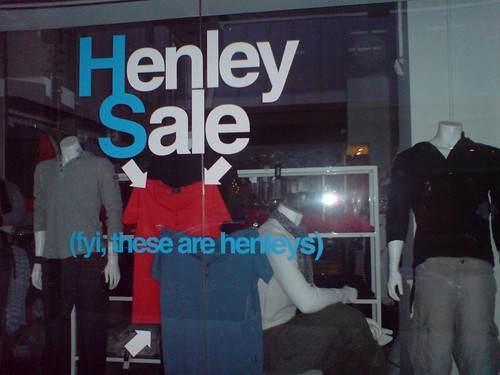
Back at the start of March, I was walking past the Industrie store on Little Collins Street and I noticed this striking window display. What struck me about it in particular was that it's not only performing a promotional role; it's also performing a pedagogical one. If you didn't know what a Henley shirt (sometimes called a Henley sweater) was, the Industrie shop window is prepared to teach you.

I myself am one of the educated, because I'd never heard the term "Henley" before I saw this display. I'm old enough to remember the last time they were popular, in the late 80s and early 90s, when they were called "grandpa shirts" because they looked like old-fashioned men's underwear. Back then they were part of the underwear-as-outerwear grunge ethos. I used to wear them with a contrasting coloured t-shirt underneath, then I'd roll up the sleeves to reveal the under-layer.

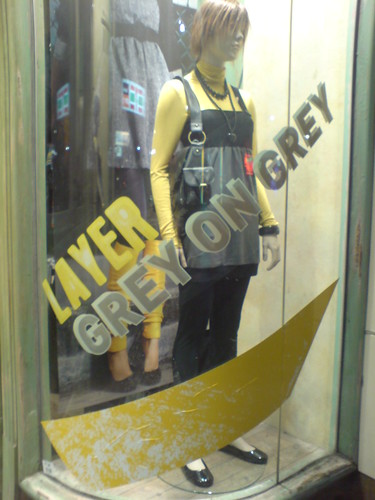
But I digress. Last week I noticed that Dotti on Swanston Street is also doing this shop-window pedagogy.


While it's another total digression, perhaps this is a good opportunity to mention that, while I'm pleased to have predicted the current resurgence of 60s mod fashion back in 2005, it gives me fresh insight into why my plump aunt is scowling and looking uncomfortable in most of the family photos taken in the 60s. Just like the first time round, it's disappointingly unflattering on all but the most Twiggy-like figures. Sack-like dresses and tops that hang from a yoke just above the bust (looks fine on flat-chested women, whereas bosomy lasses look pregnant). Prim high necklines and the return of skivvies under pinafores (like I used to wear in primary school!). Low-cut slouch boots that sit right on (or even just below!) the ankle and look ludicrously stumpy on anyone without long willowy legs. Dull drab greys and mustards and burgundies and olives. Not jaunty at all.

But anyway. The thing that intrigues me about the Dotti display is that it's teaching customers how to wear the clothes. Shopping is in fact an assemblage of teachings; shop-window visual merchandising is only the first and most striking, intended to pull you into the store. Once you're in there they continue to teach you how to wear the clothes by directing you through carefully arranged space, and getting you to interact with the shop assistants, who model and personify the brand (Supre and Alannah Hill are two particularly coherent examples of this) and, more obviously, who give you advice on how to fit and combine the clothes.

Many stores also produce literature ("magalogues" and websites) to extend their pedagogies beyond the physical retail space. These are another issue for me, because what I find interesting is the way the experience of the retail space is meant to educate. The point of this post is what's at stake for the brands in performing this role.

Most obviously, they are attempting to mould brand loyalty - to teach shoppers how to interpret fashion trends through the lens of the brand's particular ethos. Rather than tailoring their offerings to a pre-existing 'market' (eg tweens, edgy corporate wear), I think many brands try to create their market by teaching young, inexperienced clothes shoppers particular tastes and techniques that will thereafter shape their consumer practices.

But of course, that's not the entire story. We're all subject to many competing influences on our fashion consumption - popular culture (music, film, TV, etc); fashion magazines and blogs (some of which are explicitly pedagogical, eg "How to wear the new pencil skirt"); what we see other people wearing, and pleasurable feelings we get from particular garments (the swishiness of a full skirt; the fluffiness of a cashmere scarf; the clippiness and shininess of new shoes).

Perhaps what these displays are trying to bestow is a rubbed-off positive affect from having bestowed the gift of cultural capital. Sure, I might not have known what a Henley was, but now I do, and it was Industrie that taught me. Thanks, Industrie - now I will buy your garments. My phrasing is facetious, but let's not forget Miriam Silvester's idea of fashion levels - many people want to appear fashionable but don't actively follow trends. So there's money to be made by teaching them about the trends in such a way that they associate the teacher (the brand) with the pleasure of feeling newly fashionable - even if they don't actually buy the clothes.

Monday, November 20, 2006

Watch and learn


This is a ring I bought from Sportsgirl in early October for $4. That's about what it's worth, frankly. My apologies that the photo is a touch blurry - I took it with my left hand.

I bought this ring because while I was in Newcastle for This Is Not Art, I saw a panellist wearing a similar ring and I thought it looked cool. It's this confluence of observation, evaluation and desire that I want to unravel here, because it seems like one of the key processes by which 'street' trends spread. I'm emphasising the 'street' for several reasons:

  • Because cultural studies has traditionally represented 'the street' as a physical site for the display of subcultural political authenticity; an authenticity that is inevitably diluted by ideological incorporation of these subcultures by mainstream media
  • Because the 'bubble-up' fashion system refers to 'the street' as a stylistic site of unorthodox ideas or acts of bricolage to be resold to mainstream markets (with so-called 'cool hunters' and 'street teams' as the frontline troops)
  • Because an entire market of 'streetwear' (documented by an entire accompanying media genre) follows traditional product design, distribution and marketing methods, yet trades on a generalised (ie, not invoking specific subcultural motifs, or encompassing a diversity of motifs) idea of 'streetness'
In a paper I'm researching right now, I plan to outline the ways in which the phenomenon I'm calling hipsterism intersects with and evades these three paradigms.

Thursday, October 26, 2006

Perhaps the best hipsterism resource ever!

Jeremy just sent me this - it's a self-described preppie guy wanting suggestions for putting together a Halloween costume as a "hipster".

I want to return to this (and also, just to bookmark it with this post), but my initial thoughts are that this is a really rich resource for articulating the discursive figure of the 'hipster'; that is, the imaginary person who comes to mind when you think of hipsters, regardless of the tastes and activities of real people.

Second, it's notable as a survey of the style motifs that are most commonly associated with hipsterism. Many of these things (for example, the idea that a hipster's clothes must be much tighter than a preppie's) might seem simple and self-explanatory, but the fact that they're offered here in a pedagogical context highlights that they actually require cultural capital to make them that way.

Third, it reveals the hazy space between trends and stereotypes. When, for example, does wearing a bandanna around your neck stop being 'in fashion' (something that signifies only 'in-the-momentness') and start saying wider things about the person wearing it, for example that they are the sort of person who pays close attention to fleeting and arbitrary fashions? To put it more bluntly, when do style motifs begin to do their discursive work to create the figure of the 'hipster'? Are they always-already signs of hipsterdom, or do they become that way through the passage of time, or the processes of irony?

Thursday, October 27, 2005

Industrious


Some time ago, I wrote about Industrie, the menswear chain that has a similar logic to Sportsgirl (in the women's mass fashion retail market) as a signifier of 'fashionability'. That is, the clothes appeal to young men who don't really know what's in fashion, but want to look as though they do.

But it's not just about 'fashion', but 'style', which I have previously defined as "a more permanent and idiosyncratic dress sense that works aesthetically in a variety of contexts and fashion cycles". Sportsgirl's elaborate boho clothes are designed to generate individual 'looks' through multi-layering and mismatching mass-produced garments and accessories. Likewise, Industrie makes stylistic gestures towards 'individuality' - deconstructed shapes, torn edges, prints and embroidery that are designed to make the garments look customised, even though they are mass-produced.


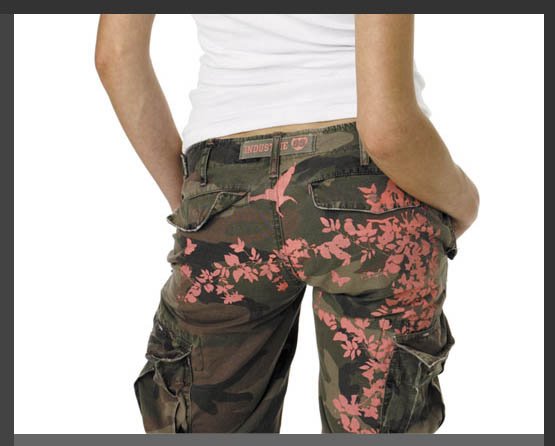
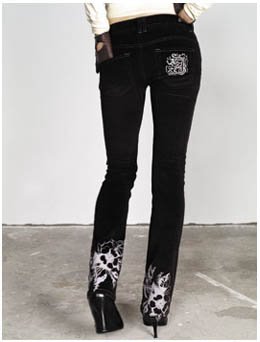
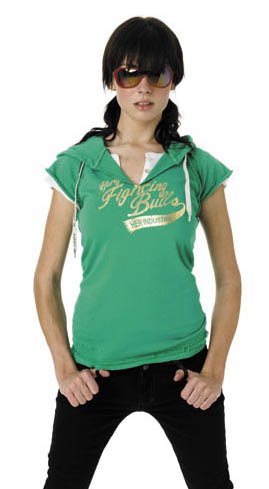
The company has diversified into womenswear with a line called Her Industrie, which has been out for about a year now. As you can see from these images, Her Industrie carries the same streetwear-influenced logic of 'individuality' as the men's line. Look at the stencils on the cargo pants, and the stencilled version of the black stovepipes that, by now, are everywhere in high street fashion stores. There are also layered t-shirts and singlet tops, and raw-edged, printed hoodies.


(As an aside, it's worthwhile mentioning that these hoodies are called "Harajuku". Since Gwen Stefani introduced this word into mainstream parlance, it's become completely disassociated from the specific geographic, aesthetic and cultural context of the Harajuku district in Tokyo, and now seems to mean something closer to "crazy-hip".)

Industrie seems very unstylish indeed to people who have a strongly defined personal aesthetic. And it seems very uncool to people who thrive on the affect of exclusivity that comes with being a style innovator or early adopter. As Will pointed out in the comments to my 'deconstructed hoodie' post: "Industrie is the kind of stuff where, if you wore it to an extended family barbeque, your family might think you were hip." And the hipster kids over at ThreeThousand are "so over" this style they wish to be woken when its moment is over.

For me, the most fascinating thing about brands like Her Industrie is that they relate only tenuously to the standard 'bubble-up' and 'trickle-down' models of fashion adoption. There was a really stupid and unsophisticated article recently in the Sydney Morning Herald which espoused the 'bubble-up' model:
Sportsgirl and the like may have finally discovered the skirts of India swirling around the ankles of nerdy girls in high schools across the land. Market research is all about youth, hunting for the next big thing. Business pays market research companies big bucks to observe young people and predict which of their angst-ridden outpourings will inspire the next Witchcraft [does the writer mean Witchery?] spin-off or be-labelled beanie.
Using this (unhelpfully crude) logic, whatever styles these trendspotters see subculturally affiliated kids (or, in this example, any kids at all!) will show up, blanded out and priced up for the masses, in chain stores. But this model breaks down when the subcultures and the hipsters don't even like the style to begin with.

So, why develop fashion lines like Her Industrie? Not because they are innovative, and not because they're associated with subcultures, but because they're just versatile and customisable enough to reassure most shoppers that by purchasing and wearing these garments, they're exercising their individuality and staying 'in fashion'.

As mainstream New Zealand women's lifestyle portal NZGirl opines:
The best way to inject a taste of ‘army girl’ into your wardrobe is with a pair of army print pants or shorts. Available from most chain stores, these will be a summer staple which will be worn year after year. We love the pictured Rose Bud combats from her industrie. These funky combat pants mix the masculine army print with girly accents by using print detail and feminine ties. Wear them longer on a cooler day or hitched up over your bikini at the beach – sweet and casual.
I did a bit of Googling to work out who's talking about Her Industrie, and the answer seems to be semi-articulate teenage girls:
went to myer, and omgsh i want these 'her industrie' pants.. but they 100$ and i didnt like the printing on the ass part of it.. hahaa so i derno if i'll get them or not.. may just look arnd first at city or something..
Here's another one:
my mother wont let me buy my Her Industrie three quarter pants thing.. she sed its army and its baggy. i guess it makes me look tom boyish x, x MY MOTHER!
This is a case for real market research - interviewing people to ask them what they like and dislike about the clothes. But from what's written on blogs and forums, it seems that people think about how the pants fit (are they in my size? are they comfortable?), how much they cost (young shoppers rely on allowances, part-time income, and parental permission), and where they can wear them (good for the beach, for going out, etc).

Intriguingly, there seems to be a backlash against the 'sameness' of Industrie clothing, particularly the prominent screen-printed branding. People posting to this bulletin board laugh at men (and women) who wear exclusively Industrie. Rather than making them seem fashionable, it makes them seem like dull-witted fashion followers. Still, I do think this is an exception. It might pain me, and it might pain the ThreeThousand kids, but stencilled army pants probably are going to come back in this summer.

Wednesday, August 17, 2005

Starter kits for hipsters

Awww, how cute! Supre is selling the yoof of today everything they need to dress like a real hipster! I was in there today and they were bigging up black stovepipe jeans...


And only $60 - all the more to spend at Ding Dong! They had them displayed on a rack with stripey t-shirts in different colours - pink, blue, yellow... Now all they require is a blazer with a few button badges on the lapel, some scuffed-up Chuck Taylors, a chunky studded belt and some black eyeliner. And voila! instant hipster.

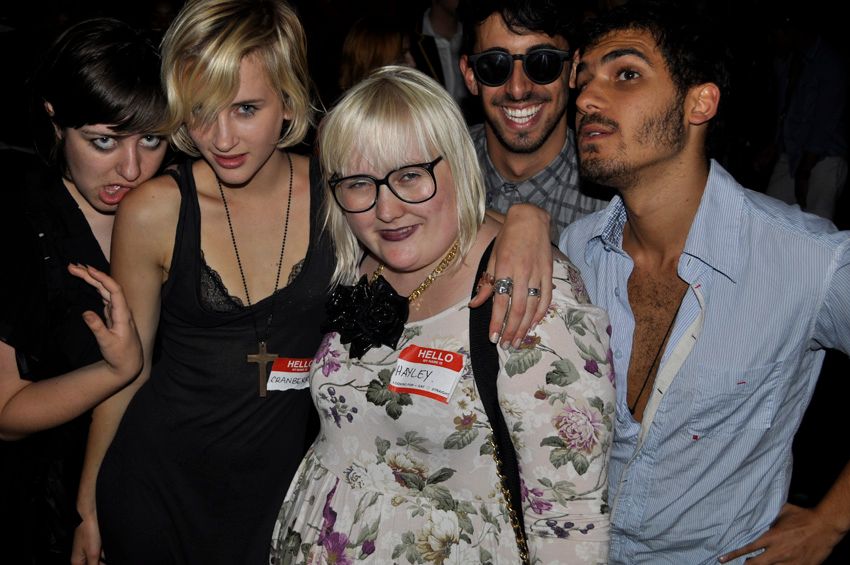
Sometimes I think I am too critical of hipsters. After all, in Melbourne there is not much difference between hipster style and mainstream fashion. The picture below was taken at the second birthday party of Australian Vice magazine. I was there earlier in the evening and couldn't move for all the posing. My friends who worked the bar said it got much worse. People were spewing and passing out and you had to wade through rivers of spilled alcohol. As you can imagine, the wooden floor kinda suffered. Hipsters scaled the outside of the building and broke the lift. The building owners now will not hire the venue out for parties because of the expense involved in restoring it to normality.


I quite like her little bow. Very Jaunty Pussy. Please also note the vintage Nike sneakers worn with the regulation black stovepipes and blazer, ugly op-shop 80s footwear such as grey pumps and red Rumpelstiltskin boots, and that chick with the blonde bowl haircut who I've seen before at these kind of events. I like to subject hipsters to Mel's patented "Would this person look odd walking down the street?" test, and Melburnian hipsters generally pass.

By contrast, here are a couple of examples of how they play things in the States (pictures via the always-hilarious Tale of Two Cities):


Thursday, February 10, 2005

Welcome to the zeitgeist!

Melbourne is a style city, and you don't always know the zeitgeist is coming until it brushes past you on the street. It's belittled by comparison. Melbourne isn't Harajuku. Melbourne isn't the Lower East Side. Melbourne isn't Soho. Melbourne isn't South Central. Melbourne isn't the Marais. Most of all, Melbourne is not Sydney.

I shop. I socialise. I observe. I ponder. I notice global trends in clothing, nightlife and music, and analyse how they play out on the streets of Melbourne. Footpath Zeitgeist will be a mixture of photos and sketches, chain-store odysseys and boutique missions, academic essays and cafe small-talk. It's a blog dedicated to the research and enjoyment of street style.

But I don't want to fetishise street style for its kooky originality, bitch about ugly clothing, gush about the latest designers, or celebrate hipster irony. Nor do I want to treat the street as a resource for marketers to plunder. Instead, I want to write intelligently about how style moulds identity, how clothing shapes the body and the emotions, and how all this reflects the city around me.