Showing posts with label retail review. Show all posts

Monday, July 29, 2013

More heartache in the underwear department


I had some free time before my first MIFF film on Friday, so I went to Target where they are currently having an underwear sale. I urgently need to buy a plain, everyday pale-coloured bra – white, cream or pale pink – because mine are so old their elasticity is almost gone and they are that sad grey colour. I came away empty-handed, of course.

You can see from this instore display that Target is buying into that oft-cited statistic about the percentage of women who wear ill-fitting bras. I tracked down the journal article they cite; I can't read it without an institutional subscription (paywalled academic publishing is a GODDAMNED RACKET) but it charmingly says in the abstract: "women were found to have a poor ability to independently choose a well-fitted bra, which was not improved by trying on several bras or using bra-sizing measurements."

Women's ignorance is the key message conveyed by this "wrong bra size" statistic when it's cited in the popular media. We are portrayed as idiots who blithely squish or flop our boobs into ill-fitting bras, and who need the assistance of 'expert' bra fitters and extensive how-to literature.

Here is Target's 'checklist' for well-fitting bras:
1 The band sits horizontally around the body.
2 The centre front panel sits flat against the chest.
3 The cups are smooth and wrinkle-free.
4 The breasts are fully contained within the cups – no bulging or spilling out of the top or sides.
5 The underwires surround the breasts without digging into the breast.
6 The straps are secure but not tight – the main support comes from the body of the bra, not the straps.
Women are not idiots. We know all this stuff. We know it because we are constantly reading a bazillion media articles telling us we're doing it wrong.

Here's an alternative view: what if women just want to come home with a new bra? Like other heartache-causing garments including swimsuits and jeans, bras are something women go on missions to buy, knowing it will be no fun but suffering through it because they need the garment and don't want to go home empty-handed.

What if women get so fed up with the poor selection available that they pick the best of a bad lot and learn to live with it?

I really want to hammer home that so many of the problems we face with clothing size and fit are retail issues. For instance, negative experiences with customer service (and my survey unearthed some heartbreaking stories) deter us from seeking 'help with sizes', and poor stock replenishment means we can never access a complete size range in the one store.

So many times I'm forced to settle for a bra I don't really like because they don't have a suitable size in the one I do like. On Saturday I went to Big Dubs, where I tried on various styles of bra in four different sizes. The store didn't have my preferred size in any of the styles I liked, and none of the ugly bras I tried on fitted me either.

I turned myself over to the 'expert' advice in Target's 'bra book', and measured myself according to the instructions. The size chart tells me I should be wearing a size 22B. That is interesting, since Target does not make such a size and nor does anyone else. I am not the only one to call bullshit on Target's bra sizing.

Target recommends solving fit problems by trying larger or smaller cup or band sizes, or trying on a style of bra you wouldn't have picked yourself because it's frickin' ugly. For instance, if underwires are jabbing you, they recommend "a minimiser style as they are designed for a wider breast shape." Too bad if you don't have big boobs that you want to minimise, or if you like to wear low-cut tops.

Target also advocates 'swing sizes' – rather than a 12C, try a 14B or a 10D. Good luck trying to find those in the store in the style and colour you want. But swing sizing only works if you stay within the conventional 10A-16D. If a 16C doesn't fit, you can't try an 18B because there is no such size.

Indeed, it is very hard to find bras with small cup sizes in relation to the back size. I'd be interested to see the percentage of women who have this body shape because I imagine it's quite low – too low for brands to be bothered trying to market to it.

There is, however, a market for fashionable lingerie for small-bodied women who have comparatively large breasts for their size. Culture is beginning to normalise (rather than fetishise) this body shape, although large-breasted women get slut-shamed and female politicians including Julia Gillard and Angela Merkel have been criticised for showing cleavage.

Yet there isn't a complementary bra market for large-bodied women who have comparatively small breasts for their size. They get the obesity stigma of plus-size, yet they lack the bountiful 'curves' that plus-size women often use to combat obesity stigma by associating themselves with retro-styled pinup glamour.

Judging from Target's plus-size range, fat chicks must clamour for either nanna-beige minimisers or 'sexy' bras in bold prints and bright colours, doused in cheap-looking machine lace. Target did not stock any plain, pale-coloured bras in sizes outside 10A-16D. They were black, red, purple and leopard-print vampish styles with lots of lace and satin.

My search for a plain, pale-coloured bra that doesn't make me look like a trussed ham continues.

Monday, August 06, 2012

Trying on clothes in shops

I'm starting to write my chapters about clothing size. If fit is the way the clothes are contoured to the human body, size is the set of industrial techniques for mass-producing and mass-marketing clothes. It offers a fascinating history of problem-solving as retailers invent new ways to sell clothes, and changing populations present themselves as new market segments needing to be wooed with new sizes.

But right now, I'm interested in how this system exerts itself on the feelings of the individual shopper. How does it feel to enter a shop, be confronted by displays of clothes, and have to figure out which ones will fit?

More importantly, how does it feel when trying on clothes goes badly? We often imagine that we're the only people who go home empty-handed, feeling like ugly freaks. We imagine that everyone else just waltzes into a shop and picks something off the rack if they like the look of it.

But shopping for clothes is, by definition, a battle. The vulnerable human body, so intriguing in its individual variation, is assaulted from two sides: by the weighty cultural meanings we attach to clothes; and by the implacable heft of the industries trying to sell them to us. This happens to everyone – old, young, thin, fat, men, women.

I plan to share some of my strategies and war stories in my book, but I'm keen to hear yours too. So I've done another one of my trademark surveys about trying on clothes in shops. If you leave your name with the survey, you'll be quoted here on the blog, and/or in my finished book.

Click here to do the survey. It'll only take about five minutes.

Saturday, March 10, 2012

The heartache of the underwear department

Jeans, swimsuits and bras are perhaps the three most misery-causing garments to buy. All three are closely fitting and reveal the shape of the body, and all three have posed immense challenges to the garment industry to ensure good fits.

People come in a vast variety of shapes and sizes, none of which is intrinsically better or worse than the others, but some of which are marginalised by the clothing industries and by popular culture, making those who have these 'outlier' bodies feel ugly and rejected. My research is interested in the strategies by which this happens, and also in the embodied feelings of pleasure and shame linked to clothing fit and size.

An excellent place to observe these processes in action is the underwear floor of a department store. Because it's not a specialty lingerie store, it only stocks mainstream brands and sizes, and so it can't possibly fit everyone. It is an exercise in heartache, a machine for making women feel bad about their bodies.

Today I went to Myer Melbourne to buy a black T-shirt bra with plain thin straps. This is often defined as 'everyday' underwear (as opposed to the 'fashion' underwear you don in romantic scenarios when you want to be admired); its main purpose is to provide a smooth, moulded and unadorned silhouette that looks good under tight-fitting tops. My shopping was utilitarian – I was seeking to plug a hole in my repertoire of bras for everyday wear. But I also wanted something a little bit fancy; maybe some lace, ribbon, tucking or satin, or an understated print that combined black with other colours.

A truism of bra fitting is that women's shape changes over their lifetimes, but they cling to the idea that they wear a particular bra. There's a genre of popular media reportage bemoaning women who wear ill-fitting bras, which Time magazine neatly summarises:
If you are a woman, and you are wearing a bra, you are probably wearing the wrong size one. That's what they say. According to "experts," "industry studies" and "surveys," anywhere between 70% 85% of women are treating their breasts badly, either shoving them into too-small cups or allowing them to float freely in a draping sling. The statistic's origins are murky — some cite a Victoria's Secret poll, others something from the Wacoal brand. But it has been quoted back to me by friends, colleagues, interns. It sounds true. "Eighty percent of American woman are wearing the wrong bra" is the "more likely to be killed by a terrorist than get married" statistic of the new millennium.
The current bra sizing system that combines a lettered cup size with a numbered back size was invented in the early 1930s as a marketing technique, similarly to the way corsets had earlier been marketed by defining certain body shapes or customer life cycle stages as problematic and then offering the corset as the solution.

In 1933, advertisements for SH Camp and Company were categorising their bras by their ability to counteract varying degrees of 'sag', with A being the least degree of correction needed and D the greatest. I haven't read anything yet that convinces me this system has any biometric basis whatsoever; the persistence of ad-hoc additions such as "DD", "FF" and "GG", as well the logical alphabetical progressions, certainly suggest bra manufacturers have been making sizes up as they went along.

Similarly, if the use of back measurements numbered by inch did not actually originate in biometrics, its adoption after WWII was a marketing response to a cultural interest in biometrics and ideal body proportions. If women were already measuring themselves against an ideal "36-24-36" hourglass figure, it made sense to size bras in inches as well.

It is ridiculous to believe your bra size defines you, yet so many women have strong emotional and psychological responses to bra sizes. Back sizes larger than 16 carry the same stigma as plus-size clothing, while women feel embarrassingly juvenile or unwomanly in AA and A cup sizes, and the stigma of obesity rubs off on cups larger than D. So do prurient, fetishistic associations; take the exploitation movie sequel Piranha 3DD, or the tabloid focus on the cup size of famous women's breast enlargements. Women feel freakish in large cup sizes.

This blog post from Knickers offers a good summary of bra sizing and fit issues that also offers insights into the general confusion that consumers feel. Many people feel that clothing size and fit ought to be intuitive: you try something on and if it feels comfortable, or if you're pleased with the way it makes your body look, then you call that feeling 'a good fit'.

For instance, when I buy a bra, I want it to make me look good in my clothes. I want the bra to create the illusion of a Barbie doll's smooth, firm body; it should not draw attention to its presence by creating visible rolls or lines in my flesh, or a crinkly texture that's visible on the surface of my top.

Also, because I sometimes wear low-cut or strappy tops and wide necklines, I needed to consider the accidental exposure of the bra. Mary Russo writes in The Female Grotesque that the notion of 'making a spectacle of oneself' carries specifically gendered assumptions:
"For a woman, making a spectacle out of herself had more to do with a kind of inadvertence and loss of boundaries: the possessors of large, aging and dimpled thighs displayed at the public beach, of overly rouged cheeks, of a voice shrill in laughter, or a sliding bra strap – a loose dingy bra strap especially [my emphasis] – were at once caught out by fat and blameworthy."
There is a thriving industry of bras and bra widgets designed specifically to create invisibility under particular kinds of clothes – for instance, strapless bras, super-low-cut plunge bras, 'convertible' designs whose straps can be reconfigured, and those clear plastic straps that fool nobody. Owning these items is a technique of compliant womanhood that acknowledges our culture's requirement of public propriety in women. Alternatively, the visibility of one's bra mimetically conveys a messy psyche or messy morality. Loose bra strap = loose woman! Dingy bra strap = dirty woman!

It has become far more acceptable to reveal one's bra than when Russo was writing in 1994. I could trace this to subcultural bra-wearing that re-coded 'sluttish' (in both its original sense of 'slovenly' and its patriarchal sense as 'sexually active') as 'insouciant' – for instance, in punk and Riot Grrrl music scenes – and the popularity of the burlesque and 'retro' aesthetic that has made it fashionable to glimpse lingerie in necklines or through transparent garments. Talk about mainstream: Dita von Teese has a lingerie line at Target!

But even this contemporary bra-exposure is concerned with propriety – the criteria are simply different. It's acceptable for bra straps to echo the straps of singlet tops, or boldly stripe across shoulders exposed by off-the-shoulder or racer-back cuts, but you don't want a chunky sports bra; you want a thin, plain strap, or a deliberately decorative one. Similarly, if the bridge of your bra is visible in your neckline, it should be a fancy one with ribbons or lace, and one that matches the aesthetic of your outer garment in style or colour.

Meeting these expectations while also meeting the criteria of 'support' and 'comfort' actually poses a major challenge to bra manufacturers and fitters. My body is upholstered in soft flesh, and the wide, spongy strap that looks like shit under my singlet top, or creeps into the frame of my boat-neck T-shirt, is the same one designed to stay put on my shoulder all day. The fancy lace that looks so sexy peeping from my neckline looks terrible rumpling the contours of my T-shirt.

Unfortunately, the bra industry deems phenomenology – that is, the wearer's feelings and experiences – to be a thoroughly inadequate method of determining bra fit. Instead, bra fitting is cognitive and quantitative – it's about measurement and problem-solving.

For instance, today I tried on a bra that I found really pretty, but it was too small. But the next cup size up in the same style was a fundamentally different garment. The straps were wider and made from a different fabric and colour; it had three clasps in the back rather than two; and it had corsetry-style boning inserted in the sides of the band. This shit makes sense to the bra manufacturer, which has made the industrial decision that these design elements are more 'supportive'. But it disrupts my expectations.

A successful bra fitter understands these dissonances. She is halfway between a counsellor and an engineer. She simultaneously scrutinises the wearer's body, exerting her expert knowledge on it, and offers change-room sympathy when the wearer feels vulnerable and frustrated because the bras she's trying on don't make her feel the way she wants to feel.

When she's good at her job, she can inspire feelings of gratitude and even liberation in her customer. That is, she has successfully influenced the bra wearer's perceptions and associations, subtly realigning them with bra manufacturers' size ranges.

While I was trying on some bras today, I overheard a bra fitter at work in the neighbouring cubicle, fitting a pregnant woman for her first maternity bra. Making matters difficult was that the customer claimed to wear a 16G, which you will immediately recognise as an outlier size.

It was fascinating to hear the fitter and customer talking, growing more and more apologetic as it became obvious that Myer didn't have anything to sell this lady.

"It fits well here, but not here"
"It fits fine now, but it will be too small once your milk comes in"
"I'm sorry, that one only goes up to an F-cup"
"Sorry it looks a bit old-fashioned, but that's the only one we have in a G"
"There's another good brand you can find in maternity boutiques – you could try XX in Australia On Collins…"

The bra fitter succeeded in creating sympathy with her customer, but she failed to align the customer's feelings about bras with the sizes available.

Sunday, July 26, 2009

The Beautiful And The Damned


Zac Posen For Target: A replica of the Posen evening dress Katherine Heigl wore to the 2007 Emmy Awards. Only 50 of these dresses were made for Target, retailing at $299.99.

When fashion designers – or fashionable celebrities – “collaborate” with retail chains, it raises intriguing questions about the value we place on “designer clothes”. Just as the movie industry has invested heavily in logics of auteurism, so fashion’s fulcrum is the notion of a single creative vision, distilled in the ‘label’ and personified by the ‘designer’.

These collaborations owe their frisson to the presence of a famous name in a mundane retail environment where it usually doesn’t belong. Linking themselves with labels and designers adds a certain gloss to downmarket retailers.

In return, designers get to grow their brand without having to use their own logistical and marketing resources. The bargain is especially tempting for emerging designers.

Some collaborations operate more like designer diffusion lines exclusive to one retailer. There’s Ksubi’s Alba Fan Club, sold only at Jeans West, and in August, Sportsgirl will spin off The Beautiful And Damned from jeans label 18th Amendment.

“Sportsgirl were interested in us creating a one-off style for them and we thought we would go one step better by designing an entirely new brand,” designer Rachel Rose recently told Vogue Australia.

However, collaborations also tend to suffer from a perception of inferior workmanship and dull styling. They can cheapen a designer’s brand and erode its value to smaller boutiques that pride themselves on unearthing new talent and stocking ‘directional’ merchandise.

With new collaborations constantly entering the marketplace, it’s hard to remember the genuine excitement in 2004 when Swedish chain H&M announced it was working with Karl Lagerfeld. Could a couture designer adapt his creative vision to the tyrannies of the fast-fashion marketplace?

Turns out he could – Lagerfeld’s range sold out within hours, and H&M went on to collaborate with Stella McCartney, Viktor & Rolf, Jimmy Choo, Roberto Cavalli and Comme Des Garçons. Celebrities designing H&M ranges have included Madonna and Kylie Minogue, but the best-known celebrity collaboration is Kate Moss for Topshop, in May 2007.

In January 2006, Target in the United States launched its Go International house brand, which has featured Proenza Schouler, Alexander McQueen and Thakoon Panichgul. US Target has no corporate relationship with the Australian chain of the same name, whose first designer collaboration came in October 2006 with a range by Alice McCall.

Recently, proudly fat singer Beth Ditto’s collection for British plus-size chain Evans has generated some old-school, Lagerfeld-style buzz. The contrast with Lagerfeld is delicious, considering that the once-obese German had railed against H&M’s decision to sell his designs across their full size range. “What I designed was fashion for slender and slim people,” he harrumphed to German magazine Stern.

Lagerfeld swore he’d never do a collab again, also complaining H&M had deliberately made too few garments. “I find it embarrassing that H&M let down so many people,” he said. “I don't think that is very kind, especially for people in small towns and countries in eastern Europe. It is snobbery created by anti-snobbery.”

Meanwhile, the Designers For Target label earned notoriety in March 2007 for the frenzied consumer response to its Stella McCartney collection. Spurred on by the novelty of international designer merchandise in a discount department store, shoppers splurged on huge and random armfuls of clothing, most of which ended up glutting eBay and being returned sheepishly to Target stores.

These are the tensions that plague collaborative ventures: exclusivity versus availability; the ordinary versus the special; a designer’s vision versus consumers’ tastes.

“I’m in two minds – I’m yet to decide whether it’s good or bad,” says Bianca Wiegard, director of Fat boutiques. “From our perspective, as a boutique, cutting-edge retailer, it dilutes the brand for us. What these [designers] are doing, essentially, is selling the same collections that they’re selling to boutiques like us, but with cheaper fabrics.

“But obviously it gives designers the opportunity to get a huge injection of cash,” Wiegard continues. “These big companies come along and they’re obviously targeting businesses like ours, so they’ll see who are the up-and-coming designers and then they’ll offer them cash upfront. A lot of the designers would never have seen that much money.”

Wiegard’s colleague Ben Esakoff adds: “In this market, designers need opportunities, because it’s tiny. For them it’s that fine line between doing something really commercial and selling themselves out to their core market.”

Esakoff wagers that smaller retailers might actually benefit from the collaboration phenomenon. “It’s a different demographic to us at the cheaper end, but creating a cheaper brand makes it more aspirational, which is beneficial for us,” he says. “The only thing that’s bad for us is if the brand is overexposed.”

It also doesn’t pay to underestimate consumers, who’ve become much less willing to be seduced on the promise of celebrity alone. They’re no longer the star-dazzled dupes who filled trolleys with Stella McCartney clothes – indeed, proudly parading around in clothes identifiably from collaborative ranges carries a “Stella stigma”, a whiff of fashion illiteracy.

To succeed these days, collaborative collections must seem like meteorites landing, bright and hot, in a paddock. They’re only exciting if they arrive, fully realised, from somewhere else mysterious and inaccessible, and if they look radically different to everything else in that paddock.

A major criticism of Romance Was Born for Sportsgirl and Josh Goot for Target was that both labels replicated designs from their existing collections. Other collections, such as TV for Sportsgirl, Chip Chop! for Sportsgirl and Zac Posen for Target, disappointed blog commenters and fashion forum users who deemed them “bland” and “boring”.

Without that alien allure, more pragmatic considerations come into play… like uniqueness, price and wearability. “Wearable” is somewhat of a fashion industry euphemism for “unimaginative design”, but from the consumer’s perspective, it’s about quality fabrics and tailoring that make a garment look good when worn. For this reason, Yeojin Bae’s Target collection got a big thumbs-up from fashionistas.

No amount of hype about the designer will save garments that are deemed “overpriced” or “cheap-looking”. The clothes will hang forlornly in the stores forever, getting ignominiously cheaper and cheaper.

“I actually bought the Gail Sorronda black denim skirt today for $4.86, because I needed something to paint my house in,” gloated one Vogue Forums user.

The notion of ‘designer-ness’ alone won’t dazzle shoppers into buying anything. But there’s definitely a certain magic when designer/retailer collaborations yield something genuinely original.

This article first appeared in Design Reporter.

Sunday, April 15, 2007

Window teaching


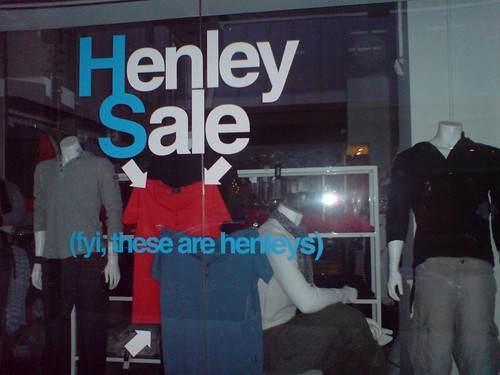
Back at the start of March, I was walking past the Industrie store on Little Collins Street and I noticed this striking window display. What struck me about it in particular was that it's not only performing a promotional role; it's also performing a pedagogical one. If you didn't know what a Henley shirt (sometimes called a Henley sweater) was, the Industrie shop window is prepared to teach you.

I myself am one of the educated, because I'd never heard the term "Henley" before I saw this display. I'm old enough to remember the last time they were popular, in the late 80s and early 90s, when they were called "grandpa shirts" because they looked like old-fashioned men's underwear. Back then they were part of the underwear-as-outerwear grunge ethos. I used to wear them with a contrasting coloured t-shirt underneath, then I'd roll up the sleeves to reveal the under-layer.

But I digress. Last week I noticed that Dotti on Swanston Street is also doing this shop-window pedagogy.


While it's another total digression, perhaps this is a good opportunity to mention that, while I'm pleased to have predicted the current resurgence of 60s mod fashion back in 2005, it gives me fresh insight into why my plump aunt is scowling and looking uncomfortable in most of the family photos taken in the 60s. Just like the first time round, it's disappointingly unflattering on all but the most Twiggy-like figures. Sack-like dresses and tops that hang from a yoke just above the bust (looks fine on flat-chested women, whereas bosomy lasses look pregnant). Prim high necklines and the return of skivvies under pinafores (like I used to wear in primary school!). Low-cut slouch boots that sit right on (or even just below!) the ankle and look ludicrously stumpy on anyone without long willowy legs. Dull drab greys and mustards and burgundies and olives. Not jaunty at all.

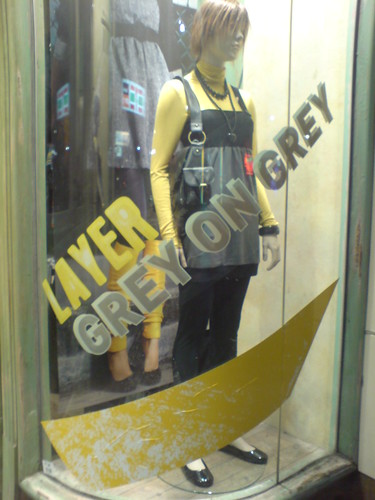
But anyway. The thing that intrigues me about the Dotti display is that it's teaching customers how to wear the clothes. Shopping is in fact an assemblage of teachings; shop-window visual merchandising is only the first and most striking, intended to pull you into the store. Once you're in there they continue to teach you how to wear the clothes by directing you through carefully arranged space, and getting you to interact with the shop assistants, who model and personify the brand (Supre and Alannah Hill are two particularly coherent examples of this) and, more obviously, who give you advice on how to fit and combine the clothes.

Many stores also produce literature ("magalogues" and websites) to extend their pedagogies beyond the physical retail space. These are another issue for me, because what I find interesting is the way the experience of the retail space is meant to educate. The point of this post is what's at stake for the brands in performing this role.

Most obviously, they are attempting to mould brand loyalty - to teach shoppers how to interpret fashion trends through the lens of the brand's particular ethos. Rather than tailoring their offerings to a pre-existing 'market' (eg tweens, edgy corporate wear), I think many brands try to create their market by teaching young, inexperienced clothes shoppers particular tastes and techniques that will thereafter shape their consumer practices.

But of course, that's not the entire story. We're all subject to many competing influences on our fashion consumption - popular culture (music, film, TV, etc); fashion magazines and blogs (some of which are explicitly pedagogical, eg "How to wear the new pencil skirt"); what we see other people wearing, and pleasurable feelings we get from particular garments (the swishiness of a full skirt; the fluffiness of a cashmere scarf; the clippiness and shininess of new shoes).

Perhaps what these displays are trying to bestow is a rubbed-off positive affect from having bestowed the gift of cultural capital. Sure, I might not have known what a Henley was, but now I do, and it was Industrie that taught me. Thanks, Industrie - now I will buy your garments. My phrasing is facetious, but let's not forget Miriam Silvester's idea of fashion levels - many people want to appear fashionable but don't actively follow trends. So there's money to be made by teaching them about the trends in such a way that they associate the teacher (the brand) with the pleasure of feeling newly fashionable - even if they don't actually buy the clothes.

Tuesday, February 28, 2006

Things to do with t-shirts

Back in 2004, I wrote an article about t-shirts for The Age. I wanted to explore the growth of t-shirts as design objects; the ways they were being turned into a fashion fetish and every second graphic designer seemed to be putting out a t-shirt line. But only the final three paragraphs of the final article are about this idea. The week I submitted it, there was a media panic about a provocative t-shirt that Westco made its retail staff wear, and so my editor changed the focus to be mainly about t-shirt slogans. This really annoyed me, but you have to respond to these news cycles.

Today I was reminded of my lost article when reading this piece about innovations in the t-shirt market. I was particularly struck by its entrepreneurial streak: the point seems to be to identify trends to rip off in other markets. But I am interested in the closing section: "Blurring the lines between conventional displays and selling methods may well mirror your customers' blurring perceptions of what constitutes value, or experience."

But as I see it, the success of the brands mentioned in the article doesn't just suggest a blurring of retail convention. It's about changing the basic relationship between product, seller and buyer. As Meaghan Morris writes in her classic essay "Things to Do With Shopping Centres", "it isn't necessarily or always the objects consumed that count in the act of consumption, but rather that unique sense of place"; and I guess what I want to do with this post is to use these examples of new t-shirt marketing as a sort of "place-making" - and as an antidote to the idea of t-shirts as "designer fashion".

The paradox of the "t-shirt label" is that a generic, banal, mass-produced garment takes on what Walter Benjamin would call an 'aura'. In my favourite part of Morris's essay, she dismantles this possibility:

The commodities in a discount house boast no halo, no aura. On the contrary, they promote a lived aesthetic of the serial, the machinic, the massreproduced: as one pair of thongs wears out, it is replaced by an identical pair, the same sweatshirt is bought in four different colours, or two different and two the same; a macrame planter defies all middle-class whole-earth naturalness connotations in its dyes of lurid chemical mustard and killer neon pink. Second, commodity boudoir-talk gathers up into the single and class-specific image of the elite courtesan a number of different relations women and men may invent both to actual commodities, the activity of combining them and, above all, to the changing discursive frames (like shopping centres) that invest the practices of buying, trafficking with and using commodities with their variable local meanings.

So, taking my cue from Morris, I want to sketch several "things to do with t-shirts". And importantly, the new "things" being done with t-shirts are succeeding because they create new spaces that manage to make the t-shirt simultaneously special and generic. First, there's customisation, in which the buyer alters the structure and look of the t-shirt in various ways. Then there's merchandising, in which the t-shirt itself remains unchanged; it's how the buyer interacts with its retail environment that constitutes innovation. Such merchandising techniques are what Morris would call a "discursive frame" - they infuse shopping with meaning.

Clothing customisation has long been understood as a grassroots practice of bricolage - changing the meanings of clothes through a judicious and unexpected alteration of pre-existing items. Journalists still tend to get excited about its possibilities for creativity and individuality. I think the absurdity of such a stance is encapsulated in this phrase from NZGirl: "The only way to achieve individuality is by customising, and we're going to show you how..."

But I'm more interested in the place customisation occupies in the market. For instance, I have customised a number of my old Bonds t-shirts by cutting off the sleeve bands, altering the necklines, ruching the sleeves and reattaching the sleeve bands in different places. But were I to try and sell them, Bonds would get up in my grill about it. When I interviewed Dylan Martorell, who in March 2004 was running Outskirts T-Shirt Gallery, he had this to say:

Mel: What would you do if someone came in with a seriously ordinary t-shirt that looked like they’d just taken a texta to a Bonds t-shirt in their bedroom?
Dylan: And it was good or bad?
Mel: And it was really bad.
Dylan: Well, for a start we wouldn’t stock it because it was Bonds. Um, Bonds are about the only brand that actively, uh, go out of their way to stop people using their t-shirts.
Mel: Oh really?
Dylan: Yeah, I think every other t-shirt brand is happy for their t-shirts to be used, but not Bonds. We’d just tell them we weren’t interested, I guess. That it wasn’t right for the store.

Contrast the attitude of Bonds, a company that seeks to protect its brand from being 'ruined' by customisation, with American Apparel, a company that makes being generic its major selling point. American Apparel began as a wholesale business, selling t-shirts to artists, designers, bands and anyone else who needed a wearable canvas to print on. The company's selling points are quality, fit (slim fit - is it any surprise its biggest customers are hipsters?) and a rainbow of colours.

But I do want to get away from the 'wearable canvas' idea, because it perpetuates the t-shirt label mentality that t-shirts are 'works of art in the age of mechanical reproduction'. Instead, let's look at two ideas that treat t-shirts as commodities in the most obvious way: by inserting them into the retail logics of entirely separate industries.

In Chicago, patrons at the Windy City's own T-Shirt Deli can order fully customised American Apparel t-shirts as easily as picking out sandwich ingredients. Indeed, the company's tagline is "T-shirts made fresh daily". Pick your desired size, colour and style out of a glass-fronted deli cabinet, then spell out a witty slogan in iron-on letters of a variety of typefaces (at US$1 per letter). You can also provide your own design. The final t-shirt is wrapped up in butcher's paper. The concept is similar to Neighborhoodies, which I previously discussed here.

But while Neighborhoodies is a customising shop, plain and simple, I'm more interested by the food/fashion pun on 'freshness' employed by the T-Shirt Deli. Here, customising is a ritual of performing the 'fresh'. Rather than making your own sandwich at home, you go to a deli, and you feel more virtuous for resisting the temptations of the bain-marie. Moreover, you verify the freshness and healthiness of your lunch (and thus, your virtue) by seeing it made before your eyes. In a similar way, you go to the T-Shirt Deli because you want a product that could have been made by you. You feel better about yourself (more original, individual - more like a bricoleur) because you didn't just buy a pre-sloganed t-shirt. You thought up a witty catchphrase yourself. And the slogan looks especially good to you because it's being assembled right in front of you.


Brazilian store Banca de Camisetas(translation: T-Shirt Stand) is a kind of t-shirt newsagent. There are currently five ‘bancas’ in Sao Paulo. The merchandise is arranged in racks like magazines, the stock is changed weekly, and the store only carries three of each design. The ‘publishers’ are freelance graphic designers; from these photos, the shirts look a lot like the sort of stuff you can find at the T-Shirt Barn in Newtown, Sydney.

But the intriguing thing about Banca de Camisetas is that, while its merchandise fits squarely into the 'art' aesthetic of the 't-shirt line', it isn't sold in a 'gallery' environment and the t-shirts are packed into squares. Instead, there's an accessible, 'convenience' mentality - just as you would in a magazine shop, you're encouraged to 'drop in', to browse, to choose quickly and to return often. I really like the way it refuses to treat the t-shirts as fetishes.

However. Another thing that struck me is that the packaged shirts look almost like records, which in turn connotes another kind of retail fetishism - that of the hip, intense, mostly male vinyl hound spending hours browsing in music stores for rare discs. In every city there's a cartography of subcultural space marked out by spaces like these, and continually reinscribed by DJs and record enthusiasts. For example, in his article on death metal, "It'll All Come Out in the Mosh", Dominic Pettman refers to certain Melbourne metal record shops as the "Devil's Triangle".

The good people at Springwise "can't really think of any big city where this would NOT work!" I agree. It's a great idea. But my contention is that a 'banca' would work in different, locally specific ways in different cities, because people would incorporate it into their existing repertoire of retail techniques. As Morris writes, if a company can create a sense of place, they can market a very banal product with great success.

Thursday, October 27, 2005

Industrious


Some time ago, I wrote about Industrie, the menswear chain that has a similar logic to Sportsgirl (in the women's mass fashion retail market) as a signifier of 'fashionability'. That is, the clothes appeal to young men who don't really know what's in fashion, but want to look as though they do.

But it's not just about 'fashion', but 'style', which I have previously defined as "a more permanent and idiosyncratic dress sense that works aesthetically in a variety of contexts and fashion cycles". Sportsgirl's elaborate boho clothes are designed to generate individual 'looks' through multi-layering and mismatching mass-produced garments and accessories. Likewise, Industrie makes stylistic gestures towards 'individuality' - deconstructed shapes, torn edges, prints and embroidery that are designed to make the garments look customised, even though they are mass-produced.


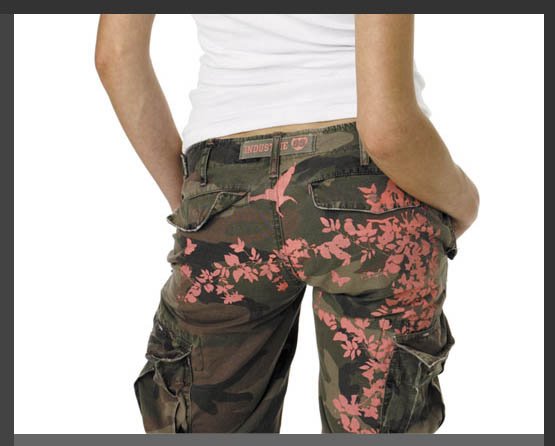
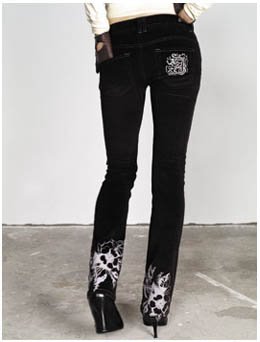
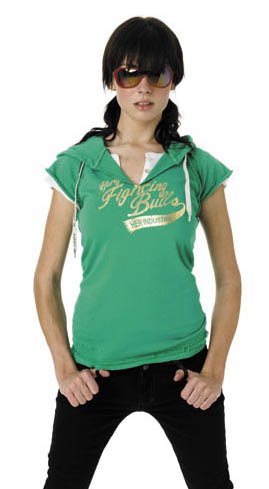
The company has diversified into womenswear with a line called Her Industrie, which has been out for about a year now. As you can see from these images, Her Industrie carries the same streetwear-influenced logic of 'individuality' as the men's line. Look at the stencils on the cargo pants, and the stencilled version of the black stovepipes that, by now, are everywhere in high street fashion stores. There are also layered t-shirts and singlet tops, and raw-edged, printed hoodies.


(As an aside, it's worthwhile mentioning that these hoodies are called "Harajuku". Since Gwen Stefani introduced this word into mainstream parlance, it's become completely disassociated from the specific geographic, aesthetic and cultural context of the Harajuku district in Tokyo, and now seems to mean something closer to "crazy-hip".)

Industrie seems very unstylish indeed to people who have a strongly defined personal aesthetic. And it seems very uncool to people who thrive on the affect of exclusivity that comes with being a style innovator or early adopter. As Will pointed out in the comments to my 'deconstructed hoodie' post: "Industrie is the kind of stuff where, if you wore it to an extended family barbeque, your family might think you were hip." And the hipster kids over at ThreeThousand are "so over" this style they wish to be woken when its moment is over.

For me, the most fascinating thing about brands like Her Industrie is that they relate only tenuously to the standard 'bubble-up' and 'trickle-down' models of fashion adoption. There was a really stupid and unsophisticated article recently in the Sydney Morning Herald which espoused the 'bubble-up' model:
Sportsgirl and the like may have finally discovered the skirts of India swirling around the ankles of nerdy girls in high schools across the land. Market research is all about youth, hunting for the next big thing. Business pays market research companies big bucks to observe young people and predict which of their angst-ridden outpourings will inspire the next Witchcraft [does the writer mean Witchery?] spin-off or be-labelled beanie.
Using this (unhelpfully crude) logic, whatever styles these trendspotters see subculturally affiliated kids (or, in this example, any kids at all!) will show up, blanded out and priced up for the masses, in chain stores. But this model breaks down when the subcultures and the hipsters don't even like the style to begin with.

So, why develop fashion lines like Her Industrie? Not because they are innovative, and not because they're associated with subcultures, but because they're just versatile and customisable enough to reassure most shoppers that by purchasing and wearing these garments, they're exercising their individuality and staying 'in fashion'.

As mainstream New Zealand women's lifestyle portal NZGirl opines:
The best way to inject a taste of ‘army girl’ into your wardrobe is with a pair of army print pants or shorts. Available from most chain stores, these will be a summer staple which will be worn year after year. We love the pictured Rose Bud combats from her industrie. These funky combat pants mix the masculine army print with girly accents by using print detail and feminine ties. Wear them longer on a cooler day or hitched up over your bikini at the beach – sweet and casual.
I did a bit of Googling to work out who's talking about Her Industrie, and the answer seems to be semi-articulate teenage girls:
went to myer, and omgsh i want these 'her industrie' pants.. but they 100$ and i didnt like the printing on the ass part of it.. hahaa so i derno if i'll get them or not.. may just look arnd first at city or something..
Here's another one:
my mother wont let me buy my Her Industrie three quarter pants thing.. she sed its army and its baggy. i guess it makes me look tom boyish x, x MY MOTHER!
This is a case for real market research - interviewing people to ask them what they like and dislike about the clothes. But from what's written on blogs and forums, it seems that people think about how the pants fit (are they in my size? are they comfortable?), how much they cost (young shoppers rely on allowances, part-time income, and parental permission), and where they can wear them (good for the beach, for going out, etc).

Intriguingly, there seems to be a backlash against the 'sameness' of Industrie clothing, particularly the prominent screen-printed branding. People posting to this bulletin board laugh at men (and women) who wear exclusively Industrie. Rather than making them seem fashionable, it makes them seem like dull-witted fashion followers. Still, I do think this is an exception. It might pain me, and it might pain the ThreeThousand kids, but stencilled army pants probably are going to come back in this summer.

Thursday, June 23, 2005

Retail Review

A couple of days ago, I read an interesting article in The Age which reviewed three new Melbourne shopping precincts: the GPO, QV and the revamped Melbourne Central. It was all the more interesting because shops don't really get reviewed in the general press like fashion shows, art installations, theatre or even architecture, although I would argue that retail combines elements of all these. Jonathan Green's piece nicely evokes the way shopping centres are designed to move shoppers through space, to generate affective responses that will stimulate purchases, and to mirror the CBD's older, laneway-based retail environment. Here he is, for example, on Melbourne Central:
The spaces are enclosed and intimate, a warren of laneways, lofts and balconied atriums spreading in a fair replica of organic old-city chaos from the cleared central circle that surrounds the cone-topped atrium and the brick battlements of the Coop shot factory tower.

Somewhere around here, we'll find no fewer than nine mobile phone retailers, 32 female fashion specialists, 12 for men and everything in between all set in a crazy, vibrant clutter that screams pace, pace, pace. The signage seizes you at the Lonsdale Street entrance — "Scooter", "Grab", "Sushi Sushi" — and propels you deeper into the increasingly complex innards through a bombardment of sound as well as scent and vision, each shop pumping out its own particular notion of aural ambience at volume.

[...]

Onwards ever onwards. There are multiple entry points, from Elizabeth Street through a fragrant series of sidewalk eateries; from Latrobe, Swanston and, of course, from below, through the centre's own proprietary branded station on the City Loop. The redevelopment has closed in formerly open spaces and redrawn the massive footprint to enclose laneways that ape the intricate retail lacework of Flinders Lane and Little Collins Street.

For the last few months, I've been wanting to take Footpath Zeitgeist "live" by actually photographing street style in Melbourne rather than relying on other people's photos. I've been holding out for a decent digital camera and the money to buy it with. Suddenly becoming a full-time freelancer hasn't helped matters.

But one of the things I plan to do when I get my camera is institute a regular review of retail store merchandising and promotion. The Retail Review section will analyse store window and retail interior design using aesthetic, trend-based and more general cultural criteria. I will also critically review catalogues, particularly hybrid "magalogues" like Furst Publishing's STU, which is a General Pants house magazine.

I think that much of the time, these things are seen as peripheral promotional devices, and as such they're not worth reviewing. But they perform a crucial mediating role between a retail store and the people on the street. Street style can be influenced by a window display or a smart catalogue, even if people can't afford or would never buy the clothes in the store.

Saturday, February 12, 2005

Humphrey B Bear wants his coat back!


Target's stab at careless luxe looks dangerously like dress-up box chic. I think it's a combination of the delicate little brooch almost buried in Humphrey's fur, the satin camisole and the rose belt buckle.

If I were styling this shoot and wanted it to look dress-up box chic, I would ditch the little girly accessories and put the model in big, fuck-off Beyonce chandelier earrings and/or a blinged-out necklace, and swap the jeans for a big puffy skirt. This is because the key to getting dress-up box chic right is putting lots and lots of unsubtly cheap and girly things together until they look almost absurd. Subtlety has no place.

If I were styling this shoot for careless luxe, however, I would ditch the satin camisole and put her in a faded rock t-shirt and a single strand of really big pearls. That way, the luxury of the fur would be offset by the grungy t-shirt and jeans and the vulgar size of the pearls. Or I'd put the fur with a crisp striped or spotted top, a thick, punky studded leather belt and big silver skull-and-crossbones earrings. That way, the tough accessories would go well with the conservative top and the luxurious fur.

Perhaps the entire problem is that everything is new, so any attempt at careless luxe or dress-up box chic would automatically fail. There was another picture on page 17 of Target's cowboy boots, which are so stiff, monocolour and plastic-looking they're actually funny (one boot has a stiff new crease where the model bent her foot). But they would be quite cool if they were a little battered. I remember last year when I was in Perth, Betts shoe store had some great distressed cowboy boots. I thought they got them just right, but Gemma said they still weren't vintage-looking enough.