I'm starting to write my chapters about clothing size. If fit is the way the clothes are contoured to the human body, size is the set of industrial techniques for mass-producing and mass-marketing clothes. It offers a fascinating history of problem-solving as retailers invent new ways to sell clothes, and changing populations present themselves as new market segments needing to be wooed with new sizes.
But right now, I'm interested in how this system exerts itself on the feelings of the individual shopper. How does it feel to enter a shop, be confronted by displays of clothes, and have to figure out which ones will fit?
More importantly, how does it feel when trying on clothes goes badly? We often imagine that we're the only people who go home empty-handed, feeling like ugly freaks. We imagine that everyone else just waltzes into a shop and picks something off the rack if they like the look of it.
But shopping for clothes is, by definition, a battle. The vulnerable human body, so intriguing in its individual variation, is assaulted from two sides: by the weighty cultural meanings we attach to clothes; and by the implacable heft of the industries trying to sell them to us. This happens to everyone – old, young, thin, fat, men, women.
I plan to share some of my strategies and war stories in my book, but I'm keen to hear yours too. So I've done another one of my trademark surveys about trying on clothes in shops. If you leave your name with the survey, you'll be quoted here on the blog, and/or in my finished book.
Click here to do the survey. It'll only take about five minutes.
Monday, August 06, 2012


Thursday, July 26, 2012
On the 'medieval bra'
Several people have forwarded me articles about the 'world's oldest bra'. Dating from the 15th century, it was discovered in 2008 during extensive reconstructions in Lengberg Castle, eastern Tyrol, Austria, but has only been widely reported in the last week following a story in the August 2012 issue of BBC History Magazine.
Several garments that resemble modern women's underwear were found in a vault filled with layers of dry material – straw, twigs and wood, but also leather (old shoes) and textiles (old clothes). They could have been thrown in there simply to dispose of them, or to level the floor when a second storey was added to the castle in the 1480s.
The textiles range from complete, well-preserved linen and wool garments to fragments. Some belonged to men, while the small cuff circumference on some of the shirts suggests they were worn by women or children. Basically, it's a complete fluke that this stuff has survived to the present, a quirk of the dry archival conditions in which it's inadvertently been stored.
But you wanna know about the bra, right? Well, there were four items resembling contemporary bras. Two of them were kind of like crop tops; they end right under the breasts, but cover the decolletage. These were trimmed with lace along the hems. A third garment had broad shoulder straps that widen into the cups like a halter-neck top, and was elaborately decorated with lace on the straps, between the cups and along the hem.
What makes them most like contemporary bras is the use of tailored cups, rather than a simple flat band across the breast, as worn in ancient Greece and Rome.

This mosaic from the Villa Romana del Casale in Sicily is often dubbed the 'bikini girls' for obvious reasons, but these women are clearly athletes and their 'bikinis' look much more like contemporary elite running apparel.

This is Melissa Breen, currently Australian 100m and 200m champion and soon to represent Australia at the London Olympics.
But anyway, the fourth garment is the one that most resembles a modern bra, and is the one most frequently depicted in the current media coverage. It extends to the bottom of the ribcage, and there's an extant row of eyelets on the left side in which laces would be inserted to fasten it.
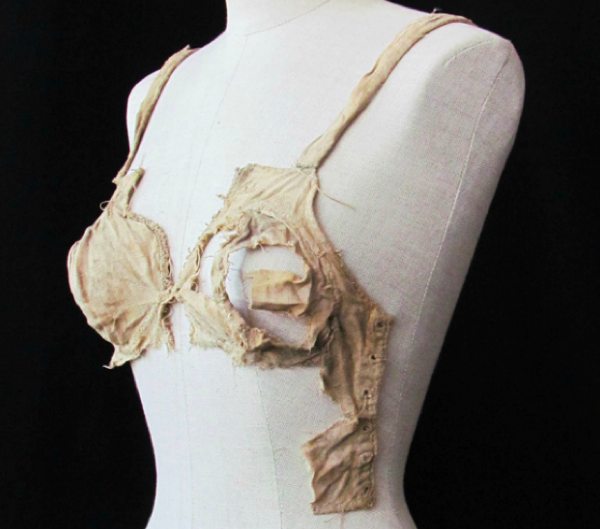
Most of the torso and back is missing, so it's unclear how it originally looked. But what annoys me is the photo comparing this garment to a 1950s-style longline bra, as if to suggest that's how it would have looked when intact.
You can see the two garments aren't even cut the same way! (The medieval garment has vertical seams down the centre of the cups.) And what might look to us like a low-cut cleavage might well be an accident of where the 15th-century linen has torn over time.

We often try to make these connections through time to make history seem less distant, much as we call the Roman athletes 'bikini girls'. Because the older garment looks like its modern equivalent, we see them as a teleological trajectory of fashion, with our own garments as the logical and most 'evolved' version.
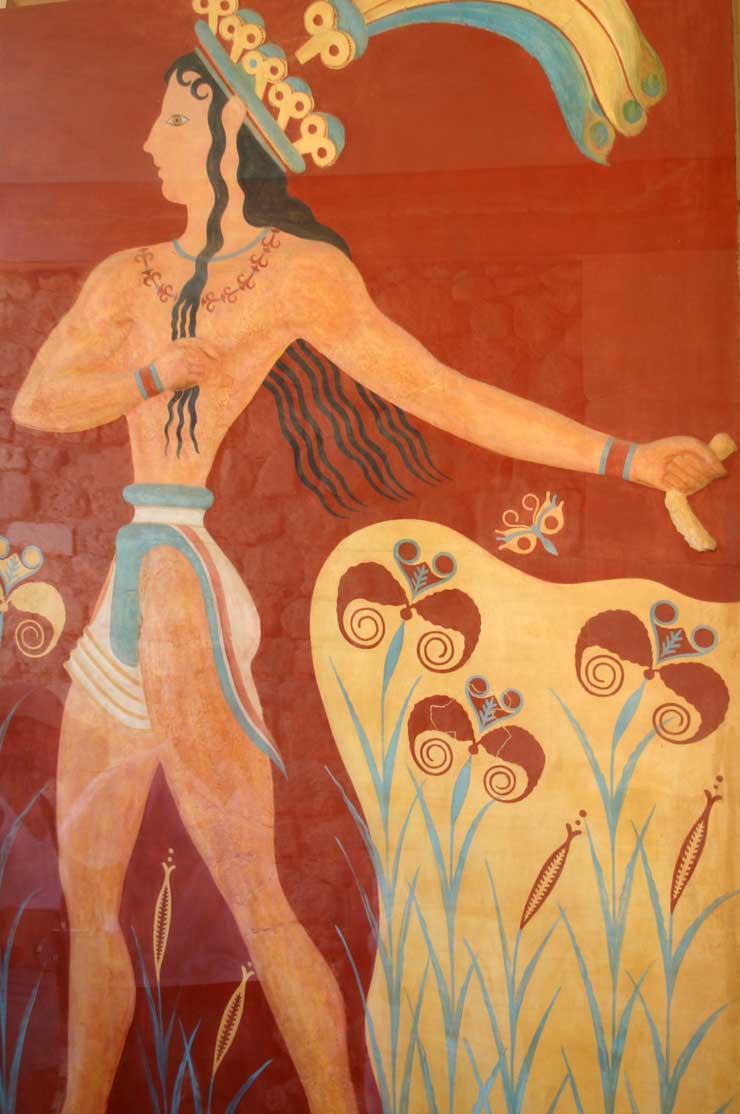
For instance, a 1932 feature article in the Chicago Sunday Tribune located the corset's 'origin' in the image of the bare-breasted Minoan snake goddess, despite the fact that Minoan art also depicted slender waists on men who are not wearing corset-like bodices.

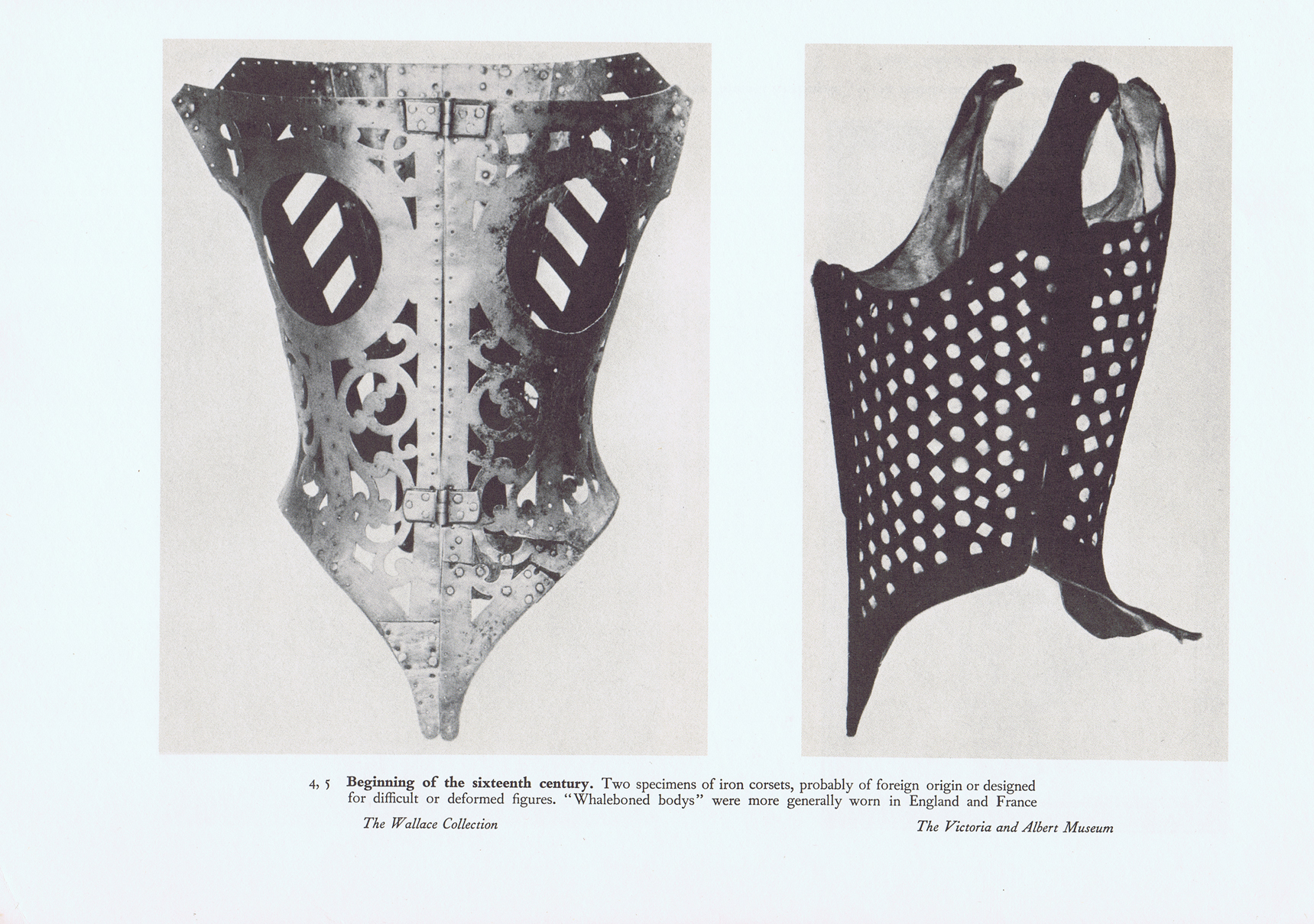
The same article contrasts what was then the modern corset, “a subtle, supple thing of silk and elastic”, with the corset of yore, “a torturous device of leather and steel”. Trouble is, metal corsets were almost certainly orthopaedic – meant to correct deformed bodies.
Of course, we now see 1930s corsets as restrictive. It seems to be human nature in every era to interpret the clothes of the past as 'primitive' versions of our own familiar apparel.
So basically, the Lengberg textiles are not "the world's oldest bra", and they don't prove that bras were "invented" 500 years earlier than we thought. While they might serve a similar sartorial function to a bra, they are completely separate garments with their own cultural context. So… what might that be?
The huge significance of this Austrian find is that it's the first extant medieval underwear. Until recently, our ideas of medieval clothing came only from illuminated manuscripts and artworks, from literature, and from written records such as clothing inventories or receipts, wills (clothing was often bequeathed, but you wouldn't give your undies to your heirs!) and the rules of religious orders.
For instance, while regulations on monks' clothing mention shirts, stockings/hose and under-breeches (known as braies), chemises and stockings are the only underwear listed as being allocated to nuns, leading us to conclude they didn't wear anything else. This is also borne out in E Jane Burns' analysis of gender and underwear in the French Prose Lancelot.
Burns quotes one instance in Chrétien de Troyes's Le Chevalier de la Charrette (c1180) where a damsel being ravished is "villainously held down … uncovered to the waist." This means she's not wearing any drawers under her chemise.
But what about on the top half?
Christina Frieder Waugh writes (PDF link) that in medieval poetry, a beautiful woman's breasts were often described as being "hard as little apples". Umberto Eco's much-cited book Art & Beauty in the Middle Ages quotes Gilbert of Hoyland's Sermones in Canticum Salomonis, on ideals of feminine beauty:
A satirical poem by an unknown 15th-century German author also refers to "breastbags" or "bags for the breasts":
Several garments that resemble modern women's underwear were found in a vault filled with layers of dry material – straw, twigs and wood, but also leather (old shoes) and textiles (old clothes). They could have been thrown in there simply to dispose of them, or to level the floor when a second storey was added to the castle in the 1480s.
The textiles range from complete, well-preserved linen and wool garments to fragments. Some belonged to men, while the small cuff circumference on some of the shirts suggests they were worn by women or children. Basically, it's a complete fluke that this stuff has survived to the present, a quirk of the dry archival conditions in which it's inadvertently been stored.
But you wanna know about the bra, right? Well, there were four items resembling contemporary bras. Two of them were kind of like crop tops; they end right under the breasts, but cover the decolletage. These were trimmed with lace along the hems. A third garment had broad shoulder straps that widen into the cups like a halter-neck top, and was elaborately decorated with lace on the straps, between the cups and along the hem.
What makes them most like contemporary bras is the use of tailored cups, rather than a simple flat band across the breast, as worn in ancient Greece and Rome.
This mosaic from the Villa Romana del Casale in Sicily is often dubbed the 'bikini girls' for obvious reasons, but these women are clearly athletes and their 'bikinis' look much more like contemporary elite running apparel.
This is Melissa Breen, currently Australian 100m and 200m champion and soon to represent Australia at the London Olympics.
But anyway, the fourth garment is the one that most resembles a modern bra, and is the one most frequently depicted in the current media coverage. It extends to the bottom of the ribcage, and there's an extant row of eyelets on the left side in which laces would be inserted to fasten it.
Most of the torso and back is missing, so it's unclear how it originally looked. But what annoys me is the photo comparing this garment to a 1950s-style longline bra, as if to suggest that's how it would have looked when intact.
You can see the two garments aren't even cut the same way! (The medieval garment has vertical seams down the centre of the cups.) And what might look to us like a low-cut cleavage might well be an accident of where the 15th-century linen has torn over time.
We often try to make these connections through time to make history seem less distant, much as we call the Roman athletes 'bikini girls'. Because the older garment looks like its modern equivalent, we see them as a teleological trajectory of fashion, with our own garments as the logical and most 'evolved' version.
For instance, a 1932 feature article in the Chicago Sunday Tribune located the corset's 'origin' in the image of the bare-breasted Minoan snake goddess, despite the fact that Minoan art also depicted slender waists on men who are not wearing corset-like bodices.
The same article contrasts what was then the modern corset, “a subtle, supple thing of silk and elastic”, with the corset of yore, “a torturous device of leather and steel”. Trouble is, metal corsets were almost certainly orthopaedic – meant to correct deformed bodies.
Of course, we now see 1930s corsets as restrictive. It seems to be human nature in every era to interpret the clothes of the past as 'primitive' versions of our own familiar apparel.
So basically, the Lengberg textiles are not "the world's oldest bra", and they don't prove that bras were "invented" 500 years earlier than we thought. While they might serve a similar sartorial function to a bra, they are completely separate garments with their own cultural context. So… what might that be?
The huge significance of this Austrian find is that it's the first extant medieval underwear. Until recently, our ideas of medieval clothing came only from illuminated manuscripts and artworks, from literature, and from written records such as clothing inventories or receipts, wills (clothing was often bequeathed, but you wouldn't give your undies to your heirs!) and the rules of religious orders.
For instance, while regulations on monks' clothing mention shirts, stockings/hose and under-breeches (known as braies), chemises and stockings are the only underwear listed as being allocated to nuns, leading us to conclude they didn't wear anything else. This is also borne out in E Jane Burns' analysis of gender and underwear in the French Prose Lancelot.
Burns quotes one instance in Chrétien de Troyes's Le Chevalier de la Charrette (c1180) where a damsel being ravished is "villainously held down … uncovered to the waist." This means she's not wearing any drawers under her chemise.
But what about on the top half?
Christina Frieder Waugh writes (PDF link) that in medieval poetry, a beautiful woman's breasts were often described as being "hard as little apples". Umberto Eco's much-cited book Art & Beauty in the Middle Ages quotes Gilbert of Hoyland's Sermones in Canticum Salomonis, on ideals of feminine beauty:
The breasts are most pleasing when they are of moderate size and eminence…they should be bound but not flattened, restrained with gentleness but not given too much licence.The same Gilbert of Hoyland who had such definite opinions on women's breasts was a 12th-century English Cistercian abbot. Waugh quotes him advising his monks to practise restraint, much as women restrain their boobs!!
For what are they more anxious to avoid in embellishing the bosom, than that the breasts be overgrown and shapeless and flabby? … Therefore they constrain overgrown and flabby breasts with breast-bands, artfully remedying the shortcomings of nature.And in the Romance de la Rose, a 13th-century poem by two authors, the Old Woman character offers what's basically a medieval French version of Cosmo magazine advice:
And if her breasts are too full, let her take a kerchief or scarf and wrap it round her ribs to bind her bosom, and then fasten it with a stitch or knot; she will then be able to disport herself.Beatrix Nutz, a University of Innsbruck archaeologist who's writing her thesis on the Lengberg textiles, cites French royal surgeon Henri de Mondeville's description, in his Cyrurgia: “Some women… insert two bags in their dresses, adjusted to the breasts, fitting tight, and they put them [the breasts] into them [the bags] every morning and fasten them when possible with a matching band.”
A satirical poem by an unknown 15th-century German author also refers to "breastbags" or "bags for the breasts":
…with them she roams the streets, so that all the young men that look at her, can see her beautiful breasts; But whose breasts are too large, makes tight pouches, so there is no gossip in the city about her big breasts.What's interesting is that the 'bags' here seem more structured than a band, and also adjustable to the size of the breasts. Perhaps the greatest cultural similarity between contemporary bras and the Lengberg textiles is that in the 15th century, large breasts were interpreted as excessive and licentious – much as they are now.
Wednesday, June 27, 2012
Dressing Downton
Tomorrow, Thursday 28 June, I'll be on a panel at ACMI discussing Downton Abbey. My particular focus will be on the costumes: how they're sourced; how they reflect character; and how they create an atmosphere of 'historical accuracy' within which the narrative nestles. It's the costumes that make a 'costume drama'.
I'll be writing up my presentation as an essay for Kill Your Darlings. Here are a few screencaps from my slideshow to give you a taste of what I'll be showing.


Incidentally, 'Dressing Downton' is also a dressmaking and costuming project spearheaded by The Girl with the Star-Spangled Heart. Sewing enthusiasts are invited to blog their Downton Abbey-inspired projects, and you can see pics of their work.
I'll be writing up my presentation as an essay for Kill Your Darlings. Here are a few screencaps from my slideshow to give you a taste of what I'll be showing.
Incidentally, 'Dressing Downton' is also a dressmaking and costuming project spearheaded by The Girl with the Star-Spangled Heart. Sewing enthusiasts are invited to blog their Downton Abbey-inspired projects, and you can see pics of their work.
Wednesday, June 06, 2012
What dress size am I?
Almost a month ago, I voyaged to Southland shopping centre to participate in a sizing survey being undertaken by Target using 3D body scanning technology. The scanner was travelling to various Australian capital city shopping centres as the retailer collected 10,000 datasets.
When I mentioned this on Twitter, I was really surprised by the utter confusion and suspicion people expressed about what 3D body-scanning was and how it worked. I thought it was pretty self-explanatory. A machine scans your body and records precise biometric data that you can then use to shop for clothes.
Due to me not realising how long it takes to get to Southland on public transport, I arrived there with only 20 minutes before the centre closed, so the blurriness of the phone pics I took reflects the unaccustomed aerobic activity of finding the damn thing in time, as well as my usual shaky hands that mean I seldom manage to take an in-focus photo.

Here's the setup. It wasn't in the actual Target store but in the mall itself. As you can see, people of all ages were queueing up to get scanned. You can see one lady holding the little form we had to fill out, in which we listed name, age, race/ethnicity (I wrote "Caucasian/Anglo" and felt like some creepy KKK member), email, phone and postcode. Presumably Target will cross-match those details with its biometric data to build a picture of how body shape varies demographically.
We also had to promise not to horse around in the machine, and acknowledge that Target was not responsible for any injuries we might incur in there. Yikes!

Here's the little booth. You stand on footprints on the floor and hold your arms slightly out from your body. A vertically mounted scanning bar whizzes in a circle around you once, then makes another pass in the opposite direction, presumably to check its measurements. It takes less than 30 seconds. Then you're done, and you get a printout with your stats on it.
But while you're standing there, trying to be very still, you have to look at an unnerving bullseye on the wall of the booth. This mingles unfortunately with people's anxieties over the intimate nature of 3D body scanning, which stem not just from the idea of having your vulnerable body assessed in such a robotic way, but also from most people's only prior experience with the technology – at airport security. The fact we had to decant our personal belongings into what looked like cat litter trays only added to this Homeland Security atmosphere.
Let's face it, if any other retailer had done this survey, it would have been instantly far less creepy. Look at all the staff with targets on their backs!!

The nerdy guy with the computer was responsible for running the system. I was immensely relieved that I did not receive a visualisation of my body in 3D; just the vital statistics.
I've gotta say I felt crushed, though, at the clothing size the scanner told me I should be wearing. Somehow, the fact my size had been assessed by a computer felt much more authoritative and conclusive than if someone had done it with a tape measure. I felt very fat and depressed.
I have an entire chapter of my book that examines the way culture teaches us to identify so strongly with clothing size – which is ridiculous, as it is a completely arbitrary and inconsistent system – and to feel such strong emotions of satisfaction and shame based on these numbers.
But I also wonder if other people bring that same level of scrutiny and judgment to our bodies that we do to ourselves. I was curious to see if people could 'tell' what dress size I wear simply by looking at me. So last weekend, I decided to ask some sales assistants.
Forever New is an Australian chain catering to young women, which offers feminine, sophisticated and slightly retro looks at fast-fashion prices. It is preposterous that I would ever fit into any of their clothes; I only go in there to look at the accessories. The young sales assistant there assessed me as a size 14, but said that the size I took would vary according to style; they have a lot of waisted dresses with full skirts, but also A-line shifts.
Sussan has an older, more maternal target market; while still offering fashionable styles and colours, their sizing is more generous and they do a lot of sleepwear. Appropriately, an older, more maternal sales assistant advised me that I would be a "medium to large". Again, she said this would vary on the style I chose, and she said that once I'd found something I liked, she could help me with sizes.
This is when I gave up my mystery-shopping experiment. I realised that because sales assistants are trained to make sales, they will always flatter the customer and try to find something in the store to sell them. It's much like the complicated dance of the bra fitter.
Even my friends, family and colleagues would feel bad about telling me, to my face, what size they thought I was, because clothing sizes are so psychologically fraught.
So I have decided on another experiment: an anonymous survey in which you can tell me what dress size you think I wear.
Click here to take the survey – it involves about a minute of your time.
Haha, guess who's got two 3D-scannable thumbs & is going to Target Southland this weekend to see the 3D body scanner in action? ME!
— Mel Campbell (@incrediblemelk) May 10, 2012
When I mentioned this on Twitter, I was really surprised by the utter confusion and suspicion people expressed about what 3D body-scanning was and how it worked. I thought it was pretty self-explanatory. A machine scans your body and records precise biometric data that you can then use to shop for clothes.
Due to me not realising how long it takes to get to Southland on public transport, I arrived there with only 20 minutes before the centre closed, so the blurriness of the phone pics I took reflects the unaccustomed aerobic activity of finding the damn thing in time, as well as my usual shaky hands that mean I seldom manage to take an in-focus photo.
Here's the setup. It wasn't in the actual Target store but in the mall itself. As you can see, people of all ages were queueing up to get scanned. You can see one lady holding the little form we had to fill out, in which we listed name, age, race/ethnicity (I wrote "Caucasian/Anglo" and felt like some creepy KKK member), email, phone and postcode. Presumably Target will cross-match those details with its biometric data to build a picture of how body shape varies demographically.
We also had to promise not to horse around in the machine, and acknowledge that Target was not responsible for any injuries we might incur in there. Yikes!
Here's the little booth. You stand on footprints on the floor and hold your arms slightly out from your body. A vertically mounted scanning bar whizzes in a circle around you once, then makes another pass in the opposite direction, presumably to check its measurements. It takes less than 30 seconds. Then you're done, and you get a printout with your stats on it.
But while you're standing there, trying to be very still, you have to look at an unnerving bullseye on the wall of the booth. This mingles unfortunately with people's anxieties over the intimate nature of 3D body scanning, which stem not just from the idea of having your vulnerable body assessed in such a robotic way, but also from most people's only prior experience with the technology – at airport security. The fact we had to decant our personal belongings into what looked like cat litter trays only added to this Homeland Security atmosphere.
Let's face it, if any other retailer had done this survey, it would have been instantly far less creepy. Look at all the staff with targets on their backs!!
The nerdy guy with the computer was responsible for running the system. I was immensely relieved that I did not receive a visualisation of my body in 3D; just the vital statistics.
I've gotta say I felt crushed, though, at the clothing size the scanner told me I should be wearing. Somehow, the fact my size had been assessed by a computer felt much more authoritative and conclusive than if someone had done it with a tape measure. I felt very fat and depressed.
I have an entire chapter of my book that examines the way culture teaches us to identify so strongly with clothing size – which is ridiculous, as it is a completely arbitrary and inconsistent system – and to feel such strong emotions of satisfaction and shame based on these numbers.
But I also wonder if other people bring that same level of scrutiny and judgment to our bodies that we do to ourselves. I was curious to see if people could 'tell' what dress size I wear simply by looking at me. So last weekend, I decided to ask some sales assistants.
Forever New is an Australian chain catering to young women, which offers feminine, sophisticated and slightly retro looks at fast-fashion prices. It is preposterous that I would ever fit into any of their clothes; I only go in there to look at the accessories. The young sales assistant there assessed me as a size 14, but said that the size I took would vary according to style; they have a lot of waisted dresses with full skirts, but also A-line shifts.
Sussan has an older, more maternal target market; while still offering fashionable styles and colours, their sizing is more generous and they do a lot of sleepwear. Appropriately, an older, more maternal sales assistant advised me that I would be a "medium to large". Again, she said this would vary on the style I chose, and she said that once I'd found something I liked, she could help me with sizes.
This is when I gave up my mystery-shopping experiment. I realised that because sales assistants are trained to make sales, they will always flatter the customer and try to find something in the store to sell them. It's much like the complicated dance of the bra fitter.
Even my friends, family and colleagues would feel bad about telling me, to my face, what size they thought I was, because clothing sizes are so psychologically fraught.
So I have decided on another experiment: an anonymous survey in which you can tell me what dress size you think I wear.
Click here to take the survey – it involves about a minute of your time.
Wednesday, May 16, 2012
High retro anxiety
This weekend I'm going to the Melbourne leg of Love Vintage, a travelling vintage, retro and antique expo that heads around Australia throughout the year. I'm familiar with the phenomenon of vintage fairs; years ago I wrote up The Way We Wear for Is Not Magazine and Hello Sailor for ThreeThousand, but I find actually going to these events very intimidating.
For a start, I rarely find anything that fits me in a vintage shop. That was the catalyst for my current book project. Second – and more importantly – I feel very worried about being judged sartorially by people who are much more into vintage than I am. The vintage subculture feels like a club whose membership can instantly be extended or denied with a single assessing look at someone's outfit.
As well as Jaunty Pussy, I would call my dress sense 'low retro'. That is, I am inspired by looks ranging from the 1950s to the 1970s, I own a lot of preppy, old-fashioned clothes, wear winged eyeliner and browline glasses most days, and I guess Stam is an old-fashioned frame handbag. But I don't aim for period-accuracy, and I usually mix the retro stuff up with contemporary items.
On an evening last April I found myself on a tram sitting opposite a 'high retro' chick. She had a rolled fringe and was wearing a cardigan over a red, white and blue striped sailor-esque outfit. The dark regrowth in her blonde hair, her set face and harsh, heavy makeup reminded me of a '40s working-class girl – like something from Come In Spinner, Summer of the Seventeenth Doll or Caddie.
I could see her suspiciously eyeing my low-retro getup: my glasses and eyeliner; button-through floral frock, cardigan and bag. I felt as if she were judging me on her standards, and deciding that I had tried and failed to be high retro.
So I am very intimidated about what to wear on Friday to the opening night of Love Vintage, as there will be a 'best dressed' fashion parade and I imagine everyone there will be pulling out their best looks. Unfortunately, I pulled the trigger on my own best look too early; I wore it to a country vintage fair last Sunday.
I took my parents, and it was a lovely Mother's Day outing, but to be honest I was disappointed by the small scale of the fair, and I felt embarrassed that I'd got dressed up, because the only other people dressed like me were Miss Lulu and Miss Ruby Rabbit, the pinup hairdo ladies, and Lauren Randle of Castlemaine vintage store The Reclaimed Room. I had a nice chat with Lauren, though.
Today I was looking through my wardrobe and fretting that nothing in there looked high retro enough. I started pulling dresses out and laying them on the bed and then laying necklaces and cardigans on top, and then I started fiddling with my hair, and then ultimately this is what I ended up wearing today:

I am not trying very hard. I didn't bother to straighten my fringe or curl my hair; I just did victory rolls, which is incredibly easy once you get the hang of it; these ones don't even have any hairspray fixing them in place.
The look is vaguely 1940s, I suppose. It's hard to see in the photo, but my teal blouse matches the sequins on my cardigan. The blouse has puffed sleeves and lots of pintucks along the shoulder seams, and is tucked into a pair of high-waisted black harem pants. I'm also wearing my half-wingtips, half-sneakers, which I got from a Richmond garage sale recently for $5.

I am still low retro, but I'm climbing a little higher than usual. Hopefully by Friday I will be high enough to pass muster among the hardcore vintage aficionados.
For a start, I rarely find anything that fits me in a vintage shop. That was the catalyst for my current book project. Second – and more importantly – I feel very worried about being judged sartorially by people who are much more into vintage than I am. The vintage subculture feels like a club whose membership can instantly be extended or denied with a single assessing look at someone's outfit.
As well as Jaunty Pussy, I would call my dress sense 'low retro'. That is, I am inspired by looks ranging from the 1950s to the 1970s, I own a lot of preppy, old-fashioned clothes, wear winged eyeliner and browline glasses most days, and I guess Stam is an old-fashioned frame handbag. But I don't aim for period-accuracy, and I usually mix the retro stuff up with contemporary items.
On an evening last April I found myself on a tram sitting opposite a 'high retro' chick. She had a rolled fringe and was wearing a cardigan over a red, white and blue striped sailor-esque outfit. The dark regrowth in her blonde hair, her set face and harsh, heavy makeup reminded me of a '40s working-class girl – like something from Come In Spinner, Summer of the Seventeenth Doll or Caddie.
I could see her suspiciously eyeing my low-retro getup: my glasses and eyeliner; button-through floral frock, cardigan and bag. I felt as if she were judging me on her standards, and deciding that I had tried and failed to be high retro.
So I am very intimidated about what to wear on Friday to the opening night of Love Vintage, as there will be a 'best dressed' fashion parade and I imagine everyone there will be pulling out their best looks. Unfortunately, I pulled the trigger on my own best look too early; I wore it to a country vintage fair last Sunday.
I took my parents, and it was a lovely Mother's Day outing, but to be honest I was disappointed by the small scale of the fair, and I felt embarrassed that I'd got dressed up, because the only other people dressed like me were Miss Lulu and Miss Ruby Rabbit, the pinup hairdo ladies, and Lauren Randle of Castlemaine vintage store The Reclaimed Room. I had a nice chat with Lauren, though.
Today I was looking through my wardrobe and fretting that nothing in there looked high retro enough. I started pulling dresses out and laying them on the bed and then laying necklaces and cardigans on top, and then I started fiddling with my hair, and then ultimately this is what I ended up wearing today:
I am not trying very hard. I didn't bother to straighten my fringe or curl my hair; I just did victory rolls, which is incredibly easy once you get the hang of it; these ones don't even have any hairspray fixing them in place.
The look is vaguely 1940s, I suppose. It's hard to see in the photo, but my teal blouse matches the sequins on my cardigan. The blouse has puffed sleeves and lots of pintucks along the shoulder seams, and is tucked into a pair of high-waisted black harem pants. I'm also wearing my half-wingtips, half-sneakers, which I got from a Richmond garage sale recently for $5.
I am still low retro, but I'm climbing a little higher than usual. Hopefully by Friday I will be high enough to pass muster among the hardcore vintage aficionados.
Thursday, May 03, 2012
Underwear in action
Historical underwear is usually fetishised. The garments themselves, in museums, as historical artefacts. Period advertisements for those garments, as consumer artefacts. Caricatures fetishise the wearing of the underwear as a ridiculous sign of vanity. Then, of course, historical erotica fetishises underwear sexually – that is, the form of fetishisation with which we're most familiar.
But when we fetishise historical underwear – that is, focus obsessively on it as an object and imbue it with an almost magical meaning – we lose perspective on what it was like to wear these garments on an everyday basis. It's very difficult to view images of the past without bringing our own fetishes to them (Indeed, our ideas of how to wear and comport ourselves in old-fashioned underwear often come from our own narratives set in the past and vintage fetish imagery), or misreading historical fetishes as objective truths about the past. We should aim to tread a middle path.
When we think of 'sexy underwear', for instance, it seems commonsensical to wear a garter belt over underpants, as Dita von Teese does here:

But in pinup illustrations and vintage 'naughty postcards', we often see the undies worn over the garter belt so the suspenders emerge from beneath, as in this 1969 Gil Elvgren illustration:

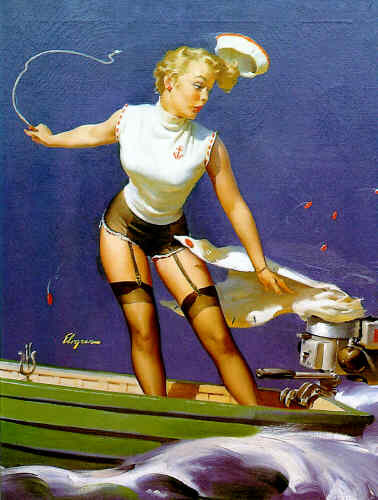
And this one, from 1954. Elvgren's girls always have such hilarious wardrobe malfunctions involving their skirts getting ripped off, stuck in machinery, or snagged on fences and nearby trees…
From the shoes, the images below seem to be from the 1920s or 1930s. Stockings from this era are also, apparently, quite recognisable for the sheen they give the legs; this is when semi-synthetic 'artificial silk' appeared; it was renamed Rayon in 1927. Nylon didn't come in until 1940.
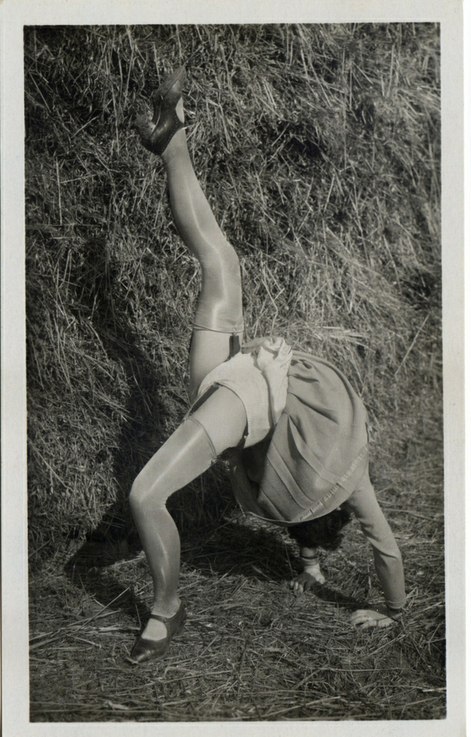
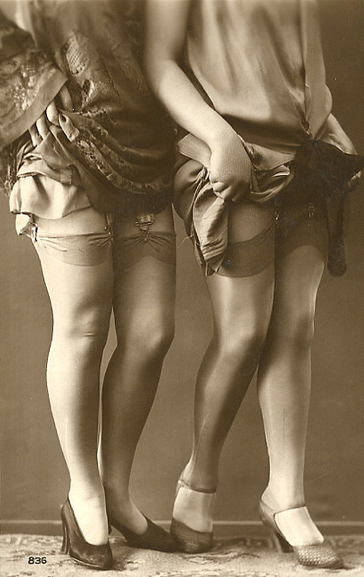
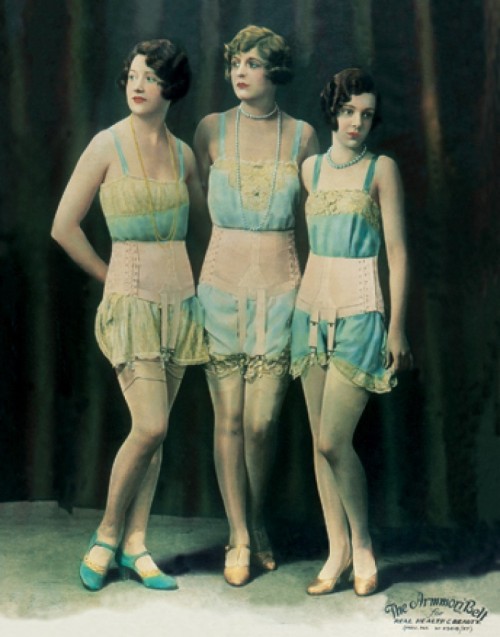
Here, we see a corset modelled over the top of the chemise or camiknickers, with attached suspenders. Also, notice how the purpose of the corset is not to cinch the waist but to slim and smooth the abdomen and hips. Speaking of corsets, these days they tend to be worn as an alluring undermost garment:

…but back in the day, when corsets were everyday items, you wouldn't do that because you would sweat into your expensive corset or get chafing, even abrasions. A chemise was always worn underneath, as in this image from the 1900s.

Note how the suspenders attached to the corset bunch up the chemise.
Blogger and US Civil War re-enactor Scott B Lesch noticed that his female colleagues were wearing their drawers under their shifts, as we might wear underpants under a slip. But he unearthed quite a few archival references to the earlier practice of tucking one's shift into one's drawers (which had no crotch seam; they were only attached to the waistband, so ladies could relieve themselves without getting undressed).
If you weren't careful, or the chemise was too long, it poked out the back and your little brother laughed at you:

At this time, stockings were held up with leg garters rather than suspenders, which were hidden under the chemise and drawers.
The trouble with using naughty postcards as source material is that they probably do depict sexually fetishistic practices from the time they were photographed. Take this image, for instance:

Whether or not it has been airbrushed, it almost certainly depicts a participant in a tight-lacing fetish culture. We're tempted to claim that everyone in "the Victorian era" tight-laced – mainly because of the moral panic media coverage about it at the time – but it was only a niche practice. We marvel at the tiny waist dimensions of corsets in museums, but of course they were seldom worn completely closed. Besides, women's bodies were trained to wear corsets from a very early age.
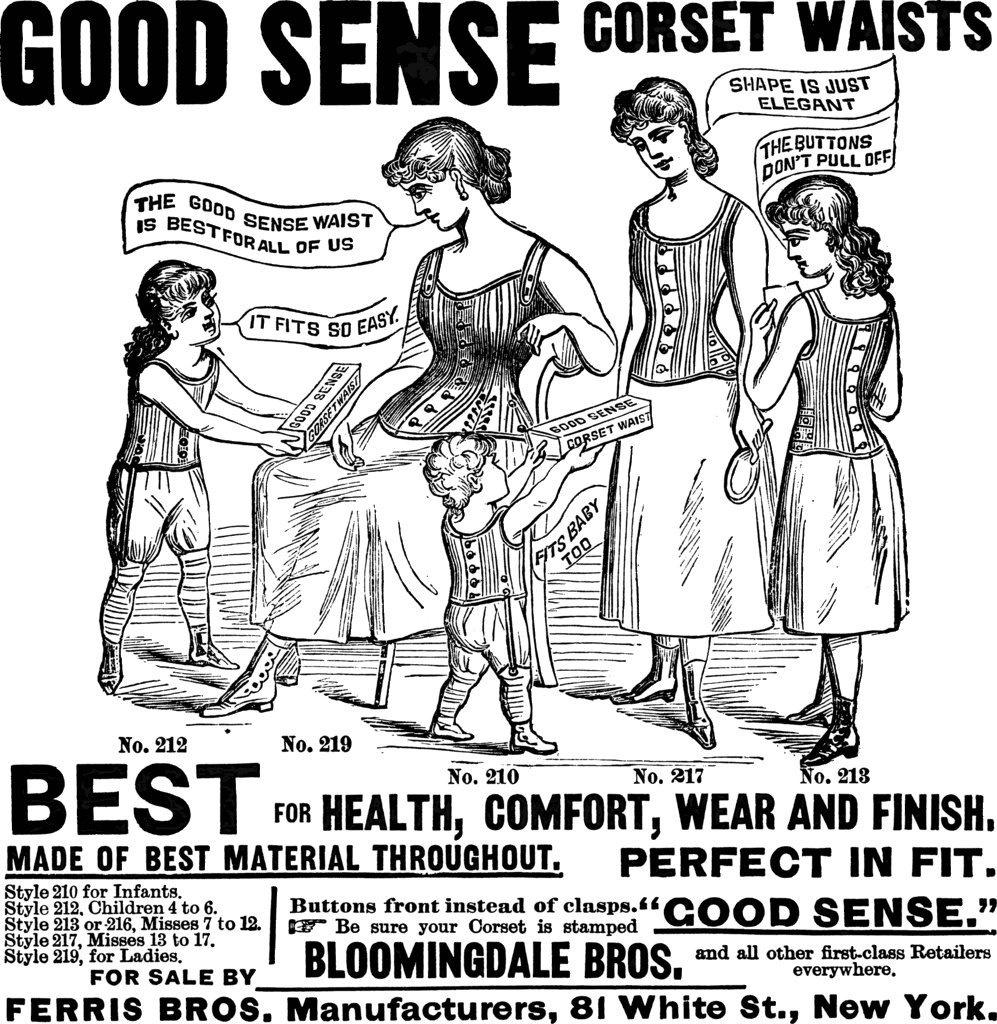
Meanwhile, advertisements for underwear speak so conspicuously of comfort and fit that we should be skeptical that they really depict the lived experience of wearing the underwear. A slightly different picture emerges when we look at the 'toilette' genre of art, which was basically an excuse for painters to depict women in attractive states of déshabillé.
While some of these paintings depict the fashion that began in pre-revolutionary France to invite people over to hang out and gossip with you while you got dressed, others depict women in a dreamy, vulnerable state somewhere between nudity and social visibility.

Woman at Her Toilette, Edgar Degas, 1876-77
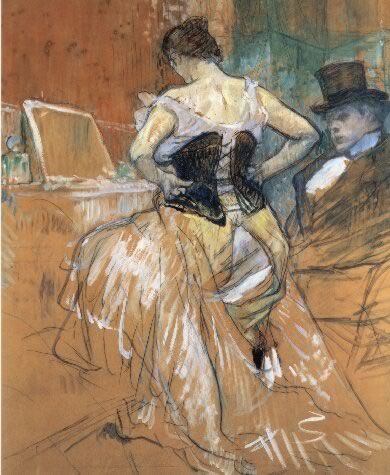
Femme à la Toilette, Henri de Toulouse-Lautrec, 1896.

La Toilette, Georges Croegaert, 1891
They also offer information about how and in which order garments were donned. In Pietro Longhi's Lady at the Toilette (1736), we see the decorative petticoat, neckline and sleeves that will end up peeping from the pink outer dress her maid is holding out.


But if we are to believe Nicolas-René Jollain's La Toilette, the hat always went on first.
But when we fetishise historical underwear – that is, focus obsessively on it as an object and imbue it with an almost magical meaning – we lose perspective on what it was like to wear these garments on an everyday basis. It's very difficult to view images of the past without bringing our own fetishes to them (Indeed, our ideas of how to wear and comport ourselves in old-fashioned underwear often come from our own narratives set in the past and vintage fetish imagery), or misreading historical fetishes as objective truths about the past. We should aim to tread a middle path.
When we think of 'sexy underwear', for instance, it seems commonsensical to wear a garter belt over underpants, as Dita von Teese does here:
But in pinup illustrations and vintage 'naughty postcards', we often see the undies worn over the garter belt so the suspenders emerge from beneath, as in this 1969 Gil Elvgren illustration:
And this one, from 1954. Elvgren's girls always have such hilarious wardrobe malfunctions involving their skirts getting ripped off, stuck in machinery, or snagged on fences and nearby trees…
From the shoes, the images below seem to be from the 1920s or 1930s. Stockings from this era are also, apparently, quite recognisable for the sheen they give the legs; this is when semi-synthetic 'artificial silk' appeared; it was renamed Rayon in 1927. Nylon didn't come in until 1940.
Here, we see a corset modelled over the top of the chemise or camiknickers, with attached suspenders. Also, notice how the purpose of the corset is not to cinch the waist but to slim and smooth the abdomen and hips. Speaking of corsets, these days they tend to be worn as an alluring undermost garment:
…but back in the day, when corsets were everyday items, you wouldn't do that because you would sweat into your expensive corset or get chafing, even abrasions. A chemise was always worn underneath, as in this image from the 1900s.
Note how the suspenders attached to the corset bunch up the chemise.
Blogger and US Civil War re-enactor Scott B Lesch noticed that his female colleagues were wearing their drawers under their shifts, as we might wear underpants under a slip. But he unearthed quite a few archival references to the earlier practice of tucking one's shift into one's drawers (which had no crotch seam; they were only attached to the waistband, so ladies could relieve themselves without getting undressed).
If you weren't careful, or the chemise was too long, it poked out the back and your little brother laughed at you:
At this time, stockings were held up with leg garters rather than suspenders, which were hidden under the chemise and drawers.
The trouble with using naughty postcards as source material is that they probably do depict sexually fetishistic practices from the time they were photographed. Take this image, for instance:
Whether or not it has been airbrushed, it almost certainly depicts a participant in a tight-lacing fetish culture. We're tempted to claim that everyone in "the Victorian era" tight-laced – mainly because of the moral panic media coverage about it at the time – but it was only a niche practice. We marvel at the tiny waist dimensions of corsets in museums, but of course they were seldom worn completely closed. Besides, women's bodies were trained to wear corsets from a very early age.
Meanwhile, advertisements for underwear speak so conspicuously of comfort and fit that we should be skeptical that they really depict the lived experience of wearing the underwear. A slightly different picture emerges when we look at the 'toilette' genre of art, which was basically an excuse for painters to depict women in attractive states of déshabillé.
While some of these paintings depict the fashion that began in pre-revolutionary France to invite people over to hang out and gossip with you while you got dressed, others depict women in a dreamy, vulnerable state somewhere between nudity and social visibility.
Woman at Her Toilette, Edgar Degas, 1876-77
Femme à la Toilette, Henri de Toulouse-Lautrec, 1896.
La Toilette, Georges Croegaert, 1891
They also offer information about how and in which order garments were donned. In Pietro Longhi's Lady at the Toilette (1736), we see the decorative petticoat, neckline and sleeves that will end up peeping from the pink outer dress her maid is holding out.
But if we are to believe Nicolas-René Jollain's La Toilette, the hat always went on first.
Thursday, April 26, 2012
The 40-year nostalgia cycle
Having written about nostalgia and re-enactment – and earlier about cycles of retro – I've just been pointed (thanks, Jess!) to this New Yorker piece by Adam Gopnik, who identifies a 40-year lag between history as experienced, and as re-enacted.
Gopnik argues that this happens because the creators and gatekeepers of pop culture are largely in their forties. "Forty years past is the potently fascinating time just as we arrived, when our parents were youthful and in love, the Edenic period preceding the fallen state recorded in our actual memories."
Perhaps this identification with one's parents (before they were parents) is an attempt to find a personal connection to the past that doesn't rely on one's own memories. It's literally intergenerational nostalgia.
When I see my friends posting pictures of themselves with their young children on Facebook, I imagine myself as those kids all grown up, looking back nostalgically at how happy and beautiful their parents were, unaware of how these dudes, my friends, are just getting through their day-to-day lives. It makes me melancholy.
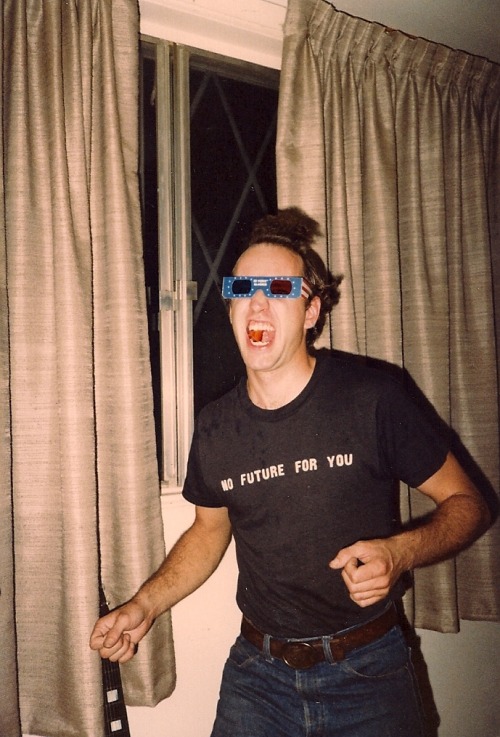
This image (from Dads Are The Original Hipsters) is undated, but the slogan on the T-shirt sounds like a riff on the Soup Nazi from Seinfeld – wittily contemporary, yet ominously true. Do we have no future when we constantly look to the past?
Gopnik argues that this happens because the creators and gatekeepers of pop culture are largely in their forties. "Forty years past is the potently fascinating time just as we arrived, when our parents were youthful and in love, the Edenic period preceding the fallen state recorded in our actual memories."
And so, if we can hang on, it will be in the twenty-fifties that the manners and meanings of the Obama era will be truly revealed: only then will we know our own essence. A small, attentive child, in a stroller on some Brooklyn playground or Minneapolis street, is already recording the stray images and sounds of this era: Michelle’s upper arms, the baritone crooning sound of NPR, people sipping lattes (which a later decade will know as poison) at 10 A.M.—manners as strange and beautiful as smoking in restaurants and drinking Scotch at 3 P.M. seem to us. A series or a movie must already be simmering in her head, with its characters showing off their iPads and staring at their flat screens: absurdly antiquated and dated, they will seem, but so touching in their aspiration to the absolutely modern. Forty years from now, we’ll know, at last, how we looked and sounded and made love, and who we really were. It will be those stroller children’s return on our investment, and, also, of course, a revenge taken on their time.Gopnik is onto something. There is already a movement to post online the youthful images of one's parents – and even grandparents or other ancestors – and to appreciate their clothes, their hairstyles, and their attitudes as cool and chic by today's standards.
Perhaps this identification with one's parents (before they were parents) is an attempt to find a personal connection to the past that doesn't rely on one's own memories. It's literally intergenerational nostalgia.
When I see my friends posting pictures of themselves with their young children on Facebook, I imagine myself as those kids all grown up, looking back nostalgically at how happy and beautiful their parents were, unaware of how these dudes, my friends, are just getting through their day-to-day lives. It makes me melancholy.
This image (from Dads Are The Original Hipsters) is undated, but the slogan on the T-shirt sounds like a riff on the Soup Nazi from Seinfeld – wittily contemporary, yet ominously true. Do we have no future when we constantly look to the past?
Historical re-enactment as political forgetting
Yesterday, April 25, was Anzac Day, an Australian and New Zealand national holiday to commemorate war dead. Ideologically it's best compared to the US's Memorial Day, as it arose from a specific conflict (in this case, oddly, a disastrous military blunder in April 1915 that unnecessarily claimed tens of thousands of lives) yet has become generalised as an event of national remembrance in a way that, ironically, Remembrance Day has not.
The motto of Anzac Day is "Lest we forget". It has become a ritual text, almost an incantation, along with the third verse of Robert Lawrence Binyon's poem For The Fallen, which is inscribed on many Australian war memorials:
For Sparrow, the political context of World War I has been almost entirely forgotten by an Australian population that thinks of war as a specific brand of hellishness utterly removed from everyday life, calling on a form of courage and sacrifice utterly lacking in civil affairs. Hence, it requires a response of horror and attempted empathy, rather than social or political critique.
I really recommend reading Sparrow's article if you've ever felt uneasy about the celebration of nationalist warriors as righteous Übermenschen. But what struck me as relevant to my project is Sparrow's observation about the increasingly common Australian pilgrimages to the Gallipoli peninsula, the birthplace of the Anzac mentality:
However, Sparrow's article has given me pause about whether the desire to empathise with the past is a worryingly anti-political gesture that evacuates the past of its context, filling it instead with today's political imperatives (even if that is, as Sparrow argues in this case, a political imperative to 'forget politics'). We are driven to re-enact things rather than to analyse or question them, because as Sparrow argues, "the question ‘what did it feel like?’ always implies a follow-up: ‘I wonder what it would be like.’"
There are, of course, many military re-enactment groups who gather on weekends to play out famous battles, and medieval or Renaissance groups who compete in mock-tourneys. On a wider level, many people re-enact favourite historical periods in their everyday lives by consuming goods from those periods – as 'commodity nostalgia'.
I've thought a fair bit about nostalgia. In 2010 I wrote an essay on whether there is an ethical dimension to nostalgia, or whether it is always anti-political, or politically conservative.
And in 2009 I wrote an op-ed on Mad Men theme parties as nostalgic events. In it I mentioned an exhibition of Australian modernist design from 1917-1967 that was showing at the time. At a public forum discussing the influence of modernism on design today, industry heavyweight Garry Emery remarked that people today focus on the aesthetics of modernism without considering its political aims (which ranged from utopian to iconoclastic).
I might also highlight the irony of this disconnectedness – that a design philosophy based on functional rather than aesthetic principles has come to be appreciated for its aesthetics alone. But I mention it here as it seems uncannily to foreshadow Sparrow's contention that, viewed retrospectively, aesthetics are anti-political.
My article appeared in the A2 lifestyle section of The Age and isn't archived online; however let me quote:
Who gets to be the expert on, say, corsets? Us, examining them in museums and in old advertisements and magazines, or dressing up in them for special events? Or the women who wore corsets on an everyday basis, the way we wear bras?
The motto of Anzac Day is "Lest we forget". It has become a ritual text, almost an incantation, along with the third verse of Robert Lawrence Binyon's poem For The Fallen, which is inscribed on many Australian war memorials:
They shall grow not old, as we that are left grow old:But Jeff Sparrow's current essay at Overland begins with a contentious claim: "Anzac Day celebrates forgetting."
Age shall not weary them, nor the years condemn.
At the going down of the sun and in the morning
We will remember them.
For Sparrow, the political context of World War I has been almost entirely forgotten by an Australian population that thinks of war as a specific brand of hellishness utterly removed from everyday life, calling on a form of courage and sacrifice utterly lacking in civil affairs. Hence, it requires a response of horror and attempted empathy, rather than social or political critique.
I really recommend reading Sparrow's article if you've ever felt uneasy about the celebration of nationalist warriors as righteous Übermenschen. But what struck me as relevant to my project is Sparrow's observation about the increasingly common Australian pilgrimages to the Gallipoli peninsula, the birthplace of the Anzac mentality:
The attendees at the dawn service do not ask themselves why Australians died invading a country thousands of miles away. No, that particular issue’s rendered inherently irrelevant, since the backpackers go there not to think about history but to marvel at the height of the cliffs and the sharpness of the rocks, and to feel an awe at people their own age experiencing horrors that they couldn’t imagine. The question arising from the pilgrimage is thus not ‘why did it happen?’ (a query that leads not only into history but into politics) but rather ‘what did it feel like?’, an aestheticisation of the past that’s explicitly anti-political. [my emphasis]For me Sparrow isn't really speaking of aestheticising the past, but of phenomenologising it: seeking an understanding of how it felt to live through the past. This is a key aspect of my project, because clothing fit is so clearly about phenomenology – about the experience of wearing clothes, as well as how one looks in those clothes.
However, Sparrow's article has given me pause about whether the desire to empathise with the past is a worryingly anti-political gesture that evacuates the past of its context, filling it instead with today's political imperatives (even if that is, as Sparrow argues in this case, a political imperative to 'forget politics'). We are driven to re-enact things rather than to analyse or question them, because as Sparrow argues, "the question ‘what did it feel like?’ always implies a follow-up: ‘I wonder what it would be like.’"
There are, of course, many military re-enactment groups who gather on weekends to play out famous battles, and medieval or Renaissance groups who compete in mock-tourneys. On a wider level, many people re-enact favourite historical periods in their everyday lives by consuming goods from those periods – as 'commodity nostalgia'.
I've thought a fair bit about nostalgia. In 2010 I wrote an essay on whether there is an ethical dimension to nostalgia, or whether it is always anti-political, or politically conservative.
And in 2009 I wrote an op-ed on Mad Men theme parties as nostalgic events. In it I mentioned an exhibition of Australian modernist design from 1917-1967 that was showing at the time. At a public forum discussing the influence of modernism on design today, industry heavyweight Garry Emery remarked that people today focus on the aesthetics of modernism without considering its political aims (which ranged from utopian to iconoclastic).
I might also highlight the irony of this disconnectedness – that a design philosophy based on functional rather than aesthetic principles has come to be appreciated for its aesthetics alone. But I mention it here as it seems uncannily to foreshadow Sparrow's contention that, viewed retrospectively, aesthetics are anti-political.
My article appeared in the A2 lifestyle section of The Age and isn't archived online; however let me quote:
In a sense, Mad Men parties are a hipper version of those much-maligned historical re-enactment societies. Both create a vision of the past that is self-consciously imaginary and ephemeral. Yet they allow participants to feel a mastery over the past by experiencing – with their eyes, tastebuds, the bodily sensations of unfamiliar clothes and hairstyles – what it might have been like to live it. [again, my emphasis]I feel anxious now about those words "mastery over the past", because I don't believe it's a good thing to feel that the passage of years allows us to understand history more perfectly than the people of the past understood it at the time.
Who gets to be the expert on, say, corsets? Us, examining them in museums and in old advertisements and magazines, or dressing up in them for special events? Or the women who wore corsets on an everyday basis, the way we wear bras?
Wednesday, April 18, 2012
Historical Disney princesses
If you're interested in historical dress, Disney or Tumblr, you have probably already come across Claire Hummel's illustrations in which she reinterprets the Disney princesses in outfits that are historically appropriate to the time when the films are set.
I came across them last year in one of those un-annotated Tumblr photosets whose origins were lost several hundred reblogs ago, but I've only just discovered Hummel's thoughtful, well-researched rationales for her choices.
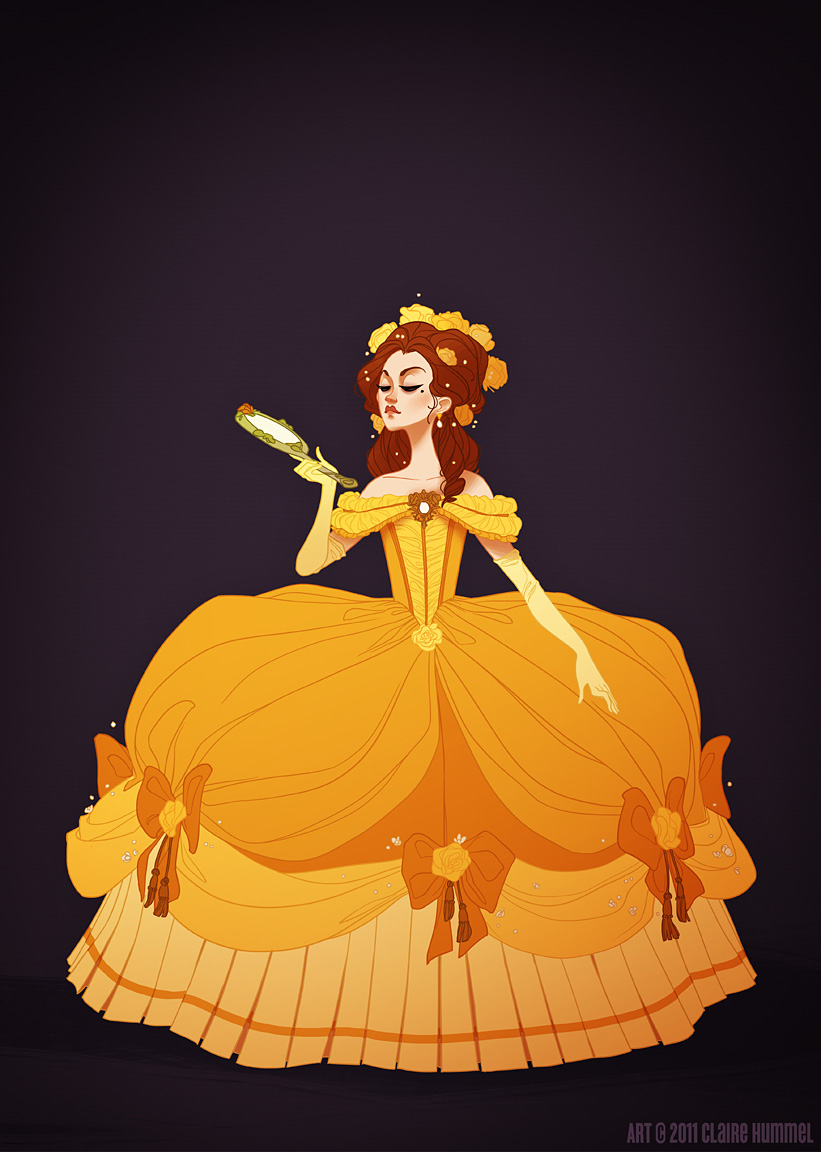
That's Belle from Beauty and the Beast, obviously. What I like about the images is that Hummel has worked hard to keep the recognisable tropes of the characters intact, while being imaginative about their historical contexts.
"Beauty and the Beast has always hovered hesitantly in the late 18th century (especially in the earlier concept art), so I redid Belle's gold dress to match 1770's French court fashion," she writes of this image.
It's fascinating stuff because the Disney films are already such 'impure' texts, with such hazy evocations of time and place, full of anachronisms and anatopisms. Of Mulan, Hummel says, "pinning down her time period stopped being fun and rapidly became a headache- you have the original legend taking place in the Wei Dynasty, the Huns as an actual threat during the Western Han Dynasty, the Forbidden City of the Ming Dynasty, the hanfu fashion setting it earlier AGHGHGhjffjhfghgjhkh".
And of Pocahontas: "the shell necklace should in theory be a deep purple (turquoise is a much more Southwestern commodity), but you lose so much of the Pocahontas visual identity without the splash of teal around her neck."
The project throws an agreeable doubt blanket on the entire idea of 'historical accuracy', about which it's really easy to get pedantic.
I came across them last year in one of those un-annotated Tumblr photosets whose origins were lost several hundred reblogs ago, but I've only just discovered Hummel's thoughtful, well-researched rationales for her choices.
That's Belle from Beauty and the Beast, obviously. What I like about the images is that Hummel has worked hard to keep the recognisable tropes of the characters intact, while being imaginative about their historical contexts.
"Beauty and the Beast has always hovered hesitantly in the late 18th century (especially in the earlier concept art), so I redid Belle's gold dress to match 1770's French court fashion," she writes of this image.
It's fascinating stuff because the Disney films are already such 'impure' texts, with such hazy evocations of time and place, full of anachronisms and anatopisms. Of Mulan, Hummel says, "pinning down her time period stopped being fun and rapidly became a headache- you have the original legend taking place in the Wei Dynasty, the Huns as an actual threat during the Western Han Dynasty, the Forbidden City of the Ming Dynasty, the hanfu fashion setting it earlier AGHGHGhjffjhfghgjhkh".
And of Pocahontas: "the shell necklace should in theory be a deep purple (turquoise is a much more Southwestern commodity), but you lose so much of the Pocahontas visual identity without the splash of teal around her neck."
The project throws an agreeable doubt blanket on the entire idea of 'historical accuracy', about which it's really easy to get pedantic.
Saturday, April 07, 2012
Fit as narrative in period film and television
At this stage, at least one chapter of my book will discuss ill-fitting clothes in popular culture, from Cinderella to The Incredible Hulk. But I'm already running into trouble when it comes to contemporary texts set in past eras.


Jane Austen's Pride and Prejudice was published in 1813. They've got Darcy's look down okay, but Lizzie looks absolutely wrong. Her hairstyle is totally '40s with the upper hair in a smooth puff and lower hair in rolls curled towards the neck, whereas fashion plates and portraits of the early 19th century depict a chignon on the back of the head with small ringlets softly clustering around the temples.
Meanwhile, the voluminous skirt, nipped waist and shawl collar of her dress are far more contemporary than the Empire-waisted columnar silhouette of the period. The middle image of the three below is closer to how young women would have dressed at that time (more 1813 fashion plates are here)

I also want to include this image to show that while we tend to think of 'Regency fashions' as being relatively stable over time, they altered just as fashion always has and still does. In the image on the far right, you can see the migration of the waist closer to its natural point, and the broadening of the skirt to a bell shape.
Mind you, sometimes period costumes are quite accurate. Here is Queen Victoria's 1840 wedding dress, which was vastly influential for wedding fashions (not least of all, the tradition of brides wearing white):

And here is the dress Mia Wasikowska wore in last year's Jane Eyre (costume by Michael O'Connor). Jane Eyre was published in 1847 but Jane's wedding took place several years earlier than her narrative.

As I wrote a few years ago in a feature article about period film casting, "what we really seek from contemporary historical cinema are emotional truths: impervious to anachronism, resonating down the ages to reassure us of the universality of human experience."
In the service of this universality, costuming is often used as narrative metaphor. For instance, contemporary period dramas often use corsetry and voluminous dresses to mimetically convey women 'trapped' or 'subjugated' by class and marriage (for instance, in Marie Antoinette, Titanic and The Duchess).
Mad Men is set in the 1960s but similarly seeks universal emotional truths, even though its meticulous strivings towards period-accuracy are a key marketing strategy. Season 5 episode 3, 'Tea Leaves', which aired last week in the US, has a storyline in which Betty has become a sad, fat hausfrau. In the opening scene, her children struggle unsuccessfully to help her do up her dress…

…and she has to plead "a women's thing" (which isn't actually a lie – wardrobe malfunctions are often presented as a feminine failing) to avoid the humiliation of being seen to have gained weight.

Meanwhile at chez Draper, Megan slips easily into her own dress…

and is promptly zipped up by Don, cementing that Megan has just as easily slipped into Betty's place at his side. What makes this juxtaposition quite unfair, however, is the issue of ease. Betty's dress is super-fitted, whereas Megan's is loose through the dropped waist.

Later, at the doctor's office, Betty wears a horrible, boxy synthetic knit jacket. "Betty Draper – I almost didn't recognise you!" says an acquaintance who runs into her. Throughout the episode, Betty wears garish housedresses and dressing gowns in bright synthetics, as opposed to the cool pastel palette and sleek, fitted lines she wore in the show's earlier seasons.
Universality aside, I really appreciated a line of dialogue in which dropping a few pounds is referred to as "reducing" rather than the more familiar (to our ears) "slimming" or "weight loss". I've just finished reading Calories and Corsets, Louise Foxworth's excellent cultural history of dieting, in which she extensively quotes diet books and advertisements going back centuries. While reading the book I was struck by the way "reducing" or even "reducing flesh" was a favoured 19th- and 20th-century turn of phrase, and so I was pleased to see it in Mad Men.
For a historian, it's reasonable to conclude that the attitudes towards size and fit displayed in a book, a film, a TV show, a comic book, etc, are those of the time the text was created. These change over time as texts are remade by new generations. For instance, think of the way the Batsuit has changed from Adam West's almost vulnerable-looking leotard and satin undies to Christian Bale's carapace-like Kevlar armour. And take a look at my old post comparing Honor Blackman's catsuit in the 1960s Avengers to Uma Thurman's in the 1998 movie.
But when it comes to period-set texts, we have a certain suspension of disbelief. We're prepared to take the author, the screenwriter, the production designer and costume designer's words for it that we are seeing an 'authentic' representation of a particular era.
But we are wise to be skeptical of these images as transparent visions of 'what it was like', because like any other reinterpretation of a text, they apply our own ideas about clothing size and fit. For instance, take what I reckon is the single worst-costumed period film of all time: the 1940 version of Pride and Prejudice starring Greer Garson and Laurence Olivier:
Jane Austen's Pride and Prejudice was published in 1813. They've got Darcy's look down okay, but Lizzie looks absolutely wrong. Her hairstyle is totally '40s with the upper hair in a smooth puff and lower hair in rolls curled towards the neck, whereas fashion plates and portraits of the early 19th century depict a chignon on the back of the head with small ringlets softly clustering around the temples.
Meanwhile, the voluminous skirt, nipped waist and shawl collar of her dress are far more contemporary than the Empire-waisted columnar silhouette of the period. The middle image of the three below is closer to how young women would have dressed at that time (more 1813 fashion plates are here)
I also want to include this image to show that while we tend to think of 'Regency fashions' as being relatively stable over time, they altered just as fashion always has and still does. In the image on the far right, you can see the migration of the waist closer to its natural point, and the broadening of the skirt to a bell shape.
Mind you, sometimes period costumes are quite accurate. Here is Queen Victoria's 1840 wedding dress, which was vastly influential for wedding fashions (not least of all, the tradition of brides wearing white):
And here is the dress Mia Wasikowska wore in last year's Jane Eyre (costume by Michael O'Connor). Jane Eyre was published in 1847 but Jane's wedding took place several years earlier than her narrative.
As I wrote a few years ago in a feature article about period film casting, "what we really seek from contemporary historical cinema are emotional truths: impervious to anachronism, resonating down the ages to reassure us of the universality of human experience."
In the service of this universality, costuming is often used as narrative metaphor. For instance, contemporary period dramas often use corsetry and voluminous dresses to mimetically convey women 'trapped' or 'subjugated' by class and marriage (for instance, in Marie Antoinette, Titanic and The Duchess).
Mad Men is set in the 1960s but similarly seeks universal emotional truths, even though its meticulous strivings towards period-accuracy are a key marketing strategy. Season 5 episode 3, 'Tea Leaves', which aired last week in the US, has a storyline in which Betty has become a sad, fat hausfrau. In the opening scene, her children struggle unsuccessfully to help her do up her dress…
…and she has to plead "a women's thing" (which isn't actually a lie – wardrobe malfunctions are often presented as a feminine failing) to avoid the humiliation of being seen to have gained weight.
Meanwhile at chez Draper, Megan slips easily into her own dress…
and is promptly zipped up by Don, cementing that Megan has just as easily slipped into Betty's place at his side. What makes this juxtaposition quite unfair, however, is the issue of ease. Betty's dress is super-fitted, whereas Megan's is loose through the dropped waist.
Later, at the doctor's office, Betty wears a horrible, boxy synthetic knit jacket. "Betty Draper – I almost didn't recognise you!" says an acquaintance who runs into her. Throughout the episode, Betty wears garish housedresses and dressing gowns in bright synthetics, as opposed to the cool pastel palette and sleek, fitted lines she wore in the show's earlier seasons.
Universality aside, I really appreciated a line of dialogue in which dropping a few pounds is referred to as "reducing" rather than the more familiar (to our ears) "slimming" or "weight loss". I've just finished reading Calories and Corsets, Louise Foxworth's excellent cultural history of dieting, in which she extensively quotes diet books and advertisements going back centuries. While reading the book I was struck by the way "reducing" or even "reducing flesh" was a favoured 19th- and 20th-century turn of phrase, and so I was pleased to see it in Mad Men.
Friday, April 06, 2012
Survey on retro and vintage sewing
A large part of my project is investigating retro and vintage fashion practices – that is, why people prefer the styles of the past over what's currently fashionable. 'Retro' and 'vintage' are often used interchangeably in mainstream culture; let me explain the differences I see between them.
I see 'vintage' as a specific retail fashion system that gleans original garments from past eras and sells them in boutiques, auctions, markets and fairs. For the shopper, the value of vintage is knowing the garment is authentically of a particular time, with a particular provenance. Similarly to the antiques market, the vintage fashion aims to capture and preserve past eras through the garments themselves.
Pardon my pun, but it's also a material culture, in that it's interested in a garment's industrial context – its fabrics, its labels, its designers, its manufacturers – that makes it representative of its time.
By contrast, 'retro' is an ethos as well as a retail logic. I argue that people who consume 'retro' are attracted to the overarching aesthetic of a past era – and an accompanying set of feelings and cultural associations – so authenticity is less important than semiotic fit.
If you're 'into retro', or a member of a retro-oriented subculture, you learn to seek out contemporary objects and experiences that look and feel like those of the era you love, even if they're not made the same way. While you ultimately prefer original stuff, reproduction stuff is okay too.
At the moment I'm interested in home sewing as an expression of these ideas. A vintage-oriented maker might be more likely to choose original clothing patterns, construction techniques, and fabrics and trims authentically of the right period. It would be very important to this maker to create a close replica of an authentic vintage garment.
On the other hand, a retro-oriented maker might be more likely to choose a contemporary pattern that just has a retro look, and more likely to alter it so it has a retro 'spirit' but is not entirely faithful to the way authentic vintage dresses would look.
Of course, these are just hypotheses at the moment. To make a start on excavating these issues, I've created a survey on size and fit in retro and vintage sewing. It only has ten questions and so is a very blunt tool, but I'm hoping it will lead me in directions that clarify my ideas, and will help direct my more in-depth interviews.
If you make your own clothes – either to vintage patterns, or to obtain a retro look – please help me out by completing the survey. And please feel free to forward the survey link to anyone you know who makes their own vintage or retro clothes. It's anonymous, but you have the option to leave your name so your comments can be credited in my finished book.
I see 'vintage' as a specific retail fashion system that gleans original garments from past eras and sells them in boutiques, auctions, markets and fairs. For the shopper, the value of vintage is knowing the garment is authentically of a particular time, with a particular provenance. Similarly to the antiques market, the vintage fashion aims to capture and preserve past eras through the garments themselves.
Pardon my pun, but it's also a material culture, in that it's interested in a garment's industrial context – its fabrics, its labels, its designers, its manufacturers – that makes it representative of its time.
By contrast, 'retro' is an ethos as well as a retail logic. I argue that people who consume 'retro' are attracted to the overarching aesthetic of a past era – and an accompanying set of feelings and cultural associations – so authenticity is less important than semiotic fit.
If you're 'into retro', or a member of a retro-oriented subculture, you learn to seek out contemporary objects and experiences that look and feel like those of the era you love, even if they're not made the same way. While you ultimately prefer original stuff, reproduction stuff is okay too.
At the moment I'm interested in home sewing as an expression of these ideas. A vintage-oriented maker might be more likely to choose original clothing patterns, construction techniques, and fabrics and trims authentically of the right period. It would be very important to this maker to create a close replica of an authentic vintage garment.
On the other hand, a retro-oriented maker might be more likely to choose a contemporary pattern that just has a retro look, and more likely to alter it so it has a retro 'spirit' but is not entirely faithful to the way authentic vintage dresses would look.
Of course, these are just hypotheses at the moment. To make a start on excavating these issues, I've created a survey on size and fit in retro and vintage sewing. It only has ten questions and so is a very blunt tool, but I'm hoping it will lead me in directions that clarify my ideas, and will help direct my more in-depth interviews.
If you make your own clothes – either to vintage patterns, or to obtain a retro look – please help me out by completing the survey. And please feel free to forward the survey link to anyone you know who makes their own vintage or retro clothes. It's anonymous, but you have the option to leave your name so your comments can be credited in my finished book.
Tuesday, March 27, 2012
Retro retro
So, Mad Men has just started up again in the US, sparking a fresh wave of general '60s nostalgia. But we shouldn't fall into the trap of thinking we are the first people ever to idealise the past.

"It doesn't take a Douglas Fairbanks Jr to know that … a paisley shirt and khaki trousers are indigenous to a Saturday afternoon stroll," Bryan writes. Indeed.
But as this truly amazing visual history of paisley illuminates, it first entered Western fashion from Persia, via India, in the first part of the 17th century. It was so crazy popular that a French royal decree banned its import between 1686 and 1759.
Whether imported, made in Europe or brought home from India by soldiers and colonialists as souvenirs, cashmere shawls with paisley weaves became status symbols for women by the early 19th century. The English term 'paisley' comes from the central Scottish weaving town that came to specialise in the textiles.
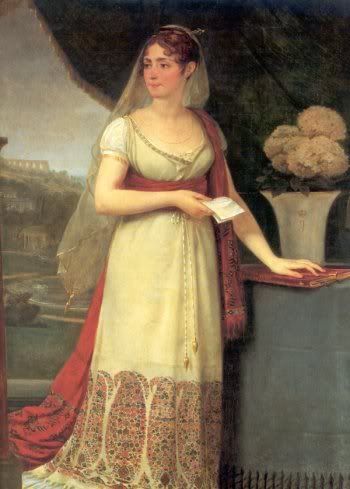
Empress Josephine, 1809
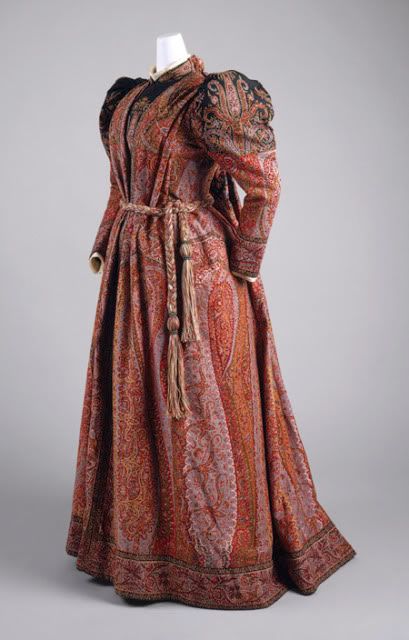
During the Victorian era, paisley shawls were a common outer garment for women. Old shawls were also used as linings in newer garments, or cut up and DIYed into informal robes and jackets like this one from 1890:
By the 1960s, paisley had gathered counter-cultural associations – perhaps because the Beatles and psychedelic rockers had reignited interest in India (the psych-rock influence is clear in Prince's 1985 song 'Paisley Park'), or because hippies were generally into 'ethnic' and 'folk' motifs? Perhaps it's with these connotations in mind that Faye Dunaway wore a paisley bandanna in 1967 to portray 1930s rebel Bonnie Parker.

All these layers of retro associations in one image. Paisley's use in bandannas also took on other contexts when these scarves were used as signifiers of gang colours. Snoop Dogg has never stopped Crippin'…

The films Midnight in Paris and The Artist, along with ABC TV's series Miss Fisher's Murder Mysteries, have sparked renewed interest in 1920s style; I found the images from my previous post on anachronistic fit while researching my Phryne Fisher costume for a costume party. No doubt Baz Lurhmann's version of The Great Gatsby will fuel the fire when it comes out early next year.
But as Lizzie Bramlett reminds us at The Vintage Traveler, the 1974 Robert Redford/Mia Farrow Great Gatsby film was just part of a general wave of 1920s and 1930s nostalgia during the 1970s. Art Deco, which had languished in popularity during the Atomic Age, enjoyed a comeback around this time, and there was a renewed interest in Golden Age Hollywood.
Take paisley, for instance. I associate it with '70s hippie clothing, and men's casual shirts in the 1980s and early 1990s. This picture, which I found at 'Ivy style' menswear blog The Trad, is from 'Clothes with Style', a 1985 article by legendary New York fashion journalist Robert Bryan, in the January 1985 edition of M magazine.
"It doesn't take a Douglas Fairbanks Jr to know that … a paisley shirt and khaki trousers are indigenous to a Saturday afternoon stroll," Bryan writes. Indeed.
But as this truly amazing visual history of paisley illuminates, it first entered Western fashion from Persia, via India, in the first part of the 17th century. It was so crazy popular that a French royal decree banned its import between 1686 and 1759.
Whether imported, made in Europe or brought home from India by soldiers and colonialists as souvenirs, cashmere shawls with paisley weaves became status symbols for women by the early 19th century. The English term 'paisley' comes from the central Scottish weaving town that came to specialise in the textiles.
Empress Josephine, 1809
During the Victorian era, paisley shawls were a common outer garment for women. Old shawls were also used as linings in newer garments, or cut up and DIYed into informal robes and jackets like this one from 1890:
By the 1960s, paisley had gathered counter-cultural associations – perhaps because the Beatles and psychedelic rockers had reignited interest in India (the psych-rock influence is clear in Prince's 1985 song 'Paisley Park'), or because hippies were generally into 'ethnic' and 'folk' motifs? Perhaps it's with these connotations in mind that Faye Dunaway wore a paisley bandanna in 1967 to portray 1930s rebel Bonnie Parker.
All these layers of retro associations in one image. Paisley's use in bandannas also took on other contexts when these scarves were used as signifiers of gang colours. Snoop Dogg has never stopped Crippin'…
Sunday, March 25, 2012
Forearms and sleeves

Today I had the sleeves of my T-shirt pulled up to just below my elbow as I was reading the paper, and when I happened to glance at them I quite liked the effect. I bought this top five or more years ago and sewed the lace around the collar and cuffs in 2010 as part of a costume for a party where we had to come dressed as our favourite kids' book character. I went as Burglar Betty from Alan and Janet Ahlberg's Burglar Bill:

…but at the time I couldn't find my copy of the book, and there were no images online of Burglar Betty, so I went by memory and ended up getting the colour of her top wrong, along with the fact it had plain cuffs, not lace. I didn't even wear a hat because I couldn't remember what it looked like.

The lace was just hurriedly tacked on for the party with the intention of unpicking it afterwards, but in the end I couldn't be bothered and it survived the wash anyway, so here it remains. The lace is not stretchy, so in order to still be able to push up my sleeves, I sewed the lace onto the cuffs at full stretch. Here's what they look like at my wrists:

The top is one of those cheaply made Asian imports and while the body and the upper arms are very tight on me, the sleeves are actually too long for me, even before I added the lace, and aren't tapered in the lower arm, so they're quite baggy. This is why I often push them up.
What struck me at the time was how gestural a three-quarter sleeve can make the forearm and hand look.

I'm not especially proud of my forearms or hands, but I like the way they look in this sleeve. It reminds me of the graceful look captured in 18th-century portraiture:

Queen Charlotte, by Thomas Gainsborough, 1781. Along with a portrait of Charlotte's husband George III, this hung in the royal dining room and was widely copied, coming to represent the 'official' royal portrait of the Georgian era. I love her graceful arms emerging from the lace sleeves.

Miss Susanna Gale, by Joshua Reynolds, c1763-64. This portrait is owned by the National Gallery of Victoria and is my favourite work in the gallery. I love Susanna's alert expression and the richness of her gown. She was the daughter of a colonial plantation owner and these paintings were commonly commissioned when the sitter went to study in England.
18th-century dresses seem designed to show off the forearm. They were closely fitted through the upper arm, and then cut shorter on the inner forearm while the sleeve continued over the elbow. The forearm emerged in a simple, elegant line, framed by the elaborate puffs of lace, ribbons, trim and ruching continuing past the elbow over the outer arm.

The best way to observe this effect is in portraits, as many museum garments are displayed on armless mannequins. This is a detail from The Marquise d'Aigurandes by François-Hubert Drouais, 1759. Fashion Is My Muse explains further how fashions in ruffled lace sleeves changed over the course of the century.
But I am more interested in the exposure of the forearm, because historically Western women's forearms have not been eroticised – although in Japan, their judicious display is part of the geisha's art. Today, men's forearms have become sexy. There's a photo gallery of 15 "super sexy" male celebs, some of whom aren't revealing more than a couple of inches' worth.
One fan of musician Raul Malo enthuses about how on stage, he rolls his sleeves up between songs:
Love long sleeve shirts with the sleeves rolled up just about two or three turns […] I'm not sure I can explain what it is that makes a sexy forearm but it has to do with the amount of hair on the arm, the tan, the musculature of the forearm, a refined wrist....not too thin, not too pale not too much hair or too little hair.Documentary series The Desire Project has an episode devoted to women's appreciation of male forearms. In the commentary of this blog post about the project, user @ilikemints says, in part:
[My boyfriend] got really confused. He had never heard of the male forearm as a sexy body part before, or what made a forearm sexy. I had to do an image search to show him, explain why that was a big part of why dudes in bands tend to get ladies even if they're ugly (he has been in bands for almost 15 years!), because playing guitars and drums get dudes' forearms ripped. He knew that women like guys' bodies, but had never really thought deeply about individual male physical attributes that had merit or were valued in any specific way, other than general "that dude's really muscular, most girls want that"…Perhaps it's in the name of gender contrast that popular culture does not encourage female forearms to be either muscular or slim. They are one of the few parts of the female body that can be plump. Instead, we tend to concentrate our arm-related shaming and resculpting on the fleshy upper arm. Remember the absurd mania over Michelle Obama's arms?
"You can cover up legs and bottoms, but many women lament their flabby 'tuckshop lady arms' or 'batwings' because they're often bared to the world," says fitness trainer James Menage in Woman's Day magazine, which alleges "flabby arm syndrome is on the rise." Meanwhile at Mamamia, women bemoan the difficulty of finding summer clothing with sleeves.
Some in the plus-size fashion community knowingly suggest that plus-size clothes are sleeveless so that shoppers will be coerced into buying shawls, boleros and short-sleeved cardigans as additional summer items. Those with an edgier, more activist bent argue that shoppers should not capitulate to pressure to disguise 'unflattering' aspects of their bodies. Plus-size fashion retailer Dream Diva includes in its manifesto:
In summer a plus size girl wants to enjoy the warmth of the sun on her skin just as much as anyone else. Strappy and sleeveless tops and short skirts and sundresses are what she wants to wear.Conversely, flaunting very muscular or thin arms is another kind of wardrobe malfunction. Last year I wrote in detail about UK tabloid The Daily Mail's war on sinew, which targets celebrities including Madonna, Sarah Jessica Parker, Renee Zellweger, Angelina Jolie and Courteney Cox. The raw disgust in the language the paper uses is quite extraordinary, as well as its dismay that these women continue to go out in public showing their sinewy arms to the world.
Sure you hear some plus size women saying that they want to cover up their upper arms and that they prefer to wear dark colours because they create an illusion of a smaller body shape. But these plus sizes are the exception to the rule.
The "now" plus size girl is not afraid to show off her curves and is proud of who she is and is happy in her own skin.
Subscribe to:
Posts (Atom)