Saturday, May 09, 2009

Further thoughts on colour

Since I first posted about my resolution to dress for colour this winter, I have realised just how little colourful clothing I own. I really don't have enough to do top-to-toe layering in more than a few colours. Reds, pinks, purples and blues, mainly – dressing for colour is a great way of getting a fresh perspective on your wardrobe.

Sadly for my wallet, dressing for colour has also been an excuse to buy colourful new clothes. I have been getting a lot of wear out of a bright apple-green cardigan that I got from a cheap-shop, and I went to Cotton On, where I purchased a large red patterned scarf, a magenta scarf in T-shirt material (purely so I would have something to match with my new harem pants), a pair of turquoise leggings and two men's T-shirts in sky-blue and red (on special for $5 each).

It's interesting that I had to raid the men's department to find bright colours in winter. I'm quite shocked at how few colourful clothes are in shops right now. I can walk into a shop and from its entire winter range, I can pick out only three or four garments colourful enough to interest me. Even tights this year are in muted colours, and the availability of brightly coloured opaques is usually something you can count on in winter. On the flipside, this is a wonderfully economical way to shop.

This experiment has made me realise how cruelly my dress sense was previously governed by silhouette. I used to choose outfits based on how they draped, revealed and concealed my body. However, the new regime of colour is much looser and more layered, far less neat and preppy than what I would wear in the past. Yet I don't feel sloppy or frumpy; the bright colours make the outfit look carefully assembled.

I'm also finding I'm far more adventurous with contrasting and clashing colour combinations, such as red and purple, orange and pink, and yellow and blue. However, as I think I may have written on this blog before, I just can't bring myself to wear green and red (too Christmassy), yellow and green (too Aussie) and blue and red (too much like Superman).

Another thing I've decided to do is to layer clashing prints as well. So I'll have polka dots with checks with florals with stripes with geometric prints, but all in the same colour family so they blend together. Or I'll layer several different-coloured versions of the same print: maybe a striped dress with a differently striped top underneath. I really liked this look from the Sartorialist's recent trip to Australia (although I must say his coverage of Melbourne was really pitiful – why do we persist in giving overseas visitors the misleading impression that Chapel Street is Melbourne's fashion hub?).


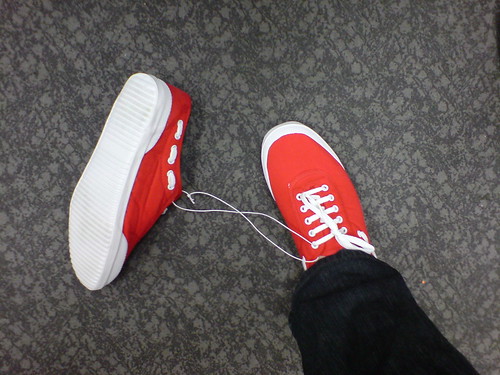
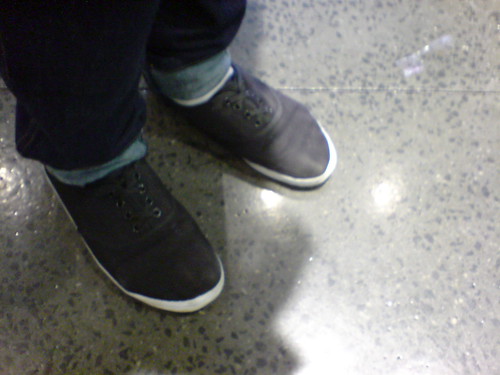
Here is a bizarre photo montage of my outfit from yesterday. I was very uneasy with it at first, but then as the day wore on I got happier and happier. By the time I was walking down a drizzly Swanston Street at 11:30pm, surrounded by people wearing dull black, grey and other wintry colours, I felt wonderful, like a peacock. I didn't care whether I looked ridiculous or not.


This is my outfit today. You can see my recent acquisitions, the apple-green cardigan and the blue T-shirt, and I realised that the necklace was the same colour as the T-shirt. There's a history to the scarf: my mother made it for me only recently from some remnant fabric she found while cleaning out a cupboard.

It's a dark turquoise microfibre (it came up lighter in the photo) that I picked out in 1993 for a dress my mother made me to wear to my year 10 school 'semi-formal' dance. My friends and I ended up getting extremely drunk before the semi-formal and then were horribly, publicly sick at the event itself. The next day, my dad took my dress to the dry-cleaner where he met my school vice-principal, who was getting her own dress dry-cleaned.

The dress was never the same after the dry-cleaning, I have to say. I wore it only once more, as an in-joke, to my year 12 valedictory dinner, and I have long since fattened out of it. But the scarf is a fun reminder of the whole debacle.

The sharif don't like it

Almost a month ago I was in Supré, "just to see what they had", and I came away with three new garments: a pair of red tartan leggings, a pair of black harem pants, and a pair of what can only be described as magenta three-quarter-length MC Hammer pants.


They also had them in violet and in black. I don't know why I bought the magenta ones, because as I've mentioned, magenta is one of those colours that looks wonderful and vibrant in the shop, but that I find really difficult to match to the rest of my clothes and accessories.

The label described the magenta pants as having a 'drop crotch'. Reader, this was not true. The 'rise' of the pants (the space between the waistband and the crotch) was actually smaller than the average pair of pants, and if not worn very low on the hips, they were horribly tight and bunchy in the crotch. I actually undid the crotch seam and re-sewed it lower down to loosen up the pants.

2009 is definitely shaping up as The Year Of Drop-Crotch Pants. These have been hanging around (pardon my pun) since at least 2007, then Radar was sure they were heading mainstream in 2008, but it's only this year that mainstream fashion commentators have started talking about them and Australian designers have started including them in their collections. And, of course, they've trickled down to fast-fashion stores such as Supré.
These aren't so much your traditional harem pants that are voluminous all through the leg and then gather at the ankle. Rather, they're in cotton jersey material and are pleated or gathered at the waist or hip and voluminous to the knee, then tight or ruched to mid-calf or ankle.

Fashion Flux has an interesting 'pattern' for making your own – just get some stretch jersey fabric and use your favourite leggings as a template, but make the crotch lower and allow more material around the thighs. Livejournal user Moohoop went one better and converted an old windcheater into drop-crotch pants – an idea of such simple genius that I want to run to the op-shop right now to do the same.
Many observers seem to have a problem with drop crotch pants because they distort the body's 'natural' silhouette, making the legs look ridiculously short and the body too long – "like a penguin", was one response. Other people think they're unflattering on all but the tallest and thinnest body shapes. Others can't get over the '80s/'90s-ness of them – they are ashamed to look like MC Hammer. Some think it looks as though you've pooed your pants. And others think drop crotch pants just look badly designed or fitted, as though the wearer has borrowed someone else's clothes.

The counter-argument is "but they're so comfortable!" Especially because they're usually made from soft material that drapes nicely, drop crotch pants are kind of the fashion-forward version of tracksuit pants. They're also far more forgiving on the body than leggings – which are still being worn as pants, despite at least two bloggers' outrage. You don't need to worry about visible panty lines, cameltoe or polterwang. And the pants skim right over the wobbliest parts of your legs.

A related phenomenon is boyfriend jeans, so-called because they're so baggy and oversized they look borrowed from the man in the wearer's life. The way they're often worn with the cuffs turned up also reminds me of harem pants, because this tends to draw the jeans in at the ankles. Also, men's jeans tend to have longer rises and more room in the crotch, which, when worn by women, creates the drop-crotch effect.

These jeans, too, are about comfort – as well as the actual fit, they imply the comfortable domesticity of having a man about the house whose clothes you casually borrow. It's curious to think that in a way, boyfriend jeans are another kind of harem pants in that they suggest the wearer 'belongs' to a man, just as an odalisque or concubine belongs to the sultan. Could drop-crotch pants, with their radical de-emphasising of a woman's buttocks, crotch and thighs, be suggesting that the wearer isn't sexually available to the viewer – that she's already 'taken'?

Saturday, April 11, 2009

True colours

On Tuesday I bought a pair of harem pants (more on this later) in magenta. The pants were available in black, violet and magenta, and for some reason, magenta is one of those colours that I buy because it seems really striking when it's on the rack, but then I find it really difficult to work in with my other clothes when I get it home.

The same is true of some other colours I love. There's a blue that I call cornflower blue but (according to my computer monitor) is closer to Persian blue. I first bought this as a T-shirt, then another T-shirt that's orange with stripes of this blue, then I bought matching canvas ballet flats, and after a very drawn-out search for accessories in the same colour, I was very excited to find an Indian silk scarf in this blue in a $1 basket at Camberwell Market.

Another colour I'm obsessed with is a light orange-red (scarlet?). I first became obsessed with this colour in lipstick and nail polish, but I now own several T-shirts in various hues of it, plus several scarves. I own a lot of red clothing, but it varies between a 'true' medium red (stop sign red), a faded medium red, a blueish red and a rich ruby red.

Being from Melbourne I own a lot of black clothes – I now own five pairs of black pants, four black skirts, two black cardigans, four black jackets, three black dresses, and so many black tops that I have to pick them out by the feel of the fabric when I want to wear one in particular. Sometimes I get into hopeless rages because I can't find the particular black top I want, and I have to empty them all onto my bed to sort them out.

When I feel especially despondent about the way I look, I will wear black because it is easy to look 'put together' in an all-black outfit. But in shops, I prefer looking at colourful garments. Today I was in French Connection and I was drawn to a bold orange winter jacket with square buttons (they want $260 for it, tell 'em they're dreaming!) and some knitwear in oranges and apple-greens… purely because these things stood out from the boring blacks, greys and navies in the rest of the store.

So this winter I have decided to dress for colour rather than for silhouette or texture. Being a fat chick, I find dressing for silhouette quite dispiriting because I simply don't look good in many sculptural clothes: for instance, nipped-in waists with voluminous skirts, tops tucked into high-waisted pencil skirts, or form-fitted dresses with voluminous sleeves.

Dressing for texture I see as something ageing women do to show they're still 'in fashion' while wanting to de-emphasise their bodies. So they'll layer different textures with stuff like scrunched-up satin, embroidery, fringing and beading, knits of various gauges, and varying amounts of sheerness and opacity. Maybe I'm wrong about this being something that older women do, but I think it can be quite ageing on young people.


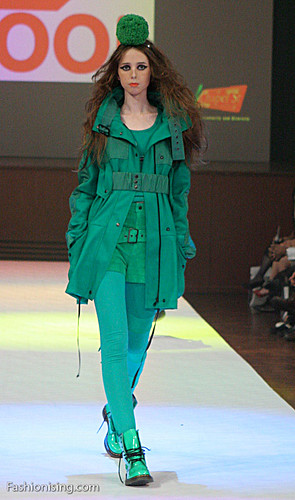
Fool, 2009 L'Oreal Melbourne Fashion Festival. Image: Fashionising.com


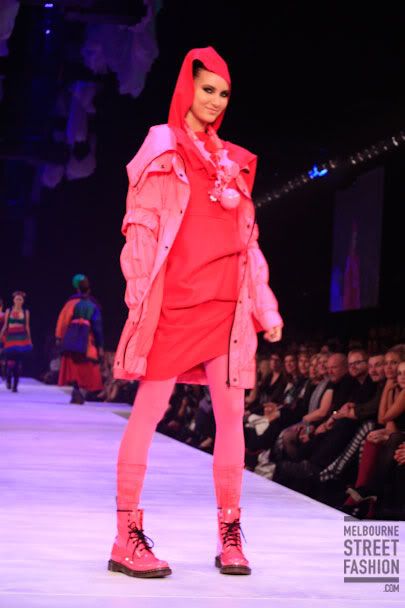
Fool, 2009 L'Oreal Melbourne Fashion Festival. Image: Melbourne Street Fashion

I was really inspired by Fool's collection at this year's Melbourne Fashion Festival. They brought out some models in very bright contrasting colours, with playfully oversized knit accessories. But my favourite outfits were the ones that layered different shades of the one colour. I think it looks really striking.

I was also really inspired by the outfits that Isla Fisher wears in Confessions Of A Shopaholic. I love the bright yellows, pinks and oranges she wears, and I especially love her colourful leather gloves.


So my strategy this year is to wear relatively soft and shapeless garments, but to layer different shades, or wear bold contrasting (or even clashing) colours. I even want to wear clashing prints, such as polka-dots with tartan or different florals together. I would try to make sure that there was a common colour in all the prints to hold the look together.

The risk you run with colour layering is that you look like a batty old lady. Here I always think of Linda Jaivin when she appeared on that old ABC arts panel show, Critical Mass, always with her red glasses and red accessories. I find it embarrassing when people have a 'signature colour' and that's all they ever wear.

The opposite risk is that you look matchy-matchy, which is my word for the sad result when you can tell someone has attempted to match the colours in different parts of their outfit but it looks very timid and fussy. For instance, the other day I saw a woman wearing a pink top, grey pants and pink shoes – but they were the wrong shade of pink. Her top was more like a salmon colour, whereas the shoes were fuschia. You could almost imagine her thought process while getting dressed that morning: "Yeah, I'll wear my pink shoes".

I used to mistake matchy-matchiness for elegance, but (largely after reading The Sartorialist) now I feel it's much more elegant to echo the colours of an outfit rather than attempt to match them precisely. You don't want to look as though you're in uniform: you want several small colour details to leap out at the eye.

Today I am wearing my fuschia Hammer pants with my cornflower blue T-shirt, scarf and shoes. I am wearing a black cardigan over the top but for once I don't feel it's too 'Melbourne' of me, as in this new way of thinking, the black is the highlight colour rather than the base colour.

Saturday, November 29, 2008

Lamb dressed as mutton

Today I picked up my new glasses. I haven't bought a new pair in years and years. The frames I desperately wanted looked like this:


They are by iconic American optical company Shuron. The model is called Ronsir, or as I first thought of them, "Malcolm X glasses". The style is known as browline after the heavy top half and lighter metal bottom half of the frame, but they're also colloquially known as "G-Man" glasses, I guess because they were hugely popular in the '50s and '60s, the period when lots of FBI-themed movies are set. Annoyingly, they're becoming more popular now that people are seeing the style on the TV show Mad Men.

Ray-Ban also makes a style of sunglasses like this called Clubman. Belinda Carlisle wears them in the video for 'Mad About You', which I've always thought was unbelievably cool. With her little black dress and voluminous bob haircut, she reminds me of an '80s version of Marilyn Monroe. Unlike the gimmicky stuff that most kids today think of as '80s, this video reminds me of what I longed to look like back then. I loved Wendy James from Transvision Vamp as well; I thought she was so glamorous and sexy.

The thing that I like most about this style is that it instantly makes me look cooler. I don't especially want to look ultra-hip, but I can't stand looking like a dorky laughing-stock either. I often agonise over this. One of the main shortcomings of my failed leather jacket is that, rather than make me look instantly twice as cool, it makes me look twice as dorky. Now I can only ever wear the leather jacket with some ridiculous hipster get-up, so that the dorkiness and the hipsterness cancel each other out and I represent a modest, acceptable amount of cool. Anyway, the point of these frames is that even a fairly drab outfit will instead look "minimalist", and a potentially frumpy one will look "eccentric".

Australian shops don't really stock browline glasses, and when they do, it's mind-bogglingly expensive. I went to Henderson Optical, where I was told that to get a similar frame from Japanese label Dita, with my lenses, would cost me about $800. For crying out loud! In the end I bought a pair of vintage Ronsirs from eBay a couple of weeks ago. Even with the terrible Aussie dollar exchange rate, the cost of postage and of getting my prescription lenses put in, they'll work out at about half the price.

But along the way I was tipped off about an optometrist in Clifton Hill that might have what I was looking for. Turned out they didn't, but they did have a very attentive (probably bored; I was the only customer in the store) sales assistant who didn't give up when I disliked most of the Sarah Palin-esque frames in the store. She went out the back to rummage in boxes of old and sample stock.

The older and uglier the frames she brought out, the more I liked them, and eventually I got very enthusiastic about a pair of pink plastic grandma frames that, the assistant informed me, she'd got from their "Veteran's Affairs box" - the super-cheap, ugly frames they keep for pensioners. All up, these glasses cost me $270, and I'll admit that it was the price that ultimately won me over.


Today I went and picked up the glasses, and so far I'm disappointed. I wanted some kind of reverse librarian effect: where instead of being told you're beautiful when you take the glasses off, you put them on and instantly your look comes together. However, I look like a bad babysitter who has murdered her young charges. Sorry about my dreadful posing, but this was actually the best of a very bad lot of pictures. The way the frames cut off the tops of my eyes is no good either.

After I picked them up I went for brunch, and I was paranoid that the waitresses were staring at my glasses in order to make fun of me in the kitchen. At first I gloomily figured I looked like Estelle Getty from The Golden Girls, but some picture research shows that her frames are much larger and more owlish than mine. But there's another woman I look like, I'm sad to report:


God save me!

This episode has made me think about how people "pull off" ostensibly unflattering things. I am just going to have to become the sort of person who looks awesome in pink old-lady specs, but I am going to have to rethink my ways of dressing. I will need to dress very boldly and sexily, avoiding all the neat, preppy things I generally like to wear (like this scarf, for instance), because now they make me look like lamb dressed up as mutton.

I have more thoughts about "pulling it off", but they deserve a post of their own.

Thursday, November 20, 2008

The vintage/op-shop debate continues

This time it's about the ethics of mining op-shops for clothes and reselling them in vintage shops or on eBay. Miss Patrice wrote an angry post targeting Sarah from Foreva Young Vintage, basically, it seems, for being too entrepreneurial. (Patrice has now edited the post to reflect that Sarah is only one of many resellers who source their stuff from op-shops.) Now the topic has cropped up on I Op, Therefore I Am.

Most of the commenters on the latter blog say they have no problem with resellers and feel they deserve any profit they make from such a labour-intensive enterprise. Defending themselves, the resellers make ethical arguments about saving garments from landfill, or about catering to demand from buyers who don't have easy access to op-shops.

Another comment, which I thought was quite shrewd, was that eBay is now many people's first resort for getting rid of unwanted stuff, so the "good stuff" that all op-shoppers are after sometimes bypasses the op-shop economy altogether these days. (What precisely is "good stuff" depends on the op-shopper's tastes.)

My own feelings on the matter were echoed by an anonymous commenter who wrote:
I don't object to reselling but I don't like the way it's become such a theme on this blog. Somehow a great find doesn't seem so great if you just bought it to sell it.

Another thing that bothers me - and I have posted this as a comment on the blog - is when garments bought in an op-shop are mutilated to make them conform to a more contemporary aesthetic. I write 'mutilated' deliberately, because I see garments being altered in ways that don't respect their original designs. To me this seems to miss the point of vintage: and admiration for the styles of the past.

Of course, I've bought things from op-shops with the intention of cutting them up, re-sewing them or otherwise changing them - but only for me to wear. If you're planning to sell these things to other people, then who are you to decide what's "wearable" and what isn't? Surely that's something a buyer decides for themselves, using their own tastes?

Alternatively, perhaps these people who both resell and mutilate consider themselves creative: what they are selling is a certain look. It's akin to being a fashion designer who works only with second-hand materials. Again, I have no problem with this... unless the clothes are being sold as 'vintage'. You simply can't have your cake (trading on the cachet of vintageness) and eat it too (hacking those vintage garments up so they no longer have their vintage shapes).

Monday, October 06, 2008

It's not called Sidewalk Zeitgeist

Lately I've been noticing Australian fashion bloggers (especially Foreva Young Vintage and Fashion Hayley) describing the process of second-hand shopping as "thrifting". This isn't a dig at these blogs - I enjoy reading them - but this "thrifting" bizzo really grates on me, because "thrift stores" are what they call op-shops in the United States. (In the United Kingdom they're mostly called "charity shops".) We are not Americans, so why do we have to use their words?

It might seem like a petty complaint, but it seems to evoke a certain cultural cringe: that Australians inevitably take their fashion cues from overseas. But perhaps I'm just hypersensitive to (and more than a little sick of) the studied curatorship that goes into buying clothes second-hand, given that I've just written a post about the way that the fashion press uses "vintage" as a synonym for "personal creativity", and because I recently wrote up a vintage clothing market for ThreeThousand.

I have the unsettling feeling that when they're op-shopping, some fashionable chicks see themselves as part of a global aesthetic culture of "thrifting" rather than a local affective culture of "op-shopping". There seems to be very little thinking about how garments have histories, often local histories, and how the garment resonates with the buyer's own history. Instead the op-shop is treated as a resource for cheaply acquiring (and even on-selling via eBay) on-trend clothing that is emptied of its previous history so it becomes 'new' to the buyer.

By way of contrast, I've really been enjoying reading the collaborative op-shopping blog I Op, Therefore I Am. I found out about it when I was invited to blog there, but I figured that since I already blog in three regular places, none of which is specifically about op-shopping, I'd be over-committing myself. What I enjoy most about this blog is that it isn't just about the 'vintage' logic that seems to dominate the thinking of the fashion blogosphere.

Instead, the bloggers - and there are heaps of them - visit op-shops around Melbourne and Victoria and report excitedly on their finds - not just clothing. Some things I get excited about too, and some leave me cold. Some I think are embarrassingly daggy. But the striking part is how these purchases go on to enrich the lives of their new owners. These objects have meaning aside from their aesthetic meaning. It's the amateur still life painting that sits in the buyer's bathroom for her to enjoy as she brushes her teeth, wishing she could tell the anonymous painter how much she likes it.

So when I think of "thrifting", I think of the hipster's pursuit of a distinctive look, but when I think of "op-shopping", I think of shopping practices that recognise the ways that an object's history creates affect, or feeling, in the buyer. I know I was recently overjoyed to discover the twin of my favourite coffee mug for $1 in the Don Bosco op shop in Brunswick - it seems so serendipitous that for so little money, you can find something that's already special to you.

Friday, September 26, 2008

On 'vintage' and 'stylism'

God help us all, boho is back, with its jangly, awful baubles, cheap-looking pleather accessories and scrunchy, wafty 'ethnic' clothes that make everyone look less like folk singers from the '70s than refugees from suburban op-shops full of discarded boho crap from the last time this rubbish was in fashion. I hated it back when it was championed by the dread Sienna Miller and I still hate it now. Such was my annoyance that I've just written a story for the A2 section of The Age - it should be in tomorrow's paper - about why boho is such an empty look yet people really seem to love and embrace it.

In particular, I argued that a logic of individualism is crucial to boho, and I tied this into the ways that mainstream fashion appropriates and decontextualises second-hand cultures. As Nicky Gregson and Louise Crewe argue in their book of the same name, and as I touched on in my post on ethics, plenty of people shop second-hand simply in pursuit of bargains - but just as many are in pursuit of distinction, either by demonstrating their mad bricolage skillz or by ensuring few other people will own the same items as them.

But within mainstream fashion systems, "vintage" styles are re-worked and brought back in a way that highlights their retro-styling and general 'old-schoolness'; according to this logic, there's no point wearing second-hand clothing if it could pass for something you bought new. (There are "designer recycle boutiques" that do specialise in second-hand clothing that looks new, but they tend to privilege 'designer labels' and 'pristine condition' rather than an overtly anachronistic look.) And 'vintage' transmutes the rituals and skills of personalisation that surround clothing in the second-hand fashion system into a hazier idea of "personal creativity". This happens both in the retail environment and in fashion journalism.

We all know that "vintage" is a much-abused term because it enables shops to ask large amounts of money for garments that are simply pre-worn - or even merely retro-styled. Owners of "vintage stores" openly buy up bulk clothing from flea markets, op-shops, garage sales and estate sales, carefully curating them and then marking the prices up vastly. These are the people who rock up at your Camberwell Market stall at 7am and go through your car boot with a torch before you've even unpacked. You'll also see them at Savers with shopping trolleys piled high.

This is starting to happen in high-street retailers too as they realise the market for 'vintage'. For instance, Sportsgirl is currently selling second-hand cowboy boots for something like $150, but rather than the motley collection of items you fossick through at a second-hand store, they've been carefully picked to look similar. What's more, they're displayed alongside a rack of dresses that are marked "vintage" but, similarly, have a look of extreme curatorship in order to make them 'match' both each other and the new goods elsewhere in the store.

It's easy to scorn people as dumb bunnies for buying their clothes this way, but while it's definitely a move away from the skill set that's required to fossick through heaps of old clothes and choose the right garments (the vintage clothing dealer has done all the hard sifting for you), there is still a certain feeling of pride and creativity that comes from saying, "It's vintage" when someone asks you where you got something. Here, "vintage" means, "I'm too individual to settle for mass-produced new clothes", even though the 'vintage' garment was almost certainly worn on a mass scale whenever it was new. More subtly, it also means, "I'm sophisticated enough to redeploy the styles of the past, not just wear whatever's new" and of course, "No, you cannot buy this item yourself, it's all mine."

I guess for me the question right now is: "How do we make clothing our own?" Too often, fashion writing answers that question through a logic I could call "stylism". Stylism is the belief that having a coherent and identifiable 'personal style' is the yardstick of chic. It's a somewhat counter-intuitive move from a fashion press that spends most of its time prescribing what to wear, but some people are held up as possessors of an ineffable logic of creativity and bricolage that enables them to render old ideas new, either through recombination or by recontextualisation. The rest of us can learn to attain that logic ourselves through observation (especially in 'street style' discourse) and copying.

A key aspect of stylism is its irritating insouciance: it must appear completely effortless. It must appear to stem from your brilliant personality and your fancy-free whims rather than a calculated attempt to stand out from the crowd or surf the waves of breaking trends before everyone else. Successfully cultivating a personal style requires a very high level of fashion literacy, or else a complete ignorance of fashion altogether - a kind of Forrest Gump-esque holy fool approach of getting it totally right, totally by accident.

Boho is a triumph of stylism because the most retarded things can be worn together and rather than being pitied for dressing like a pretentious git or a bedraggled hippie, the wearer is praised for their free-spirited originality and their stupid outfits actually trickle down into mainstream fashion stores. It's the central paradox of stylism that while it champions individuality, it ends up being so prescriptive. It's not an intellectual logic, it's an intuitive one; and because it's so hard to put your finger on how a particular style comes together, all you can do is copy it dumbly.

Monday, September 15, 2008

The Golden Plimsoll


It sounds like some kind of award for hipsterism. (Ceremony to be held at McCarren Park Pool, hosted by Steve Aoki. How many Plimmys did Agyness Deyn win this year? Best New Hipster Plimmy for MGMT. Lifetime Achievement Plimmy for Dave Eggers.)

Anyway, as you can see, back in August I bought a pair of hipster plimsolls, the silliest Big Dubs had to offer. I had to splash out on a pair of insoles because it was like walking around on pancakes. Still, I am enjoying them.

Moments in the limelight

Last week the issue of Meanjin in which my article appears was released. The article turned out to be quite stressful to write and I'm pleased that it appears to make some sense. So when I got to the end and realised it still didn't have a title, I was somewhat dismayed to remember that, unlike journalism - in which you simply call it "Leather Jacket Story" and the subs will do the rest - journal articles require you to invent a title yourself. Usually my academic titles are horrible affairs strewn with colons and puns, but luckily I was defeated enough to call my Meanjin story simply: "My Failure As A Leather Jacket Person".

I was interviewed about the article by Elly Varrenti for Radio National's Life Matters program. I always tend to think of radio as a evanescent medium but of course that's not true in these days of podcasting and online streaming. In that spirit, you can listen to the interview. In it, too, I have inexplicably managed to make some sense.

The rest of the issue is very good, too, and it's a beautiful object to look at and hold. Sophie Cunningham should be congratulated on putting together a literary quarterly that's juicy and engaged with the wider world, rather than dry, insular and academic.

Friday, May 30, 2008

Here we go again

It's fascinating that after years and years of determinedly ignoring the political connotations of the keffiyeh, certain idiotic sections of the media have decided to have a "kerfuffle" about it, thanks to American TV chef Rachael Ray's wearing a keffiyeh-like scarf in, of all things, a Dunkin Donuts ad.


My own immediate thought was that it is way too late to start getting high and mighty about how ignorant people are of this garment's political connotations. Conservative US commentator Michelle Malkin's characterisation of the mainstreamed keffiyeh as some kind of unAmericanism is tediously disingenuous. It's a total nonsense to argue that chirpy, smug Rachael, who loves to groan with pleasure as she ingests various foodstuffs, endorses terrorism, cares about the Palestinian cause, or indeed was even wearing a keffiyeh. It is even doubtful that she endorses Dunkin Donuts.

But this stoopid manufactured media panic (check out how my blog post on this subject from two years ago briefly flashes up on the screen during this fish-in-a-barrel audio story from the Sydney Morning Herald) is at least informative, because it acts as a foil to the way people actually view these scarves: as floating signifiers of cool. It is deeply comical to see the bewilderment of kids who bought these scarves from mainstream shops without any thought of political connotations – even ironic ones. These doofuses just wanted to be cool, and now they are being punished?

"I thought it was a nice scarf, a cowboy scarf," wails 20-year-old uni student Sandra Tieger of the black-and-white patterned scarf she bought from corporate-hippie chain Tree Of Life and which got her in trouble at her part-time job as a bottle shop attendant.

(As an aside, I find it really interesting that these 'ethnic' shops, like Ishka, seem to have lost any subcultural or political connotations their wares might previously have had. Now, they are just 'exotic'. It seems odd to me that someone who bought a garment from Tree Of Life would be surprised that it might hold meanings other than a generalised hipness; but that must say more about the shop's mainstreaming than anything else. Let's not forget that Starbucks was once a countercultural coffee shop.)

But back to Sandra: "I thought: 'It's black and white, no-one will say anything to me because that's all we can wear [with our work uniform]'." Poor Sandra doesn't understand why customers started complaining, and started crying when her boss told her not to wear the scarf to work any more. Now she won't even wear it out of the house: "It's in my drawer, I feel very uncomfortable wearing it now, I don't wear it on the street anymore [sic]."

Friday, May 23, 2008

The search for the perfect black cardigan

Right now I'm wearing my favourite garment, a black V-neck cardigan. For many years now this has been my default garment to put in my bag as a precaution against cold weather, as well as a layering garment for under a jacket. It looks neat enough to wear to work, casual enough to wear on weekends and because it is black and plain, it still looks okay over some dressed-up outfit at night. And because it is a cardigan and not a jumper, I can wear it unbuttoned and it will skim my body flatteringly.

The one I'm wearing now was bought specifically as a replacement for one I bought in 1998 and lost last year on a night out. I must admit I didn't really try very hard; I was rushed into the purchase after work one day because I knew I would be out this particular night and would be cold without a jumper. It is thinner, longer and not as warm as its predecessor, which has come to be faintly irritating to me as the weather gets colder, but at least I can console myself that it was a utilitarian purchase that I made in a rush from a cheap-shop near the tram stop. Plus it fulfils all the other key roles of a black V-neck cardigan. Plus it has pockets.

But the really interesting thing for me is that the insufficiency of this cardigan leaves conceptual room for the mythic 'perfect black cardigan' I could theoretically go on to buy. I'm thinking about this because I'm currently writing an essay for Meanjin about leather jackets, and I'm thinking through the processes of fetishisation that accompany a search for a particular item.

While leather has various sex-fetish connotations, that's probably a red herring. I'm thinking about fetishism in a different way. Matt Wray wrote a good primer essay on the fetish for Bad Subjects in 1998 in which he criticises the media focus on the psycho-sexual dimension of fetishism at the expense of a Marxist critique of commodity fetishism. Whether it's because of the increased presence of sex in official discourse, the cultural influence of pyschoanalysis with its insistence on the sexual subtext of everything, or the individualism that leads us to eroticise ourselves, he writes, holding up consumer goods as the solutions to our problems makes us "lose sight of and forget the processes of exploitative production which create commodities in the first place."

But Wray's essay also usefully points out that however you conceptualise the fetish, it involves the fixation on a particular object in which we invest some kind of magical power. It's that magic that we invoke when we speak of finding "the perfect" iteration of some garment. Marketers traditionally break down this quest into a linear buyer decision-making process. I doubt anyone reading this is taking notes for their Buyer Behaviour class (as an aside, I realise it is now 10 years since I took that subject at uni!) so I won't hold your hands by explaining what each step means. It's pretty self-explanatory.


The thinking is that the more expensive the item, the more drawn-out this process. High-end items like leather jackets typically involve elaborate, drawn-out rituals where you combine logical factors, like price, colour, cut, fit and utility value (eg, "warm in winter"), with more abstract or affective factors, like 'fashion-forwardness', pleasurable tactility, erotic potential, etc.

But I really don't think it works in the linear way outlined above. Rather, there's an interplay between the first three steps. You might do some shopping and come away feeling disheartened, doubting your initial decision to shop at all, thinking, "Do I really want this?" You might evaluate alternatives and then go back for more information – aka "dragging your friend into the shop for their opinion".

Glen Fuller has an interesting diagram, cribbed in turn from Professor Bob Hodge of the University of Western Sydney, which he uses to teach about the writing, researching and interviewing process. I've done up my own version below. Glen writes:
"It represents a non-linear process of differentiating feedback. The timeline is the spiral, whenever you start something you are in the middle. The coloured lines are ideas, questions or problems that you return to in different ways in different points in time."

I especially like this as a metaphor for shopping because it allows for the spatiality of shopping. In its most literal reading, the spiral could be a shopping centre through which you roam, finding potential purchases one by one and comparing them with each other as you move through the space.

But even if you don't think of it that way, I like the way this model accounts for all the possible purchases to exist in your head simultaneously: once you've encountered them all, you return to each one individually in turn, in relation to the others. Even once you've made a purchase, you relive the purchasing process over and over in your head. In the Meanjin article I plan to sketch the bathetic episode in which I returned to the shop where I bought my leather jacket, wearing the damn thing, only to discover it had been reduced to half the price I paid, and in a frenzy of post-purchase dissonance I actually contemplated buying it again.

It seems obscene to get so worked up over what is, after all, the product of someone else's exploited labour. And in Point Of Purchase, Zukin actually addresses shoppers' shame and self-loathing for investing so much time, effort and thought in such a narcissistic quest – and interestingly, she says it's a gendered self-loathing:
The more sophisticated and self-aware we are, the more we try to distance ourselves from our urges for commodities — or even to laugh ironically about them. Deep within our belief in sexual equality lurks a severe distrust of our aesthetic urges — our unworthy urges for goods. (91)
So men are to make robot-like logical shopping decisions, unfettered by any aesthetic considerations, while women must bear the moral weight of what their search for "the perfect" garment says about them? Zukin goes on to argue:
Daydreaming about goods is our attempt to fill the gap between a perfect self and the imperfections of reality. ... Besides, many women tend to visualise their perfect selves in outfits rather than in physical activities. This doesn't prove that we are obsessed with buying clothes. It does demonstrate that women think of themselves as cinematically performing certain roles, and shopping is the way we get into costume for these roles." (92)
I find this quite troubling – that gendered theory of "the gaze" where men watch women, and women not only watch themselves being watched (cf John Berger), but also create their "perfect" selves through this gaze. I'd like to argue something different, but I'm not quite sure what that is yet.

Thursday, May 22, 2008

Leather and PVC

Sharon Zukin's book Point Of Purchase: How Shopping Changed American Culture has an interesting chapter that follows a New Yorker, Cindy, on her quest for "the perfect pair of leather pants". "Leather is such a classic thing," says Cindy.

Wait, what? Not when we are talking about pants! Zukin seems to agree with me... at first. She writes:
When I was her age, in my late twenties, I never thought that leather pants were classical. In those years, if you wore leather pants, especially black pants, people thought you were some sort of a sexual fetishist — or, at the very least, that you didn't mind being stared at for flaunting a well-honed pair of thighs. Recently, however, leather pants have changed their image. If you wear them with a cashmere turtleneck and a houndstooth jacket, they look simple, rich, and casual. They represent the 'classic' American sense of comfort with a materially satisfying life. (89-90)
My first reaction was to check when this book was written – like, 1985 or something? But no. It was published in 2005. Perhaps it's an American thing, or perhaps it's Cindy's own taste; after all, she rejects some leather hipster flares she sees at The Gap because she's obsessed with finding "classic" (ie, high-waisted, straight-legged) pants.

Still, leather pants are semiotically very different from a leather jacket. While the jacket is an outer garment, a carapace, the pants are usually tight and worn next to the skin, becoming a mimetic 'second skin'. The fact that they hug the crotch, and the fact that you can't launder them frequently, like other types of pants, marries unfortunately with the animalistic connotations of leather in general to make one think, basically, that leather pants are for dirty sluts.


PVC is something else again. Plastic-look leggings like the ones Kate Moss wore at Glastonbury last year are currently "on the radar" in Australia, according to the May 18 issue of The Sunday Age's M magazine. Honestly, I roll my eyes. Also I feel sorry for Josh Goot, whose Designers For Target range was all over this trend last year, with black foil leggings for $70. It irritates me that Target don't archive their previous Designers on the website; it's as though they vanish into thin air. Poor old Josh would know that's not true – his stuff seemed to hang around in the stores forever, gradually getting cheaper and cheaper. (The leggings went down to $14, according to the ever-alert Vogue Forums.)

The mainstreaming of this style means we'll see more people wearing them this winter; some hipsters were wearing them last winter as an edgier take on matt black leggings. My theory about this is that if you wear a lot of black and monochrome, like plenty of art and fashion hipsters do, you use texture to spice things up: shiny Lycra, American Apparel style; 'wet-look' textures; lamé and lurex.

But let's get back to that 'edgy' stuff. Thanks to Vivienne Westwood's SEX boutique and its punk associations, PVC now connotes both fetish and rock. For me it also connotes goth, of that particularly unpleasant 'techno-goth' strain – and that's something that I think differentiates PVC from leather. Yesterday I was reading a great book called Wild: Fashion Untamed that was basically the catalogue for an exhibition at New York's Museum of Modern Art. Over various themed and gloriously illustrated chapters it examines fashion's use of leather, fur, feathers and other animal motifs.

So I was examining a photo spread that juxtaposed Diana Rigg in her black leather Emma Peel jumpsuit from The Avengers with a photo of the dominatrix and latex fashion designer Pigalle in a catsuit of her own design. I was curious about what made the leather different from the latex. These are the actual two images in the book: I'm quite pleased I could find them online.


While it's common to speak of Rigg as being in "skin-tight" leather, it fits relatively loosely in the arms and across the torso. And the arms are too short! It looks absurdly modest next to the moulded, almost Batsuit-esque PVC outfit worn by Uma Thurman as Emma Peel in the awful and unnecessary movie remake.


Although it doesn't cling to the body like the synthetics, the leather is still inescapably made from animal skin. It's organic, tough, supple – we can't really speak of synthetics being 'supple'. It reminds me of the way a lion's skin slides over its shoulder blades as it prowls, and then slackens in repose: you can imagine the way that the leather will tauten and slacken as Emma Peel kicks arse.

By contrast, the latex is almost terrifyingly, surreally robotic and futuristic. Pigalle's haunches look like pistons in a machine, or even like the liquid metal from which the T-1000 cyborg in Terminator 2: Judgment Day is constructed. The suit appears absolutely seamless, almost erasing the reality of the body beneath: it seems impenetrable, despite the sexual invitation of her pose.

The same inorganic, anodyne quality attends the PVC leggings that are in fashion at the moment. Various commentators nodded approvingly at Kate Moss's decision to wear something she could "wipe clean" to Glastonbury. (Because of the mud, smutties!) As the look trickles down, it seems to say something vaguer along the same lines: about looking 'sharp', 'clean', 'crisp' or suchlike.

Wednesday, December 05, 2007

Canvas shoes - the not-so-new frontier of hipsterism


It's extremely annoying that my day job has taken up so much of my time that I rarely get to blog about things when I first notice them. I've been meaning to write about the hipster plimsoll since at least August, and it's been on my radar for far longer. You know the look I'm talking about - skinny jeans on both men and women, with these dainty little canvas sneakers - usually in snowy white (or, more commonly, in scungy white).

The term plimsoll is British - I first remember encountering it in a picture story book about a street football match between neighbourhood children, where one character laments that he could have performed better if he hadn't forgotten his plimsolls. (If anyone can tell me the name of this book, I'd be very pleased.) The shoe was invented as beachwear, and is better known in Australia as a 'sandshoe'. Hilariously, I've discovered a British dotcom called White Plimsolls: "Purveyors of the finest white canvas plimsolls delivered directly to your door. An essential fashion items (sic), worn by style warriors, indie kids, emo-s (sic) and haircuts." Haircuts! ha! ha! ha! I love how they nail their target market.


The trend has been to wear them with short skinny jeans and no socks, so you'll see these hipsters' bony little ankles. Even through bitterest winter. Chicks can also wear them with tights or with bare legs and a skirt, in the manner of Mischa Barton, who popularised this look in 2005 when she became spokesmodel for Keds, a formerly old and daggy shoe company established in 1916. I always associated Keds with old-school hip-hop, but they're better known for these preppy shoes - they do a range of ballet flats as well. Another variation on the trend is to wear the sneakers without laces - as Mischa obligingly demonstrates:


Price-wise, these shoes are at the absolute bottom end of the market - at $60, Keds are massively marked up for what they are. I'm well aware of the unethical reasons why such shoes are so cheap; I'm picturing teenagers in Chinese factories sewing and gluing them together. Still, I don't want to get into an ethical debate specific to these sneakers, because with rare exceptions, hipsters don't care about ethics.


So what do they care about? In early September, I discussed hipster plimsolls with Tait (above). (Customary apologies for the shaky hands.) Tait bought these ones from an Asian import store on Smith Street, Fitzroy. I forget how much they cost, but it's significantly less than the plimsolls at Welcome To Alphaville; Tait alleged that Alex from Alpha60 buys the shoes from the same import store he did, and marks them up for sale at Alphaville.

"No, I didn't buy them from Big W like everyone else," said Tait, "but these are better quality."


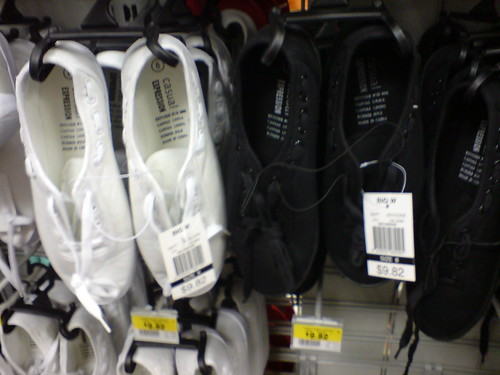
Here are the ones at Big W. They're $9.82, and I thought that represented fairly good value. They're the sort with decorative threaded eyelets along the sides. But they're not, in fact, the cheapest plimsolls around. That honour goes to Kmart.


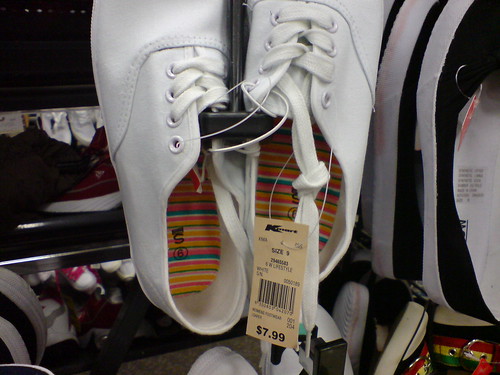
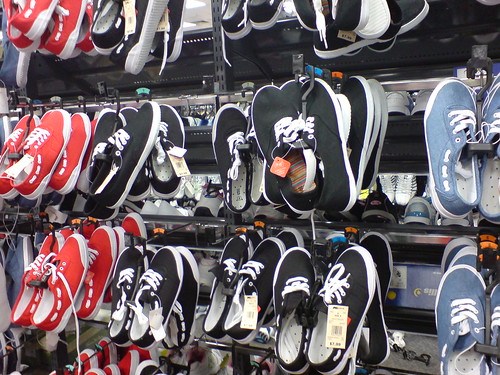
Eight bucks! And check out their range... All this plus white! (The white ones had nearly sold out; only two pairs remaining.)


The extreme cheapness and ubiquity of these shoes seem to speak to the mainstreaming of hipsterism I've written about before (and that a commenter on my previous post also mentioned in reference to Australian Idol's Matt Corby). Although last night I learned about an alleged evolution in hipsterism - "new authenticism" - that I found absolutely fascinating and would like to write about at length.

The other interesting thing is that this is quite a genteel preppie look that isn't immediately homologous with the tough-edged '50s-via-'80s pastiche hipsters tend to favour (the high waists; the rolled T-shirt sleeves, the Wayfarer sunglasses). Still, another trend I've observed lately is an old-fashioned casual style - white lace trim on black garments, the return of the tucked-in top - and there is a definite semiotic slippage between toughness and primness - Fred Perry, for example, shifts uncomfortably between being the preppie brand and the bovver-boy brand.

Sunday, October 07, 2007

Keffiyehs - they refuse to die


Keffiyeh-style scarves for sale in The Basement, Myer Melbourne.

Recently I was contacted by Dewi Cooke from The Age, who'd read my post about the keffiyeh. She's writing a story about the proliferation of this item in mainstream (not hipster) fashion. I've been meaning to do the same thing for months now, because it troubles two different ideas: that a) hipster style exists parallel to 'mainstream' style, sharing some of its motifs but remaining identifiable in itself; b) hipster style can be distinguished by its rapid-moving logic of early adoption and obsolescence.

I used to imagine a person inhabiting a 'hipster' cultural logic in a relatively stable way. I should add that I use 'inhabiting', rather than 'identifying with', because people don't tend to identify as hipsters, or admit a desire to be hip, except in self-deprecating ways (Indeed, you could argue that you instantly lose any hipness or coolness when you believe it of yourself or consciously realise you aspire to it; hipness is about insouciance), and I want to highlight a Bourdieuian concept of 'habitus' - a coherent set of knowledges and practices that produce one as a hipster.

Under this logic, you'd imagine that keffiyehs would be incredibly played out by now, and that if they're still around, they've lost their pseudo-subcultural hipness and are a mainstream accessory like any other. The fact that I spotted them yesterday in the Myer basement seems to support that "bubble-up" theory, as does the label on the scarf in question (apologies for my shaky hands):


It is hardly a Middle Eastern scarf now.

Thing is, I can't really endorse this "bubble-up" theory. The keffiyeh is now patently unconvincing as an authentic product of cosmopolitanism or politics (bought while travelling overseas, or in the knowledge of its political connotations - however abstracted or ironised). I'd like to raise the possibility that, rather than being cut loose and despised as a 'played' or uncool signifier, its continued popularity stems from its deployment by hipsters, and hence marks the mainstreaming of hipsterism.

I've always thought of hipsterism as a kind of gestalt organism that picked up and discarded tropes, and that if you were new to it, you had to be aware of the 'playedness' of particular things so you could avoid looking like a rube. But now I'm thinking about hipster generationism. Isn't it likely that people go through a 'phase' of hipsterism (from, say, age 16-25) and then other things in their lives take priority over the search for distinction? For one thing, hipsterism demands time, hedonism and research into the 'next thing', so it's well suited to students, whose habitus is already geared towards leisure, partying and information accumulation.

So, perhaps the continued run of the keffiyeh is simply its discovery by a new generation of hipsters. Perhaps hipster signifiers don't fall by the wayside in the manner I've imagined (picture a sad, sunbleached trucker hat lying in a ditch along with back issues of Vice magazine and albums by The Bravery and Clap Your Hands Say Yeah), but contribute to a cumulative hipster 'culture' to which young people want to aspire in and of itself? Maybe people no longer say "I want to be cool!" - they say, "I want to be a hipster!"

I don't know; I'm still thinking this through.

A cloth-covered button

A cloth-covered button is a new publication of which I approve heartily. Founded by Jessica Friedmann and Gillian Terzis, both of whom are from student media backgrounds, it welcomes analytical and curious writing on fashion, eschews modelled photo spreads, and rejects the advertising- and advertorial-driven approach of most fashion publications.

I have an article in the launch issue that is an expanded version of this post. I would have liked to contribute something completely new, but lately I've found my work commitments have impeded the amount of time I have free to think about things with the clarity that I'd like to apply to this blog. But I wanted to contribute to a cloth-covered button because, as I outline in that post, I believe strongly in the importance of intelligent and considered writing on dress. I don't agree with all the arguments mounted in the various stories, either - and I believe that's a good thing, because I welcome the proliferation of opinion, and of debate where opinions differ (as opposed, I stress, to ad hominem attacks like: "you have no taste...").

Another thing that pleases me about a cloth-covered button is that it features writing by both men and women. In the past, it's made me uncomfortable to realise how female-dominated the world of academic "fashion studies" can be, which in turn makes me worry about ghettoisation (people confirming each other's arguments rather than challenging or reinterpreting them), and the marginalisation of dress as a "soft" intellectual topic in an academy that tends to valorise abstract theory.

Anyway, I feel it's important for anyone who's interested in seeing the proliferation of intelligent writing about clothes and fashion to put their money where their mouths are by purchasing a cloth-covered button. It is a beautiful object as well as being smart, and would make a good gift. It's currently available at Mag Nation in Melbourne, or directly from the editors.

Saturday, October 06, 2007

On ethics

I've been sitting on this post for a while; I began it in July, when I got an interesting email from Rebecca, who writes:
I was recently perusing your very witty blog, "footpath zeitgeist". I've always loved your writing and your critique is excellent, from a cultural perspective, but I had a niggling feeling of discomfort as I read your descriptions of fashion trends and merchandising techniques. I got the impression that you accept that consumption, on the whole, is a good thing. Is this right? - please feel free to correct me if I'm wrong. :)

I see shopping and fashion as being about much more than self-expression. It is a process of moral decision making. Everything we buy has an effect on other people and on our natural resources. The fashion industry is notoriously bad at recognising this and promotes, I think, a very selfish mindset. Think about how clothing is made - mostly it is produced in appalling factories in developing countries or by (mostly migrant) outworkers here who can get paid only $2 an hour and work up to 18 hours a day, seven days a week. By buying this stuff, we are giving tacit approval to the perpetuation of these practices. There is also the environmental cost of subscribing to an essentially trend-based ideology that constantly requires the acquisition of new pieces. The energy and materials needed to make and transport the amount of clothing and accessories we currently consume is totally unsustainable.

Should we be considering these things as we window shop our way down Swanston St?
Yes, we probably should. But mostly we don't. I should say off the bat that this blog does not celebrate consumption in itself, and Rebecca is quite right that we need to consider its wasteful and exploitative aspects. My interest is in the ways in which people choose their clothes, and the ways that clothes make us feel. Sometimes people shop thoughtlessly, selfishly and with an eye to convenience, 'bargain-hunting', 'luxury' and distinction; and I tend to find these interesting in themselves (as opposed, I stress, to condoning the system that gives rise to them).

I also tend to emphasise the playful possibilities of dress, whereas Rebecca is saying that this play is a privilege that comes at the cost of the economically disadvantaged and the environment. Again, that's true. But her email did remind me of the idea of 'fashion levels' - the idea that some people buy their clothes purely for utilitarianism whereas others negotiate the fashion industry's cycles of novelty and obsolescence. You could add that the ability to shop ethically (choosing organic materials, non-sweatshop products, etc) is a very high-level fashion practice in that it requires knowledge and judgement.

There has been more and more mainstream media coverage lately about issues of ethics in fashion, which is giving consumers this kind of knowledge. Sue Thomas's opinion piece lays out most of the main things that consumers should consider, and there was a recent Sunday lifestyle story (which I can't seem to find online) directly comparing the environmental footprint of various fabrics (taking into account the water and energy needed to grow and/or process them into fabrics, the energy to transport them to factories and retail outlets, their durability (hence how often they'd need to be replaced) and the energy, water and detergents needed to launder them. I remember taking from this article that organic cotton used extravagant amounts of water and that polyester was surprisingly environmentally friendly because of its durability and the fact that old garments can be broken down and recycled into new synthetic fabric.

But the thing that strikes me is that all this still takes place inside the same consumer logic. For many people, ethical choices confer a positive range of affective states, but I'd argue that ethics is a still relatively small consideration when shopping for clothes. Even second-hand clothing exchange systems, as advocated by Sue Thomas, are shaped by similar decision-making processes to first-hand systems. Introducing their 2003 British study, Secondhand Cultures, Nicky Gregson and Louise Crewe write:
When we set up the research, we expected to encounter a lot of [ethical and environmental] talk (and practice), especially among certain facets of the 'critical' middle classes, and we anticipated that 'second hand' goods and their consumers might be seen, and see themselves, as part of an alternative, critical consumer culture. What we actually found though was very different. ... Instead, consumption through the second-hand market turns out to be shaped by many of the very same motivations that shape consumer culture more generally. We see here then how thrift - saving money by working at consumption - is a prime imperative. About capturing relative value through the 'bargain', this works in much the same way as in first hand exchange ... 'Distinction' too figures. Indeed, what is being sought through 'second-hand' frequently bears a marked similarity to the practices that shape designer purchasing and consumption in the first cycle: difference, taste and individuality. (11)
The second point about distinction seems particularly pertinent to hipsters, who tend to use secondhand shopping as an exercise of two kinds of distinction: a demonstration of their bricolage skills (a way of being 'in fashion' without having to resort to visiting high street stores that only offer mass-produced interpretations of current trends) and a method of minimising the number of other people who will own that item, thus ensuring singularity.

In The Rebel Sell, Joseph Heath and Andrew Potter offer the provocative contention that the counter-culture that sets itself up as a more conscious 'alternative' to consumer culture in fact is not revolutionary and poses no threat whatsoever to the capitalist system; instead it feeds that system:
...fair trade and 'ethical marketing' are hardly revolutionary ideas, and they certainly represent no threat to the capitalist system. If consumers are willing to pay more for shoes made by happy workers - or for eggs laid by happy chickens - then there is money to be made in bringing these goods to market. (4)
So 'ethical' consumerism is still an exercise of cultural capital; in this instance it demonstrates the consumer's 'thoughtfulness' or 'consciousness'. That's interesting, I guess, but it's still only one iteration of dress among many, and it's certainly not enough to make me abandon my posts on mainstream shopping and trends.

Saturday, June 30, 2007

Jaunty Pussy newsflash!

Last night I actually saw a guy wearing the pussy-bow shirt pictured in this post! In a state of feverish excitement, I blurted out, "I love your shirt! It's Hem & Haw, isn't it?" God. Like Melissa Rivers or, worse, Richard Wilkins.

He smirked. "Naturally!" he said. Bah. For all I know he designed the thing.

Wednesday, June 20, 2007

Read my tits and take dictation


I am always fascinated by hipster trends. These are short-lived style motifs seen among tastemakers around town. My original observation on these was they operate parallel to the trends espoused by regular fashion trend cycles because you tend to see them only on hipsters, and indeed that you can identify a hipster by the fact that they are wearing one of these motifs.

Some examples are the bandanna worn with the point at the front (and worn over the face in party pics) and the keffiyeh scarf, which refuses to die even though it seems tremendously played to me now. This does trouble what I had always taken as a central tenet of hipsterism: its cyclical logic of early adoption and obsolescence. I'll return to that later.

Anyway, I was getting my light dose of entertainment at Blue States Lose when the writer sarcastically pointed out the "originality" of the hipsters photographed at Misshapes because three of them were wearing nearly identical t-shirts:


As for where the t-shirts come from... I can't see the black one completely - it looks like a transcript from an interview with someone who has Tourette's Syndrome. The red one in the middle is from the "Fashion Groupies" collection by House of Holland and they have been around since at least last September. You have to know your fashion designers to get some of the references. And the aqua one is a lyric from the song "Close to You" by DJ Tiesto.

None is particularly clever or meaningful, and they certainly are not new:


But my point is that they share an aesthetic. They are baggy (designed to be worn with 80s-style rolled sleeves) with the sans-serif text covering the entire front of the shirt rather than just the chest. They are also long enough for No Pants 2007 - the terrifying 90s-throwback trend that I shall write about in another post, in which you wear just a t-shirt or shirt and leggings.

But the best thing is - the chain stores are all over them like a rash. The image at the top of this post is from Supre, where you can buy a variety of retarded versions of this t-shirt style. You can get "I heart my boyfriend", "I heart my hubby" (!!! - surely worn for irony by Supre's 13-year-old target market) and "I crossed-out heart my ex". But my favourite is if you are a computer nerd:


These shirts come with pre-rolled sleeves (sewn in place so they won't unroll). Also note that they are directly ripping off the House of Holland t-shirts in that the negative spaces of the letters are filled in. When I saw some in the flagship Sydney store last Friday I went into a kind of frenzy and determined to buy one, but none of the slogans interpellated me (fun fact: my very first experience at Supre involved trying on a t-shirt that said "Mel" in diamante-studded letters. It did not fit).

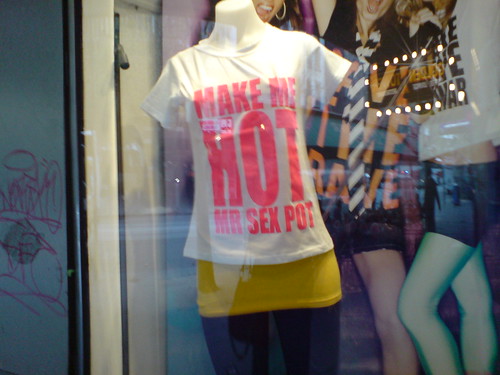
But the shenanigans continue at that dreadful Swanston Street store called Ice, where I saw a take on this trend so pitiful that I laughed raucously in the street:


AHAHAHAHAHHHAAAAHH! Mr Sex Pot! It's even more tragic when you realise that they are trying for the same rhyming pattern as the House of Holland collection. As another aside, I am more interested in the poster behind the mannequin where you can see a chick wearing a t-shirt that says "Save the Rave". Again, a 90s nostalgia from people not old enough to remember a time when raves required saving.

For me, the most interesting thing about this trend is that if local hipsters do cotton on to it, they're just as likely to get their t-shirt from one of these chain stores as get one from some more exclusive place. The trend is so samey that it disrupts what you might imagine to be hip patterns of consumption. In a similar way, we can see the keffiyeh still around because lately you can buy it in army disposal stores rather than actually having to travel. Isn't that a fascinating paradox, that the increasing availability of an item only prolongs its hipness rather than destroying it?

It's a similar situation to the way that Misshapes is always claimed to be tired and 'over', and yet it's survived a number of venue shifts to maintain its iconic status among hipster club nights. In the past I would have put that down to hipster generationalism, much as Streetparty has a reputation in Melbourne for attracting an extremely young crowd that grows out of the scene before they even have real IDs, to be replaced with more indie infants. The upshot is that now I really don't think people abandon stylistic motifs with quite as much alacrity as I used to suppose.

Moreover, if hipster motifs are cheaply available in chain stores, how can hipsters preserve a logic of individualism and tastemaking in their dress? I think this has to do with the baroqueness of hipsterism and its privileging of detail. People carve out a hip space within a mainstream look by making it their own in infinitesimal ways. In this case, this means we'll see more variety in the t-shirt slogans, and probably an semi-amusing parodic phase, before people get bored of them. I will be particularly interested to see if a hand-drawn felt-pen version takes off.

Tuesday, May 15, 2007

Jaunty Pussy for men


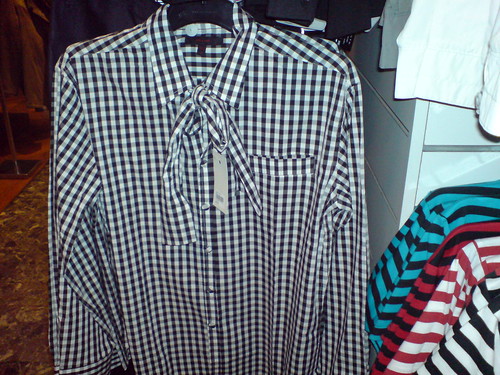
I spotted this shirt a few days ago in David Jones, but I only managed to snap a picture of it today. It's from Hem & Haw, the jaunty fellows behind Bobby's Cuts, who always get the tick of approval from me. What I like about them is that they are interested in creating and living a particular aesthetic that borrows a little bit from 50s rockabilly (and later kustom kulture), a little bit from 70s Melbourne sharpies and a little bit from 80s new wave, but is instantly recognisable and relatively easy to attain (if your body favours that lean silhouette).

I can see where they're coming from here; Thom does like his gingham shirt/plantation tie combo. But I do wonder whether men are going to wear what is essentially a pussy-bow blouse.

With the zeal of the prophet, I look forward to the spread of Jaunty Pussy through both male and female apparel.

Sunday, April 15, 2007

Window teaching


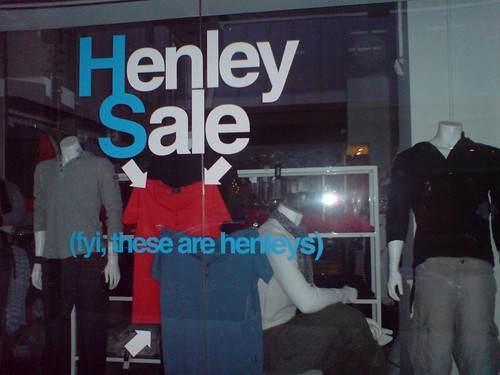
Back at the start of March, I was walking past the Industrie store on Little Collins Street and I noticed this striking window display. What struck me about it in particular was that it's not only performing a promotional role; it's also performing a pedagogical one. If you didn't know what a Henley shirt (sometimes called a Henley sweater) was, the Industrie shop window is prepared to teach you.

I myself am one of the educated, because I'd never heard the term "Henley" before I saw this display. I'm old enough to remember the last time they were popular, in the late 80s and early 90s, when they were called "grandpa shirts" because they looked like old-fashioned men's underwear. Back then they were part of the underwear-as-outerwear grunge ethos. I used to wear them with a contrasting coloured t-shirt underneath, then I'd roll up the sleeves to reveal the under-layer.

But I digress. Last week I noticed that Dotti on Swanston Street is also doing this shop-window pedagogy.


While it's another total digression, perhaps this is a good opportunity to mention that, while I'm pleased to have predicted the current resurgence of 60s mod fashion back in 2005, it gives me fresh insight into why my plump aunt is scowling and looking uncomfortable in most of the family photos taken in the 60s. Just like the first time round, it's disappointingly unflattering on all but the most Twiggy-like figures. Sack-like dresses and tops that hang from a yoke just above the bust (looks fine on flat-chested women, whereas bosomy lasses look pregnant). Prim high necklines and the return of skivvies under pinafores (like I used to wear in primary school!). Low-cut slouch boots that sit right on (or even just below!) the ankle and look ludicrously stumpy on anyone without long willowy legs. Dull drab greys and mustards and burgundies and olives. Not jaunty at all.

But anyway. The thing that intrigues me about the Dotti display is that it's teaching customers how to wear the clothes. Shopping is in fact an assemblage of teachings; shop-window visual merchandising is only the first and most striking, intended to pull you into the store. Once you're in there they continue to teach you how to wear the clothes by directing you through carefully arranged space, and getting you to interact with the shop assistants, who model and personify the brand (Supre and Alannah Hill are two particularly coherent examples of this) and, more obviously, who give you advice on how to fit and combine the clothes.

Many stores also produce literature ("magalogues" and websites) to extend their pedagogies beyond the physical retail space. These are another issue for me, because what I find interesting is the way the experience of the retail space is meant to educate. The point of this post is what's at stake for the brands in performing this role.

Most obviously, they are attempting to mould brand loyalty - to teach shoppers how to interpret fashion trends through the lens of the brand's particular ethos. Rather than tailoring their offerings to a pre-existing 'market' (eg tweens, edgy corporate wear), I think many brands try to create their market by teaching young, inexperienced clothes shoppers particular tastes and techniques that will thereafter shape their consumer practices.

But of course, that's not the entire story. We're all subject to many competing influences on our fashion consumption - popular culture (music, film, TV, etc); fashion magazines and blogs (some of which are explicitly pedagogical, eg "How to wear the new pencil skirt"); what we see other people wearing, and pleasurable feelings we get from particular garments (the swishiness of a full skirt; the fluffiness of a cashmere scarf; the clippiness and shininess of new shoes).

Perhaps what these displays are trying to bestow is a rubbed-off positive affect from having bestowed the gift of cultural capital. Sure, I might not have known what a Henley was, but now I do, and it was Industrie that taught me. Thanks, Industrie - now I will buy your garments. My phrasing is facetious, but let's not forget Miriam Silvester's idea of fashion levels - many people want to appear fashionable but don't actively follow trends. So there's money to be made by teaching them about the trends in such a way that they associate the teacher (the brand) with the pleasure of feeling newly fashionable - even if they don't actually buy the clothes.

Wednesday, March 28, 2007

Turf wars

For some time now, I've been wanting to write about the recent spurt of blogs devoted to 'street style' in Melbourne. As I commented at Camarilla, I am interested in them as a cultural phenomenon, and also as an industrial phenomenon.

Have a look to your right and you'll see that I maintain a list of street style and hipsterism resources. (It's by no means comprehensive.) I see hipsterism as the phenomenon of ironising and spectacularising hedonism and cultural capital, and street style as a genre of fashion reportage that focuses on how real people put outfits together. I am very clear what this blog means by 'street style', as my slightly pompous inaugural post outlines. I have always been interested in the mundane and taken-for-granted ways that people wear clothes, as well as how the cultural institutions of branding, advertising, retail space and fashion media subtly influence how people dress. I am also interested in how clothes make you feel.

But in many other 'street style' publications, the two ideas of hipsterism and lived fashion collapse together so that what we see covered in street style photography is a documentation of hipster culture. (These are general research interests of mine, which I've touched on in previous writing.) We see only the most outlandish outfits; the ones that are strikingly different from 'ordinary' people's clothes and are deliberately put together to attract attention. They are meant to serve as 'inspiration' for us ordinary people, as well as to designers and marketers who adapt these looks for profit. We can also see that in turn, this creates a culture of exhibitionism in which people actively solicit the photographer's attention and then look for themselves in online galleries.

So there's a triple audience: subcultural tourists getting a frisson from observing a scene in which they themselves don't participate; insiders of this scene hoping to see themselves documented; and outsiders hoping to make money from those in the scene. There is even a fourth audience of outsiders who visit to ridicule the photographs: a rich vein of comedy mined by Gawker's Blue States Lose and Mess+Noise's ShakeSomeCaptions.

This is the genre of 'street style' blogs that have started to proliferate lately. The first one to come to my attention is Melbourne Runway. It reminds me strongly of The Sartorialist, one of my favourite street style blogs, and I wouldn't be surprised if this resemblance is deliberate - you can see Marianne positioning herself as a fashion insider in the same way The Sartorialist does. The commentary isn't particularly incisive, but I like this blog's attention to the details of styling and the way that, while it never strays far from Melbourne's CBD, it captures a variety of different aesthetics and is interested in very simple outfits as well as ostentatious ones.

And then there's Third Best, which, while not innovative or insightful at all, is extremely interesting. Third Best is largely photographic and is clearly modelled on photography-centric European street style blogs. Unlike Melbourne Runway, which aims to catalogue a range of different styles and to establish its blogger's credentials as a thoughtful participant in local fashion culture, Third Best tends to depict a samey parade of baby hipsters deliberately looking spectacular, and most of its images appear shot at St Jerome's or in Caledonian Lane (clearly a favourite haunt of Nadia and Adele, the bloggers). Although Nadia and Adele are fashion students with technical knowledge and a rudimentary grounding in branding and market processes, their comments are vague and semi-literate, and they know it. As they write in the comments at Opulent:
We are NOT social commentators and we do not owe anyone a fuckin explanation of where a certain trend started or what was going through someone’s head when they put their outfit on… to tell you the truth we don’t really give a shit. What is funny to us is that we write some bullshit comments that mean absolutely nothing, yet suddenly we’ve got E grade sites such as this giving us shit for not being able to write or choosing crap outfits to document.

[...]

We didn’t start this blog with any intentions. All we wanted to do was document for ourselves all this crazy shit that people were wearing, and share it with people we knew.
It depresses me that we are creating generations of designers and commentators who are unable to articulate why they like particular clothes, and who are unwilling to be curious about the sartorial behaviour of those outside their comfort zone. It also bothers me that Third Best aims to document Melbourne style, and yet the blog is not uniquely local. Instead, Third Best is about fetishism - as Nadia and Adele explain, it's about preferencing "crazy shit" over less spectacular outfits. Rather than reflecting how Melburnians dress, Third Best slots itself into an international hipster aesthetic of "craziness" that would be equally in place in Helsinki, Tokyo, New York or London. It promotes a depressing stylistic conformity that is ironic because it appears so individual.

None of this would be a problem - people are entitled to put whatever crap they want on their blogs, just as others are entitled to mouth off about them. Except that Third Best, you'll see by clicking on that link, has been picked up by The Age. This is important. Being hosted by a media organisation with a reputation for 'quality' and 'intellect' sets up a conflict at Third Best between the traditional Age reader, who expects a high standard of writing and looks to blogs for social commentary, and young, semi-literate people for whom this style of fashion reportage is a novelty, and for whom St Jerome's is the hottest bar in town.

This is a problem that The Age is facing more and more as its website moves relentlessly downmarket. In the interests of disclosure, I should mention that I was one of four candidates interviewed for the position of online community editor at The Age, and was phlegmatic when James Farmer got the job instead. Farmer's background is in the pedagogy of blogging, and under his stewardship I anticipated a thoughtful development of blogs that was sympathetic to the heritage of The Age.

I have no idea what editorial and commercial pressures Farmer faces at Fairfax Digital, but the many blogs that have sprung up since his appointment are mostly complete crap. Third Best is perhaps the worst of all in terms of the standard of writing and the sophistication of the content. But commercial blogging is all about audiences; and people go to Third Best not only to be fashion tourists at St Jerome's, but also to mock the outfits and get outraged by the woolly-headedness of the bloggers.

When criticised, Nadia and Adele fall back on the fact of their endorsement by The Age as a raison d'etre. It's the idea that "if a newspaper believes we're worth hosting, then we're worth reading" - or, less elegantly, "We know we suck, and The Age publishes us anyway, so who's the real sucka?" And anyone who criticises is only doing it because "ur just jal00z". Jealous at not being photographed for the blog; jealous at not having the same publishing opportunities.

That is precisely the frustrating thing for me. Despite their complete lack of insight into the clothes they document, despite the fact that they aren't doing anything innovative, despite their complete refusal to show why Melbourne even needs a blog like Third Best, Nadia and Adele take on a certain authority because of their prominent position in the media. Fashion students and enthusiasts are going to link to their inane ramblings from their own blogs; journalists are going to interview them as 'fashion commentators'.

It makes me incredibly angry when Australian media outlets abandon any commitment whatsoever to innovative thought. Blogging does not need to be stupid; but for some reason our paper of record has decided that fashion is such a ridiculous subject that it deserves to be documented by a pair of clowns.