Tuesday, October 10, 2006

No need for ethnography

About a month ago I received the following comment on my post about hipsters and keffiyeh. It was just way too good to leave in the comments, and I'd love to incorporate it into my upcoming CSAA conference paper. But even as I considered that possibility, I couldn't help smiling at my autodidactic research methodologies – blog comments are the new ethnography, doncha know...
Who named them "hipsters" they certainly don't refer to one another as "hipsters' it's a name given to them by the media or overlookers. These people dress differently and look for the next trend to push the boundries of fashion. It's like a celebration of design. Deeper thought goes into their clothing then slammin on a pair of clarks finest lace ups, BHS trousers and berghaus pull-overs (I'm guessing you people roll along these lines as you strongly frown upon others with a side of creativeness). Maybe some people do find Keffiyeh's strange to wear if you don't live in the middle east, but it's not always about politics and religoun as people adamently associate with it and fashion in general. If your so interested in why people wear such things just think why you don't. Obviously you don't know or care about sub-culture or fashion. So leave it that way. Also I think boring un-original people like your negative selves, are part of the reason "hipsters" dress differently. If it offends you so badly and deeply confuse's you as to why these kids are doing this......it means FUCK YOU
There are so many wonderful things written here that deserve further examination. First, let's look at the first question - and it's a very good one: "who named them 'hipsters'?" It's a question of self-identification versus external identification, and it's one that subcultural theory has been grappling with since the Birmingham School days. In my extremely anecdotal travels, I've heard people that I would call hipsters use the word to deride others, or to refer to themselves self-deprecatingly. So, then, 'hipster' becomes a way of othering the self - of quarantining ourselves from aspects of our tastes and habits with which we're uncomfortable.

You could call this the 'hipster discourse'. And while we often 'identify' hipsters in an informal, everyday (Foucault would say "capillary") way, it's the media that really drives the creation of a discursive figure which we could call the 'hipster'. My MA thesis, while flawed in many ways, at least makes me familiar with the idea that a figure like the hipster (or in my example, the bogan) can appear 'real' and objectively observable, but yet nevertheless this figure is the product of a very specific ideology.

Another possibility of "who calls them hipsters" is more commercial. On my recent trip to Newcastle for This Is Not Art, where I was on panels, or in the audience for panels, with a number of people from media outlets often identified with hipsterism), there was a real reluctance to use the term, or to be associated with the term. Instead there was lots of marketingspeak of "tastemakers" and "innovators" and "peer leaders" and "early adopters", used both ironically and unconsciously. And Barrie Barton from Right Angle Publishing made the obvious but genius point that his advertisers target the 10% of his readership who are hipsters in order to appeal to the other 90% who actually buy the advertisers' products.

But anyway. The second thing I see about this comment is its affirmation of a particular philosophy of stylistic individualism that I have always associated with hipsterism. It is absurd to claim that this blog isn't interested in individuality, fashion, subculture or design, so I'll just ignore that criticism. But it does seem as though the key aspect of hipsterism that I'd like to investigate is its tension between individualism and conformity, between 'subculture' and 'mainstream'. It does seem very important to people who invest in this individualism that they be recognised as innovators, and it also suits marketers who look to them for ideas, but I don't think that's the whole picture. I think the processes of appropriation and originality are far more even-handed, given that fashion always raids the popular cultural archive. More on this in an upcoming post.

Finally, and most intriguingly, the arguments here are framed affectively, from the aggressive and dismissive second-person address to the triumphant "FUCK YOU" at the end, and especially the commenter's imagining me as a resentful dork who criticises because I am jealous of the hipster creativity I don't possess myself. The key sentence is: "If your [sic] so interested in why people wear such things just think why you don't." This seems like a non-sequitur (whether or not I wear a keffiyeh has nothing to do with the reasons other people do), but it does suggest that the strong affective states attached to the clothes people wear are largely dependent on interpersonal relationships. One wears certain clothes because there are certain emotional states linked with the observation of other people wearing and not wearing the same things. Again, I want to look at this some more, because it seems to be important.

Let's also consider the comment as an event. This person finds the post - I'd love to know precisely how, although someone from London recently Googled "keffiyah craze" to get here, and the language in the comment suggests it's written by someone from the UK ("pullovers", anyone?). Then he or she writes the comment, filled with righteous anger at the stupidity and lack of fashion sense of the blogger and previous comments. And strangely, I don't feel angry or crushed myself. Instead I am filled with delight imagining the anonymous author typing the immensely satisfying FUCK YOU. Who hasn't smacked down someone on the internet? Doesn't it make you feel awesome?

Again, this makes me wonder about the role of media in facilitating this event and creating the dissonance that foments it. So often I read over my own posts, imagining how specific people might interpret them, or research a product I've just bought to find out if it was a good buy (in cultural as well as economic terms). But at the same time, I don't agree that the internet, or magazines, or TV, or whatever else, is the major facilitator of hipsterism. Sure, someone from the UK can flame me semi-literately on my own blog, but it hasn't made the same impact as if they had done it to my face. I think that corporeal, real-time encounters are much more interesting and reveal much more about the way we use clothes to define ourselves.

Monday, August 21, 2006

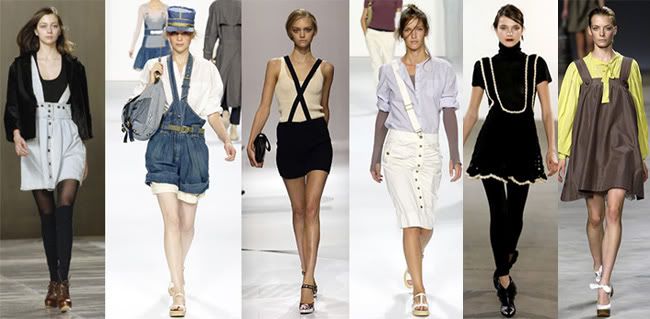
Brace yourself for a journey into pinafores


On Thursday I was wandering about in the city looking at the cheap Asian import shops -- a pleasure in which I often indulge in the name of "research" into "trend diffusion". I use the scare quotes because, while I'm professionally interested in the semiotic metamorphosis of style motifs as they spread through different market segments, I don't follow couture trends closely enough to chase them as they 'trickle down' to my price bracket.

Rather, my fashion research (and this blog) is about how ordinary people negotiate clothing choices that make them feel individual and creative within a retail market that is already crammed with mass-produced, mass-mediated, always-already knocked-off clothing. So when I do "research" in extremely low-market stores like Apple Spice, Femme Connection, Modiste or Studio Girl (Cheapest Price in Town!), I'm not joining the mental dots between the merchandise on display and a 'look' I've previously seen in a magazine, on a celebrity or at a recent Fashion Week. Instead, my eye is drawn to things that stand out precisely because I haven't seen them before.

This is a bizarre strategy, really, as this market segment moves so fast that it won't be long before any given look reaches a tipping point and suddenly it's everywhere. About a month ago I spotted a $20 t-shirt printed with rabbit silhouettes, but while I was still deciding whether to buy it, it tipped. First I saw it on an artist who wore a black version with white rabbits to her exhibition opening. Then it was a uni student wearing the pink one with black rabbits. And then it was all on -- the t-shirts multiplied as quickly the very bunnies printed on them, and I seem to see them in every second cheap shop.

But for now, I want to focus on the pinafore dress. I'm feeling quite buoyant about my trendspotting abilities right now, because not only has Jaunty Pussy become the dominant look this year (2006: International Year of the Spot and Stripe!), but my 2006 Fashion Prediction of "Back to School" is also ringing true, big time. (Please allow me my moment of glory; remember I also predicted a vogue for Elvis-style capes back in 2004, so I'm not used to actually being right.)

One manifestation of the Back to School trend appears to be braces. Alex Singh from Sydney label Extra Tasty cites Bobby's Cuts as a retail innovation -- and its appropriation of the food logic of 'freshness' fits well with the examples I've raised before. But I think I've previously hinted at the store's aesthetic role: Bobby's Cutsis totally championing the boyish use of elastic straps to hold one's pants up, along with the other school uniform-ish looks of tucked-in shirt and tie with cardigan. I would love to know the reasoning behind this, because it seems so consistent. On Friday night I asked store owner Thom why he tucked his tie into his shirt. He was shitfaced at the time and hugged me by way of reply.

The pinafore dress is the chicks' version of the same look. On Thursday, as I browsed in Studio Girl, my eye, ever alert for sartorial distinction, alighted on a pinafore dress that was pretty much a high-waisted bubble skirt, made from a light, puffy floral-printed cotton, with matching detachable braces. It was so badly made that a button holding on one of the braces popped off while I was trying on the dress. I thought, "Well, I'll have to buy it now," which more than anything else was an excuse to talk myself into my purchase. The salesgirl sewed the button back on at the register, which made me realise that she must do this to quite a few shoddy garments. Then two more of the buttons popped off that evening as I tried on the dress at home, so I sewed them all back on.

I wore this dress to Friday night's Is Not Magazine party. In a nice piece of inadvertent synergy, myself and my fellow editors were wearing preppy schoolkid outfits because as part of the event, we were performing a song from The Sound of Music. That's when I realised that the hipsters have embraced Back to School and that our 'costumes' were actually the height of fashion!

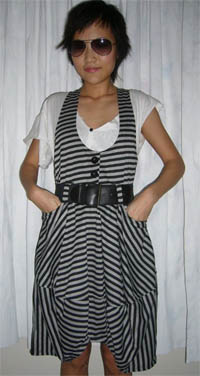
There are all sorts of bubble skirt pinafores around at the moment. Here's one I found on eBay.


The seller was billing it as 'vintage', but its unevenly gathered skirt and the grey and black diagonal stripe look very contemporary to me. That's the thing with the nouveau pinafore: it's a stylistically ambiguous garment. Whereas past pinafores had pedigrees -- the dungaree dress from workman's overalls; the tailored pinafore from school uniforms -- it's hard to know what to make of a soft, draped pinafore made from t-shirt fabric:


Or one that looks like a stretch miniskirt with an attached bib (this one's from Alice McCall's spring/summer 2006 collection):


The bib brings me to the issue that pinafores are hard for grown-arse women to wear. The braces have to go around the breasts, while the bib sits awkwardly on top of them. And while you'd imagine them being forgiving for the squidgy, they're not. About a month ago I spotted a grey pinafore dress at Supre with an empire (aka "babydoll") line and a very low-cut scoop neckline. I bought it on impulse, even though I thought the colour was quite dull, because I hadn't seen the style anywhere else and because I thought the cut would skim right over my roll of midriff fat.

Unfortunately it's turned out to be the kind of dress that makes my mother ask when the baby is due. Making you look fatter than you are seems to be a common problem here. Maybe it's the silhouette? FashionTribes has a problem with the bulky look of the Jaunty Pussy pinafores on Peter Som's Fall 2006 collection and the bubble shapes at Vera Wang, while another blogger worries that bubble skirts make you look like an egg.

The pinafore is reminiscent both of childhood and of the impossibility of returning to it. Its wearers look girlish -- but they also look like they're in costume as the little girls they used to be. And the fact that pinafores look good on so few people says a lot about the ultimate ephemerality of nostalgia. Perhaps that's why the most successful pinafores are the hybridised ones rather than the 'classics'. You can dress up in the past, but you must always return to the present.

Tuesday, June 27, 2006

The dandy is in the detail


Meccanoid website launch, Melbourne, 9 June 2006. Image from NowNow Pics.

Last week I was catching up on my reading and noticed that Roland Barthes was not in fact killed by a laundry truck in 1980, because he had written this article for The Age. But it turns out Barthes is freelancing from beyond the grave, as this is an extract from a new collected volume of essays entitled Roland Barthes: The Language of Fashion. I find it compelling and heartening that Barthes, the godfather of semiotics, was overwhelmed by the prospect of studying street style. As The Australian remarks:

Said Barthes: "Originally I had planned to study real clothing, worn by everyone in the street. I gave up." He protested that fashion was too complex - "it deploys a number of 'substances': the material, photography, language" - and the science of its analysis was too young.

And so this pioneer had decided to confine himself to the study of a single, pure substance: "fashion clothing as it is refracted through the written language of specialist magazines".

But I am interested in the subject of the Age extract: Barthes's thoughts on the phenomenon of the dandy art of dress. When we think of dandies, we think of a historical yet strangely a-historicised phenomenon. It's historical because there is a commonsense understanding that dandies are supposed to look 'old-fashioned'; yet it's a-historicised because people tend to associate dandyishness with an over the top, camp fashion aesthetic, when during the height of the dandy phenomenon in the late 18th and early 19th century, these OTT fellas were more likely to be fops.

But it's deliberate that I've including this picture of the spastic hipster looking what many people would call "dandyish". Because I want to mull over whether there is something dandyish about hipsters: in the way they fetishise aesthetic individualism; in the way the dandy was said to cultivate a detached and sceptical manner, much as hipsters are identified with a relentless irony. I was struck by the observation made by the novelist George Meredith, who once defined cynicism as "intellectual dandyism".

However, Barthes makes it clear that he is bracketing the rest of dandy culture and concentrating solely on the clothes. First, he talks about the notion of distinction and what it implies for the 'reading' of clothes.

A distinguished man is a man who marks himself off from the crowd using modest means, but it is a means whose power, which is a kind of energy, is immense. Since, on the one hand, his aim is to be recognised only by his peers, and on the other, this recognition relies essentially on details, the distinguished man adds to the uniform of his century a number of discreet signs (that is, those that are both barely visible and yet not in keeping with the outfit), which are no longer spectacular signs of a condition that is openly adopted but the simple signs of a tacit agreement. Indeed, distinction takes the signalling aspect of clothes down a semi-clandestine path: for, on the one hand, the group that reads its signs is a limited one, on the other the signs necessary for this reading are rare and, without a particular knowledge of the new vestimentary language, perceptible only with difficulty.
At first this reads like a very straightforward, Bourdieuian analysis (and bear in mind that Bourdieu was probably conducting his first Parisian fieldwork while Barthes was writing): a distinguished man distinguishes himself through the cultural capital that determines his tastes. But Barthes is gesturing towards a distinction that is a relation between insiders: one that "classifies the classifier" in the sense that only insiders can recognise the process of classification itself.

The dandy [...] is a man who has decided to radicalise the distinction in men's clothing by subjecting it to an absolute logic. Dandyism is not only an ethos but also a technique. The dandy is condemned to invent continually distinctive traits that are ever novel: sometimes he relies on wealth to distance himself from the poor, other times he wants his clothes to look worn out to distance himself from the rich - this is precisely the job of the "detail", which is to allow the dandy to escape the masses and never to be engulfed by them; his singularity is absolute in essence, but limited in substance, as he must never fall into eccentricity, for that is an eminently copyable form.

The dandy's clothes are based around a semiotic building block that Barthes calls the "detail". For the dandy continually strives not only to be "other" but also to be alone in his otherness (unlike a subculture, which aims for collective otherness). It is this "detail" that enables such pure distinction. And it is in the (at least theoretical) infinity of singularity that dandies can identify each other. They are recognising each other's thoughtful originality: the precision and subtlety of each other's sartorial signatures. They are not identifying with the other's stylistic similarities, but with the other's stylistic differences.

But in practice, writes Barthes, the "detail" was not absolutely singular, and the rise of ready-to-wear clothing struck dandyism a fatal blow.

But, more subtly, what ruined dandyism for good, was the birth of "original" boutiques; these boutiques sold clothes and accessories that were not part of mass culture; but because this exclusivity was part of commerce, albeit within the luxury sector, it become itself normative: by buying a shirt, a tie or cufflinks at X or at Z, one was conforming to a certain style, and abdicating all personal (one might say narcissistic) invention of singularity.
I am interested in Barthes's insistence that "once limited to the freedom to buy (but not to create), dandyism could not but suffocate and die". He's suggesting that the creativity in consumption is not sufficient to sustain the extreme singularity required by dandyism.

What really interests me is Barthes's specific example of the boutique. Boutiques perform a weird balancing act between originality and homogeneity. There are the high-end boutiques specialising in prestigious ready-to-wear labels, like Le Louvre in Melbourne. The advantage of going to such places is the personalised service and the access to exclusive high-end merchandise not available elsewhere. Then there are 'branded' boutiques that sell an idiosyncratic house style or label, like Biba and SEX/World's End, or to give some Melbourne examples, Quick Brown Fox and Frauhaus. These seem to have their own signature: a certain kind of 'look' that is homogenous.

Then there are the most interesting sort (and the most relevant to hipsters), which are effectively a collection of niches: they source small-run artisanal labels that would otherwise be hard to buy unless you went straight to the designer. Melbourne examples include Fat, Alice Euphemia and Bobby's Cuts. Now these places also offer a kind of stylistic consonance: in the past I've condemned Alice Euphemia for selling "sheltered workshop clothes"; and Bobby's Cuts specialises in a more tailored kind of rock-star wear featuring skinny ties, vests, what have you.

So, does this mean that someone who shops at such boutiques is not a dandy? Well, yes and no. Of course more than one hipster will take a liking to the same "detail", and they might even (quelle horreur!) spot each other at a record label launch wearing the same "detail". But I think that, rather than destroy originality, this inevitability creates a baroque style. When I talk about the 'baroque', I mean the intricate and detailed repetition of a particular stylistic motif such that it becomes something distinct from the original. And I think it's this baroqueness, rather than the absolute singularity of his or her clothing, that marks a hipster.


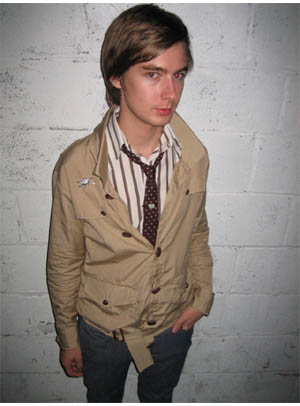
These two fellows were photographed at Misshapes in New York on 10 and 17 June 2006. They are wearing essentially the same outfit: boxy casual jacket; dress shirt; skinny tie; subtle jewellery (badges, necklaces); skinny jeans. But they've managed enough variations on the outfit to make the look their own. And importantly, the constituent elements of the look are not stylistically consonant. There is no way they can have obtained the entire outfit from the one store: it requires bricolage.


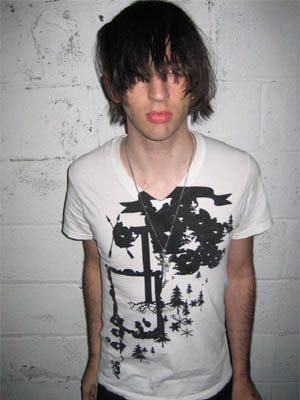
I included these two because of the startling similarity of their outfits. Fitted V-necked t-shirt in which the neckline cuts into the print; necklace on a long dangly chain; Mick Jagger rock hair and stagey posing. Their baroqueness is of the crudest and laziest kind; but nevertheless they are performing the same process of subcultural distinction that Barthes describes. The tiny differences between their outfits and those of a man who's bought his entire outfit from a high-street chain like Industrie or General Pants "are both barely visible and yet not in keeping with the outfit". There is just enough detail (the necklaces, the t-shirt prints) to mark them as hipsters, and to enable them to recognise each other as hipsters.

Ultimately, I don't think this post answers the question of whether hipsters are contemporary dandies. But I think it's valuable to be able to identify what it is about someone's clothing -- someone who isn't necessarily dressed in a spectacular, subcultural way -- that nevertheless allows us to categorise them. I also think Barthes's theory of the detail gives us a point of access into the processes by which we all assert our individuality. Perhaps the hipster has more perceived individuality at stake than most of us. And perhaps that's an interesting perspective itself: the idea of the hipster as a person disaffected with the death of dandyism, and attempting to reassert its lost singularity in the baroque ways that are enabled by contemporary consumer culture.

Monday, June 26, 2006

Time to get pragmatic

As I posted recently on my personal blog, the field of commercial blogging is growing exponentially, and bloggers are increasingly being viewed as 'content providers', much as television has always been a content provision exercise that delivers audiences for advertisers. As I've argued, the trouble begins when bloggers aren't adequately recognised and remunerated, and I see syndication agencies such as ScooptWords as a dangerous development.

This is because they notice and exploit a culture in blogging in which bloggers are amateurs who are not equipped or not inclined to deal personally with editors wishing to republish their work. Indeed, new business ventures driven by the growth in so-called "citizen journalism" rely on an amateurised (as opposed to a professionalised) market of "content providers" who are willing to provide their work anonymously and to have it edited with impunity. All because they are happy just to see their words in print, under the aegis of a 'respectable' media masthead.

I argue that this is a patronising attitude. It may work for some people for whom blogging is a hobby. Indeed, I run a number of personal blogs for which I wouldn't expect to get paid. But as a working journalist and cultural critic, I would like to earn a living from my research, my innovative ideas, my authoritatively argued opinions and my analytical abilities. These are my tools of trade. And I believe that bloggers writing this sort of material should learn to put a dollar value on the work they publish.


This is why I am adding this button to my sidebar. I'll keep posting here for free, but I will ask for a reasonable pay rate if any editors should be interested either in republishing my posts or in commissioning stories from me. I believe that if enough bloggers are polite but firm about this, there is no reason that bloggers can't be content providers. And this more equal industrial relationship ought to be the future of online content provision.

Thursday, May 04, 2006

Free your signifier and the rest will follow


For some months now, I've been reading about the hipster trend of wearing Palestinian headdresses or keffiyeh as neck scarves. It's only recently that I've begun to see kids in Melbourne doing it too.

Let's set aside the well-known debates over cultural and political appropriation, because they've been rehearsed so many times before when it comes to hip-hop apparel, bindis, dreadlocks, Thai fisherman pants and any number of other 'ethnicised' forms of clothing. I mean, I have always been a little shocked when I saw non-Palestinians wearing keffiyeh because I've always thought of it as a religious as well as an ethnic and political thing. But who am I to talk? I was at a tiki party last Sunday wearing a tropical print 50s-style dress and a lei, drinking rum punch out of a coconut and watching my friends' pitiful attempts at hula dancing.

No: here I am more interested in the transnational flows of hipster cultural capital. Blue States Lose has wondered many times, in its usual tone of laconic despair, how it happens that hipsters somehow 'know' how to be hipsters without ever 'learning' it. I began thinking about this after reading this blog post about a magazine series on the 'flashmobbing' fad, and the ensuing comments.

As Bill Wasik writes in the article,
hipsters, our supposed cultural avant-garde, are in fact a transcontinental society of cultural receptors, straining to perceive which shifts to follow. I must hasten to add that this is not entirely their fault: the Internet can propagate any flashy notion, whether it be a style of eyewear or a presidential candidacy, with such instantaneity that a convergence on the “hip” tends now to happen unself-consciously, as a simple matter of course.
For Wasik, this is the essential paradox of hipsterism: that a culture predicated on aesthetic individualism could be so homogenous and susceptible to fads. And according to Wasik's logic, the Palestinian keffiyah craze, like the popularity of McSweeney's, Interpol and black stovepipe jeans, is all about the internet.

But I am not about to celebrate the transnational information flows enabled by technology. Rather, I am interested in a rather more low-tech idea: that hipsters work out what to do next using their general worship of that altar of cool, "the street". I am interested in the physical congregation of people, the ways their bodies occupy physical space, and the strategies they have of displaying themselves and of observing and interacting with others. If the internet is involved, it's using blogs, email, MySpace and messageboards - technologies that play off and replicate face-to-face networks.

And, importantly, I think these events and technologies are governed by affective relations. In his comments, Doug reflects the commonsense understanding of what it means to be 'cool':
But are hipsters permitted to 'feel' anything? Isn't it a bit twee to feel? [...] how, then, do hipsters manage to be simultaneously 'cool' - universally depicted as being slightly detached from normal worries and concerns - and yet be affected by their cultural consumption?
I blame Fredric Jameson and his famous essay on postmodernism for the 'commonsenseness' of the equation: "irony = lack of affect". Detachment isn't a lack of affect: it is an affect; and it requires a certain repertoire of performances and knowledges. Hipster irony generates a variety of affective registers including the pleasure of feeling 'cool', the humiliation of exclusion and the outrage of moral violation.

Importantly, hipsterism is private yet public, just as irony relies for its meaning on a privately understood but publicly unacknowledged other meaning. I think that this, and not the nihilism that is often ascribed to hipsterism, is why it is incapable of politicisation. Politics relies on convincing an ignorant or uncaring audience of the importance of a topic: it's insiders talking to outsiders. Hipsterism is insiders talking to insiders, and that's why its aesthetics are apolitical.

Or rather, hipsterism has only a base, brain-stem politics: it delights in the event, in the idea of togetherness, even if that togetherness serves only hedonistic purposes. There is a primitive kinship in the idea of seeing someone wearing a keffiyeh, identifying them as 'cool', and deciding that you want to be cool, too.

Tuesday, February 28, 2006

Things to do with t-shirts

Back in 2004, I wrote an article about t-shirts for The Age. I wanted to explore the growth of t-shirts as design objects; the ways they were being turned into a fashion fetish and every second graphic designer seemed to be putting out a t-shirt line. But only the final three paragraphs of the final article are about this idea. The week I submitted it, there was a media panic about a provocative t-shirt that Westco made its retail staff wear, and so my editor changed the focus to be mainly about t-shirt slogans. This really annoyed me, but you have to respond to these news cycles.

Today I was reminded of my lost article when reading this piece about innovations in the t-shirt market. I was particularly struck by its entrepreneurial streak: the point seems to be to identify trends to rip off in other markets. But I am interested in the closing section: "Blurring the lines between conventional displays and selling methods may well mirror your customers' blurring perceptions of what constitutes value, or experience."

But as I see it, the success of the brands mentioned in the article doesn't just suggest a blurring of retail convention. It's about changing the basic relationship between product, seller and buyer. As Meaghan Morris writes in her classic essay "Things to Do With Shopping Centres", "it isn't necessarily or always the objects consumed that count in the act of consumption, but rather that unique sense of place"; and I guess what I want to do with this post is to use these examples of new t-shirt marketing as a sort of "place-making" - and as an antidote to the idea of t-shirts as "designer fashion".

The paradox of the "t-shirt label" is that a generic, banal, mass-produced garment takes on what Walter Benjamin would call an 'aura'. In my favourite part of Morris's essay, she dismantles this possibility:

The commodities in a discount house boast no halo, no aura. On the contrary, they promote a lived aesthetic of the serial, the machinic, the massreproduced: as one pair of thongs wears out, it is replaced by an identical pair, the same sweatshirt is bought in four different colours, or two different and two the same; a macrame planter defies all middle-class whole-earth naturalness connotations in its dyes of lurid chemical mustard and killer neon pink. Second, commodity boudoir-talk gathers up into the single and class-specific image of the elite courtesan a number of different relations women and men may invent both to actual commodities, the activity of combining them and, above all, to the changing discursive frames (like shopping centres) that invest the practices of buying, trafficking with and using commodities with their variable local meanings.

So, taking my cue from Morris, I want to sketch several "things to do with t-shirts". And importantly, the new "things" being done with t-shirts are succeeding because they create new spaces that manage to make the t-shirt simultaneously special and generic. First, there's customisation, in which the buyer alters the structure and look of the t-shirt in various ways. Then there's merchandising, in which the t-shirt itself remains unchanged; it's how the buyer interacts with its retail environment that constitutes innovation. Such merchandising techniques are what Morris would call a "discursive frame" - they infuse shopping with meaning.

Clothing customisation has long been understood as a grassroots practice of bricolage - changing the meanings of clothes through a judicious and unexpected alteration of pre-existing items. Journalists still tend to get excited about its possibilities for creativity and individuality. I think the absurdity of such a stance is encapsulated in this phrase from NZGirl: "The only way to achieve individuality is by customising, and we're going to show you how..."

But I'm more interested in the place customisation occupies in the market. For instance, I have customised a number of my old Bonds t-shirts by cutting off the sleeve bands, altering the necklines, ruching the sleeves and reattaching the sleeve bands in different places. But were I to try and sell them, Bonds would get up in my grill about it. When I interviewed Dylan Martorell, who in March 2004 was running Outskirts T-Shirt Gallery, he had this to say:

Mel: What would you do if someone came in with a seriously ordinary t-shirt that looked like they’d just taken a texta to a Bonds t-shirt in their bedroom?
Dylan: And it was good or bad?
Mel: And it was really bad.
Dylan: Well, for a start we wouldn’t stock it because it was Bonds. Um, Bonds are about the only brand that actively, uh, go out of their way to stop people using their t-shirts.
Mel: Oh really?
Dylan: Yeah, I think every other t-shirt brand is happy for their t-shirts to be used, but not Bonds. We’d just tell them we weren’t interested, I guess. That it wasn’t right for the store.

Contrast the attitude of Bonds, a company that seeks to protect its brand from being 'ruined' by customisation, with American Apparel, a company that makes being generic its major selling point. American Apparel began as a wholesale business, selling t-shirts to artists, designers, bands and anyone else who needed a wearable canvas to print on. The company's selling points are quality, fit (slim fit - is it any surprise its biggest customers are hipsters?) and a rainbow of colours.

But I do want to get away from the 'wearable canvas' idea, because it perpetuates the t-shirt label mentality that t-shirts are 'works of art in the age of mechanical reproduction'. Instead, let's look at two ideas that treat t-shirts as commodities in the most obvious way: by inserting them into the retail logics of entirely separate industries.

In Chicago, patrons at the Windy City's own T-Shirt Deli can order fully customised American Apparel t-shirts as easily as picking out sandwich ingredients. Indeed, the company's tagline is "T-shirts made fresh daily". Pick your desired size, colour and style out of a glass-fronted deli cabinet, then spell out a witty slogan in iron-on letters of a variety of typefaces (at US$1 per letter). You can also provide your own design. The final t-shirt is wrapped up in butcher's paper. The concept is similar to Neighborhoodies, which I previously discussed here.

But while Neighborhoodies is a customising shop, plain and simple, I'm more interested by the food/fashion pun on 'freshness' employed by the T-Shirt Deli. Here, customising is a ritual of performing the 'fresh'. Rather than making your own sandwich at home, you go to a deli, and you feel more virtuous for resisting the temptations of the bain-marie. Moreover, you verify the freshness and healthiness of your lunch (and thus, your virtue) by seeing it made before your eyes. In a similar way, you go to the T-Shirt Deli because you want a product that could have been made by you. You feel better about yourself (more original, individual - more like a bricoleur) because you didn't just buy a pre-sloganed t-shirt. You thought up a witty catchphrase yourself. And the slogan looks especially good to you because it's being assembled right in front of you.


Brazilian store Banca de Camisetas(translation: T-Shirt Stand) is a kind of t-shirt newsagent. There are currently five ‘bancas’ in Sao Paulo. The merchandise is arranged in racks like magazines, the stock is changed weekly, and the store only carries three of each design. The ‘publishers’ are freelance graphic designers; from these photos, the shirts look a lot like the sort of stuff you can find at the T-Shirt Barn in Newtown, Sydney.

But the intriguing thing about Banca de Camisetas is that, while its merchandise fits squarely into the 'art' aesthetic of the 't-shirt line', it isn't sold in a 'gallery' environment and the t-shirts are packed into squares. Instead, there's an accessible, 'convenience' mentality - just as you would in a magazine shop, you're encouraged to 'drop in', to browse, to choose quickly and to return often. I really like the way it refuses to treat the t-shirts as fetishes.

However. Another thing that struck me is that the packaged shirts look almost like records, which in turn connotes another kind of retail fetishism - that of the hip, intense, mostly male vinyl hound spending hours browsing in music stores for rare discs. In every city there's a cartography of subcultural space marked out by spaces like these, and continually reinscribed by DJs and record enthusiasts. For example, in his article on death metal, "It'll All Come Out in the Mosh", Dominic Pettman refers to certain Melbourne metal record shops as the "Devil's Triangle".

The good people at Springwise "can't really think of any big city where this would NOT work!" I agree. It's a great idea. But my contention is that a 'banca' would work in different, locally specific ways in different cities, because people would incorporate it into their existing repertoire of retail techniques. As Morris writes, if a company can create a sense of place, they can market a very banal product with great success.

Wednesday, February 08, 2006

Bubble Trouble


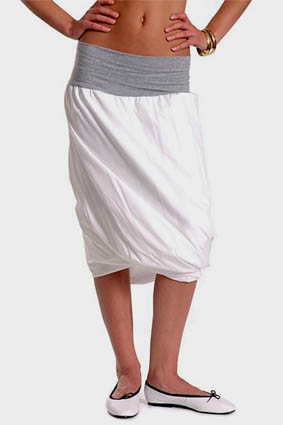
Bubble skirts are back! Well, they've been back since at least 2003 - at least in the minds of designers and on the runways of London, Paris and New York. We've had to endure endless fashion editorials telling us bubble skirts are back. And Australian designers including Rebecca Taylor, Mad Cortes and Jayson Brunsdon have been making them since 2004.


(Jayson Brunsdon, 2004. Image from Sydney Morning Herald.)


(Alexander McQueen, 2005. Image from Style.com)

Most people think of bubble skirts as a particularly 1980s trend; but they date back to the 1950s, when designers were experimenting with fabrics and silhouettes. This pattern is described as "harem draping", which makes sense if you think of the gathered ankles of harem pants.


So, why haven't we seen bubble skirts on the streets until now? The key is the fabric used in a bubble skirt. You only get the true puffball look with stiff yet light materials like taffeta and raw silk - incidentally, the same fabrics popular in 1980s formal wear. And those were the fabrics used by Alexander McQueen, Marc Jacobs and Christian Lacroix in recent runway collections. There are dressy bubble skirts available this season at relatively upscale stores like Review, Cue and Bettina Liano.

But the skirts that have made the trickle-down to high-street stores like Sportsgirl, Jay Jays, Valley Girl, Pilgrim and General Pants are very different. Made from cotton jersey, they're slinky and comfortable, heavily gathered from a basque waistband, without the pintucking you see on the more 'formal' versions. I've seen people on the street wearing these in two lengths: mini-skirt length and just below the knee. The mini version is cute and perky (and has been favoured by 'young' designers like One Teaspoon), but the longer version has a sculptural quality to it, and it moves fluidly and gracefully as the wearer walks.


(DKNY, New York Fashion Week, 2006. Image from Women's Wear Daily.)

Incidentally, I hate Donna Karan's baggy jumper - it's the casual, relaxed skirt I'm interested in. I think this fluidity is the reason why bubble skirts are only just becoming popular among young buyers, and why we're only just starting to see them on the street as casual wear. I suspect that the bubble mini might well take the place in teen fashion currently occupied by the ra-ra skirt - a cute, disposable casual skirt with a retro feel. Worn with boots and opaque tights during autumn and winter, it might get even more popular.

I'm also particularly interested in designs that play with the bubble skirt, twisting and deconstructing it in ways that complement the sculptural qualities of its soft fabrics. A few weeks ago, I was at an art launch where a woman was wearing a bubble skirt where the hem appeared to have been gathered and secured randomly at intervals. Rather than being smooth and puffy, the hem was puckered and asymmetrical. And I particularly like the Ed & Bek design pictured at the top of this post. It reminds me of sheets drying on a clothesline and billowing in a gust of wind.

Wednesday, January 11, 2006

Fashion Predictions 2006

This time last year, I made my usual rash fashion predictions. Now it's time to evaluate them and come up with more.

1. Fluoro colours.
Just today I saw a chick walking down Rathdowne Street wearing a hot-red jumper. You know: that very bright red. I liked it so much that I remarked to Amanda how nice it was. But other than people who like to wear retro clothes, my prediction of fluorescent pink and red as the colours to watch didn't exactly come true, although Supre is bringing in those kind of bright colours for summer. Instead, the hot colours of 2005 were aqua, mint green, rusty pinks and reds, and metallic shades of gold, bronze and pewter.

In general, my colour predictions stemmed from a larger prediction of a kind of 60s and 70s modernist aesthetic. This turned out to be horribly wrong, as boho ruled the racks for yet another year. Personally, I find 'boho' an overly busy and reprehensible style, but its persistence in fashion cycles is fascinating as a cultural phenomenon. There is another post in this...

2. Neckerchiefs.
Well, obviously I was spearheading this trend myself with my Jaunty Pussy look. For a large part of the year, I took to wearing a silk scarf or ribbon around my neck, tied in a pussy-bow. More recently, I've modified the look to include the wearing of men's ties in pussy-bows. I have also experimented with pinning brooches and button badges across the knot, which I have found provides a satisfyingly jaunty effect.

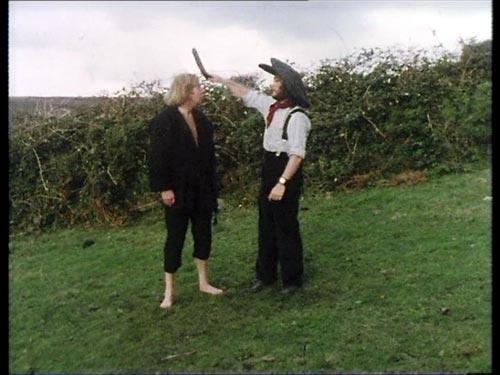
By May, scarves were declared to be back, vindicating me. I still see the occasional young rock scenester with a neckerchief on. Curiously enough, waistcoats and braces came back in 2005, for both men and women, and there is a certain category of Melbourne hipster who gets about looking like something from the Ecky Thump episode of The Goodies:


"Eee bah gum!"

There was a cute episode in December where I was chatting to one of these creatures and described his outfit as "ultraviolent". He mustn't have heard me properly because he replied, "Um, no, it doesn't glow in the dark."

3. Backwards stuff.
I tried wearing Jaunty Pussy bows backwards, especially if the ribbon ends were very long and dangled down the back, but it never looked right on me. That said, I did notice women wearing scarves tied in their hair with the ends dangling down the back. But really, there wasn't much conviction behind this prediction. And it didn't really happen.

4. Long dangly single-stranded necklaces.
I'm pleased to say that I was totally on the money on this front. I had been envisaging necklaces with jewelled pendants, or perhaps the ones consisting of lengths of chain interspersed with pearls and faceted glass beads. These were indeed in fashion, especially Victorian-looking faux jet beads, and necklaces with ribbon bows attached. Long strings of different-coloured and shaped beads were also in fashion: the sort I used to call 'ethnic'. I had one of those in my early teens, until it broke one day on Swanston Street and the beads went everywhere, unable to be retrieved. If it had remained intact I'd have worn it this year.

But a welcome addition, and one I didn't predict, was the popularity of large, chunky necklaces made of brightly coloured plastic or wooden beads. Ranging in size from small beads at the nape to enormous ones dangling between the breasts, these were available in all sorts of shops, and I loved them but couldn't afford them. However, I have got lots of mileage out of some plastic necklaces that I already had: a long strand of white beads, and a short necklace of red beads that I call my "Marge Simpson".

And now to my 2006 Fashion Predictions!

1. Back to School
Blazers covered in button badges have been around for years on the indie scene, and they were popular in the mainstream (Jeans West was pushing them particularly hard) earlier in 2005. I predict that more nostalgic, preppy images of school are going to make a comeback in 2006. White shirts with t-shirts underneath and stripey ties askew. Ribbons worn around ponytails. Ankle and knee socks. Button-down print minidresses. Mary-Jane shoes and T-bar sandals. Oversized jumpers with holes in the wristbands to stick your thumbs through. In fact, because nothing at school ever fits properly, I predict that outfits will be put together with one deliberately too-small or too-large item.

Pencil cases carried as clutch purses or, with straps added, as little handbags. I already use an aqua-blue vinyl pencilcase as a carry-all in my bag to ensure I never have to scrabble around for pens, tampons, lipsticks, USB disks and the like. It's the sort that has clear windows and letters you can cut out and insert to spell out your name. My mother would never let me have one in primary school - she thought they were tacky. Well, I had my revenge!

2. Slinky stencil-print dresses
70s wrap dresses in the Diane von Furstenberg style are one of the key Jaunty Pussy looks, and I was most satisfied to see them become fashionable this spring and summer. It seems every second chick is wearing that wrap dress with a vaguely tropical stencilled print like a vintage aloha shirt - it comes in red and white, green and white and navy and beige, and costs anything from $40 to $90, depending on the poshness of the shop - I've seen it in Studio Girl ("cheapest price in town") and other Asian import stores, as well as in more upmarket boutiques. In September I pulled out my old 60s-style red and white print sundress and got plenty of compliments on it. And I just bought a slinky dress from Supre in a safari-esque black and white print.

This year I think bold prints are going to come back in - think Hawaiian meets William Morris. The prints will look like woodcuts or stencils. The fabrics won't be crisp cottons, but slinky silks and jerseys. Check out some stuff from Furstenberg's Spring 2006 collection, as shown at the recent New York Fashion Week:


After summer the tropical stuff won't be as popular, but I predict lush Art Nouveau designs like something out of a Klimt painting. We may even see a return to the Orientalist kimono top trend of 2003.

3. Alice in Wonderland
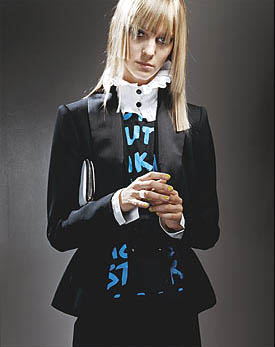
At the end of 2004 Gwen Stefani's "What You Waiting For" video was all over the television, and she was appearing on TV and in magazines wearing this nutty Alice in Wonderland garb. It's wonderfully excessive: part dandy; part bling; part Marie Antoinette. It's a combination of prissiness and sluttiness with a faintly surreal sense of the absurd.


I wouldn't have thought anyone in their right mind would wear this stuff. But considering the moderate success of Jaunty Pussy in 2005, I think people will be open to wearing more formal, old-fashioned-looking stuff in 2006, but giving it a casual twist. Also, given what I've observed recently with the Clockwork Orange hipsters, doesn't this chick look capable of a bit of the old ultraviolence?


I found this picture at New York magazine, where they were espousing an Andy Warhol-esque Pop Art aesthetic as an 'autumn look'. Let's bear in mind that Factory Girl, the Edie Sedgewick biopic starring odiously bland 'style icon' Sienna Miller, is slated for release this year. And look at the high-necked blouse with the graffiti t-shirt underneath - that sort of layering is a look I pointed to almost a year ago.

Obviously I don't expect the average person to wear such ridiculous clothes. I think it will diffuse into a slightly dandyish, layered look that combines decadent tailoring with streetwear.

Happy new fashion year! Let's hope my rash predictions have some basis in reality this year.

Thursday, October 27, 2005

Industrious


Some time ago, I wrote about Industrie, the menswear chain that has a similar logic to Sportsgirl (in the women's mass fashion retail market) as a signifier of 'fashionability'. That is, the clothes appeal to young men who don't really know what's in fashion, but want to look as though they do.

But it's not just about 'fashion', but 'style', which I have previously defined as "a more permanent and idiosyncratic dress sense that works aesthetically in a variety of contexts and fashion cycles". Sportsgirl's elaborate boho clothes are designed to generate individual 'looks' through multi-layering and mismatching mass-produced garments and accessories. Likewise, Industrie makes stylistic gestures towards 'individuality' - deconstructed shapes, torn edges, prints and embroidery that are designed to make the garments look customised, even though they are mass-produced.


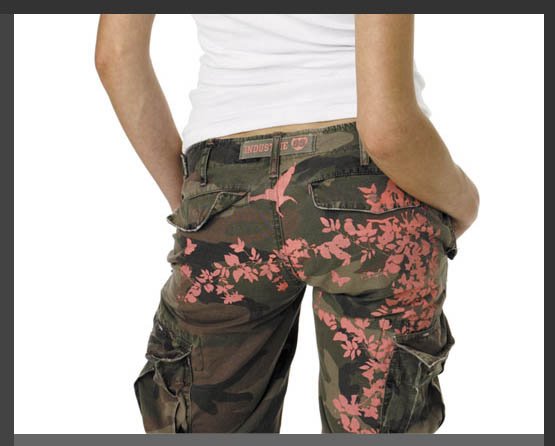
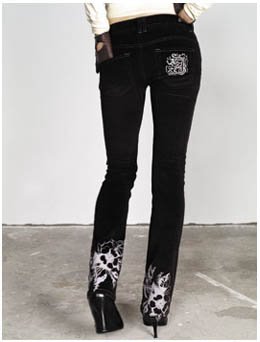
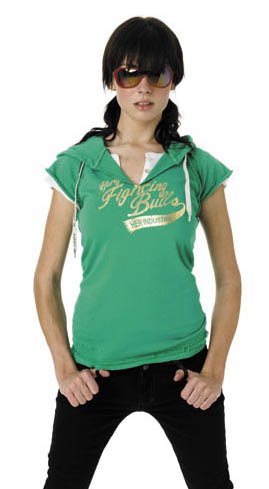
The company has diversified into womenswear with a line called Her Industrie, which has been out for about a year now. As you can see from these images, Her Industrie carries the same streetwear-influenced logic of 'individuality' as the men's line. Look at the stencils on the cargo pants, and the stencilled version of the black stovepipes that, by now, are everywhere in high street fashion stores. There are also layered t-shirts and singlet tops, and raw-edged, printed hoodies.


(As an aside, it's worthwhile mentioning that these hoodies are called "Harajuku". Since Gwen Stefani introduced this word into mainstream parlance, it's become completely disassociated from the specific geographic, aesthetic and cultural context of the Harajuku district in Tokyo, and now seems to mean something closer to "crazy-hip".)

Industrie seems very unstylish indeed to people who have a strongly defined personal aesthetic. And it seems very uncool to people who thrive on the affect of exclusivity that comes with being a style innovator or early adopter. As Will pointed out in the comments to my 'deconstructed hoodie' post: "Industrie is the kind of stuff where, if you wore it to an extended family barbeque, your family might think you were hip." And the hipster kids over at ThreeThousand are "so over" this style they wish to be woken when its moment is over.

For me, the most fascinating thing about brands like Her Industrie is that they relate only tenuously to the standard 'bubble-up' and 'trickle-down' models of fashion adoption. There was a really stupid and unsophisticated article recently in the Sydney Morning Herald which espoused the 'bubble-up' model:
Sportsgirl and the like may have finally discovered the skirts of India swirling around the ankles of nerdy girls in high schools across the land. Market research is all about youth, hunting for the next big thing. Business pays market research companies big bucks to observe young people and predict which of their angst-ridden outpourings will inspire the next Witchcraft [does the writer mean Witchery?] spin-off or be-labelled beanie.
Using this (unhelpfully crude) logic, whatever styles these trendspotters see subculturally affiliated kids (or, in this example, any kids at all!) will show up, blanded out and priced up for the masses, in chain stores. But this model breaks down when the subcultures and the hipsters don't even like the style to begin with.

So, why develop fashion lines like Her Industrie? Not because they are innovative, and not because they're associated with subcultures, but because they're just versatile and customisable enough to reassure most shoppers that by purchasing and wearing these garments, they're exercising their individuality and staying 'in fashion'.

As mainstream New Zealand women's lifestyle portal NZGirl opines:
The best way to inject a taste of ‘army girl’ into your wardrobe is with a pair of army print pants or shorts. Available from most chain stores, these will be a summer staple which will be worn year after year. We love the pictured Rose Bud combats from her industrie. These funky combat pants mix the masculine army print with girly accents by using print detail and feminine ties. Wear them longer on a cooler day or hitched up over your bikini at the beach – sweet and casual.
I did a bit of Googling to work out who's talking about Her Industrie, and the answer seems to be semi-articulate teenage girls:
went to myer, and omgsh i want these 'her industrie' pants.. but they 100$ and i didnt like the printing on the ass part of it.. hahaa so i derno if i'll get them or not.. may just look arnd first at city or something..
Here's another one:
my mother wont let me buy my Her Industrie three quarter pants thing.. she sed its army and its baggy. i guess it makes me look tom boyish x, x MY MOTHER!
This is a case for real market research - interviewing people to ask them what they like and dislike about the clothes. But from what's written on blogs and forums, it seems that people think about how the pants fit (are they in my size? are they comfortable?), how much they cost (young shoppers rely on allowances, part-time income, and parental permission), and where they can wear them (good for the beach, for going out, etc).

Intriguingly, there seems to be a backlash against the 'sameness' of Industrie clothing, particularly the prominent screen-printed branding. People posting to this bulletin board laugh at men (and women) who wear exclusively Industrie. Rather than making them seem fashionable, it makes them seem like dull-witted fashion followers. Still, I do think this is an exception. It might pain me, and it might pain the ThreeThousand kids, but stencilled army pants probably are going to come back in this summer.

Wednesday, August 17, 2005

Starter kits for hipsters

Awww, how cute! Supre is selling the yoof of today everything they need to dress like a real hipster! I was in there today and they were bigging up black stovepipe jeans...


And only $60 - all the more to spend at Ding Dong! They had them displayed on a rack with stripey t-shirts in different colours - pink, blue, yellow... Now all they require is a blazer with a few button badges on the lapel, some scuffed-up Chuck Taylors, a chunky studded belt and some black eyeliner. And voila! instant hipster.

Sometimes I think I am too critical of hipsters. After all, in Melbourne there is not much difference between hipster style and mainstream fashion. The picture below was taken at the second birthday party of Australian Vice magazine. I was there earlier in the evening and couldn't move for all the posing. My friends who worked the bar said it got much worse. People were spewing and passing out and you had to wade through rivers of spilled alcohol. As you can imagine, the wooden floor kinda suffered. Hipsters scaled the outside of the building and broke the lift. The building owners now will not hire the venue out for parties because of the expense involved in restoring it to normality.


I quite like her little bow. Very Jaunty Pussy. Please also note the vintage Nike sneakers worn with the regulation black stovepipes and blazer, ugly op-shop 80s footwear such as grey pumps and red Rumpelstiltskin boots, and that chick with the blonde bowl haircut who I've seen before at these kind of events. I like to subject hipsters to Mel's patented "Would this person look odd walking down the street?" test, and Melburnian hipsters generally pass.

By contrast, here are a couple of examples of how they play things in the States (pictures via the always-hilarious Tale of Two Cities):


Saturday, July 02, 2005

The bag's the charm


(Picture: Vice magazine)

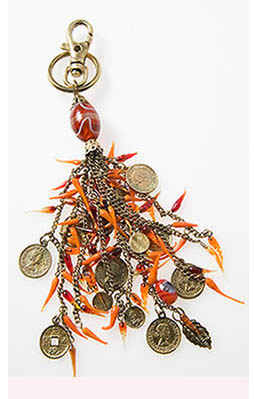
2005 really seems to be a charmed year, accessory-wise. (Haw haw.) Elaborate charm necklaces and earrings continue their reign, and probably will as long as people persist with the boho look. (As an aside, I am just astounded at how long this boho nonsense has persisted for. Surely people will get tired of it soon. Surely.) But lately I have been noticing that mainstream stores are getting into the idea of bag charms, something that only used to be popular with international students. (I've had a little decorative satin toy on my bag for the last couple of years - it was given to me by a Chinese postgrad in my department after a trip back to China, and I couldn't think what else to do with it.) But now you can buy leather bag tassels at Witchery, diamante initials at Portmans and beaded charms at Sportsgirl.

(Image from Sportsgirl.)

This object is billed as a "keyring", but you can tell by the size and the fact it also has a hook that you're also meant to use it as a bag charm. You can buy blinged-out versions of these at accessory shops like Diva. I was in there last week and asked the assistant about them. She said they were very popular, along with mobile phone chains.

At first, this seems to stem from a desire for individuality - making mass-produced accessories reflect your own taste and personality. But there are two problems with that. First, these accessories are just as mass-produced. You're equally likely to see someone with 'your' charm on their bag as you'd otherwise be to see 'your' bag on someone else. Second, when you mass them up as in the photo above, it loses coherence and just looks insane.

As the bag equivalent of wearing about a billion button badges on your jacket, I suppose you could call it 'punk'. But what is punk? Is it an anarchic philosophy? Is it a DIY style of cultural production? Is it an aesthetic of bricolage? Punk is such an elastic term that a recent BBC Radio 1 poll on the greatest punks of all time includes Che Guevara, Johnny Cash and Eminem. In turn, that makes me wonder whether the punkest thing you could do right now would be to defy any coherent semiotic reading of your clothes, like Dick Hebdige and a thousand other British academics performed on the original punks.

In that sense, the insane proliferation of charms on your bag doesn't make a statement about 'who you are' - it repels analysis, and obscures your tastes and identity. Instead, it's just a bowerbird mentality - a love of decorative 'shiny things'. Rather than a semiotic statement, it's an affective statement. It's saying "I wear these things because the way they look makes me feel good." And perhaps, like the bowerbird's collection, it's intended to draw admiring glances, thus drawing a kind of affective circle: "these objects make me feel good, and the attention of others also makes me feel good."

Thursday, June 23, 2005

Retail Review

A couple of days ago, I read an interesting article in The Age which reviewed three new Melbourne shopping precincts: the GPO, QV and the revamped Melbourne Central. It was all the more interesting because shops don't really get reviewed in the general press like fashion shows, art installations, theatre or even architecture, although I would argue that retail combines elements of all these. Jonathan Green's piece nicely evokes the way shopping centres are designed to move shoppers through space, to generate affective responses that will stimulate purchases, and to mirror the CBD's older, laneway-based retail environment. Here he is, for example, on Melbourne Central:
The spaces are enclosed and intimate, a warren of laneways, lofts and balconied atriums spreading in a fair replica of organic old-city chaos from the cleared central circle that surrounds the cone-topped atrium and the brick battlements of the Coop shot factory tower.

Somewhere around here, we'll find no fewer than nine mobile phone retailers, 32 female fashion specialists, 12 for men and everything in between all set in a crazy, vibrant clutter that screams pace, pace, pace. The signage seizes you at the Lonsdale Street entrance — "Scooter", "Grab", "Sushi Sushi" — and propels you deeper into the increasingly complex innards through a bombardment of sound as well as scent and vision, each shop pumping out its own particular notion of aural ambience at volume.

[...]

Onwards ever onwards. There are multiple entry points, from Elizabeth Street through a fragrant series of sidewalk eateries; from Latrobe, Swanston and, of course, from below, through the centre's own proprietary branded station on the City Loop. The redevelopment has closed in formerly open spaces and redrawn the massive footprint to enclose laneways that ape the intricate retail lacework of Flinders Lane and Little Collins Street.

For the last few months, I've been wanting to take Footpath Zeitgeist "live" by actually photographing street style in Melbourne rather than relying on other people's photos. I've been holding out for a decent digital camera and the money to buy it with. Suddenly becoming a full-time freelancer hasn't helped matters.

But one of the things I plan to do when I get my camera is institute a regular review of retail store merchandising and promotion. The Retail Review section will analyse store window and retail interior design using aesthetic, trend-based and more general cultural criteria. I will also critically review catalogues, particularly hybrid "magalogues" like Furst Publishing's STU, which is a General Pants house magazine.

I think that much of the time, these things are seen as peripheral promotional devices, and as such they're not worth reviewing. But they perform a crucial mediating role between a retail store and the people on the street. Street style can be influenced by a window display or a smart catalogue, even if people can't afford or would never buy the clothes in the store.

Friday, June 03, 2005

Every jaunty pussy needs a tomcat

On Tuesday we were discussing names for the male equivalent of Jaunty Pussy. We arrived at one that I found extremely satisfactory, but of course I can't remember it now. Suggestions in comments are more than welcome. But today, I was perusing a feature on dandies at Style.com, the online home of US Vogue, where a variety of jaunty pussies cavorted in photographic and painted form before my eyes.

Ladies and gentlemen, I bring you David Hockney!


Moreover, I bring you the rock star of bespoke tailoring, Duncan Quinn!


Any man who's into hot pink is All Right By Me. (Says she wearing her pink jaunty-pussy bow with pink and black striped over-the-knee socks.) There is also a wonderfully camp picture on the website of Duncan sitting in an armchair, surrounded by tousle-haired male models, with a fluffy white dog on his lap. He even has his own Duncan Quinn Signature Cocktail, the French 75:
A LARGE measure of English gin
A generous splash of freshly squeezed lemon juice
A swirl of syrop de sucre

Shake over ice
Pour to fill 2/3 of a flute and top with fine champagne
Miaow, baby!

Wednesday, May 25, 2005

More jauntiness


Today I found this round-up from Australian Fashion Week, captioned: "a taste of what we'll be wearing this spring". There were also a couple of looks featuring ribbon pussy-bow sashes at the waist, but what I want to point out is that clothes are becoming simultaneously slinkier and simpler in line - which I argue is a key attribute of the Jaunty Pussy look.

Today my co-worker Kate is wearing a vintage jumper which is cream with gold lurex pinstripes, and with a long line of pearl buttons up the left side. It's glamorous and prim, all at the same time. Very Jaunty Pussy.

Tuesday, May 24, 2005

Jaunty Pussy goes mainstream

I got into work earlier and found a magazine article open on my keyboard. (Thanks Lucy!) It was from last Sunday's Herald Sun Sunday Magazine (22 May 2005) and had the following tidbit in the fashion page:

Tie me up

Primly knotted at the neck Parisian-style, tied in a pussy-bow or long, tasselled and tossed loosely around the shoulders, winter sees the return of the silk scarf in all its different incarnations. Experiment with pattern, colour and even the size of the scarves, and you'll soon wonder how you ever accessorised without them. For a modern interpretation, from one of the classic homes of the silk scarf, check out the Hermes Twilly, $185, which resembles a wide ribbon and comes in a range of prints and patterns. Or tie a little tenderness with Scanlan & Theodore's spots and stripes (above), both $120 (stockists: (03) 9826 5742).


Of course, you know something is extremely mainstream when it gets into the Sunday glossy supplements, but on the whole, most street style is mainstream. The edgy fashion that most people think of when they think "street style" is worn by a definite minority; everyone else gets their inspiration from pop culture (particularly movies and music videos), magazines, shop window displays, and to a much, much lesser extent, what they see other people wearing in public.

Jaunty Pussy has gone mainstream, my friends. I'm wearing my lilac spotted scarf today - what about you?

Saturday, May 21, 2005

Jaunty Pussy!


On Monday night, I watched Anchorman on DVD, with Christina Applegate. I was struck by her 1970s corporate style. It was a combination of crisp, relaxed and glossy elements - her wavy blonde hair; her pink, shiny lips; her tailored jackets and vests; her satin shirts and Diane von Furstenberg wrap dresses. It reminds me of the clothes on The Mary Tyler Moore Show.


I wanted to make it after all.

Right now all the shops are still stuck in their tiresome "boho" theme, but people on the street are getting into cleaner and more structured elements of that style: tailored velvet jackets; tucking their jeans into their boots. As I've repeatedly written, I'm interested in the combination of soft and structured elements in fashion; and back in March, I noticed the layering of soft blouses with t-shirts, singlet tops and jumpers.

For a while, I have anticipated that the 1960s mod era will start influencing the way people dress - not least because the dread Sienna Miller, who is something of a fashion touchstone, was supposed to be starring in the film Factory Girl. She has just been replaced with Katie Holmes, who is currently surfing the dubious wave of being Tom Cruise's 'girlfriend'; but I still predict that the contrasting block colours (particularly black and white) and geometric shapes of mod style are going to find their way into fashion.


Biba boutique, London, 1965. Image from Sixties City.

More generally, I think there will be more fashion references from the "Swinging Sixties", and the decorative, dandy elements of mod style - the Carnaby Street look epitomised by Austin Powers. Melbourne's indie-pop scenesters already wear this kind of thing - just go to Cherry Bar, Ding Dong Lounge, Weekender or Shake Some Action. And, being Melbourne, many people already wear black.

But I predict the emergence of a specific hybrid of 70s career-chick and swinging 60s style. It's a tailored yet slinky look. Think satin blouses with tight jeans and flat boots; berets and velvet jackets with striped t-shirts and boyish pants; messy hair, shitloads of mascara and glossy pink lipstick. The key colours are bright, space-age, Technicolours - pink, yellow, neon red, black and white, with judicious touches of denim.

Penny came up with the perfect title for this look: Jaunty Pussy. This was a work of unspeakable brilliance. I liked it so much that I've taken to saying it repeatedly in a plummy English accent.


"You're a woman of many parts, Pussy! "

I tried out Jaunty Pussy last Tuesday. I wore a hot-pink racer-back singlet with a hot-pink sash tied in a floppy pussy-bow around my neck. Over it I wore a black and white striped jumper; and I teamed it with black knee-length, man-style shorts, hot-pink opaque tights and white cowboy boots, with a bracelet made from three rows of very large pearls.

On Thursday, I wore a pale pink puffed-sleeve blouse with a black racer-back singlet over the top like a vest, with the pink pussy-bow, grey pinstriped jeans, and pink Chuck Taylor sneakers. Yesterday, I wore the pink singlet again with the pink pussy-bow, a fluffy white off-the-shoulder angora jumper, a black a-line skirt, hot-pink-and-silver-striped knee socks, and white cowboy boots. And today I'm wearing a lilac silk scarf with black polka-dots, tied in a pussy bow, with a black off-the-shoulder t-shirt, a black skirt, black tights and white cowboy boots.

It would seem that I find the pussy-bow the key accessory.

Look out for Jaunty Pussy on a footpath near you. It's also making its way back onto the catwalk - here are some looks from the Fall 2005 collection from Diane Von Furstenberg.

Thursday, May 05, 2005

No slouch at fashion - or not?

You may remember that I commented on Janice Breen Burns' theory of soft versus hard in clothing, saying that the majority of people will find a way to be fashionable without sacrificing comfort. Well, along these lines, I was very interested to see that at Australian Fashion Week in Sydney, Josh Goot has just presented a collection of very soft, comfortable, sporty clothes made entirely from cotton jersey ("t-shirt material"). You can find them in Melbourne at Marais in the Royal Arcade, above Caffe e Torta. Here are a couple of my favourites:


(Photos: Sydney Morning Herald)

There were other pics, as well. Maybe I should call this look "Back to the Future". They look very 80s in that baggy, preppie, pastel-coloured way that to me, makes them look like something from old-school Benetton, Tommy Hilfiger or Ralph Lauren, especially when you go to the website and see the models lined up. But at the same time, they're completely futuristic - you know, that image of "the future" that you sometimes see in movies, where everyone wears floppy, unisex clothes in grey, white and beige. In The Matrix they wear weird homespun t-shirts when they are in "the real world", as opposed to the tight, structured, tailored clothes they wear in the Matrix.

Goot won the Tiffany Design Award at this year's Melbourne Fashion Festival. He's only 25, and all the usual pundits are predicting he's one to watch. But what I find most interesting about Goot is that he creates structured pieces like jackets, trench coats and tailored pants. I am interested in this combination of formal tailoring and casual fabrics.

Today I am wearing a cropped, double-breasted jacket with raw edges on the lapels and cuffs, made from windcheater material. I got it from erstwhile hippie shop Rasa Rani in the Royal Arcade, which has now closed for renovations, after which time they'll reopen as Hello Gorgeous (the brand name of the clothes they produce). I was drawn to this jacket because it looks dressed-up, but is still casual and very comfortable; and I think that's also the attraction of Goot's clothes. As one anonymous commenter says on Coolchiq:
at first sight, the jackets doesn't make you want to own one. But once you put it on, you'll know what josh is trying to achieve in his line "easy and affortless" ... it will remain one of your staple wordrobe item for a while... you can dress it up or down by playing with scarfs and accessories... the silver track suits definately capture the vintage feel if you are looking for one!!! try one and you'll know!
I am drawn to this idea: "try one and you'll know." It implies an affective dimension to the clothes: that they are made to instil feelings in the body. For example, today I'm wearing thicker than usual socks and my cowboy boots sit quite snugly. I don't have a word for the pleasure this gives me as I walk around; but it makes me feel more cosy and luxurious, even though the actual items I'm wearing are not particularly 'glamorous' in appearance.

Perhaps the genius of Josh Goot's clothes is in creating an innocuous, everyday garment that doesn't look like much, but feels like everything. As he told The Australian:
"People today want to feel relaxed and easy, to counter the stress in their lives. I'm taking that feeling and putting it into my clothes."

Wednesday, May 04, 2005

Business casual is back, mofo!


Rockin' the Chicago street. (Picture: WearWhatWhen)

As I pointed out on my other blog, the idea of wearing a tie with casual clothes was huge a couple of years ago when Avril Lavigne and a million teenage girls did it, but that it is probably considered "totally played" by hipsters. Well, it's funny how many people I see around actually wearing ties. Skinny ties, fat ties, ties pinned to the side and worn as kerchiefs (kerchiefs, if you'll recall, were one of my 2005 Fashion Predictions). Ties with shirts, polo shirts, t-shirts, singlets. Business casual is here to stay.

Now, when I say "business casual", I don't mean it in the Andrew G sense of "let me put on a blazer with the sleeves pushed up with my jeans, t-shirt and appalling Farrah Fawcett hair," nor in the pragmatic sense "clothing to wear to work when professional dress codes have been relaxed". Many companies have given up on their business casual codes because workers were confused by them or because they actually prefer to wear suits.

This ties into the careless luxe trend I identified several months ago - the mixing of signifiers. So, what is business casual all about? Is it a nostalgia for dressing up in an era when dressing casually is more widely accepted than ever? Well, you have to admit that the more prominent new-tie wearers are the usual artsy, creative types, who can afford to wear whatever they want. Perhaps they wear business casual as a declaration of their independence from the socioeconomic tyranny of 9-5 labour. As Dougie (my source on the ground for Japanese fashion) wrote recently:
Watching MTV, I realised that one of the reasons punk and rock bands dress bizarrely and let their hair shag out wildly is effectively telling the world that they've made it, because they're completely unemployable by any other industry.
This week, I've been doing my own version of business casual - cutting off old black or navy pantihose and turning them into sheer footless tights. I wear them ankle-length with my cut-down Dunlop Volleys, or hitch them up to mid-calf or just under the knee to wear with sneakers or cowboy boots. I was reading with interest an article (the link is to the cached version) about how business casual policies have meant that pantihose fall by the wayside as corporate wear. Most young people I see (even business types) wear opaque tights. So, I'm interested to see if my idea of sheer leggings takes off.

But I am not so much into the Tommy Hilfiger look of tucking the shirt into the jeans. No, Tommy, no!