Saturday, March 10, 2012

The heartache of the underwear department

Jeans, swimsuits and bras are perhaps the three most misery-causing garments to buy. All three are closely fitting and reveal the shape of the body, and all three have posed immense challenges to the garment industry to ensure good fits.

People come in a vast variety of shapes and sizes, none of which is intrinsically better or worse than the others, but some of which are marginalised by the clothing industries and by popular culture, making those who have these 'outlier' bodies feel ugly and rejected. My research is interested in the strategies by which this happens, and also in the embodied feelings of pleasure and shame linked to clothing fit and size.

An excellent place to observe these processes in action is the underwear floor of a department store. Because it's not a specialty lingerie store, it only stocks mainstream brands and sizes, and so it can't possibly fit everyone. It is an exercise in heartache, a machine for making women feel bad about their bodies.

Today I went to Myer Melbourne to buy a black T-shirt bra with plain thin straps. This is often defined as 'everyday' underwear (as opposed to the 'fashion' underwear you don in romantic scenarios when you want to be admired); its main purpose is to provide a smooth, moulded and unadorned silhouette that looks good under tight-fitting tops. My shopping was utilitarian – I was seeking to plug a hole in my repertoire of bras for everyday wear. But I also wanted something a little bit fancy; maybe some lace, ribbon, tucking or satin, or an understated print that combined black with other colours.

A truism of bra fitting is that women's shape changes over their lifetimes, but they cling to the idea that they wear a particular bra. There's a genre of popular media reportage bemoaning women who wear ill-fitting bras, which Time magazine neatly summarises:
If you are a woman, and you are wearing a bra, you are probably wearing the wrong size one. That's what they say. According to "experts," "industry studies" and "surveys," anywhere between 70% 85% of women are treating their breasts badly, either shoving them into too-small cups or allowing them to float freely in a draping sling. The statistic's origins are murky — some cite a Victoria's Secret poll, others something from the Wacoal brand. But it has been quoted back to me by friends, colleagues, interns. It sounds true. "Eighty percent of American woman are wearing the wrong bra" is the "more likely to be killed by a terrorist than get married" statistic of the new millennium.
The current bra sizing system that combines a lettered cup size with a numbered back size was invented in the early 1930s as a marketing technique, similarly to the way corsets had earlier been marketed by defining certain body shapes or customer life cycle stages as problematic and then offering the corset as the solution.

In 1933, advertisements for SH Camp and Company were categorising their bras by their ability to counteract varying degrees of 'sag', with A being the least degree of correction needed and D the greatest. I haven't read anything yet that convinces me this system has any biometric basis whatsoever; the persistence of ad-hoc additions such as "DD", "FF" and "GG", as well the logical alphabetical progressions, certainly suggest bra manufacturers have been making sizes up as they went along.

Similarly, if the use of back measurements numbered by inch did not actually originate in biometrics, its adoption after WWII was a marketing response to a cultural interest in biometrics and ideal body proportions. If women were already measuring themselves against an ideal "36-24-36" hourglass figure, it made sense to size bras in inches as well.

It is ridiculous to believe your bra size defines you, yet so many women have strong emotional and psychological responses to bra sizes. Back sizes larger than 16 carry the same stigma as plus-size clothing, while women feel embarrassingly juvenile or unwomanly in AA and A cup sizes, and the stigma of obesity rubs off on cups larger than D. So do prurient, fetishistic associations; take the exploitation movie sequel Piranha 3DD, or the tabloid focus on the cup size of famous women's breast enlargements. Women feel freakish in large cup sizes.

This blog post from Knickers offers a good summary of bra sizing and fit issues that also offers insights into the general confusion that consumers feel. Many people feel that clothing size and fit ought to be intuitive: you try something on and if it feels comfortable, or if you're pleased with the way it makes your body look, then you call that feeling 'a good fit'.

For instance, when I buy a bra, I want it to make me look good in my clothes. I want the bra to create the illusion of a Barbie doll's smooth, firm body; it should not draw attention to its presence by creating visible rolls or lines in my flesh, or a crinkly texture that's visible on the surface of my top.

Also, because I sometimes wear low-cut or strappy tops and wide necklines, I needed to consider the accidental exposure of the bra. Mary Russo writes in The Female Grotesque that the notion of 'making a spectacle of oneself' carries specifically gendered assumptions:
"For a woman, making a spectacle out of herself had more to do with a kind of inadvertence and loss of boundaries: the possessors of large, aging and dimpled thighs displayed at the public beach, of overly rouged cheeks, of a voice shrill in laughter, or a sliding bra strap – a loose dingy bra strap especially [my emphasis] – were at once caught out by fat and blameworthy."
There is a thriving industry of bras and bra widgets designed specifically to create invisibility under particular kinds of clothes – for instance, strapless bras, super-low-cut plunge bras, 'convertible' designs whose straps can be reconfigured, and those clear plastic straps that fool nobody. Owning these items is a technique of compliant womanhood that acknowledges our culture's requirement of public propriety in women. Alternatively, the visibility of one's bra mimetically conveys a messy psyche or messy morality. Loose bra strap = loose woman! Dingy bra strap = dirty woman!

It has become far more acceptable to reveal one's bra than when Russo was writing in 1994. I could trace this to subcultural bra-wearing that re-coded 'sluttish' (in both its original sense of 'slovenly' and its patriarchal sense as 'sexually active') as 'insouciant' – for instance, in punk and Riot Grrrl music scenes – and the popularity of the burlesque and 'retro' aesthetic that has made it fashionable to glimpse lingerie in necklines or through transparent garments. Talk about mainstream: Dita von Teese has a lingerie line at Target!

But even this contemporary bra-exposure is concerned with propriety – the criteria are simply different. It's acceptable for bra straps to echo the straps of singlet tops, or boldly stripe across shoulders exposed by off-the-shoulder or racer-back cuts, but you don't want a chunky sports bra; you want a thin, plain strap, or a deliberately decorative one. Similarly, if the bridge of your bra is visible in your neckline, it should be a fancy one with ribbons or lace, and one that matches the aesthetic of your outer garment in style or colour.

Meeting these expectations while also meeting the criteria of 'support' and 'comfort' actually poses a major challenge to bra manufacturers and fitters. My body is upholstered in soft flesh, and the wide, spongy strap that looks like shit under my singlet top, or creeps into the frame of my boat-neck T-shirt, is the same one designed to stay put on my shoulder all day. The fancy lace that looks so sexy peeping from my neckline looks terrible rumpling the contours of my T-shirt.

Unfortunately, the bra industry deems phenomenology – that is, the wearer's feelings and experiences – to be a thoroughly inadequate method of determining bra fit. Instead, bra fitting is cognitive and quantitative – it's about measurement and problem-solving.

For instance, today I tried on a bra that I found really pretty, but it was too small. But the next cup size up in the same style was a fundamentally different garment. The straps were wider and made from a different fabric and colour; it had three clasps in the back rather than two; and it had corsetry-style boning inserted in the sides of the band. This shit makes sense to the bra manufacturer, which has made the industrial decision that these design elements are more 'supportive'. But it disrupts my expectations.

A successful bra fitter understands these dissonances. She is halfway between a counsellor and an engineer. She simultaneously scrutinises the wearer's body, exerting her expert knowledge on it, and offers change-room sympathy when the wearer feels vulnerable and frustrated because the bras she's trying on don't make her feel the way she wants to feel.

When she's good at her job, she can inspire feelings of gratitude and even liberation in her customer. That is, she has successfully influenced the bra wearer's perceptions and associations, subtly realigning them with bra manufacturers' size ranges.

While I was trying on some bras today, I overheard a bra fitter at work in the neighbouring cubicle, fitting a pregnant woman for her first maternity bra. Making matters difficult was that the customer claimed to wear a 16G, which you will immediately recognise as an outlier size.

It was fascinating to hear the fitter and customer talking, growing more and more apologetic as it became obvious that Myer didn't have anything to sell this lady.

"It fits well here, but not here"
"It fits fine now, but it will be too small once your milk comes in"
"I'm sorry, that one only goes up to an F-cup"
"Sorry it looks a bit old-fashioned, but that's the only one we have in a G"
"There's another good brand you can find in maternity boutiques – you could try XX in Australia On Collins…"

The bra fitter succeeded in creating sympathy with her customer, but she failed to align the customer's feelings about bras with the sizes available.

Monday, March 05, 2012

Take it easy

In garment construction, 'ease' (or easement) is the difference between garment measurements and body measurements. It determines how tightly the garment fits, and as the name implies, how easy it is to move in the garment.

There are two kinds of ease – 'wearing ease', which is the amount of ease you need to be comfortable in your clothes; and 'design ease', which is the creation of looseness as an aesthetic choice. According to this chart, wearing ease is generally 6.4 cm (2 1/2") in the bust, 2.5 cm (1") in the waist and 7.6 cm (3") in the hip.

Ease could also be part of various clothing brands' marketing strategies – for instance, sportswear and casual wear might allow more ease than a brand marketed as fashion-forward, whose customers will accept a certain restriction of movement as the trade-off for achieving a very fitted look. I still need to do more research to discover whether different manufacturers have different ideas of wearing ease.

I'll also need to figure out if ease is factored into online size charts, because online shoppers are entitled to expect that if they measure their bodies to decide which size to buy, they should get a good fit.

Online vintage dealer Maggie Wilds consulted her colleagues at the Vintage Fashion Guild on how much ease to allow when purchasing clothes. Nicole Jenkins of Circa Vintage Clothing recommended an ease of between one and two inches at the waist, with less for smaller sizes and more for larger. Anne Marie Cook of Vintage Baubles recommends that since most movements – walking, sitting, bending – are through the hips, ease is more important there.

Ease, like other size and fit issues, changes over time; for instance, a 1947 Simplicity sewing guide suggests, "About 4 inches larger than bust measurement is usual allowance." My chapter discussing shifts in ideal silhouettes over time will have to address this.


Ease is also a factor in vintage clothes, because these fabrics often don't behave in the same ways we expect of contemporary fabrics. Christina Hendricks' costumes on Mad Men have very little ease – look at how this dress pulls when she lifts her arm. They're also very tailored – look at all the vertical darts on the back of this dress – and made from woven, rather than knitted, fabric – although Joan does wear sweaters, and in season four of the show she begins to wear more jersey and other knitted fabrics.

The vintage dealers consulted by Wilds suggest that fabric is a key factor in ease. Amber of The Vintage Vortex said: “I think if I were wearing a much older item than 1950s I would want more ease for myself as thread and fabric deterioration would be a factor … I think that the age of the garment should also play a part in determining ease.” Meanwhile, Jody of Couture Allure Vintage Fashion added that it's easy to stress the seams of taffetas, satins, and loosely woven fabrics and pull the fabric along vertical seams.

I was thinking about Joan because on Friday night I went to the launch of Australian Modern magazine and decided to wear a dress I altered back in 2010 to wear to a Mad Men costume party. The dress is in a crepe fabric; I bought it from Savers in a very large size, and basically put it on inside-out, pinned it until it was tight enough to recall Joan's costumes, then took it in along the line of pins.

When doing this I allowed more ease through the waist and hips, because I'm self-conscious about this part of my body and wanted the dress to flatter me. But I made it very tight around the bust and turned the skirt from a straight shift to a tapered pencil silhouette.

The consequences of this are that I find it very difficult to walk quickly in the dress, and I have to turn sideways to walk up stairs. Wiggling my hips as I walk really does help me move better. Also, I can't wear it for an entire day or evening, because it quickly becomes uncomfortably tight across my ribs.

Hendricks told UK Glamour magazine that the costumes influence Joan's distinctive wiggly walk: "I think I was just trying to get across the room in that tight dress."

Now I know what she means! But another provocative thought regarding ease is that perhaps we, the contemporary wearers of 'old-fashioned' styles of clothing, have very little idea how to be comfortable in these clothes. We interpret the tightness, the physical discomfort, as markers of authenticity, because we have a teleological idea of history in which things always get better with time. For instance, we think of 19th-century corsets as cruel and oppressive, but what if the historical wearer of a properly fitted corset interpreted that garment's tightness as safe, civilised, 'put-together'?

Wednesday, February 22, 2012

Out of Shape, in progress

Phew, another long break between posts. Not as if I've been idle, however – I've been working on the book project formerly known as "What Fat Chicks Used To Wear", and I'm pleased to announce that it has been commissioned by Affirm Press, for a scheduled release date of March 2013.

The book now has the working title Out of Shape, and I'm imagining it as an adventure through the cultures of clothes that don't fit, fuelled by curiosity and delight. I begin with a set of questions many readers will recognise:

“Why is it so tricky and unpleasant to find clothes that fit?”
“Is my body the problem, and if not, whose problem is it?”
“Have people always struggled this way?”

Importantly, I never, ever suggest these are problems faced by only a certain set of consumers – fat, skinny, tall, short, young, old, men, women. Rather, I want to show that by even presenting them as problems for only certain consumers, we are avoiding issues that everyone shares.

Then I set off for answers, taking the reader on a journey into the privileged insider spheres of the clothing industry and the corners of the pop-cultural archive. It's also a journey into the past, which I argue is not “a foreign country” where “they do things differently”, but contains many of the same size and fit issues we face today. The past doesn't only shape our present; we actively remould and reinterpret the past according to our contemporary values and anxieties.

I can't wait to be surprised and excited by the information I discover and the connections I draw. I hope to provoke, but ultimately to comfort readers by revealing the imperfection and struggle that lies beneath the elite glamour of ‘fashion’ – to show that no wearer of clothes is alone in feeling he or she doesn’t measure up to these images.

Since I'll be working on the book pretty much full-time in 2012, expect more frequent posting here. I'm hoping to use this blog as a sort of work-in-progress journal, posting snippets of the cool stuff I discover along the way.

Wednesday, June 22, 2011

Offering tips to hipsters

So, quite a lot of radio silence here. However I have been boasting about my recent purchases on Twitter. This has never been a haul blog or a GPOY blog, although I am kind of regretting turning down the invitation to blog at I Op, Therefore I Am a couple of years ago, because I get most of my clothes at op-shops and would happily rabbit on about them.

One thing I've done, however, is start a Tumblr called The Hipster Tipster. I had this idea last October after spotting a rack of free greeting cards outside a surf shop, and thinking hipsters ought to have been all over it. I thought, "Someone should start a blog where they offer these kinds of little tips and ideas."

It is not as though I am Queen of the Hipsters and hence am speaking from an authoritative position. But I do think I should be honest with myself: I work for an alt-culture website. I know lots of coolsie types. I'm acutely conscious of how my tastes present me to the world and situate me among my peers.

Also, I feel strongly that hipsterism is unfairly maligned; as I wrote in an op-ed last year, haters gonna hate. There is nothing intrinsically wrong with wanting to be cool, liking the things you like and wanting to be around other people who like those things too, and this Maria Bustillos story from The Awl really resonated with me:
When you are around young people who have ambition and taste, and who long to enter an imagined world full of gloriously attractive and brilliant cognoscenti, it can break your heart to see their fear and insecurity—which is very natural and really, almost inescapable for the young—manifested in distrust and an assumed arrogance, in a pretense at more knowledge than they really have. The way they pretend to know about this or that band, or the way they suddenly up and say that Pitchfork itself is "too mainstream," or they pretend to read a book that they haven't read. They literally twitch with grief and fear. They are suffering! And this suffering stifles their natural curiosity and pleasure, imprisons them in an airless chamber of embarrassment and insecurity.
As Bustillos shrewdly recognises, a cultural disposition predicated on connoisseurship offers no room for people to admit they don't already know everything. But nobody knows everything, and it shouldn't be uncool to admit as much. So The Hipster Tipster comes from this position of being a face-saving solution: offering little hints and ideas that you otherwise have to figure out on your own.

I was very conscious of wanting to offer tips for both men and women, for people who like cutesy stuff and people who like futuristic stuff, for DIY fans, students, workers, and all sorts of creative people. I also wanted the tips to cover a broad terrain – not just fashion, accessories and grooming, and not just interiors, and not just food, and not just culture, but things from across all these fields.

But one of the things I've realised when running the blog is that there are so many different hipster dispositions that I can't possibly represent them all. My own tastes tend to the feminine, the DIY and the retro, and on Tumblr, your tastes curate the information you encounter (via the users you choose to follow). But I try not to make The Hipster Tipster too prescriptive.

A big however. I also want to condemn the aspects of hipsterism that I find repugnant or just irritating. I want to show readers that they can pursue cool without being reckless or callous, and point out the ways that trying to be individual sometimes leads to ill-thought-out herd behaviour and venerating dickheads. By contrast, I want to show how you can do alt-things politely, thoughtfully and ethically.

I offer readers the opportunity to ask for tips. Disappointingly, very few people have taken me up on this, and when one guy asked how to attract a hipster girl, I was tempted to think he was taking the piss. But it really pleases me to see the social negotiations of hipsterism made public like this, and for me to get an opportunity to put my oar in!

Saturday, January 15, 2011

Fewer and better shoes

This year, one of my New Year's resolutions is to buy fewer and better shoes. In the past I have chosen not to spend money on shoes because I've observed that no matter how much money a pair of shoes cost, I tend to grind the soles away and tear the insoles. So why not buy ten pairs of shoes for $100 rather than one?

However, I am sick of having a wardrobe stuffed with canvas or vinyl flats that have holes in the soles or are coming apart at the toes. I'm sick of the way that cheap shoes always have uncomfortable, pancake-thin soles that make walking a misery. I'm sick of spending more money on insoles, glue and gaffer tape than I spent on the damn shoes in the first place. And I am sick of the dismay that comes from realising, every time it rains, that I don't own any shoes that won't leak.

I've spent some time thinking about what constitutes 'value' in clothes shopping: for instance, a few years ago when I was dissed about my beloved handbag, Stam. Interestingly, my knock-off Stam bag got so much use it wore out and I had to replace it. I decided that leather would be more durable than vinyl, but oddly enough you just can't buy a knock-off Stam made from leather – the real Marc Jacobs bags are leather and the knock-offs are always 'leatherette', 'leather-like material' or other euphemisms for vinyl.

So in mid-2008, I bought a real Stam, even though I don't really give a shit about branded merchandise. What has taken me by surprise is the affective bond I have with this inanimate object. The design is not an 'It bag' any more, but I love Stam, and when it wears out, I'll buy myself another one.

But I have digressed. To recap, here are a few different ideologies of value, which sometimes intersect and complement each other.

Brand-led value: Some people believe that they're getting the best value by purchasing prominent brands or designers who act as stylistic innovators, gatekeepers of quality and markers of authenticity. If these brands are expensive, brand-led consumers reason that "you get what you pay for". My brother, for instance, always buys designer merchandise and finds cheaper, unbranded or knock-off alternatives offensive.

Material value: Some materials, or proportions of materials, have been consensually allocated a higher exchange-value. For instance, the 'thread count' of bedsheets, or the presence of 'Egyptian cotton', is now a marker of 'better quality' sheets. Right now, natural fabrics are deemed better quality than synthetics – garments are advertised as being 'cotton rich', or '100% silk', and leather is better than PVC or vinyl – although historically, synthetic fabrics have been greeted as desirable innovations.

Price value: In this ideology, the cheapest (or most discounted) goods are the best. It prioritises 'bargains' and getting more for your money, and celebrates sourcing items from factory or warehouse outlets, discount malls, VIP sales and markets, as well as through shopping at stores known for offering super-cheap prices.

Fashion value: This ideology prizes owning only items that are 'on-trend': on the leading edge of the fashion cycle. Purchases are frequent and items are turned over quickly in order to maintain maximum fashionability. Items can be very cheap (as in 'fast fashion' chain stores) or very expensive (as in designer ranges), and fashion-led consumers always have their eye on particular, coveted future purchases.

Classicism value: This ideology deliberately opts out of the fashion system and considers it vulgar to chase trends. Rather, it's interested in 'elegance' and 'chic'. These qualities can be attained by developing a repertoire of plain garments that have become consensually deemed 'classics' – usually through their appearances in classic Hollywood cinema or through being favoured by fashion icons. Little black dresses, ballet flats, beige trench coats, striped Breton T-shirts, blue jeans and 'crisp' white shirts are all classic garments.

Ethical value: For some shoppers, paying attention to ethics is the paramount consideration. This can mean being 'thrifty' by buying fewer items and re-using or altering existing garments, avoiding cheap items which are likely to have been produced by sweated labour, choosing environmentally sustainable materials and supply chains, or favouring local and independent designers over big global brands.

Affective value: While the other ideologies each have their own affects (from moral conviction to glamour), affect-led shoppers tend to buy things based primarily on how the items make them feel. A fluffy scarf feels lovely nestled against the cheek; comfortable shoes offer instant relief when tried on in the shop. Bright colours cheer you up; sparkly things make you feel rich, or that you'll attract the gaze of others.

My own shopping decisions have mainly been a combination of price and classicism value – not necessarily because I prize the 'classic' aesthetic, but because I believe that when you buy plain, simple clothes, it's less obvious how little you paid for them. As I've mentioned, I also tend to buy many identical, cheap items in the belief that this is 'good value'.

But my 2011 shoe resolution sees me shifting priorities to a combination of classicism, affective and material value, downgrading the importance of price. The idea is to possess fewer shoes, but to buy only comfortable shoes made of leather, in styles I'm 100 per cent happy with. So I'm going to throw out the worst of the current canvas ballet flats. And when I'm in a shop and get excited about some hipster plimsolls that cost $5, or when a pair of shoes is almost but not quite what I'm after, I will say to myself, "Fewer and better shoes, Mel!"

I have also – embarrassingly! – decided to invest in some 'sockettes' or 'footlets' – those shoe-liners designed to be worn with bare legs to prevent you sweating in and stinking out your shoes. I've decided that it will prolong the life of my shoes never to wear them without socks.

Damn, I've written so much and haven't even really touched on the sexist notion that all women fetishise shoes and love shopping for them, which is absolutely at odds with my own experience. Another post, perhaps.

Wednesday, October 13, 2010

Wardrobe malfunction

You know that perhaps you have too many clothes when your wardrobe rail breaks.


This happened to me last Friday. Because I was sick of tripping over my collection of sub-$10 canvas shoes, from my local op-shop I bought one of those IKEA hanging shoe storage units. It looks like this, except in plain black. It cost $8, which I thought was overpriced but didn't fuss about because it was a charity shop. But if the retail price is $17.99, I got it pretty cheaply.

I have lived in my current house for almost five years, and the wardrobe rail has always bowed alarmingly in the middle. I have to say that this, more than any single other factor, is why I have been trying to sell my old clothes on eBay.

When I hung up the shoe pigeonholes and filled them with shoes, I was very pleased with my newfound tidiness for the 30 seconds or so until the rail fell off at one end. However, my cat was very pleased with his new cushion.


The rail – which is metal with some kind of latex coating – was actually bent in the middle. I got my trusty sledgehammer and banged it straight again. Then I headed down to the local hardware shop, where one of the Bondi Vet's younger brothers sold me three brackets for $5.

Since I don't own a power drill, it was Handy Dad to the rescue. He helped me reinstall the wardrobe rail, this time reinforced by the three brackets screwed into the wardrobe ceiling. Now the weight on the rail is spread five different ways rather than just two.


Once I had a functioning wardrobe again, I tried to be ruthless and cull anything I didn't wear. In the dead of night I took four bags of clothing and accessories to the same op-shop that had precipitated the disaster. But it really didn't make much of a dint in it:


All my coats and jackets are on the far left, hidden behind the door. Then you can see some of my rainbow of cardigans. Then my shirts and blouses, then skirts, then long dresses, sleeveless dresses, spaghetti-strap dresses, short-sleeved dresses, long-sleeved dresses, cocktail and evening dresses. Then a section of stuff I'm planning to sell on eBay. And on the very far right, the notorious shoe pigeonholes.

That is just the wardrobe. I also have a chest of five drawers: the bottom drawer is knitwear, the next up is pants and foldable skirts, the next up is, shamefully, accessories, and the top two contain undies and other lingerie.

My T-shirts used to live in the accessories drawer; now they're crammed into one of those giant IKEA bags. My underwear collection grew too big to keep in the drawers, too; now a giant plastic tub holds my socks and tights (with a cardboard divider stickytaped into it). And I have a hatstand for my bags, scarves and hats.

Is it wrong – is it wasteful, narcissistic, shallow, compulsive – to own this much clothing? For instance: I own 16 cardigans. Sixteen cardigans. Does even Emma Pillsbury own that many? I also didn't have enough clothes hangers for everything. I bought a dozen more on Saturday at Big W, suckered by the sign that said, "That's 29c per hanger!"

In popular culture, women with large clothing collections are presented as out-of-control spendthrifts, the idle wealthy, fashion-obsessed, or combinations of the above. Think of Carrie Bradshaw's walk-in wardrobe and its obscene upgrade for the Sex and the City movie, Cher Horowitz's computerised outfit selection system or Rebecca Bloomwood's dangerously overstuffed cupboard.

I wouldn't put myself in any of those categories. None of my clothes or shoes are expensive or 'designer' – they are all from op-shops, trashy teenwear shops or discount department stores. Yet I don't really follow fashion; I tend to buy plain, non-trend items and keep things for years.

For a while I've been meaning to blog about clothing repairs – and perhaps I still will – but basically, I also extend my clothes' lifespan by mending them. So the only reason I get rid of something is if it no longer fits, is irretrievably stained or has totally worn out.

The other reason I have so many clothes is because I'm obsessed with repeat purchases. If I like something in one colour, I will buy it in others – usually at the same time. I see it as good value. If you eliminated all the clones from my wardrobe, you'd probably halve it.

It's also interesting that there are deemed to be two sorts of large wardrobes: the well-organised large wardrobe and the jumbled, messy large wardrobe. The storage and organisation industries prey on women whose clothing collections are so large they can never find the item they're after when they want it.

But I'd argue the well-organised wardrobe is much scarier. The sort with spots for everything, and everything always in its right place. It reminds me of Joan Crawford in Mommie Dearest: "No wire hangers!" Doubtless she would be appalled at my plastic hangers – no lovely wooden or padded hangers in my wardrobe, I'm afraid. In the numbers I require, they would probably cost more to buy than my clothes.

Monday, September 27, 2010

Some pretty basic thoughts on racist fashion

Back when I wrote about the keffiyeh as a hipster totem (and, of course, one which seems so naff and passé now), I said:
Let's set aside the well-known debates over cultural and political appropriation, because they've been rehearsed so many times before when it comes to hip-hop apparel, bindis, dreadlocks, Thai fisherman pants and any number of other 'ethnicised' forms of clothing.
Clearly these debates have not been rehearsed often enough. It seems weird to me now that I could have considered this terrain well mapped, because the fashion industry continues to deploy imagery and 'inspiration' that quite startlingly disavows any politics whatsoever.

But of course, we live in a culture in which people who draw attention or object to racist cultural moments are routinely accused of being 'politically correct', 'over-sensitive' or 'reading too much into things'. Maybe we do need to point this shit out, even if the points we are making seem obvious.

I don't make a habit of tracking this stuff; for all your erudition needs on the politics of fashion, I heartily recommend Threadbared and Fashion For Writers. However, here are several pretty basic observations I would like to make:

1. It's not okay to participate in other countries' racist traditions


Dotti window display: demonstrate your individuality by thoughtlessly replicating racist imagery.

When KFC aired its notorious "fried chicken at the cricket" ad, the company was shocked that American commentators would be upset at the suggestion that it's "too easy" to quieten down rowdy black people by offering them buckets of fried chicken.

The company's view was that the ad was never intended to be seen in the US; that in Australia, black people/fried chicken doesn't have the same racist connotation. "The ad was reproduced online in the US without KFC's permission, where we are told a culturally based stereotype exists, leading to the incorrect assertion of racism," said a KFC statement.

"We are told"! Pshaw! Such a statement betrays the attitude that cultures other than our own are fundamentally unknowable to us, and hence we can elude accusations of racism by saying it's not our racism; it's another culture's! We didn't know! To us, it's funny, or glamorous! Go tell them about racism!

Today, via Cate Lawrence, I came across this blog post about cultural appropriation, which made me remember my horror at the Dotti shop window. It was also quite eye-opening to see the resentment that ordinary consumers felt at being implicated in racist fashion practices. Some people quoted in Julia's post seemed to feel badgered by the 'PC police', or having their innocent consumer choices unfairly tainted with the racist brush.

In Australia, appropriations of American racism have been excused as harmless humour and spectacle, because "we don't have the cultural context to interpret them as racist". There might be an outcry if national chain store Dotti used cartoonish Australian indigenous imagery, but since we don't have Native Americans, it's okay to dress up as them.

Now that is just bullshit.

2. 'Nude' is not a colour


"I'm sorry Barack, you don't have X-ray vision."

I can't remember where I first read about Michelle Obama's 'nude' dress, but I was reminded about it on the weekend because Sushi Das wrote about it in The Age's A2 section, months after everyone else.

Personally I don't use the term 'nude' to describe those pale, insipid colours that so many Hollywood stars seem to find flattering on the red carpet. But the Obama incident did make me recognise that I do subconsciously think of these colours as ones that will blend with my skin tone.

There are whole industries built around the aesthetic privileging of pale skin. I've never had trouble finding concealer, stockings or Band-Aids to match my skin… but plenty of people do. It's obvious as soon as you see dark-skinned sportspeople strapped up in tape, or wearing knee, elbow and ankle supports that are clearly intended to 'blend in' with pale skin.

To think of these colours as 'nudes' implies that pale skin is the default skin tone, the skin tone. But what gets me is how easy it would be for the fashion industry to use the many other words for these colours – beige, champagne, peach – yet how 'nude' is still the preferred term. It's almost as though you show more mastery of fashion terminology by using 'nude'.

Recently Westfield shopping centres promoted a new stylist/online community manager role that they're calling the "Westfield Insider" by getting well-known fashion bloggers to put together an outfit sourced solely from a Westfield mall. There were several 'on-trend' looks to work with, including "the blazer", "the maxi dress", "nautical", "military", "coloured denim", etc.

Lady Melbourne, who is one of the Westfield Insider judges, picked several trends, but one of them was "nude and pastels".


"I loved the colour of this bag, it jumped out at me immediately as soon as I set eyes on it," she wrote.

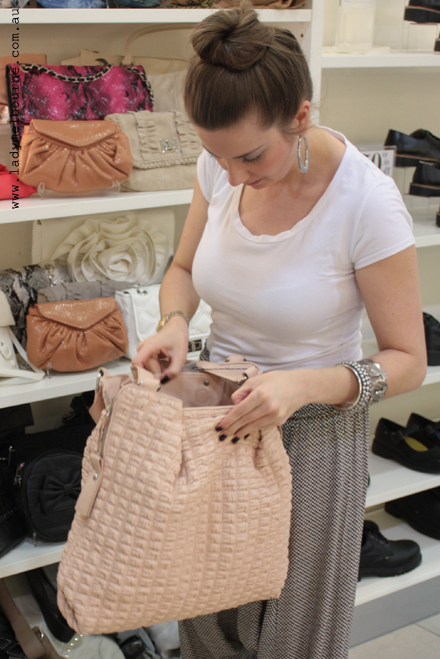
Here's where I might start to get in trouble… But I've gotta ask: what made the bag so attractive? Was it because we hold bags close to our bodies and almost consider them an extension of ourselves, and this bag is so similar to Lady Melbourne's own skin tone?

Lady Melbourne doesn't really intellectualise fashion, which is a terrible shame considering the position of influence and respect she commands among fashion bloggers. What a missed opportunity to comment, even in passing, on the oddness of that term, 'nude'.

Monday, August 23, 2010

Studying fashion

This blog – and the analytical way I tend to write here – is often called 'academic'. The funny thing is that, although I'm now employed in an academic teaching role, it doesn't really overlap with the content here.

It feels odd to call this a 'fashion blog', since I am only tangentially interested in 'the fashion industry'. I feel I've reiterated many times that over the time I've blogged here, I've become less and less interested in the industrial cycles of producing and marketing clothes, and much more interested in the cultures surrounding clothes, and in the ways people put them together in outfits.

Also, unlike many bloggers who talk about clothes, I am not especially interested in turning Footpath Zeitgeist into a fashion media hub, or using it to get work within the fashion industries (designing, styling, retailing, fashion media, etc). So I don't really participate in practices such as tracking my blog traffic and attempting to grow it, or incorporating sponsorship, advertising and giveaways for readers.

But I do realise from time to time that people see this blog as an academic resource – sometimes from the search keywords that bring people here, sometimes from the way I get cited. So if you are looking to get into the industry yourself, and you're based in Melbourne, Kangan Institute of TAFE's Centre of Fashion is having an open day on Wednesday 15 September from 6pm.
If you've been thinking about a career in fashion, millinery, retail or visual merchandising, here's your chance to see what it's all about.

You'll get the opportunity to meet with our trainers, see some of the wonderful creations our students are producing and get a first-hand look at our state-of-the-art facilities.

More info here.

Tuesday, August 17, 2010

Seriously, what is wrong with some people?

An incident happened tonight that has left me wondering why some people are so keen on their own unpleasant prejudices that they want to attribute them to me, too.

It started when the following, anonymous comment on this post came up for moderation:

Number one, was it necessary at all the mention Fashion Hayley in your post at all? And your little passive aggressive dig at Hayleys "dodgy photo" is nasty and sickening.
Also seems that by mentioning her name and site, you might have thought you could up your blog hits.

Number two, get your facts right. The Top Shop dress wasn't designed for Incu. Incu are partners with Top Shop ("Incu Presents Top Shop) and sell Top Shop wares in their paddington store.

And this post on "sitting this one out" is stupid. To say that to consciously boycott a trend due to highly stylistic knowledge seems to be contradictory, sense trends and style are mutually exclusive.

You're just a ugly bitch who looks fucking disgusting in everything.
I was like, "Whoa! Whoa!" I was totally not about to approve that. But underneath the childishness, the aggression, and that final line – which is uglier, bitchier, and more fucking disgusting than anything I've ever written – I sensed that someone felt I was dissing Fashion Hayley.

Now, where would they have got that idea from? So I did a bit of digging in my blog stats, and noticed multiple Google searches for terms such as "Mel Campbell 'Fashion' Hayley" and "Footpath Zeitgeist fashion hayley".

Clearly someone was trying to find references that linked me and this blog to Fashion Hayley. I did the same search myself, and found this sorry piece of shit. The blogger's name is Luke Devine. The reason why my hate-commenter had to Google me tonight is that Devine did not link his post back here.

Perhaps he also didn't want me to discover (via my stats) what he'd written. Perhaps he didn't want to give me a chance to respond to the way he has blatantly twisted my comments to attribute opinions to me that I simply do not hold.

Usually I have better things to do on the internet than feed trolls – for instance, looking at pictures of cats or playing Flash games – but the fact that Devine has tagged his post with my full name, and is sending hate comments my way, means that I feel compelled to respond. So I posted the following on his blog as a comment…

Luke, you have utterly misrepresented me. I don't share your weird dislike for Hayley Hughes or belittle any of her successes. I am not trying to make her "look kind of stupid" – rather, I'd suggest YOU want her to look stupid, so you're pinning those opinions on me.

Hayley works hard and I respect her genuine enthusiasm for the fashion industry. I actually pity you for being so bitter and suspicious that you would read my blog post as "surreptitious female bitchiness" or "a backhanded piece of blatant cross promotion", and consider it only a "remote possibility" that I could be sincere.

I am a regular reader of Hayley's blog. (I wonder if you know what it's like to read blogs regularly, to get a sense for the writer's tone and favourite topics, rather than Google searching them as fodder for your snark.) So when I spotted that dress in Big W, I remembered that Hayley had bought one, and that it was similar to another dress she'd bought in Sydney.

The reason I apologised for reproducing the dodgy photo is that in the blog post where it originally appears – and which I CLEARLY linked to – Hayley herself writes: 'Photos of me on nights out are at best terrible. Believe it or not this is the least bad of the bunch."

So yeah – I WAS genuinely apologising, because I wanted to show Hayley wearing the dress, but the only image on her blog was this one that even she admits she didn't like. I included the other pic of Hayley in the similar Topshop dress… because she looks BETTER in that pic! Of course, you unkindly refer to her as "aping a fashion model". Jeez, we just can't win with you.

While I'm here, let me add that I don't see Footpath Zeitgeist as a 'fashion' blog – it's a research blog where I semi-regularly post my thoughts about bodies, clothes and pop culture. These concerns only sometimes overlap with the industrial operations of the fashion industry. I don't give a shit about the amount of site traffic it gets, about 'cross promotion', or about being part of some 'machine'.

Thursday, June 10, 2010

Winter colour and scarves


I saw this girl a couple of days ago as I was walking down Rathdowne Street. I was struck by her bright green coat and blue beret, so I stalkily took this pic – it came out surprisingly well for a surreptitious one-handed phone-camera shot.

This winter, as I've mentioned, I'm getting back into the short, tight miniskirts and baggy, blousey tops I used to wear in high school. But I'm combining this with colour; I find it so important for my mental health to wear bright colours in gloomy weather.

I have been getting lots of wear from the apple-green cardigan I bought last year, and just last weekend I bought a Technicolour Dreamcardigan from Savers that is a Sportsgirl garment. It is mainly violet, but with splices of orange, red, pink, mauve and apple-green. (The apple-green knit has a sparkly thread in it.)

Also, I dyed my hair red. Read the long and involved backstory here.


In this pic you can see me doing my latest trick: wearing a pussy-bow with a long string of beads. I used to take a minimalist approach to accessories in which I felt that you either wore a scarf or a necklace, but never both, but I like the beads as background texture rather than as a feature accessory.


I remember being quite struck by the way that Cameron Diaz wore a little string of pearls with her Hermès scarf in My Best Friend's Wedding, in a way that looked quite casually chic, very old-money. (You can only see the very edge of her necklace peeping out in this pic.) Speaking of scarves, I am getting back into wearing my Doctor Who scarf, modelled here back in 2007:


(Vale my old glasses, which suddenly snapped in half one day as I was sitting at my desk, minding my own business.) The scarf is wonderfully long and snuggly, and its colours echo the colours in my new Technicolour Dreamcardigan.

Having red hair is making me even more determined to wear lots of colour, because I like the lively, zany look that results. Last time I was a redhead (in 1999), I wore lots of grey and black because I thought other colours would clash.

But now I feel that redheads can get away with all sorts of bright colours. Look what the Mad Men wardrobe department puts Christina Hendricks in. And remember Isla Fisher in Confessions Of A Shopaholic. And check out this recent discovery, a blog dedicated to the gelati-toned preppy ensembles of Jayma Mays, who plays Emma Pillsbury, the redheaded OCD school counsellor in Glee.


I especially love this outfit because of the scarf. It's probably sewn into the dress, but I like the way that it doesn't really match; it gives the impression that Joan has just tucked it in there. Which made me think: why don't I just tuck a silk scarf into the neckline of a dress or top?

So there you have my inspirations this winter: a little bit retro, a little Jaunty Pussy (today I am wearing a navy-and-white spotted pussy-bow blouse with my Dreamcardigan), but with loose, floppy silhouettes. And embarrassingly, it's also a little bit Chuck Bass.

Tuesday, May 18, 2010

Thoughts on lesbian hipsters

The Threadbared crew tweeted that I should take a look at this article on Autostraddle, a girl-on-girl culture website, about "lesbian hipsters". Well, I feel rather out of my depth talking about lesbian culture, in which I've hardly been immersed, but let's have a look at what author "Katrina" (is she like Cher or Madonna?) has to say about hipsterism.

Well, first of all I think the article is really confused about what a lesbian hipster is and does. At points Katrina doesn't sound convinced that there even is such a thing. But for the sake of argument, they're gamine girls who are just a little bit too femme to be butch, but who are still recognisably dykey, but also, not quite recognisably enough, since straight dudes still hit on them. They wear the "lesbian three-piece suit" of flannie shirt, bandanna and skinny jeans.

It's such a temptation, but ultimately quite unhelpful and non-illuminating, to create 'definitive' taxonomies ("they wear this; they like this") of a chimerical cultural figure that means a slightly different thing to each different person. It's probably more useful to talk about what hipsterism does than what it definitively is or isn't. What discussions does the term 'hipster' enable about the contemporary uses of culture?

I found Katrina's attempt to ground the lesbian hipster in subculture, and to talk about it in Dick Hebdigean terms of subcultural incorporation, to be pretty misguided, because I feel that hipsterism isn't about incorporating elements of subcultural style, but rather it's a display of aesthetic singularity and cultural capital. The irony of hipsterism is not on its T-shirts; rather, it's that people strive to show their individuality, to reject the category of 'hipster', and end up looking generically 'hip'.

Also, what we often think of as the hipster aesthetic – the ironic sloganeering; the skinny silhouette; the self-consciously whimsical or nostalgic flourishes – has never been an underground one, but rather draws on and requires a mainstream cultural machinery, whether that's textile mills to produce de-branded plain cotton separates; old movies and TV shows to invoke or plastic toys and ephemera to transform into cute jewellery and other objets de craft.

Now let's look at the 'lesbian' part of the lesbian hipster. For me, the most confused part of the article is this:
Hipsterdom may be viewed as somewhere in between genders, but identifying yourself as a lesbian means not only identifying yourself as a woman but also identifying yourself based on sexuality. Therefore, the lesbian hipster has universal appeal. Her style is just new enough to be trendy and sexy, while the items in her wardrobe are familiar enough to be safe.
There are so many nonsequiturs and assumptions here that it's difficult to know where to start teasing them out. How is the "universal appeal" bit related to self-identification? Is her appeal only universal among other hipsters, or does the lesbian hipster appeal to everyone: gay, straight, male, female, hip, unhip…? What's new about her style, and what's familiar about it? Katrina doesn't say.

I want to dispute the claim that hipsters constitute a 'third gender'. It's interesting in fashion terms, considering that perhaps androgyny is a deliberate marketing strategy – aka, the CK One effect. But androgynous dress is really not enough on which to build the foundation of gender identity, which is a wider socialised role, a way of being in the world.

I'd also argue that Katrina's example of straight hipster boys hitting on her even though she's gay says much less about a 'third gender' than it reveals how hipsterism tends to gesture towards transgressive sexuality while ultimately retreating into sexual conservatism (as the various parodies of American Apparel's ads reveal).

Perhaps the in-between-ness of the lesbian hipster inheres in being what Katrina depicts as some kind of subcultural double agent: she can enjoy the coolness of being a hipster as well as the acceptance of the wider lesbian community. But here we have to think about the difference between a pose and an identity. Is being a lesbian an immutable part of who you are, or is it something to be donned and doffed like skinny jeans?

Bah! I feel that I've waded into some identity politics that I'm not really equipped to talk about. But I do have to admit that naming your cat Jane Lynch or Shane Jr. is an unbearably 'hipster' thing to do.

Thursday, May 06, 2010

Sitting this one out


This is a "babydoll" dress currently being sold at one of my favourite places to shop, Big Dubs. Here is Fashion Hayley wearing the same dress (I'm sorry for reproducing a dodgy photo of you, Hayley!):


Here's another pic of Hayley wearing a very similar dress (that Big Dubs probably copied), which is a Topshop design for Incu.


When I saw the dress in Big Dubs I was quite excited because I love floral dresses (and paying as little as possible for my clothes). However, when I tried it on, it looked really terrible on me. As far as the waistline it fitted me well, but I was unhappy with the spot at which the waistline hovered: lower than the empire-line spot under the bust, yet higher than the true waist.

I also didn't like the shortness of the full skirt. I felt it made my body proportions look weird. Personally – and this is just my own taste – the only sort of short skirt I would wear is a straight or stretchy one. I like a full skirt to hit my knees; I think it looks better proportioned that way. I'm not a child, I don't find childlike whimsy appealing, and I don't want to dress in a doll-like or childlike way. A full short skirt just reminds me of retro-styled childrenswear, like something Sally Draper would wear in Mad Men:


When I saw Patty Huntington's pics from this year's Jayson Brunsdon show at Rosemount Australian Fashion Week, I was appalled at how short he has cut his full skirts. I don't even think they look good on the models with their coltish legs.


(Image: Patty Huntington)

But anyway. I know that Hayley does favour short skirts, and I'm not having a go at her sense of style. But it infuriates me that it's almost impossible to find a knee-length skirt in the shops at the moment; they're either these short babydoll styles or long maxidresses.

I also found it very difficult to warm to The Uniform Project because of how short the chosen dress was. It's definitely not a style that would look good on many people, although I can appreciate that it adds more versatility to the project because it can be worn as a long-line top as well as a dress.

(This is only tangentially related, but I'm fascinated by trends in the lengths of girls' school uniforms. When I was at school they tried their hardest to stamp out short skirts; the rule was that it had to touch the ground if you knelt. But now I see girls wearing ludicrously short skirts. Oddly, I also see the opposite, especially with winter uniforms: the skirts will be so long they're almost ankle-length.)

I'm using this dress as an example of the practice of "sitting this one out". This is a high-level stylistic knowledge pertaining to your own relationship with fashion cycles. You not only recognise that certain styles are 'fashionable' but also which styles suit you, and you make a tactical decision not to buy, to wait until fashion returns to the things that look good on you.

Right now I'm wearing a black babydoll dress with a cream-coloured 'doily' lace decoration across the bust. I bought it from Valleygirl perhaps three or four years ago now and have got a lot of wear out of it since, making a mockery of their 'fast fashion' ethos. I like it because it's elasticised directly under the bust and is gathered, so it glides flatteringly over my midsection. It falls to just on my knee.

Over the top I'm wearing a slouchy red cardigan from Jay Jays. I remember when I bought it at the start of last year, I just really wanted a red cardigan and settled for this one. I'd wanted a preppy, tailored style and was annoyed that it was long and loosely fitted, which happened to be the style at the time. So, I didn't sit that one out; instead I compromised. But now I'm enjoying wearing the cardigan, because this winter I've really got back into the grunge silhouette I used to favour in high school: leggings and short, tight skirts with oversized, slouchy T-shirts, flannel shirts and cardigans.

Saturday, March 13, 2010

More thoughts on mannequins: size versus shape

On Thursday night at a literary launch I talked the ears off the team from Arcade Publications about my "What Fat Chicks Used To Wear" project, and today Dale Campisi pointed me to this article that appeared on the front page of yesterday's Age. It's a pretty stock-standard iteration of the "mannequins are getting larger to reflect real women" argument that gets trotted out every so often.

I am emphatically not interested in these repetitive debates over body size/shape in fashion, and it never fails to annoy me that commentary tends to get split between "Yay! Finally retailers are interested in their customers' actual sizes", "It's a good start but it's only a token gesture; they need to go further", and "We're in an obesity crisis so anything that encourages people to normalise fatness is a bad thing".

The thing that annoys me about these responses is that they transform the mannequin, the inert fibreglass form, into a mimetic reproduction of the customer's own body, whereas the actual role of a mannequin is to display the clothes attractively enough to make you want to go into the shop and try them on. It is a visual merchandising tool just like a rack or a showcase, and there are no moral panics suggesting that people feel inadequately green next to a green-painted dummy, or worry about having heads because so many mannequins are headless.

But I am interested in the relationship between the mannequin and the clothes on it, which is about fit, which in turn is about the shape of the body under the clothes. I'm not sure when this happened, but Review has got rid of its iconic petite, wasp-waisted mannequins. Those mannequins used to say to shoppers, "This shop sells an old-fashioned, girlish kind of glamour".

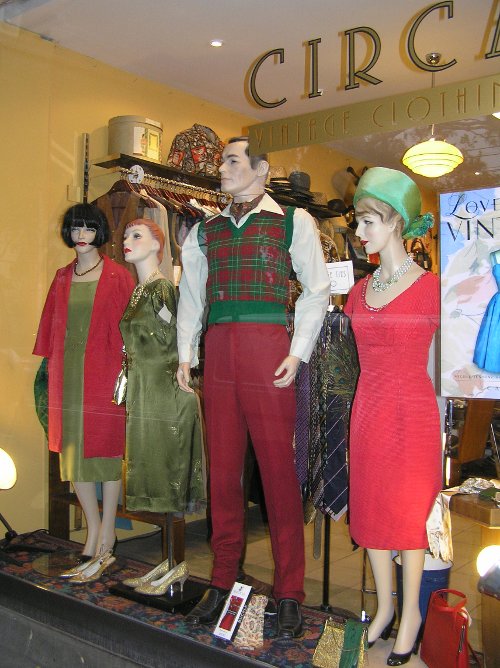
What would be far more interesting than the size of mannequins would be their shapes and proportions. From the little reading I've done on the history of mannequins, their shapes seemed to follow those of the prevailing fashions: slim during the Art Deco era and sturdier during the 1940s. Here's the collection of vintage mannequins in the window at Circa Vintage Clothing.


Image: Circa Vintage

It might be worthwhile to examine if, historically, mannequin makers have produced ones in larger sizes for the older or plumper consumer. But actually, I'm worried that this talk of mannequins is getting off-topic.

Friday, March 05, 2010

On precocity

I just read a post by Minh-ha Pham at Threadbared. It is a source of perennial infuriation to me that this blog does not have comments, so the only way to engage with the bloggers is to respond on my own blog. Except that: a) I don't always have the time to log in here and write an entire post; b) what I want to add to the discussion isn't always long or coherent enough to deserve its own blog post. Sometimes I just want to add another relevant link, or a passing observation.

Anyway. Minh-ha is talking about a topic that does deserve its own post: our attitudes towards the increased incorporation of "fashion bloggers" into the fashion industry apparatus. These include invitations to runway shows, industry events, private views of upcoming collections and magazine shoots. They also include access to PR graft such as free gifts and product giveaways for readers, being allowed to style and curate for major brands and retailers, and being the 'inspiration' or 'muse' of designers.

This is actually a topic I've struggled with myself lately: mostly in my observations of the graft-happy ways of Australian fashion bloggers, feeling alienated by Patty Huntington's insider discourse, and in my annoyance about the way in which Tavi Gevinson is being hailed as a new force in fashion journalism.

Minh-ha identifies three main issues with the snarky way in which the old school of fashion commentators have been defending their turf. She observes a techno-generational divide between older fashion journalists and younger bloggers; she sees the more established commentators bemoaning the "massification" of fashion journalism (and, especially, representating 'the masses' as feminine in their disorderliness); and she identifies a shift in the perceptions of 'democracy' in the creative economy. In this new understanding of 'democracy', blogging becomes a kind of industry apprenticeship – a foot on the bottom rung of the ladder – and bloggers will endure industry exploitation as a show of good faith in meritocratic capitalism.

These are good ways for me to organise my own reservations about the relationship between blogging and "the fashion industry". I'm sure I've written this somewhere before, but the term "fashion blog" elides the complexity of the blogging about clothing that goes on.

I am not a fashion blogger, because I not especially interested in participating in the cyclical machinations of 'collections', 'fashion weeks', 'key seasonal trends' and industry gossip about designers and models. I also do not publish photos of people's outfits on the street, and nor do I presume that my daily clothing choices will interest other people. However, I am a style blogger, because I am interested in the ways that people use clothes, and the more abstract processes behind the circulation of particular clothing motifs.

Many other fashion bloggers want to get involved in the machinery of the industry because they want careers in that industry. Their blogs operate as CVs, demonstrating that they can speak the right language, they know the right people and look the right way to be taken seriously as insiders.

This is the central problem I have with Tavi. I realise this is quite a conservative position to take, but she is a fucking child and the ethics of interpellating her in this industry machinery at such a tender age are appalling. I can't believe Tavi took a week off school in order to attend New York Fashion Week. I have heard terrible rumours that she is being wooed to attend Rosemount Australian Fashion Week – where do they get off, flying a kid across the world just so they can look zeitgeisty?

I feel the same way about her that I feel about 13-year-old Eastern-bloc Olympic gymnasts or classical music prodigies who perform Rachmaninoff like tiny tin toys. I feel it's sinister to welcome children prematurely into the adult world, and I think that attitudes of "we shouldn't patronise the genuinely gifted, they want to do this" are the worst kind of relativism. We view these children as novelties to be exploited for our entertainment, and we take advantage of the plasticity of children's brains to sculpt them in our own images.

The ethics of the industry employing young models have been discussed at tedious length, but because of the 'massification' of bloggers, Tavi gets to elude these discussions because we can pretend that she's just an 'amateur', that she's not at work when she's at fashion shows. Yes she is. She is being invited to these shows for economic reasons, so we're not just talking about techno-generational issues; we're talking about child labour.

When I wrote about 10-year-old bodybuilder Maughan Wellham, I was far more measured in assessing the ways in which we understand childhood and respond to instances in which we perceive it as under threat. I feel I still haven't got to the heart of my discomfort over Tavi Gevinson, but anyway, there you have it.

Saturday, February 27, 2010

"I'll wear my delaine"

Part of what I want to do in this project is a "semiotics of clothing fit" – the way that culture has represented garments. For instance, yesterday I saw a preview of the new Tim Burton Alice In Wonderland, and I couldn't help but be struck by the way Alice gets a new dress every time she changes size, because her previous outfit becomes too big or too small.

In the original 1865 John Tenniel illustrations, her clothes grow and shrink with her.


But viewing the affectingly mended pioneer-lady "best dress" in the Darnell Collection, which was so delicate it's displayed flat in a glass case, made me think of Little House In The Big Woods by Laura Ingalls Wilder. As a kid I loved the Little House books for their blow-by-blow descriptions of pioneer homemaking and everyday life. This was such a vastly different world to the one I was growing up in that it might as well have been another planet.

The book has been digitised for Canada's Gutenberg Project, so you can read the whole thing online. It also includes Helen Sewell's illustrations, which I think were added some time between 1943 and 1953. The part that has always stayed with me is when they make maple sugar at Laura's grandparents' house.
Pa's blue eyes twinkled; he had been saving the best for the last, and he said to Ma:

"Hey, Caroline! There'll be a dance!"

Ma smiled. She looked very happy, and she laid down her mending for a minute. "Oh, Charles!" she said.

Then she went on with her mending, but she kept on smiling. She said, "I'll wear my delaine."

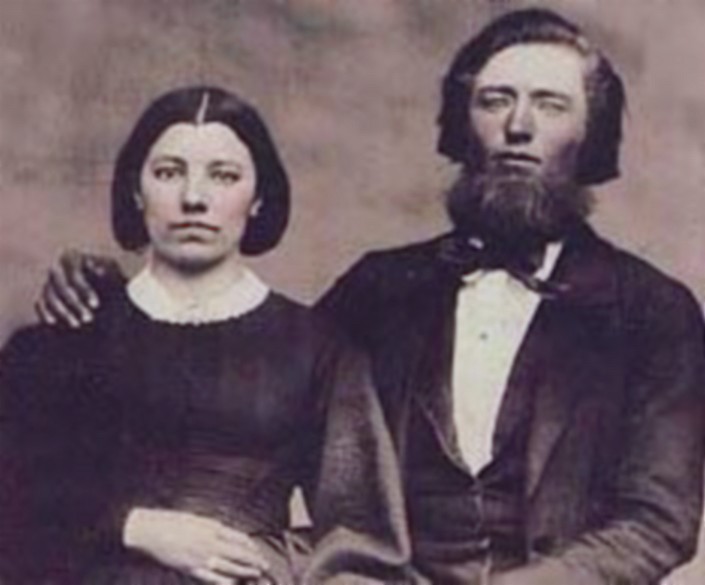
Ma's delaine dress was beautiful. It was a dark green, with a little pattern all over it that looked like ripe strawberries. A dressmaker had made it, in the East, in the place where Ma came from when she married Pa and moved out west to the Big Woods in Wisconsin. Ma had been very fashionable, before she married Pa, and a dressmaker had made her clothes.

The delaine was kept wrapped in paper and laid away. Laura and Mary had never seen Ma wear it, but she had shown it to them once. She had let them touch the beautiful dark red buttons that buttoned the basque up the front, and she had shown them how neatly the whalebones were put in the seams, inside, with hundreds of little crisscross stitches.
The book is set around 1870. At this time fashion in the United States was about a year behind Europe, and in pioneer Wisconsin I'd imagine it was further behind still. Caroline married Charles Ingalls in 1860 and her delaine (the word means a light, smooth wool fabric; it's from the French mousseline de laine, muslin of wool) probably dated from the late 1850s.

I also loved the part in which Laura's two young aunts Docia and Ruby are getting ready for the sugar dance.
They helped each other with their corsets. Aunt Docia pulled as hard as she could on Aunt Ruby's corset strings, and then Aunt Docia hung on to the foot of the bed while Aunt Ruby pulled on hers.

"Pull, Ruby, pull!" Aunt Docia said, breathless. "Pull harder," so Aunt Ruby braced her feet and pulled harder. Aunt Docia kept measuring her waist with her hands, and at last she gasped, "I guess that's the best you can do."

She said, "Caroline says Charles could span her waist with his hands, when they were married."

Caroline was Laura's Ma, and when she heard this Laura felt proud.

Then Aunt Ruby and Aunt Docia put on their flannel petticoats and their plain petticoats and their stiff, starched white petticoats with knitted lace all around the flounces. And they put on their beautiful dresses.

Aunt Docia's dress was a sprigged print, dark blue, with sprigs of red flowers and green leaves thick upon it. The basque was buttoned down the front with black buttons which looked so exactly like juicy big blackberries that Laura wanted to taste them.

Aunt Ruby's dress was wine-colored calico, covered all over with a feathery pattern in lighter wine color. It buttoned with gold-colored buttons, and every button had a little castle and a tree carved on it.

Aunt Docia's pretty white collar was fastened in front with a large round cameo pin, which had a lady's head on it. But Aunt Ruby pinned her collar with a red rose made of sealing wax. She had made it herself, on the head of a darning needle which had a broken eye, so it couldn't be used as a needle any more.

They looked lovely, sailing over the floor so smoothly with their large, round skirts. Their little waists rose up tight and slender in the middle, and their cheeks were red and their eyes bright, under the wings of shining, sleek hair.

Ma was beautiful, too, in her dark green delaine, with the little leaves that looked like strawberries scattered over it. The skirt was ruffled and flounced and draped and trimmed with knots of dark green ribbon, and nestling at her throat was a gold pin. The pin was flat, as long and as wide as Laura's two biggest fingers, and it was carved all over, and scalloped on the edges. Ma looked so rich and fine that Laura was afraid to touch her.

I've selected this extended excerpt because it's so rich with detail: not only about the dresses and underwear themselves but the physical ideal of the tiny waist. Of course, Ingalls Wilder isn't an especially reliable narrator because she is recalling events of decades earlier, but the way that Docia "gasps" yet is still dissatisfied with her waist says a lot about the way that perhaps even its own wearer's uncorseted body wouldn't have fitted into one of these dresses. Yet Caroline still fits into her delaine dress after having borne three children.

Perhaps their diet has something to do with their body shapes? Later in the same chapter, the author remarks, "They could eat all they wanted, for maple sugar never hurt anybody." Really? Ingalls Wilder's descriptions of food are quite interesting throughout; often they sound spartan to a modern reader.

Wisconsin: A History, by Robert Nesbit and William Thompson, notes that: "The recollection of food or the want of it is a common feature in pioneer reminiscences", and that pioneers who'd made it through bad winters joked darkly that they couldn't change their shirts for months, "the fish bones sticking through and preventing such an operation."


Caroline was a pretty woman, wasn't she? As for Charles… well, I guess Abe Lincoln beards were really in at that time.

Friday, February 26, 2010

My original mannequin feature

As I mentioned in my last post, in 2005 I wrote a newspaper feature story on mannequins for The Age. The version that was ultimately published is quite different to the original, spiked, version, which I've just discovered now while searching for a transcript of my interview with Daisy Veitch of Sharp Dummies. Perhaps you'd like to read it?

As a child, I was terrified of mannequins. They towered over me with their stiff poses and pallid plastic skin. I was afraid to look at them in case their painted-on eyes swivelled to glare at me. Yet I couldn’t look away, because I was convinced they could creep up behind me when my back was turned.

I wasn’t the only one. Contributors to the childhood beliefs website I Used to Believe confess to thinking mannequins were real people who’d been punished for shoplifting, or for not making it out of the store by closing time. One tormented girl was afraid to touch them in case she turned into a mannequin herself!

Wobbly logic aside, kids recognise freakishness when they see it. Mannequins embody a mass of contradictions – lifelike but not alive, sexually provocative without genitals; warm, soft flesh cast in cold, unyielding fibreglass. They flirt with how a human body can look – and hint at what makes a body human.

Japanese roboticist Masahiro Mori coined the term “uncanny valley” to describe the disquiet sparked by those contradictions. In his 1982 book The Buddha in the Robot, Mori observed that the more human an object appears, the more we empathise with it. But when the simulation is almost perfect, we start to feel something’s very, very wrong. This is the uncanny valley.

Eighteenth century wax modellers knew this, and exploited it. Galleries of notorious thieves offered a macabre thrill of authenticity because they were modelled from executed corpses. Other exhibits created believable fantasy worlds. The setpiece in the salon of Madame Tussaud’s mentor, Dr Philippe Curtius, was an astonishingly vivid but entirely invented tableau of the French royal family eating dinner at Versailles.

Visiting Madame Tussaud’s still gives spectators a frisson. The gallery encourages visitors to flout protocol and caress the Queen, or impertinently fondle Elle Macpherson. Still, you’ll never feel her ineffable star quality. It’s just a dummy, after all.

Nowhere is the elusive celebrity body more starkly highlighted than in the museum. Lindie Ward is assistant curator in international decorative arts and design at Sydney’s Powerhouse Museum. She says the Powerhouse’s vast collection of provenance costume – clothing with a personal history – demands more of mannequins.

“When we did the Moulin Rouge exhibition, we had some adapted to Nicole [Kidman]’s very slim, long figure, because we couldn’t fit anything on any other way,” Ward explains.

Ward has devised bendable wire mannequins that subtly fill the costume as a body might. “You don’t need to have the wire showing at all, so you can get the exact shape of the garment,” she says.

You enter another kind of uncanny valley when you look at these mannequins. The body is creepily absent, leaving behind only traces of sweat and makeup. Sometimes it even spooks Ward.

Several years ago, she was dressing an exhibition of gay and lesbian Mardi Gras costumes, but grew uncomfortable making the mannequin for a full body suit worn by artist and AIDS activist Brenton Heath-Kerr.

“I must say, I had to keep walking away from it, because sadly he had died a couple of years before.”

In the early 1960s, British window dresser Adel Rootstein translated the uncanny appeal of celebrity mannequins into worldwide success. For Rootstein, the plaster and papier-maché mannequins then used in shop windows were stiff and lifeless, failing dismally to capture the spirit of Swinging London.

Rootstein’s fibreglass mannequins actually swing, striking dramatic poses and lounging insouciantly. They embody the zeitgeist because they’re modelled on the very celebrities who become fashion icons – Twiggy, Sandie Shaw, Joanna Lumley, Marie Helvin, Joan Collins, Yasmin Le Bon, Saffron Burrows and Jodie Kidd.

Rootsteins are the Rolls-Royce of the mannequin business. Each figure takes thirty days to make from a live model. After initial measurements and photographs, the head and body are sculpted in clay around a wire armature. The hands and feet are moulded in dental silicon, and successive plaster and fibreglass casts made. Artists individually apply each mannequin’s makeup using oil paints, and hair stylists select and cut wigs to customers’ specifications.

The time and effort pays off. These figures are so gracefully posed and carefully rendered that you’re almost embarrassed to have glimpsed them in the nude. Still, it’s striking how similar they look. Even despite racial differences, they all have long legs, slender necks, slim hips and pert breasts.

Such mannequins can’t be called ‘realistic’, no matter how lifelike they look. But if we expect mannequins to be socially inclusive, maybe we’re the unrealistic ones.

Some commentators have praised the recent trend towards larger mannequins, saying they finally reflect real women’s bodies. Last year, New York designer Ralph Pucci released an enormously popular mannequin whose derriere was modelled on curvaceous actor-singer Jennifer Lopez.

But retailers aren’t interested in making “a statement about what size people are,” says Melbourne-based mannequin maker Phil Russell. “Mannequins are really just to display the clothes.”

Russell’s boutique company, Mannequin Revolution, works directly with clients to create or rework mannequins for specific displays. Its output includes hourglass-figured mannequins for fashion brand Review, stylised gangsters and molls for city tailor Anton’s, and the pint-sized dummies modelling Kylie Minogue’s famous gold hotpants in the Victorian Arts Centre’s current exhibition.

Mannequin Revolution has also produced dark-skinned mannequins – but not for diversity’s sake. Russell’s clients see memorable mannequins as good business sense.

“People have gotta have a point of difference, you know?” he says. “I only do a couple [of black mannequins] here and there because it decreases the impact. It floods the market.”

But for some, mannequins are more about pleasure than business. In the ancient Greek story of Pygmalion, a sculptor falls in love with his creation. Plenty of movies, including the 1987 film Mannequin, perpetuate the fantasy of a mannequin as a compliant vessel for male desire.

Of course, men have been able to buy artificial women for centuries. Dr Curtius had a profitable sideline in erotic wax dummies for the boudoir. In 1920, the painter Oskar Kokoschka obtained a life-size replica of his ex-girlfriend, Alma Mahler; although in his memoirs, he coyly avoided the question of whether he slept with it. And last Christmas, Sydney shoe store Hype DC dramatised the link between sex and consumerism – and caused an outcry – when it used inflatable sex dolls as store window mannequins.

Then there are RealDolls. Advertised online as “the world’s finest love doll,” they’re smack bang in the uncanny valley. Special effects artist Matt McMullen created them almost by accident in 1996, while working on a prototype for an extra-realistic mannequin.

“I had a website going, and people kept e-mailing, asking if I could make a love doll,” McMullen recalled in 2000. “So I changed my design. Now you have RealDoll.”

RealDolls are made of solid yet pliable silicon moulded around a metal skeleton. They weigh as much as a woman and have a similar range of movement. Where mannequin groins are fibreglass blanks, RealDolls are anatomically correct. And they’re totally customised – you choose everything from your doll’s eye colour to her bikini wax preference. All for the bargain price of US$6499.

It’s easy to dismiss RealDolls as misogynist fantasies. But they’re a powerful reminder of how we use cutting-edge technology to flesh out our desires. In the stories, magic brings mannequins to life – and isn’t technology the magic of our era?

New mannequin technology isn’t always this perverse. In 2001, Adelaide company SHARP Dummies conducted Australia’s first anthropometric sizing survey since 1927. And intriguingly, the technology it used then also produces mannequins that behave like human bodies.

SHARP creates mannequins using a mixture of tape measuring, body casting, and a laser body scanner. This creates a near-perfect copy of the live model, complete with creases, dimples and fat rolls. SHARP dummies also boast what founder Daisy Veitch calls “biofidelity.”

“A person is made from bones and tissue and muscle; our dummies are made from composite materials,” Veitch explains. SHARP overlays a hard skeleton with foam, silicon and polyurethane padding, with underlying cavities to simulate compression. There’s extra padding on the bits that make so many women self-conscious – the bottom, hips, breasts, and upper arms.

Unlike their fibreglass cousins, SHARP dummies aren’t meant for shop windows. They’re meant to make clothes look good on you. They help apparel manufacturers get an accurate fit for tight clothing like hipster jeans and underwear. Conventional mannequins just can’t deliver that kind of realism.

Displaying clothes on skinny mannequins “is a successful strategy, and it’s okay to advertise like that,” says Veitch. “The problem is when people take the clothes off the dummy and try them on, and they don’t fit.”

It’s certainly fitting that the most disquieting mannequin technology of all comes from the country that invented the uncanny valley. Japanese firm Flower Robotics has developed a mannequin robot named Palette that senses nearby shoppers and uses motion-capture technology to pose for them in window displays. Palette can also detect the age and gender of shoppers for marketing purposes.

Curiously, Palette has no face. Its inventor says customers should focus on the mannequin’s clothes. But perhaps it’s just as well. While we like our mannequins as lifelike as possible, we don’t want them too human.