Wednesday, April 27, 2005

Footpath Cracks - Bettina gets 'em young

Welcome to the first of an occasional series. Footpath Cracks are my bitchy fashion news briefs, and they'll come up when I feel some style-related issue in the press deserves a good snort of derision.

In today's inaugural crack, Bettina Liano has announced she's designing a range of children's wear. I am a little alarmed. I suppose the "ruffled tops, tulle skirts and jersey pieces with mini versions of Bettina's celebrated denim garments" won't be too much of a stretch. But isn't there something a little wrong about producing this clothing for kids? After all, this is the same designer who said in 2003,
"It is important for women to feel amazing in my clothes and feel sexy but comfortable in my jeans."
And as The Age noted last year,
"Her designer jeans (generally falling into the "spray-on" category of fit) are incredibly saucy."
I also wonder if this is her attempt at buttressing brand loyalty among mums who may have "sagged out" of her target market, so to speak. If so, you have to applaud her for thinking laterally. But by far my favourite thing about this article was that:
"The clothing will come in size 3 to 10 ..."
Just like her adult designs, then!

Winter of the deconstructed hoodie


Photographed in Nolita district, New York. (Picture: Shannon Skillem, Nylon magazine)

At the risk of sounding like the Late Show parody of The Sharp, hoodies - are - back! Not that they ever went away. They're one of those things that instantly makes you look hipper, even if you aren't. But this year, we won't just see plain old hoodies. 2005 is going to be the Winter of the Deconstructed Hoodie.

I want to look at three ways of deconstructing the plain hoodie: adding words and images; cutting it up; and reconstructing it. The most obvious way to customise hoodies is to create slogan hoodies. Chris has a wonderful hoodie, which he created himself, that has "Baudrillard" appliqued across the front. Last year I was researching an article about the explosion of specialist t-shirt labels (that my editor butchered so it merely said "whoa, ain't slogan t-shirts subversive!") and I discovered Neighborhoodies. The idea is genius. You tell them what you want on your hoodie, t-shirt, etc, and they'll sew or print it on and deliver the finished garment with a personalised note. It's a business model that I plan to emulate, with modifications, when I finally get Melkwear off the ground.

Then there are cut-up hoodies. Everyone tells me that the Flashdance 80s look - raw-seamed sportswear - is 'over', and people are now wearing tailored or 'ethnic' clothes. But that's not what I see people wearing, and those aren't the hoodies you see in the shops. Industrie has some great 80s-style hoodies with ripped-off sleeves this season (they call them "Raging Bull"), which you can check out online if you can get over the Kevin Federline-esque model.

I think Industrie is the Sportsgirl of menswear. They do some great basic menswear with a slightly edgy quality that always looks quite sharp in the catalogues and the shop windows, but never looks as good on real men. Possibly this is because the layered, structured way that stylists (and hipsters!) construct outfits seems completely alien to the approach of your average dufus: "Duh, I will put some pants on. And then I will put on a top. And then some shoes. I dress me real good."

But Industrie possibly plays the same role for men as Sportsgirl does for women - as a signifier of "fashionability" (or "fashion-ability"!) for those who aren't otherwise adept at fashion semiotics. Just as any chick can go to Sportsgirl and know that she'll be "in fashion", men can go to Industrie, safe in the knowledge that whatever distressed garment they buy will be considered "fashionable".

Here it is worthwhile differentiating between several linked ideas: "fashionable", "cool", "stylish". I should perhaps devote an entire post to this. "Fashionable" implies being on the crest of a wave of deliberate obsolescence; knowing that what you're wearing now won't be acceptable within the symbolic and actual economies of fashion. "Cool" is an ephemeral, aloof form of affect that trades on exclusivity and otherness. The cool person is always the other, because it is fundamentally uncool to call yourself cool. "Stylish" implies a more permanent and idiosyncratic dress sense that works aesthetically in a variety of contexts and fashion cycles.

According to this brief and problematic schema that I've just sketched, Sportsgirl and Industrie are fashion stores. If you pick and choose garments to fit with your own aesthetic, they can also be stylish; but their ubiquity makes them uncool.

But anyway. I also saw a wonderful men's hoodie in a shop on Little Collins Street, which had large circular cut-out panels in the sides. It was designed to be worn with a singlet or something underneath. I was so excited by this look that I went to Savers to try and find a cheap hoodie to cut up and experiment with, but there weren't any I liked. I bought a spotted t-shirt instead.

The final winter hoodie trend I want to point out is the one illustrated by this New Yorker - reconstructed hoodies. I'm fascinated by his Frankenhoodie - it appears to be constructed from two separate garments sewn together. It makes me wonder whether he has a doppelganger wearing the opposite-coloured hoodie. Industrie is doing a version of this, too. Particularly, look out for the pink one that they somewhat alarmingly describe as the "savaged zip" hoodie.

The main characteristic of the reconstructed hoodie is that it toys with the basic hoodie construction. The cut-up hoodie pulls the familiar form apart and creates dynamic absences that are only enhanced by the small traumas of their curling, frayed edges. But the reconstructed hoodie draws its dynamism from the slightly askew way it puts the hoodie form back together - the things it adds, like extra colours and zips.

Tuesday, March 22, 2005

The irritation of Sienna Miller and the curse of the It Girl

An article of mine was published today in the Sydney Morning Herald. It discusses the irritating phenomenon of Sienna Miller - someone who's famous as a clotheshorse and celebrity handbag rather than for her own accomplishments.

I don't particularly like Sienna's "signature boho style" or whatever else the papers want to call it. But it's fascinating the way she has become a style icon, even for her fashion mistakes. My SMH article briefly outlines the media's role in this - their desire to identify fresh talent and monitor its development, even as that attention crushes the talent's potential.

But I am also interested in the industrial apparatus that enables high-street fashion stores to diffuse celebrity and runway style for chicks on the street. Topshop is the best at this, but Supre and Sportsgirl are very canny Australian examples. As Elanor has said, Sportsgirl at the moment is a "shrine" to Sienna - and I would like to do more research into the process by which this happens.

I think the most interesting thing about Sienna Miller is the very blandness I object to in her media deification. While she's not very interesting as a celebrity, she's not that different from thousands of other women, and her style is wearable and comfortable. You don't have to be astoundingly beautiful or style-savvy to look like Miller - it's just clever accessorising. Basically, she is a blank canvas onto which you can project your own sense of style. Because of the bitsy nature of 'boho chic', it can sustain a wide range of variation.

But as Claudia Croft suggests in The Times (UK), this look is tired already. And if Sienna wants to maintain her status as a fashion icon, she'll have to reinvent herself. Croft points to the fact that Miller is starring in a new movie as Andy Warhol's muse Edie Sedgwick, who was also an It Girl. Maybe we'll all be dressing as beatniks next year.

Friday, March 18, 2005

Nova is a pimp. Everyone is a ho

I have been following with interest a promotion by Melbourne radio station Nova 100, called Pimp Up Your Life. The premise is that an online car sales company is giving away a 1981 Chrysler Valiant that has been "pimped up" with a new paint job, interior and accessories, much in the style of the US TV show Pimp My Ride. I mentioned this to Glen, and we are now thinking of co-writing a paper on that show for a new book on reality TV. Glen will discuss the car part, and I will concentrate on the aesthetic of pimpin' and the show's interlinkage with hip hop.

The Nova promotion culminates tonight in the "Pimp Party". People who have won tickets from Nova will dress up as pimps and hos and descend upon The Next Blue nightclub, where, fittingly enough, people go to ordinary club nights dressed up as pimps and hos. Some Australian R&B artists will perform and the car will be given away. They have probably given it away by now; I haven't been listening to the radio.

I recently had a paper published in Continuum which dealt in part with the African American notion of pimpin' and how it might translate in Australia, where we have no precise equivalent to that culture. Here is a little of what I said:
... the uses of the black female booty within African American patriarchy impose as many constraints as they provide opportunities for self-empowerment. As Rose argues in Black Noise, “male sexist discourse often involves naming and dominating black female sexuality and sexual behaviour.” (253) Some African American rappers display an enormous distrust of the booty, seeing it as a lure to manipulate men’s desire for women’s own purposes. In “The Bomb”, Ice Cube warns men to “especially watch the ones with the big derriers [sic]”, while Bell Biv DeVoe’s “Poison” cautions them not to “trust a big butt and a smile” (Rose, Black Noise 254).

This anxiety over being ‘booty-whipped’ plays out in the pimp and ho (whore) dichotomy. The figure of the pimp has a long history in black American culture, from the macquereau (mack) of nineteenth-century New Orleans to the ghettocentric images popularised in 1970s ‘blaxploitation’ films like Superfly (1972) and The Mack (1973).* “In its most simplistic (and powerful) forms,” writes Mark Anthony Neal, “pimpin’ was a constant reminder of black patriarchy’s role in the black community, as pimps were the visible controllers and connoisseurs of black female sexuality.” (Songs 153)


Thanks to hip hop, pimpin’ looms large in contemporary youth culture. In what Neal calls the “neo-pimpin’” discourse (Songs 154), terms like “big booty ho” or "hoochie"** have come to police sexually explicit African American femininity — whether or not it is for sale. In Notorious BIG’s openly misogynist song, “Big Booty Hoes”, it is a woman’s willingness to perform graphic sexual acts on Biggie that makes her ‘deserving’ of disrespect, and therefore of the name “ho”.


More importantly, writes Neal, it is the imagery of pimpin’ that is being pimped in booty-dancing songs and music videos. Jay-Z can probably be described as the preeminent exponent of the neo-pimpin’ aesthetic. In the video for his 1999 hit, “Big Pimpin’”, women in bikinis shimmy aboard a luxury yacht in the Caribbean; while in 2003’s “Crazy in Love”, Jay-Z plays the role of limousine-riding pimp to BeyoncĂ©’s delirious, booty-wiggling ho.

* While the pimp is a figure of black hypermasculinity, the ho has a far less empowered presence in black popular music. Some of the few feminist interventions into this discourse are Marlena Shaw’s “Street Talkin’ Woman” and LaBelle’s “Lady Marmalade”. Regarding the latter, Neal argues: “Rather than a narrative about the illicit and illegitimate culture that supports prostitution in places like New Orleans … in the hands of LaBelle the song became an anthem of sexual assertion and empowerment” (“Songs” 98).

** ‘Hoochie’ or ‘coochie’ means a sexually promiscuous woman. Closer in meaning to ‘slut’ than ‘whore’, it derives from ‘hoochie coochie’, a dirty dance or even a black vernacular reference to sex (eg: Muddy Waters, “I’m Your Hoochie-Coochie Man”). It may come to English from the French “couchĂ©e” — the past tense of the same verb used in LaBelle’s famous chorus “Voulez-vous coucher avec moi ce soir?”
At first, I was a little disturbed by the cavalier way that the radio station deploys cliches of pimpin' - for example the implication that hos are as much an accoutrement of the pimp as his cane, pinky ring and fur coat. You a pimp? Well, you gon' need some bitches, nigga. There seemed to be very little admission that pimpin' is still rhetorically (if not literally) a sexual economy with women's bodies as its currency, except that today I heard an announcer say that the Pimp Party would be "like Carlisle and Grey Street". (FYI: these are notorious streetwalking strips in St Kilda.)

Curiously, in Nova's view pimps and hos are equal partners. They are like stags and does, rams and ewes - just names for the male and female version of the same thing. Some of the prizes to be given away are a kind of "his and hers" thing that seems completely alien to how I understand pimpin'. No self-respecting pimp would lounge around with his ho in matching Peter Alexander robes, for example - he would wear the robe, and she would wear her booty. Later, he would wear her booty.

What had actually first grabbed my attention about this promotion was the line "This is an equal opportunity promotion." I was quite excited by the way it was inviting women to be pimps, even though that isn't at all feminist because it still maintains the pimpin' discourse. But there was something a little subversive about that I liked. It seems to have got lost along the way.

But that is really an aside. What interests me is the aesthetic of pimpin', and the use of "pimped", "pimped-up", "pimpish", etc to describe a 'look'. I haven't got time to discuss this properly now; but it is a preoccupation of mine, as is the aesthetic of bling.

Thursday, March 17, 2005

Chains of credit


You might well have noticed the TV commercials and metrolite posters for the National Bank's new Visa Mini. The thing about this new, smaller-sized credit card is that it can be attached to things - they suggest your keyring or your mobile phone. Laura was wondering whether this might tie into the 'chain' aesthetic that's popular at the moment (and which I've written about previously).

I'm interested in the 'fashion' angle they've taken. In theory, it's quite brilliant. By positioning it as a fashion accessory, they're piggybacking on fashion's voracious consumer ethic and the cycle of obsolescence that demands further purchases. With a credit card. Wearing a credit card around your neck also calls to mind the omnipresent laminated backstage passes on lanyards sported by fashion journos, PR types and other honchos at fashion events, like this week's Melbourne Fashion Festival.

In addition, by highlighting miniaturisation as the 'latest thing', they're also tapping a certain tech-nerd early-adopter desire - the sort of people who read Gizmodo and get excited by the latest iPod accessory or mobile phone. I can see the creative brief now.
TARGET AUDIENCE

AB, 18-39, M/F. Tech-savvy and style conscious professionals in the information and service economies, these men and women are big spenders and conspicuous consumers. They want the latest in everything - cars, mobile phones, music and video, fashion - and they're prepared to pay. They're connoisseurs of digital technology - they own an iPod, download ringtones, pay their bills on the internet and use their personal digital assistant for email and MMS. They have a wide social network and like to party.
Ugh. What a nice reminder why I never got into account service.

The good people at The Pen have done a marvellously succinct and biting summary of the actual (as opposed to aspirational) logic of this card. I particularly liked the observation that:
Your new card also comes packaged with a fabulous accesory kit (safety clip, long strap, phone attachment and a card cover) so you can keep your card around your neck whilst the noose of debt slowly strangles you. [my emphasis] Our gorgeous model Bianca wonderfully demonstrates this.
Yes: the chain rhetoric, much like the notorious "Unchain My Heart" refrain from the GST introduction ad campaign, is darkly ironic. And of course, the creative brief may or may not have added that this same target audience is often deeply cynical of advertisers' attempts to co-opt them. Of course, the real cynicism is among that demographic that's involved in cultural and intellectual production and has more political involvement and less money.

This target audience, by contrast, is the cynics' consumerist peers: the sons and daughters whose achievements parents boast to their friends about. Then the friends start nagging their own useless artsy children about when they're going to enter the corporate world and start buying houses and whitegoods on nice shiny credit cards. So, perhaps this campaign will work where other attempts to link products with cutting-edge fashion have failed dismally.

Still, I do wonder. Gadget Lounge puts it best:
"When is it that something moves from extremely fashionable, to completely unfashionable? When a bank uses it to get you to use their credit card."

Tuesday, March 08, 2005

Layerin' my arms

What a dreadful pun that was, even by my exacting standards. Anyway, I was looking at pictures from Paris Fashion Week, and was intrigued by this look from Collette Dinnigan:


(Picture: Herald Sun)

It looks a little too silly to be worn as a street look, but the sculptural forms are really beautiful - the way it bunches on the upper arm and then softly bells out before being caught up at the wrist. It's interesting the way that a retro-looking design is being worn in this very irreverent, casual way. It sort of brings to mind the grunge layering look, where you'll wear a t-shirt over a long-sleeved top. But it manages to look quite neat and dressed up.

Marc Jacobs had a similar design for Louis Vuitton, only his was a jacket with puffed elbow-length sleeves worn over a long-sleeved top. Sometimes you see this look on the street when someone is wearing a vintage 3/4-sleeve coat with long sleeves underneath. Also, you sometimes see girls wearing detachable thick sleeves over t-shirts or with sleeveless tops. I used to do this look by wearing legwarmers on my arms. It was surprisingly warm in winter.

I predict that we might see more sleeve layering over the next year - whether with long gloves, detachable sleeves or short-sleeved garments worn over long-sleeved ones.

Saturday, February 26, 2005

Great scarves - DIY


Spotted in Dikanyama district, Tokyo, in week of 14-18 February. (Photo: style-arena.jp.)

Look at that scarf. I've never seen anything like it. In another close-up shot, you can see that it's a very chunky knit, embroidered with huge pearls. But from a distance, it looks crisp and prim.

It would be so easy to make. I wonder if you'll see stuff like that here soon, given the knitting craze that gripped Melbourne's young women about two years ago and still continues to get coverage as if it's something wildly novel. Here is an article that's more analytical about the entire DIY fashion phenomenon. It links it to various stages of industrialisation and feminism:
This generation doesn't worry about being mistaken for their mothers because mama didn't knit, sew or bake: She fought the gender wars, leaving these young women free to be glamorous - or whatever they want. [...] Just as the Industrial Age spawned the Arts & Crafts movement, so the Information Age is begetting the Creative movement, in which individuals take charge of their own lives.
The article also links the rise of handicrafts to Faith Popcorn's edict that post-9/11, we're all into 'cocooning' - comfort, the domestic sphere, the reassuring rituals and objects of home. It also reminds me of an anti-branding backlash I read about yesterday. Interestingly, staff at Faith Popcorn's consultancy, BrainReserve, are forbidden from wearing branded apparel. Popcorn herself dresses entirely in black Issey Miyake and Armani. I was wondering - if she's so anti-branding, why does she call her dog Miyake? Maybe she equates branded clothing with conspicuous branding, and her clothes are exempt because their branding isn't obvious.

But the idea of customising your clothes to remove any traces of branding seems to me to spring from the same impulse that drives people to make their own scarves. Perhaps these people want something that nobody else has, and their taste is about displaying exclusive aesthetics rather than conspicuous consumption of brands. But there are also brands like Hauser which prominently name themselves (large labels on the outside of the garments), yet are also exclusive (in this case, available at Frauhaus on Brunswick Street). Perhaps the brand is a subcultural item, in its broadest and least Marxist sense.

I wrote about this in 2003 in terms of Australian labels like Gwendolyne, Shem and Alannah Hill. You could also add newer labels like Claude Maus, Willow, One Teaspoon and Camilla + Marc.

Thursday, February 24, 2005

Forget the arse-crack!


(Photo: AFP)

This photo from Milan Fashion Week shows that the charm look won't die anytime soon. I heard someone recently describe those necklaces with the mass of various charms as "bowerbird" necklaces - a term I love. But I particularly like the clever way the tough eyelets are substituted for a chain as the anchors for the charms. I also like the contrast between the satin dress and the leather edging.

I read an interesting Age piece by Janice Breen Burns alleging that soft, girly fabrics are on the way out, and we should enjoy their flattering drape while we can because within three seasons, we'll be shoehorned into stiff, tailored fabrics. Breen Burns may be right - it's certainly true that structured 50s-style tailoring is popular at the moment - those big skirts - those nipped-in jackets. But I think the very point she makes about soft drapery ("It's the look most women warm to, gladly invest in - even those not particularly fussed about current fashion") means that a combination of hard and soft elements will be a more likely street look.

After all, Ted Polhemus has a lot to answer for. He has been the most visible commentator to characterise 'street style' as innately subcultural, spectacular and self-contained - a range of easily identifiable 'looks'. The same thinking pervades the Fruits conception of outlandish Tokyo teens as the epitome of 'street style'. But Breen Burns undermines her entire argument, perhaps unconsciously, by setting up an opposition between the dictates of fashion and what women actually enjoy wearing.

I think actual street style reveals the compromises and interpretive choices ordinary people make; and what I like about this dress is that it combines slinky with tough, punk eyelets with preppie charms. There's something for everyone. And of course, regarding that arse-crack - my bet is that by the time the dress makes it off the back pages of mX and onto the red carpet (and through copycat designs, into stores), it will have been re-cut higher.

Wednesday, February 23, 2005

Oscar Humphries' take on metrosexual fashion

Oscar Humphries, gormless posh gadabout and son of Barry "Dame Edna" Humphries, has recently returned to London with his tail between his legs after an unsuccessful attempt to become the Kate Moss of the Antipodes. Last year, young Oscar had a really unfortunate column in News Ltd's Sunday Magazine about his raffish adventures at premieres, nightclub openings, etc. Now he's offering his sage fashion advice to readers of The Telegraph (UK).

Oscar has a very preppie, almost feminine style, but I'm not sure whether it's a Sloaney kind of street chic that's attractive, attainable and wearable, Sienna Miller-style (and Sienna isn't particularly original in her boho style - indeed, Penny quite accurately calls her "a photocopy of Kate Moss"), or whether it's a kind of personal sartorial vision that Oscar merely wants everyone to wear. Anyway, Oscar has an interesting spin on metrosexual style.

In Melbourne at the moment, metrosexual style encapsulates a tension between butch and femme signifiers. You've got butch roughed-up clothes in pretty pastel colours; distressed workwear-style jeans and visible t-shirt seams, as if put on inside-out straight from the bedroom floor, but with delicate embroidering; butch leather accessories with shiny, groomed hair and dainty sneakers that are almost like slippers.

But Oscar seems to be pure femme - he's seriously advocating that men wear velvet jackets, women's brooches and Pucci-style silk scarves. My first impulse was hysterical laughter, particularly when I saw this dashing picture:


This is such a literal interpretation of the watered-down careless luxe that's all the rage for women this season (which I have commented on extensively) that it's funny on a man. But it makes me wonder how much longer Australian men will continue wearing their polo shirts with turned-up collars, distressed t-shirts, untucked printed shirts and designer jeans. The traditional understanding of men's fashion is that its cycles are much longer and changes more subtle than women's fashion. But these trends seem to have been around for years - I remember noticing the first appliqued Roy t-shirts around 2000.

Perhaps Oscar is pointing the way.

Thursday, February 17, 2005

The Incredible Melk's Spanking Fashion Parade!


A mink-blowing cavalcade of Supre fashions like you've never seen them worn before! The Incredible Melk and her posse of foxy models will show how Melbourne's premiere youth fashion brand styles up for the runway. The Melk will perform the smutty gyno-rap you know and love, plus some outrageous freestyle mic action! There'll also be cocktail specials, and merchandise from the Melk's exclusive Melkwear range available to purchase.

The Incredible Melk's Spanking Fashion Parade is a fundraising event for the Melk's upcoming season at the Melbourne International Comedy Festival. A revamped version of her Fringe Festival hit, The Incredible Melk's Booty Pageant, is playing the Kitten Club from March 23 - April 17.

Saturday 5 March
The Galaxy Space at Tony Starr's Kitten Club (297 Little Collins Street, Melbourne)
Doors open 7pm; show starts 7:30pm
Tickets $5

Monday, February 14, 2005

How to dress like an R&B star


Usher at the 2005 Grammy Awards. (Photo: Reuters, from The Age)

Maybe it's how well he's managed to coordinate with the chocolate and white background, but Usher's outfit makes me say "Yeah!" I wouldn't call this look 'post-bling' exactly, because the bling is out in force, but I'm interested by the way his clothes are fitted, tailored and formal rather than baggy, shapeless and sporty.

I am always intrigued by how rock and rap stars, whose clothing is meant to break fashion codes, choose to dress at a black-tie event. This year looks to be more inventive than previous years - and by that, I mean that black wasn't operating as an unoriginal code for 'rebellion'. Here's a good summary of what people wore. I was more interested in some great hybrid looks at the Grammys. Check out the Avila Brothers, producers of Usher's album.


(Photo: AFP, from The Age)

I just love everything about the guy on the right - his subtly varying shades of grey, the snappy hat, tie and tailored jacket with the hoodie and untucked shirt. Expect to see more of this mixed-up look - it isn't as bold as careless luxe but it uses the same principle of mixing signifiers of 'dressed-upness'.

Saturday, February 12, 2005

Humphrey B Bear wants his coat back!


Target's stab at careless luxe looks dangerously like dress-up box chic. I think it's a combination of the delicate little brooch almost buried in Humphrey's fur, the satin camisole and the rose belt buckle.

If I were styling this shoot and wanted it to look dress-up box chic, I would ditch the little girly accessories and put the model in big, fuck-off Beyonce chandelier earrings and/or a blinged-out necklace, and swap the jeans for a big puffy skirt. This is because the key to getting dress-up box chic right is putting lots and lots of unsubtly cheap and girly things together until they look almost absurd. Subtlety has no place.

If I were styling this shoot for careless luxe, however, I would ditch the satin camisole and put her in a faded rock t-shirt and a single strand of really big pearls. That way, the luxury of the fur would be offset by the grungy t-shirt and jeans and the vulgar size of the pearls. Or I'd put the fur with a crisp striped or spotted top, a thick, punky studded leather belt and big silver skull-and-crossbones earrings. That way, the tough accessories would go well with the conservative top and the luxurious fur.

Perhaps the entire problem is that everything is new, so any attempt at careless luxe or dress-up box chic would automatically fail. There was another picture on page 17 of Target's cowboy boots, which are so stiff, monocolour and plastic-looking they're actually funny (one boot has a stiff new crease where the model bent her foot). But they would be quite cool if they were a little battered. I remember last year when I was in Perth, Betts shoe store had some great distressed cowboy boots. I thought they got them just right, but Gemma said they still weren't vintage-looking enough.

Right on, Target!


(Click to enlarge picture.)

Hurry - bling watches are on special at Target right now, but only until Wednesday!

Note that this page of the catalogue is advertising "glamorous accessories" - that gives you a clue that bling is being harnessed here for its affect. Buying a bling watch, and teaming it with various other 'girly' accessories like furry scarves, wraps and brooches, is meant to make the wearer feel glamorous and feminine. This is the affective space that Alannah Hill has made so much money exploiting.

In hip-hop culture, bling is so often a token of sexual exchanges between men and women. You could call this the "No romance without finance" syndrome, after Gwen Guthrie's refrain in "Ain't Nothin' Goin' On But The Rent". In her book When Chickenheads Come Home to Roost, Joan Scott has a great chapter called "Chickenhead Envy" dealing with this sexual economy. It's also evident in music. Some male performers lament being sexually and emotionally used by women with expensive tastes (eg Ja Rule, "Wonderful"). And some female performers equate sexual independence with financial independence (eg Destiny's Child, "Independent Women", Blaque, "I'm Good").

But as used by Target, bling is being harnessed for a very different and (putatively) less exploitative fantasy - that of being glamorous. Glamour in the contemporary sense of "mysterious and alluring" dates from 1882; originally from the Scottish gramarye, glamour meant "magic, enchantment". So the bling watch here isn't about hip-hop materialism, about exchange-value. It's about something much less culturally specific.

It's also interesting to think about the way bling actually works with the body in this (not at all linked with hip-hop) case. Not only are these accessories visually pleasurable (they sparkle and shine); they're tactile. Look at the predominance of (very unconvincing fake) fur. So the glamour - the mystery - might not just be about the traditional economic luxury-value of these fabrics, but in the actual feeling of the fur against your cheek or the satin ribbon on your capelet between your fingers.

Perhaps the affect of glamour can be linked to the affect of leisure. As Gwen Stefani sings in "Luxurious":
Working so hard every night and day
And now we get the pay back
Trying so hard, saving up the paper
Now we get to lay back
Here, luxurious things are simultaneously enabled by labour, proof of labour and reward for labour. So they're inextricably linked with relaxation, with languid enjoyment. Maybe that's what working women are hoping for when they buy a bling watch from Target. As it shows them how much longer they have to be at work, it reminds them a little of the riches - affective as well as material - their labour can reap.

The incorporation of bling watches


Since 2003 I have been researching urban music cultures in Australia. Last year I became interested in how hip-hop fashion diffuses into everyday street style. The bling watch is a great example of this.

Several aspects of the bling-bling phenomenon interest me. First, is it an aesthetic, a communication tool, an affect, a politics, or a combination of all four? Of course, I think it's the latter. It's relatively easy to trace the aesthetic of bling - the 'look' of large, chunky jewellery in gold, platinum and diamonds, over-the-top designer clothes and consumption of luxury goods. I also have an analytical framework to describe the ways bling communicates between the wearer and others, and the way it affects the body's posture, gesture and use of space. Under the affect umbrella I examine how it makes you feel rich and glamorous.

The politics of bling are tangentially related to my earlier post on careless luxe. Most academic writing on hip-hop style couches bling as both a spectacular black resistance to white notions of 'taste' and exclusivity, and as an unfortunate indication of hip-hop's incorporation. There is considerable racial and sexual power in the idea of hip-hop stars appropriating to excess all those patrician luxury brands, as epitomised by the figure of the iced-out pimp in his Bentley, mansion or yacht, surrounded by hos scantily clad in designer outfits. As Jay-Z playfully raps in "I Just Wanna Love You (Give It To Me"):
What do you say, me, you and your Clovey glasses
Go somewhere private where we can discuss fashion
Like, Prada blouse, Gucci bra
Filth marked jeans, take that off
Yet, by displaying their wealth, hip-hop stars also show how far they are from the realities of African-American life. They are deemed 'played out' and no longer 'keepin' it real'. I am painting this discourse of authenticity/incorporation in deliberately broad brushstrokes. But all I will say about that now is that it's quite myopic and not particularly useful for my purposes.

At the Kelis concert at the Metro in Melbourne last year, I was so excited by some of the iced-out fashions sported by the crowd and by Kelis herself. This is quite an unfortunate photo of Kelis, but it does show off her jewellery. Note in particular that she's wearing mismatched earrings: two diamond-encrusted hoop earrings in her right ear, and a dangly silver thing in the left.


But I was particularly struck at the time by her bling watch, because you can buy almost identical watches at Paint'n'Powder, a perfumery in the Royal Arcade that sells hard-to-find French perfumes and makeup, and tizzy, old-fashioned jewellery and accessories like silk scarves, sunglasses, brooches and tiaras. Everything in there is very expensive - I had been eyeing off a watch very similar to Kelis' for months, but it cost $200-odd.

More recently, I've been noticing cheap knockoffs of bling watches in Asian-import teenwear chain stores like Deborah K and 7 Angels. But today I was flicking through some junk mail and was astounded to see that the bling watch has received the ultimate accolade as a completely incorporated product - it's being sold to suburban mums across the nation at Target.

Perhaps the most challenging thing for me is tracing how bling, specifically a hip-hop discourse, leaps across into non-hip-hop aesthetics this way. I think the cross-generational properties of the bling watch give the lie to arguments of American cultural imperialisation - more crudely, the 'monkey-see, monkey-do' theory that Australian kiddies copy their style from the constant media parade of posturing rappers.

I think more in-depth analysis of the affective and communicative properties of bling might help to explain the popularity of the bling watch.

Charming!


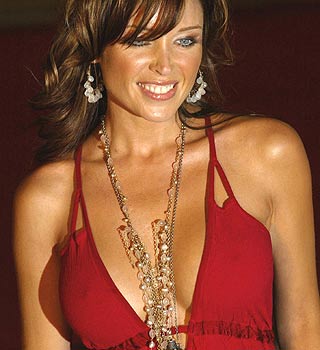
Dannii Minogue wears charm-style necklace to the Brit Awards. (Photo: Herald Sun)

Friday, February 11, 2005

Careless luxe


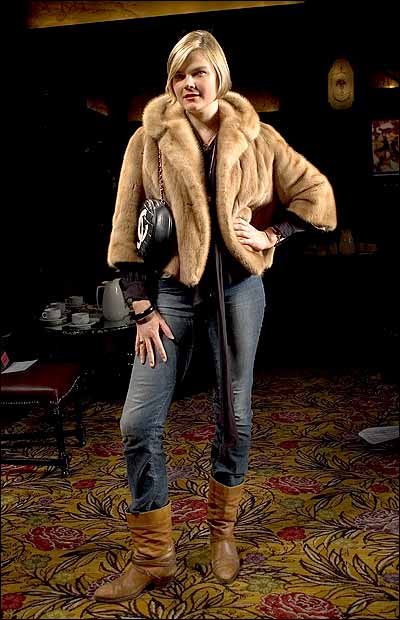
Stylist and photographer Kate Schelter says: "I never think something's too precious. I wear this mink coat like a jean jacket; I wear it everywhere." (Photo: Eliot Shepard, New York magazine.)

I like to call this look careless luxe. It's where expensive or formal wear is teamed with casual wear and worn in everyday ways. Some other examples are hoodies worn with tailored suits (huge in New York right now, apparently), cocktail dresses teamed with denim jackets, and big ostentatious jewellery, like pearls, worn with jeans and sneakers. I saw a girl yesterday wearing jeans, a pink jumper, Chuck Taylors, and a three-stranded bracelet of really big pearls.

Careless luxe is not the same as the Sparkly Top trend that refuses to die - it's still in all the chain stores and can be seen, combined with jeans and high heels, on almost all the chicks out on the town on Fridays and Saturdays. Sparkly tops are quite cheap and are designed to 'dress up' jeans rather than themselves being a 'dressy' item. By contrast, careless luxe refuses the entire hierarchy of 'dressed-upness': it refuses the hierarchy of context (fur coats are only meant for formal evening wear) and the hierarchy of value (expensive clothes are only for special occasions).

Schelter can wear her fur as an everyday jacket because she didn't shell out big bucks for it, nor does it have a sentimental history for her. She picked it up cheaply at a Cape Cod estate sale. But careless luxe also has very little in common with vintage clothing. Hardcore vintage collectors operate on a logic that I call "This Old Thing?" They 'rescue' clothes from owners who, unaware of their value, store them balled up in suitcases in the attic. They carefully clean them, store them in pristine condition, and restore them to their 'rightful' place in fashion history. This is the antithesis of the impertinent way that Schelter wears her fur.

But careless luxe is also different from dress-up box chic. Most often seen on arts student types, this where you casually pile on old formal clothes all together, giving an effect of having raided your mum's decaying old clothes from twenty years ago. Old 80s evening pumps; matted, motheaten fake furs like Humphrey B Bear; cheap plastic pearls strung slightly apart, rather than nestling together on the string like more expensive ones are. This is a great look if you can pull it off. But unfortunately, it's often done half-arsed or as a failed attempt at careless luxe. The difference is that the clothes in careless luxe may be old, but they are always of good quality and aren't literally falling apart.

"Did you get that outfit from a vending machine?"

I would not be surprised at all to see edgy fashion stores like Fat putting jewellery and accessories in vending machines. The Japanese know that vending machines aren't just for Coke. Although the most popular jidoohanbaiki do dispense drinks (Saige rhapsodised about energy drinks and miraculous cans of hot coffee) some sell clothing and accessories.

You'd probably be familiar with the Western gumball-style vending machines you see in supermarkets, where the contents are sealed in plastic spheres and are randomly dispensed by putting a coin in and turning a handle. Those do sell jewellery, although it's invariably crap, leaves green marks on your skin, and has recently been recalled in the US for fear it'll give the kiddies lead poisoning.

But at Marc Jacobs in New York, there's an identical vending machine in the foyer that sells rather more upmarket items. Karen Parr from New York magazine interviewed Iloire Blanos, a sales assistant at Marc Jacobs:
I've spent many a dollar at the gum-ball machine at the Marc by Marc Jacobs store on Bleecker Street.
Yes, the vending machine. You can get lots of cool little trinkets there.
I'd spend all my paycheck in the vending machine.
Oh, it's a problem. I buy everything.
Have you gotten anything good from it?
I actually got some of the spring jewelry - a necklace, and then the charm bracelet, which was very exciting. Then I got all the little heart marbles.
This is the sort of machine that I think we'll start seeing over here soon.

Thursday, February 10, 2005

Trucker caps: the work of the devil

They're perhaps the most hated and supposedly unfashionable fashion item around, but as a trend, trucker caps refuse to die. They were supposedly 'over' by the start of last year, but I don't think they'll go away for ages now. I posted on this on January 3 at my other blog. So here's some food for thought about the rather nasty man behind Von Dutch, the outrageously expensive trucker cap of choice for so many kids on Melbourne's city streets.

Tempting as it is, let's move away from the obvious superiority (ha ha ha, how appropriate that such an obnoxious man created such an obnoxious brand, and ho ho ho, if only these teen hipsters knew that, they'd never wear 'em!) for a minute. For me, the most interesting part of the article is how Von Dutch the man was originally a car detailer.
He made a living spray painting intricate designs on custom cars. He became a legend in his field. ... Kustom Kulture is a corporate term for the anti-establishment, deeply patriotic lifestyle [my italics] of the underground car enthusiasts of the '60s onwards. To them, Von Dutch was a national treasure. His designs were seen as revolutionary in both the motor and art worlds, and his stubborn refusal to censor himself turned him into the quintessential anti-hero for auto lovers and dejected college kids.
The funny thing is that the article couches this as the 'good old days' for the brand, with the 'bad new sell-out days' epitomised by the bland and woefully inaccurate comments of the current CEO: "We have created a clothing line and lifestyle brand with an edgy, rebellious spirit - a brand that many people, from all walks of life, can relate to." But Von Dutch was an ambivalent brand from the beginning: simultaneously lumpen and bohemian; simultaneously anti-establishment and patriotic (hence, pro-establishment).

As a cultural object, the Von Dutch trucker cap raises an interesting question about that well-worn (at least to me!) cultural-studies paradigm of incorporation (that an everyday product is decontextualised through bricolage by a small group of underground insiders, and then loses this subversive meaning when large commercial interests catch on and mass-market it). Sure, you could argue that trucker caps were once worn as practical headgear by working-class truck drivers, and are now overpriced decorations for the likes of Paris Hilton and Pharrell Williams.

Usually, when incorporation reaches some kind of saturation point, the company tries to reorient its marketing around its lost authenticity. Remember how in the mid-90s, Doc Martens returned to its punkish roots by piggybacking on the grunge movement? Quite extraordinary, considering how those boots were linked to punk's alleged violent racism - because the steel-toes were great for head-kicking. But by the 90s, Docs had become shoes for middle-class wannabe teens. The rebelliousness of grunge was a shot of authenticity in the arm.

Von Dutch is interesting because it has gone the other way. The early adopters (the hip college kids) were prepared to overlook the nasty redneck prejudices, epitomised by Howard's racism, etc, that so often lurk behind terms like "patriotism" and "anti-establishment". For them, Von Dutch was the mark of the anti-hero. Now, as the "Australian designer and fashion commentator Mandy Mills" says (I have no idea who she is - the only Google results I found for her are to do with the SMH article), Von Dutch has been overbranded to the point that "wearing it represents a lack of personality."

But I think that's entirely the point. Von Dutch has absolutely no rebelliousness to it at all now - it might as well just be a generic term for trucker cap, like Kleenex or Biro. And that's interesting in itself, isn't it? Rather than attempt to maintain a gritty edge by highlighting its founder's back-story, the brand has completely discarded it like a pair of skidmarked undies. And as a result, it's free to piggyback on all sorts of other styles and celebrities rather than being forced to choose those that match its brand personality.

And, dare I say, that lack of personality might be exactly why so many kids like Von Dutch. It's just as amorphous as wearing a hat that says "Cool". They can project their own styles and personalities onto it, or even play on it - I've seen t-shirts saying "Von Butch" and "Von Bitch". It might be completely unintentional, but like many such branding choices, it's certainly serendipitous.

So crazy right now!

Beyonce Knowles at Marc Jacobs, New York Fashion Week 2005. (Picture from New York magazine.)


Note her bling with the charms hanging off the necklace. Now, there's been a lot of hoo-ha in the press recently about the death of bling as a hip-hop philosophy and the concomitant rise of 'post-bling'. Post-bling, the papers tell us, is epitomised by Kanye West, Jay-Z and especially by Farnsworth/Fonzworth Bentley, P. Diddy's so-called "butler" or "manservant". It consists of snappy, Anglocentric dressing and discreet consumption.

There are several problems with this theory of the 'death of bling'. First, as Beyonce shows, bling lives! Admittedly, the 1920s trend of 2004 produced many 'post-bling' moments, particularly Nelly's tailored suit look in the "Tilt Ya Head Back" video. And old-school luxury brands like Bentley, Cadillac, Hennessy, Gucci and Louis Vuitton maintain their prestige in hip-hop culture. But I would argue that bling, as a philosophy of conspicuous consumption, hasn't lost one jot of its presence in hip hop - as a way that hip-hop stars themselves like to dress; as an aesthetic displayed in songs, videos, etc; and most importantly, as something hip-hop fans, and more generally, young people, like to emulate.

This leads to the second problem with the 'death of bling': it is never going to die as long as it remains enjoyable, sexy and glamorous for the wearer. I am fascinated with the affective possibilities of bling; expect many more posts exploring how it makes you feel.

But back to Beyonce. (In an aside, it is really killing me that PCs don't have keyboard shortcuts for accents, so I am unable to add the e-acute to her name. This is also very annoying when trying to type the shiny fabric pronounced lah-may.) I am particularly interested in how high the charms are hanging from her multi-stranded necklace - totally different to the pendant effect you usually see on necklaces.

Charm-style jewellery (by that, I mean a central chain with many different objects hanging from it) has now been popular since the middle of last year - I got a necklace for my birthday in August which had beads of many different shapes, colours and sizes clustered around a silver chain. More recently, I've been noticing women wearing lots of mismatched silver objects round their necks (bells, charms, crucifixes, etc), almost like a bunch of keys on a ring. One brand to look out for is Jallen (not sure of the spelling - it could equally be Jallan or any other permutation.) This is walking out of boutique stores like Rosemin in Greville St, where necklaces like those described above retail for $200-odd.

And perhaps influenced by the 1920s trend, I've been noticing very long necklaces, either worn single-stranded or looped around the neck, that consist of lengths of chain interspersed with single pearls and/or charms. I've also seen similar earrings consisting of multiple lengths of chain with single beads on the end, bunched together like tassels. For Christmas, I made my mother a three-strand necklace of gold chain randomly interspersed with matt-finish beige pearls, gold flower-shaped beads, and gold feather-shaped charms.

Keep an eye out, fashionistas!

Welcome to the zeitgeist!

Melbourne is a style city, and you don't always know the zeitgeist is coming until it brushes past you on the street. It's belittled by comparison. Melbourne isn't Harajuku. Melbourne isn't the Lower East Side. Melbourne isn't Soho. Melbourne isn't South Central. Melbourne isn't the Marais. Most of all, Melbourne is not Sydney.

I shop. I socialise. I observe. I ponder. I notice global trends in clothing, nightlife and music, and analyse how they play out on the streets of Melbourne. Footpath Zeitgeist will be a mixture of photos and sketches, chain-store odysseys and boutique missions, academic essays and cafe small-talk. It's a blog dedicated to the research and enjoyment of street style.

But I don't want to fetishise street style for its kooky originality, bitch about ugly clothing, gush about the latest designers, or celebrate hipster irony. Nor do I want to treat the street as a resource for marketers to plunder. Instead, I want to write intelligently about how style moulds identity, how clothing shapes the body and the emotions, and how all this reflects the city around me.