Tuesday, May 15, 2007

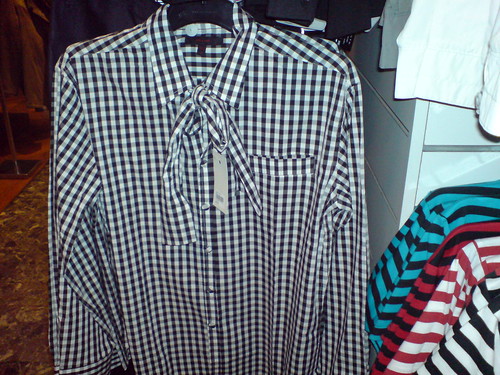
Jaunty Pussy for men


I spotted this shirt a few days ago in David Jones, but I only managed to snap a picture of it today. It's from Hem & Haw, the jaunty fellows behind Bobby's Cuts, who always get the tick of approval from me. What I like about them is that they are interested in creating and living a particular aesthetic that borrows a little bit from 50s rockabilly (and later kustom kulture), a little bit from 70s Melbourne sharpies and a little bit from 80s new wave, but is instantly recognisable and relatively easy to attain (if your body favours that lean silhouette).

I can see where they're coming from here; Thom does like his gingham shirt/plantation tie combo. But I do wonder whether men are going to wear what is essentially a pussy-bow blouse.

With the zeal of the prophet, I look forward to the spread of Jaunty Pussy through both male and female apparel.

Sunday, April 15, 2007

Window teaching


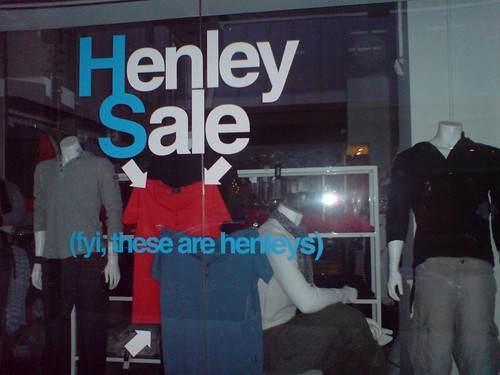
Back at the start of March, I was walking past the Industrie store on Little Collins Street and I noticed this striking window display. What struck me about it in particular was that it's not only performing a promotional role; it's also performing a pedagogical one. If you didn't know what a Henley shirt (sometimes called a Henley sweater) was, the Industrie shop window is prepared to teach you.

I myself am one of the educated, because I'd never heard the term "Henley" before I saw this display. I'm old enough to remember the last time they were popular, in the late 80s and early 90s, when they were called "grandpa shirts" because they looked like old-fashioned men's underwear. Back then they were part of the underwear-as-outerwear grunge ethos. I used to wear them with a contrasting coloured t-shirt underneath, then I'd roll up the sleeves to reveal the under-layer.

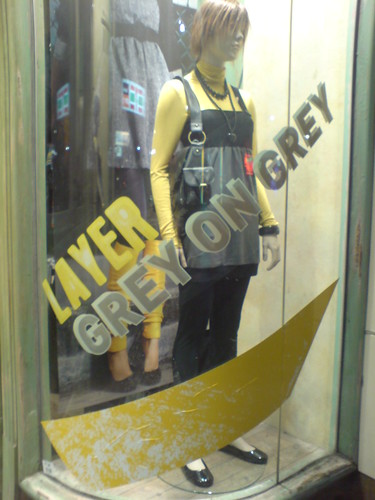
But I digress. Last week I noticed that Dotti on Swanston Street is also doing this shop-window pedagogy.


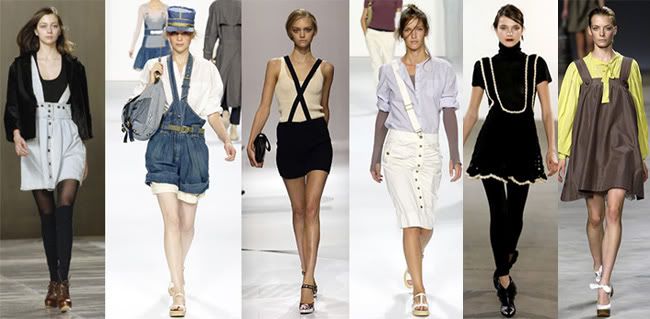
While it's another total digression, perhaps this is a good opportunity to mention that, while I'm pleased to have predicted the current resurgence of 60s mod fashion back in 2005, it gives me fresh insight into why my plump aunt is scowling and looking uncomfortable in most of the family photos taken in the 60s. Just like the first time round, it's disappointingly unflattering on all but the most Twiggy-like figures. Sack-like dresses and tops that hang from a yoke just above the bust (looks fine on flat-chested women, whereas bosomy lasses look pregnant). Prim high necklines and the return of skivvies under pinafores (like I used to wear in primary school!). Low-cut slouch boots that sit right on (or even just below!) the ankle and look ludicrously stumpy on anyone without long willowy legs. Dull drab greys and mustards and burgundies and olives. Not jaunty at all.

But anyway. The thing that intrigues me about the Dotti display is that it's teaching customers how to wear the clothes. Shopping is in fact an assemblage of teachings; shop-window visual merchandising is only the first and most striking, intended to pull you into the store. Once you're in there they continue to teach you how to wear the clothes by directing you through carefully arranged space, and getting you to interact with the shop assistants, who model and personify the brand (Supre and Alannah Hill are two particularly coherent examples of this) and, more obviously, who give you advice on how to fit and combine the clothes.

Many stores also produce literature ("magalogues" and websites) to extend their pedagogies beyond the physical retail space. These are another issue for me, because what I find interesting is the way the experience of the retail space is meant to educate. The point of this post is what's at stake for the brands in performing this role.

Most obviously, they are attempting to mould brand loyalty - to teach shoppers how to interpret fashion trends through the lens of the brand's particular ethos. Rather than tailoring their offerings to a pre-existing 'market' (eg tweens, edgy corporate wear), I think many brands try to create their market by teaching young, inexperienced clothes shoppers particular tastes and techniques that will thereafter shape their consumer practices.

But of course, that's not the entire story. We're all subject to many competing influences on our fashion consumption - popular culture (music, film, TV, etc); fashion magazines and blogs (some of which are explicitly pedagogical, eg "How to wear the new pencil skirt"); what we see other people wearing, and pleasurable feelings we get from particular garments (the swishiness of a full skirt; the fluffiness of a cashmere scarf; the clippiness and shininess of new shoes).

Perhaps what these displays are trying to bestow is a rubbed-off positive affect from having bestowed the gift of cultural capital. Sure, I might not have known what a Henley was, but now I do, and it was Industrie that taught me. Thanks, Industrie - now I will buy your garments. My phrasing is facetious, but let's not forget Miriam Silvester's idea of fashion levels - many people want to appear fashionable but don't actively follow trends. So there's money to be made by teaching them about the trends in such a way that they associate the teacher (the brand) with the pleasure of feeling newly fashionable - even if they don't actually buy the clothes.

Wednesday, March 28, 2007

Turf wars

For some time now, I've been wanting to write about the recent spurt of blogs devoted to 'street style' in Melbourne. As I commented at Camarilla, I am interested in them as a cultural phenomenon, and also as an industrial phenomenon.

Have a look to your right and you'll see that I maintain a list of street style and hipsterism resources. (It's by no means comprehensive.) I see hipsterism as the phenomenon of ironising and spectacularising hedonism and cultural capital, and street style as a genre of fashion reportage that focuses on how real people put outfits together. I am very clear what this blog means by 'street style', as my slightly pompous inaugural post outlines. I have always been interested in the mundane and taken-for-granted ways that people wear clothes, as well as how the cultural institutions of branding, advertising, retail space and fashion media subtly influence how people dress. I am also interested in how clothes make you feel.

But in many other 'street style' publications, the two ideas of hipsterism and lived fashion collapse together so that what we see covered in street style photography is a documentation of hipster culture. (These are general research interests of mine, which I've touched on in previous writing.) We see only the most outlandish outfits; the ones that are strikingly different from 'ordinary' people's clothes and are deliberately put together to attract attention. They are meant to serve as 'inspiration' for us ordinary people, as well as to designers and marketers who adapt these looks for profit. We can also see that in turn, this creates a culture of exhibitionism in which people actively solicit the photographer's attention and then look for themselves in online galleries.

So there's a triple audience: subcultural tourists getting a frisson from observing a scene in which they themselves don't participate; insiders of this scene hoping to see themselves documented; and outsiders hoping to make money from those in the scene. There is even a fourth audience of outsiders who visit to ridicule the photographs: a rich vein of comedy mined by Gawker's Blue States Lose and Mess+Noise's ShakeSomeCaptions.

This is the genre of 'street style' blogs that have started to proliferate lately. The first one to come to my attention is Melbourne Runway. It reminds me strongly of The Sartorialist, one of my favourite street style blogs, and I wouldn't be surprised if this resemblance is deliberate - you can see Marianne positioning herself as a fashion insider in the same way The Sartorialist does. The commentary isn't particularly incisive, but I like this blog's attention to the details of styling and the way that, while it never strays far from Melbourne's CBD, it captures a variety of different aesthetics and is interested in very simple outfits as well as ostentatious ones.

And then there's Third Best, which, while not innovative or insightful at all, is extremely interesting. Third Best is largely photographic and is clearly modelled on photography-centric European street style blogs. Unlike Melbourne Runway, which aims to catalogue a range of different styles and to establish its blogger's credentials as a thoughtful participant in local fashion culture, Third Best tends to depict a samey parade of baby hipsters deliberately looking spectacular, and most of its images appear shot at St Jerome's or in Caledonian Lane (clearly a favourite haunt of Nadia and Adele, the bloggers). Although Nadia and Adele are fashion students with technical knowledge and a rudimentary grounding in branding and market processes, their comments are vague and semi-literate, and they know it. As they write in the comments at Opulent:
We are NOT social commentators and we do not owe anyone a fuckin explanation of where a certain trend started or what was going through someone’s head when they put their outfit on… to tell you the truth we don’t really give a shit. What is funny to us is that we write some bullshit comments that mean absolutely nothing, yet suddenly we’ve got E grade sites such as this giving us shit for not being able to write or choosing crap outfits to document.

[...]

We didn’t start this blog with any intentions. All we wanted to do was document for ourselves all this crazy shit that people were wearing, and share it with people we knew.
It depresses me that we are creating generations of designers and commentators who are unable to articulate why they like particular clothes, and who are unwilling to be curious about the sartorial behaviour of those outside their comfort zone. It also bothers me that Third Best aims to document Melbourne style, and yet the blog is not uniquely local. Instead, Third Best is about fetishism - as Nadia and Adele explain, it's about preferencing "crazy shit" over less spectacular outfits. Rather than reflecting how Melburnians dress, Third Best slots itself into an international hipster aesthetic of "craziness" that would be equally in place in Helsinki, Tokyo, New York or London. It promotes a depressing stylistic conformity that is ironic because it appears so individual.

None of this would be a problem - people are entitled to put whatever crap they want on their blogs, just as others are entitled to mouth off about them. Except that Third Best, you'll see by clicking on that link, has been picked up by The Age. This is important. Being hosted by a media organisation with a reputation for 'quality' and 'intellect' sets up a conflict at Third Best between the traditional Age reader, who expects a high standard of writing and looks to blogs for social commentary, and young, semi-literate people for whom this style of fashion reportage is a novelty, and for whom St Jerome's is the hottest bar in town.

This is a problem that The Age is facing more and more as its website moves relentlessly downmarket. In the interests of disclosure, I should mention that I was one of four candidates interviewed for the position of online community editor at The Age, and was phlegmatic when James Farmer got the job instead. Farmer's background is in the pedagogy of blogging, and under his stewardship I anticipated a thoughtful development of blogs that was sympathetic to the heritage of The Age.

I have no idea what editorial and commercial pressures Farmer faces at Fairfax Digital, but the many blogs that have sprung up since his appointment are mostly complete crap. Third Best is perhaps the worst of all in terms of the standard of writing and the sophistication of the content. But commercial blogging is all about audiences; and people go to Third Best not only to be fashion tourists at St Jerome's, but also to mock the outfits and get outraged by the woolly-headedness of the bloggers.

When criticised, Nadia and Adele fall back on the fact of their endorsement by The Age as a raison d'etre. It's the idea that "if a newspaper believes we're worth hosting, then we're worth reading" - or, less elegantly, "We know we suck, and The Age publishes us anyway, so who's the real sucka?" And anyone who criticises is only doing it because "ur just jal00z". Jealous at not being photographed for the blog; jealous at not having the same publishing opportunities.

That is precisely the frustrating thing for me. Despite their complete lack of insight into the clothes they document, despite the fact that they aren't doing anything innovative, despite their complete refusal to show why Melbourne even needs a blog like Third Best, Nadia and Adele take on a certain authority because of their prominent position in the media. Fashion students and enthusiasts are going to link to their inane ramblings from their own blogs; journalists are going to interview them as 'fashion commentators'.

It makes me incredibly angry when Australian media outlets abandon any commitment whatsoever to innovative thought. Blogging does not need to be stupid; but for some reason our paper of record has decided that fashion is such a ridiculous subject that it deserves to be documented by a pair of clowns.

Thursday, January 25, 2007

Getting bagged

Sorry, I can't seem to shake the punmanship that set in with the Stam episode, which I thought was over now I have the bag. (Incidentally, I'm seeing them more and more now.) But Michelle has made a comment on the original post that I felt was interesting enough for me to reply at length. Michelle wrote:
Mel, why on earth would a grown woman want to buy a cheap knock off bag? Firstly, PVC looks tacky tacky tacky. Secondly, think of the 5 year old kids in China working 18 hour days to stitch the piece of garbage together -- likely since it costs $40. Thirdly, A cheap PVC handbag is not fashion, nor style. It is garbage.
At first I felt Michelle had completely missed my point, because, for me, one of the most interesting parts of the Stam exercise was to see how a style alters as it filters down from couture to bargain basement: how it changes shape and size, its details and colours change, and most interestingly, how its much more diverse distribution helps it make the shift from an exclusive status item to an everyday handbag.

Michelle's comment instead chooses to outline several distinctions or hierarchies. To put it simply, she is making a space for herself within the fashion system that she feels I ("a grown woman") ought also to occupy. But I have disappointed her by occupying another kind of space, in which buying a cheap PVC knockoff designer bag is really exciting and cool and makes me happy. I think it's fascinating the way the comment is so emphatically affective in its expression. I'll get back to that.

But I do find these hierarchies interesting and instructive, and I want to unpick them. Some are so much discussed in fashion literature that they seem self-evident; but I think it's worthwhile articulating them anyway.

First, Michelle is creating a hierarchy of material quality, suggesting that leather is a 'better' material to make handbags out of than PVC. You could similarly argue that nylon is an inferior substitute for silk, or polyester an inferior substitute for cotton. But the thing is that the way we value fabrics is constantly shifting.

Historically, anything that was expensive because it was difficult to obtain or painstaking to make was a status symbol. More recently, synthetics were embraced as a welcome innovation because they improved on the properties of natural materials. Metal and then plastic made for more comfortable corsetry than whalebone. Rayon drip-dried where silk needed to be hand-washed. And since the 1960s, couturiers have enthusiastically incorporated synthetics into their collections, from Courreges and Cardin to Donna Karan and Prada, not only because it signified 'forward-lookingness' but because they were keen to experiment with new technical possibilities.

Concurrently, ideologies of 'purity' and 'quality' developed around natural materials - they 'breathe' better; they last longer; they're better for the environment. But the most important thing is that synthetics are cheaper to produce and buy than natural materials, so natural materials have retained associations of luxury and status. I am not interested in status, which is why I'm not buying an actual Marc Jacobs bag. But I am interested in the feeling of luxury that the bag gives me. A large part of this feeling is marketing; but luxury is also a look and a texture (I've linked it with the sparkliness of diamonds and the softness of fur), and for me - and, I'd argue, for the millions of other people who content themselves with imitation luxury goods - if a synthetic material can mimic that look and texture, it's good enough.

Second, Michelle is presenting buying 'ethically' (ie, avoiding products likely to have been made in sweatshops by innocent, exploited kiddies) as a kind of moral privilege - something that places the discriminating ethical buyer further up the hierarchy than the non-discriminating knockoff buyer. But ethics really are a slippery slope - what about avoiding the systematic cruelty to animals that comes with poached and farmed fur and leathergoods, or the weird "see my vest, see my vest" fetishism of making fashion accessories from ostriches, crocodiles, snakes, et cetera?

I'm not defending sweatshops. They're indefensible. But here, moral privilege is linked to economic privilege - that spending more money is a more moral option. And that just doesn't hold up. Any handbag is likely to be made in a sweatshop - indeed, many designers outsource their manufacturing to China, where their bags are made in the same factories as their knockoffs, to the same patterns and specifications. If I wanted a more ethical handbag, I'd seek out a local designer who handmade their bags locally. But again, that's not what interested me. I was interested precisely in cheapness, in a logic of seeing how cheaply I could buy this supposedly cult product.

Here we get to the crux of the matter. Michelle is creating a hierarchy of authenticity. She's suggesting that only the 'real' designer item qualifies as 'style' or 'fashion', and that anything else is worthless 'garbage'. I couldn't disagree more. Of course, intellectual property in fashion design is a sticky area, but I don't think that's what Michelle is really getting at. Instead, she's arguing that there's an emotional response that a 'real' designer object gives you that a knockoff never can. This is the logic that has people buying cheap things at Tiffany so they can get the famous blue box, or buying designer perfumes to 'dress' themselves in fragrance.

I'd argue that when you name your bag after a fashion model then it's just ludicrous to claim that the item has no association with style or fashion. And if it is constantly photographed being used by celebrities who are popularly identified as 'style icons', then it becomes less important as an object than as a signifier of 'fashionability'. Again, I'd argue that it's not important to have the real Marc Jacobs; instead it is important to have a bag that looks like one, in order to show you are plugged into the media system that drives the trickle-down process.

Ultimately, you buy something because of the way it makes you feel. Personally, I am seized by a fierce joy when I look at the size of my Stam's gold chain, and the diamond-studded brooch pinned to it that reads "Jesus". I've noted that luxury is not an observable and incontrovertible property of an object, but a feeling instilled by a combination of ideology and, as Bourdieu would argue, habitus (the tastes that your class and upbringing have taught you to desire).

Michelle is getting a little up in my habitus when she says that only "tacky" people who cannot appreciate the finer things would buy a bag like mine. In Distinction, Bourdieu argues that the proletariat have only "the taste for the necessary" - because they don't have the cultural capital to foster aesthetic appreciation, they tend 'naturally' towards the utilitarian. But I think this has more than a tinge of those racist stereotypes of indigenous peoples adoring shiny baubles without appreciating their 'real' use. Indeed, another French sociologist, Bernard Lahire, has shown that most people's "taste profiles" are not consonant with their class location. Rather, they're "dissonant" even within individuals - you can like both "tacky" and "sophisticated" things.

Whatever. I love Stam. I don't need to justify it to people on the internet. The end.
Friday, January 19, 2007

Lovely Stam, wonderful Stam!


I sent Lucy to Apple Spice to check out the Stams I had spotted there the previous day. Here is her considered verdict:
Well. I have viewed the Stam. I like it. But I really do not think it is worth $70. There, I have said it. I wanted it to be, but it just seems that you could get even a cheap real leather bag for as much.

There does seem to be quite a difference between the ones on eBay and the ones at Apple Spice. The ones on eBay have a pocket (as does the genuine Stam) while the Apple Spice does not. Also, the eBay ones seem
to be more detailed, and the lining looks different - though it's impossible to tell if it is better or worse. But then it does say of the eBay stam: "There is an attachable chain which is optional, my only complaint is that the chain isn't long enough, however it still looks gorgeous attached on the bag."

Don't know if this is the case for the one in AS. But in conclusion, the one on ebay looks more authentic, like a better copy. But it is on eBay, so is more difficult to assess and ultimately purchase.

The End.

PS. the beige colour was much nicer than I'd imagined!
But ultimately I couldn't be bothered seeking out a Stam online, paying for shipping, etc, when I could go down the road and buy one and have it right now on my desk in my peripheral vision, making me happy. As you can see I have already customised it with my Jesus brooch; and I plan to add all manner of other tat. Hoorah! It is ridiculous how elated I am to own a knock-off bag.

Tuesday, January 16, 2007

Stam, I wish I was your owner


I don't usually get excited about designer handbags, and I don't follow designer knock-offs that closely, but since early December I've been obsessed with the Marc Jacobs Stam bag, named after model Jessica Stam. It began when I saw two different examples for sale at the Camberwell Market. I thought it was quite a smart style - it takes traditional Chanel-esque quilting and the clasp frame style and makes it look quite contemporary, and I hadn't seen it anywhere in Melbourne yet. And it's quite a large, handy size, although you can get smaller versions, hobo-styled versions, and longer, shallower versions with two zips, called the "east-west Stam".

The vendors wanted $50-$60, which I thought was quite expensive for a market bag, until I did some internet research and realised it is one of those cult bags that does a roaring trade on eBay. I reasoned that surely there would be some more affordable knock-off versions of this bag for sale in Melbourne. The good folk at Sassybella advise not to buy any of the "designer inspired" versions as PVC is "a tacky look". That's a shame, because what interests me most about this bag is the subtle variation in styling in various knock-offs I've come across in Melbourne.

You see, I discovered that there really aren't that many knock-off Stams in shops here. There really aren't even that many quilted bags with chain handles. I was surprised, because a couple of years ago there were many, many bags that ripped off the key motifs of Balenciaga's motorcycle bag (the diagonal buckles, the stitched handles, the long fronds).

Here is my Stam search, with pictures...


This is the first fake Stam I saw, in Target of all places. I like the red, but you can see immediately that they have got the shape wrong, and rather than a clasp, it has a zip across the top. But on the upside, it was $40. Of course, when I went back several weeks later, they were all gone.


Aaaah, that's more like it! This was in an el-cheapo CBD shop called Femme Connection. Can you see that it even has the flat-top clasp? It was also $40 and I would totally have bought it, despite its brassy-looking chain, except that the zip on the outer pocket was broken and they didn't have another bag. Also, it was Christmas Eve and I was in a panic and couldn't be bothered talking to the staff about it.


This one I spotted in the window of a bag shop in Howey Place. You can see that the clasp isn't right, although the chain is the right colour. The shop was closed, so I don't know how much it costs.

Of course, I could just buy a knock-off from eBay, where they are actually made of leather and come in a rainbow of colours. But the thing I have really enjoyed about this search is the random surprise of finding another variation in a shop, rather than a sterile kind of "I want, I got" mentality. For me, that's half the pleasure of shopping - actually seeing what's out there.

Update: 17 January

It turns out that the bag in the last photo is $89. They have added a beige version to the window display. And while on my lunch break today I sent the following text message to my partner in Stam-huntin' crime, Lil Lu:
Omg lucy, stam!! I saw one in apple spice for $70 and it's the right size and with the right chain and clasp and they have it in red and beige too!
She replied:
OMG indeed! You must get one! I want one! Although 70 is a bit steep...and i wouldn't want red or beige. Red is perfect for you though.
I haven't bought the bag, as I think $70 is indeed rather expensive for a knock-off bag. But we'll see how long that kind of thriftiness can withstand my bizarre new Stam bag hunger.

Friday, December 22, 2006

The uses of customisation


At the start of December I went to the CSAA conference in Canberra. One of the highlights for me was the fashion stream. I had decided not to participate because I was afraid that it would be ghettoised - it was referred to as a "fashion workshop" and I was worried that it would just be a bunch of self-identified 'fashion researchers' speaking to each other's papers, rather than forming a dialogue with the other delegates. As it turned out, the fashion papers were all held in the same lecture theatre but simply formed one of the parallel sessions, so I needn't have worried.

Many of them were frustrating because they were expository rather than analytical. They set out to describe a particular phenomenon, which many of them did in a lively and entertaining way, kind of like an interesting TV documentary. But some papers spent too much time introducing the material and not enough time situating it in a theoretical or social context. And some presenters didn't seem to have asked themselves, "What are the larger ramifications of my topic? What's at stake here?"

But one of the most exciting papers I saw was Miriam Silvester's, which focused on how strategies of customisation can extend the life of a garment beyond the traditional consumer logic of 'fast fashion'. Indeed, she spoke of the "rhythms" of clothing. Silvester is a Wellington-based designer and researcher, and a lovely person to boot. It was truly a pleasure to meet her. Perhaps it's my own impetus towards keeping lists and delineating categories, but I love the way she keeps a visual diary of all her clothes, tracking the time, energy and money she's spent on maintaining them.

Indeed, what I really liked about Silvester's research is the way that customisation isn't presented as a purely stylistic gesture or as mark of singularity for its own sake. Instead, it is a pragmatic acknowledgement of the relationships that people form with their clothing, and the way those relationships change over time. For example, you might have a favourite windcheater that you want to salvage even when it becomes torn or stained; or you might get bored with it, but it's too good to throw away. Silvester is interested in how these processes of salvage are entwined with the creativity expressed through customisation.


Look at that; isn't it beautiful the way the damaged cuffs are reworked into a design feature? For a major project, Silvester designed garments that actually anticipate and incorporate their own ruin. Her "Spill" range contains drawstrings that can be pulled to create ruched sections that disguise tea, wine or cigarette marks.


For me this seems the very opposite of those pre-distressed garments you can buy new in shops, which, ironically, by employing signifiers of 'use' and 'customisation', actually lock users out of the opportunity to form their own relationships with the garments. That is, they deter customisation.

Silvester sketched a useful model of clothing rhythms (the speed at which garments are replaced) and what she called "fashion levels" (the degree to which people respond to trends). People with low levels of fashionability, who buy purely for utility, and those with high fashionability, who can make current trends work with the minimum of new purchases, both have sustainable consuming practices. It's those with medium fashionability who are the worst consumers, because they buy and quickly discard garments in order to stay 'in fashion'. (And, I'd add, the pre-distressed garments are largely targeted to this segment.)

This begs the question of whether fashionability can be taught, and whether it even ought to be. I mean, who am I, or anyone else, to assume a position of expert knowledge and impose on other people my own ways of placing myself within current trends? All the same, there are many ways to teach people how to be fashionable - magazines, copying celebrities, observing people in the street, and the 'styling tips' that so many retail chains provide via their catalogues, their visual merchandising and their staff. I'm interested in this, and I'll return to it.

But Silvester has come up with a really interesting experiment in encouraging people to customise. It's called Wellytown. Silvester produced a lovely line art illustration of a Wellington streetscape as seen from Mt Victoria. She printed this on t-shirts which she distributed to friends and acquaintances, telling them they were free to customise the t-shirt however they liked - drawing, painting, embroidering, appliquing, etc. Some of the results were really beautiful. She's also begun selling the t-shirts in stores, together with art materials and some basic suggestions for customising. And she encourages people to photograph their work and send it to the site.

That last idea really excites me. It's as if the t-shirts are a way to join a community of creatively engaged Wellingtonians. It's a club whose members recognise each other, not only by the original image, but also by the singular ways in which they've adapted that image. It's a really smart idea. Silvester has also produced Wellytown posters which, hopefully, will lead people to the site and expand the communal idea into virtual space. There are so many wonderful possibilities.

What really interested me is that Silvester found many participants in her initial project were afraid of 'ruining' their t-shirt. Her theory is that this is because the garment is worn close to the body (as opposed to people not worrying so much about altering a collaborative artwork, for instance). But this tells me that there's a fine line between successful and unsuccessful customisation. Perhaps it's about the process - you don't quite know what the results will be until you've arrived at them, and this uncertainty deters you from even beginning. Or perhaps it's about the finish - you have an uncompromisable vision of what you want the garment to look like, and you're worried that you don't have the skills to produce this vision so you'd rather leave it to 'professionals'.

Wednesday, December 20, 2006

The Streety Morning Herald

My opinion piece on the idea of 'the street' was in yesterday's Sydney Morning Herald. I wrote it while I was writing my recent conference paper.

It's somewhat frustrating to have to compress so many ideas into the short length of an op-ed story - you could do better justice to this concept in an extended feature, and I would definitely like to write one. (Editors - you have only to click on the little lady...) But on the other hand, I'm glad I'm able to publish ideas about contemporary culture in a mainstream newspaper, especially in a space so often dominated by the minutiae of international policy and Australian parliamentary politics.

Wednesday, November 29, 2006

The nostalgia of the street


ThreeThousand is advertising its Christmas party using a doctored image from The Breakfast Club. I couldn't help noticing the startlingly contemporary way Molly Ringwald is dressed in that film. She wears a white lace neckerchief, a loose-fitting pink V-necked t-shirt with the sleeves rolled up, tucked into a high-waisted chocolate brown knee-length skirt, and brown knee boots. You can see fashionably dressed women wearing variations on this outfit right now. I guess I found this particularly striking today, given that I'm wearing a neckerchief, a high-waisted knee-length skirt, and knee boots.

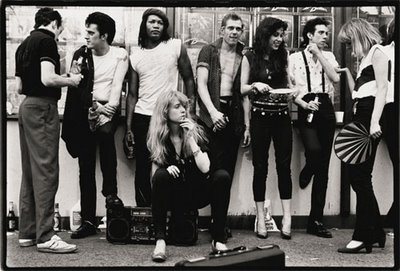
Around the same time ThreeThousand began advertising its party, I was sent a link to a marvellous slide show based on Amy Arbus's book On the Street, a collection of photographs from 1980-1990, which ran in Arbus's column of the same name in The Village Voice. Again, I was struck by the contemporaneity of the image of The Clash in 1981. You could find people in Melbourne right now dressed just like those people from 1981. It looks like an ad for jeans, except they'd never have allowed the non-jeans-wearing dude on the far left into the frame.

Why do these clothes look contemporary? I'm troubled by the distinct possibility that an ironic nostalgia is what's inspiring contemporary kids to dress like the ones in the photos, and what inspires companies to sell that nostalgia to us as lost authenticity. Because let's face it; we're talking about hipsters, and so we must tackle irony. And where there are hipsters, there are clothing manufacturers who believe in the authenticity of these hipsters' cultural activities, and want to jump on their bandwagon in order to market their clothes successfully to people who want the feeling of cool that self-perceived authenticity imparts.

Coined in the seventeenth century to describe a pathological homesickness, nostalgia has come to denote the pang that accompanies the impossibility of returning to an idealised past. In her book On Longing, Susan Stewart argues that nostalgia devalues the lived present, making the idealised past the site of authenticity. She defines nostalgia as "the repetition that mourns the inauthenticity of all repetition". Looks like she's getting all Jamesonian on our arses.

In his oft-cited Postmodernism, or the Cultural Logic of Late Capitalism, Fredric Jameson writes that the nostalgic turn arises from "the enormity of a situation in which we seem increasingly incapable of fashioning representations of our own current experience". What Jameson calls "the nostalgia form" of postmodern culture "approaches the 'past' through stylistic connotation, conveying 'pastness' by the glossy qualities of the image, and ... by the attributes of fashion". So here, we're talking about "80s-ness".

For Stewart, its utopianism gives nostalgia an innocence very unlike the self-awareness of irony, while Jameson conflates nostalgia and irony (in the form of pastiche) as equally self-aware and destructive products of the postmodern condition. But Linda Hutcheon argues that nostalgia and irony are strikingly similar, because both have doubled meanings. Nostalgia reveals both an unsatisfying present and an idealised past, while irony offers both said and unsaid meanings.

"What irony and nostalgia share, therefore, is a perhaps unexpected twin evocation of both affect and agency", writes Hutcheon. Neither inheres in a text – they’re something that the body makes happen.

As a sense of real time and history becomes lost in the postmodern morass, Jameson argues that the unified modern subject becomes fragmented and loses the capacity truly to feel -- his famous "waning of affect". Jameson doesn't, however, suggest that feelings are altogether absent from postmodern culture: rather, they become "intensities" that are "free-floating and impersonal ... dominated by a peculiar kind of euphoria" and anxiety that Jameson likens to the sublime.

But for Hutcheon, nostalgia doesn't destroy affect -- it is an affect.
... nostalgia is not something you "perceive" in an object; it is what you "feel" when two different temporal moments, past and present, come together for you and, often, carry considerable emotional weight. ... it is the element of response -- of active participation, both intellectual and affective -- that makes for the power.

So first imagine you're a hipster. You look at these images and you get excited. You're meshing these images of the past with the contemporary trends you see around you. You're imagining how you'll harness the past, how you'll look wearing these clothes. You'll imagine yourself being Molly as she gives generationalism the finger on one special Saturday. You'll imagine yourself lounging suavely like The Clash. But you'll be doing this now. Then imagine you're a marketer or a fashion designer looking for the next source of inspiration. And you trawl backwards, looking for that thing that'll get you excited. Because making the past seem fresh is your job.

Are you doing this in a thoughtless and facetious way? No, argues Hutcheon. "The ironizing of nostalgia, in the very act of its invoking, may be one way the postmodern has of taking responsibility for such responses by creating a small part of the distance necessary for reflective thought about the present as well as the past."

But it seems to me as though these are two kinds of nostalgia at play here: The Breakfast Club speaks to a mediatised nostalgia; what Hutcheon delightfully calls "commercialized luxuriating in the culture of the past". But On the Street, while also mediatised, speaks to something different -- a spatial nostalgia; a nostalgia of the street. I'm intrigued by Jameson's contention that, since the postmodern subject has lost track of temporality, "I think it is at least empirically arguable that our daily life, our psychic experience, our cultural languages, are today dominated by categories of space rather than by categories of time, as in the preceding period of high modernism".

I want to envisage "the street" as one of these categories of space. It's worthwhile remembering that nostalgia in its original sense was a longing for place. Perhaps when nostalgia seeks authenticity, it's discursively creating the street as that authentic space. And perhaps that's why marketers still look to "the street" in their quest to render the old new again. And perhaps that's why people collapse images of the past onto spaces of the present in order to create their personal styles.

This post is part of my thinking-through the paper I'm writing. I welcome your thoughts, because I am really cutting it fine now. I leave town on Tuesday morning...

Tuesday, November 28, 2006

Footnote zeitgeist


Today I checked my stats and discovered that Kate has posted on Larvatus Prodeo a response to my post about 'silly' or 'bad taste' clothing. Basically, Kate was observing two chicks out shopping wearing playsuits.
Anyway, even as I tried not to stare with incredulity at these two young women I just couldn’t help but think ‘why’? Why a short tight blue jumpsuit? Why a terry towelling athletic-style dress with red piping? And the answer is: I don’t know.
But Kate does gesture towards an answer: that it's like something Marissa Cooper would wear on The O.C. I thought this was an intriguing idea, given that these girls live in an affluent beachside community, as Marissa does (in their case, Claremont, WA), and most probably they also watch The O.C. and follow the doings of Mischa Barton in gossip magazines, etc.

Yet Kate goes on to shut down the possibility she'd just raised, turning instead to a discussion of whether it is or isn't a feminist act to stand in judgement about what women 'should' wear. She concludes:
... it is worth discussing: but not in a way that damns people who don’t dress in Approved Feminist Uniform. Or, conversely, who don’t conform to mainstream fashions. All that said, I still love Go Fug Yourself, and I reserve the right to mock people who I think dress weird, I’m just not going to pretend there’s anything feminist or intellectual about it.
I agree that moral judgements about women's clothing should never be couched as feminist, and I agree that people are entitled to wear non-mainstream fashions (although I am not nearly as interested in them as, say, a subcultural theorist would be). But - and I'm slightly perturbed by the thought - is Kate beginning with a quote from me advocating a thoughtful and open-minded way of analysing one's feelings about clothing one doesn't wear or like, and then finishing by saying her preferred mode of engagement is mindless mockery?

I couldn't disagree more with the idea that some clothing choices don't merit attention other than to dismiss them as 'ridiculous', 'silly', 'weird', or, in generationalist terms, as just one of 'those things' that 'the kids of today', aka 'Gen Y', do. (This theory was raised by a commenter on the cross-posted version of Kate's post.) So, am I one of those damned fools who "pretend there's anything ... intellectual" about the clothing choices people make? Maybe mockery is healthy in measured doses, and my seriousness is like the profound humourlessness about bogans that set in once I'd been researching that topic for too long. It disturbs me that a playful way of approaching a research topic could be hammered out of me so easily.

Perhaps a more productive way of looking at situations like these is to conceive of public space (even privatised public space - yep, I'm writing about shopping centres at the moment, can you tell?) as a space of affective encounters. Sophie Watson's City Publics: The (Dis) Enchantments of Urban Encounters seems like a useful book, because Watson explicitly couches ordinary city geographies as spaces where difference may be encountered and negative affects can erupt, but 'enchanted' and wondrous possibilities may also be found. Watson's main examples are racism and homophobia, but it'd be interesting to view the observation of 'ridiculous' and 'bad taste' clothing as another kind of exclusionary practice - one that, as Watson argues, can appear innocuous and unobservable to those not implicated in the encounter.

I also recall Melissa Gregg's excellent essay "Five Bonds T-Shirts From K-Mart: Intervening Against Indifference" (my apologies if I've got the title wrong - you used to be able to read this as a PDF on Mel's blog, but I can't find it there any more). I am sure Mel would have many more (and many more intellectual) things to say about indifference. She also has a cracker of a post up at the moment.

Monday, November 20, 2006

Let me hear your body talk


Right now I am all about the return of the rolled-sleeve t-shirt. What I like about this look is its collision of signifiers. The way it combines the 50s bad-boy t-shirt, which is about revealing the body by tightening and decreasing the length of the sleeves, with the 80s version, which references exercise wear, in which the sleeves are rolled to make a baggy shirt fit better. Of course, Springsteen's style in the 80s was an ironic pastiche of the all-American white t-shirt and blue jeans - signifiers not only of nostalgic masculine rebellion, but also of the disappearing 'authentic' American working class (the same one Billy Joel sings about in "Allentown") of which Springsteen's music was emblematic.

I love the way that Olivia Newton-John's version is also about work. Except her kind of t-shirt work is exercise. Look at how wet she is. But I especially like "Physical" because it links clothes and affective states to communication: "Let me hear your body talk." Here it's the t-shirt that facilitates the 'body talking', or corporeal orature.

This has been my epistemological preoccupation over the last three years - how ideas are communicated by the way bodies occupy space, make themselves visible, interact and collide, and the embodiedness of affect. I've been finding it very difficult to situate this interest in a particular field of study, because I'm interested in a cluster of related cultural spaces and practices - the party, the street, the shop - that fall somewhere between 'fashion', 'popular music', 'branding', 'the everyday' and 'subcultural studies'. It was very frustrating last week when I went to the Melbourne University bookshop to look for relevant literature, and found the work I was looking for variously categorised under sociology, marketing and philosophy. They have no cultural studies section. This astounded me.

But back to body talking - lately I have been trying to ask people straight-out why they chose their clothes, and what inspires them. And I'm fascinated by things like Vogue Street Chic or New York's Look Book that deliberately set out to make people explain why they wear what they do. But it isn't always a useful exercise, because I'm finding people are much less cognitive and more intuitive with their style. Or rather, they tend to favour the cognitive aspects of their dress - the stuff that's easy to explain - over the more intangible intuitive - or, should we say, affective - stuff.

Last Friday, I admired Chris's outfit - he was wearing pointy-toed shoes, black stovepipe jeans, a fitted black short-sleeved shirt with the sleeves rolled up, and a black and white striped tie tucked into the shirt several buttons down. It's a very specific look that you could even call subcultural because it's shared by a certain clique in Melbourne who deliberately dress that way. I've been told that the pointiness of the shoes is very important - the pointier the better. But when I asked Chris why he tucked his tie into his shirt - a perennial question for me, it seems - he replied that it was to stop the tie falling into his food and drinks.

I was extremely dissatisfied with this response.

In "Symbols of Trouble", Stanley Cohen problematises sociological and cultural studies research that argues for the semiotic and political richness of style:
"It seems to me ... that somewhere along the line, symbolic language implies a knowing subject, a subject at least dimly aware of what the symbols are supposed to mean. ... My feeling is that the symbolic baggage the kids are being asked to carry is just too heavy, that the interrogations are just a little forced. This is especially so when appearances are, to say the least, ambiguous or (alternatively) when they are simple, but taken to point to just their opposite."
I love the way Cohen teases the Birmingham School for their reliance on bricolage as a deus ex machina - ie, when things appear contradictory, it's because their power comes from those very contradictions. And he neatly delineates my own analytical problems:
"the problem of intent; of polysemy (a single symbol standing for many things); how people's interpretations of what they are doing might contradict how they actually behave; under what conditions the observer must go beyond indigenous interpretaitons because of what he [sic] knows of the context."
I'm keen to investigate affect as a way of addressing these problems. I've got some books on my shelf right now that I'm hoping will help me out. I'm particularly excited by Empire of the Senses: The Sensual Culture Reader (ed. David Howes). And I'm also revisiting the genre of criticism of all the old Birmingham-era subcultural theory to see if there is any wiggle room (a pun I embarrassingly included in my booty dancing paper) for the idea that bodies don't have to explain themselves in words.

Watch and learn


This is a ring I bought from Sportsgirl in early October for $4. That's about what it's worth, frankly. My apologies that the photo is a touch blurry - I took it with my left hand.

I bought this ring because while I was in Newcastle for This Is Not Art, I saw a panellist wearing a similar ring and I thought it looked cool. It's this confluence of observation, evaluation and desire that I want to unravel here, because it seems like one of the key processes by which 'street' trends spread. I'm emphasising the 'street' for several reasons:

  • Because cultural studies has traditionally represented 'the street' as a physical site for the display of subcultural political authenticity; an authenticity that is inevitably diluted by ideological incorporation of these subcultures by mainstream media
  • Because the 'bubble-up' fashion system refers to 'the street' as a stylistic site of unorthodox ideas or acts of bricolage to be resold to mainstream markets (with so-called 'cool hunters' and 'street teams' as the frontline troops)
  • Because an entire market of 'streetwear' (documented by an entire accompanying media genre) follows traditional product design, distribution and marketing methods, yet trades on a generalised (ie, not invoking specific subcultural motifs, or encompassing a diversity of motifs) idea of 'streetness'
In a paper I'm researching right now, I plan to outline the ways in which the phenomenon I'm calling hipsterism intersects with and evades these three paradigms.

Thursday, November 09, 2006

Now this is just silly - or is it?


Honkytonks, Melbourne, Friday 2 November. (Courtesy of my 3.2 megapixels of crap.)

I have posted about men's jeans before. Here's what I wrote about the genre of male trouser aesthetics that I called "arse amputation":
He is suffering from an unfortunate sickness that I like to call "Hipster's Trouser". It is what happens when subcultures collide. He is not wearing ultra-baggy homie jeans, yet he thinks it is cool to reveal two inches of underpant. I've remarked many a time on the black-stovepipe-denim-wearers at St Jerome's whose belts are mysteriously no help at all. Sometimes their waistbands even slip below the arse and sit underneath it. And from the back, it looks as though they've had an arse amputation.
And here's a picture of it from the front, where often it looks like only the penis is keeping the pants ahoist. Look at the guy on the right holding the camera.


But that still doesn't account for the question on everyone's lips, which is, "WHY WHY WHY?" It's easy to answer, "Does something as dumb as this even need an explanation?" There's a tendency to paint the wearers of these jeans as hapless fashion victims, although there's been much more criticism of women's low-riding jeans than men's. Here's just a taste:

Yup, as the Melbourne Fashion Festival comes to a close and the city whips itself into a lather over the usual catwalk parade of ridiculous, absurd and impractical clothes, it's clear Melburnians are paying no attention whatsoever. [...] I don't see a great deal of style around. I see the vulgarity of fashion that has left young Melburnians taking on a look that is shabby, slovenly and somewhat whorish. [...] chances are many girls and guys will continue to buy clothes that emphasise the huge gap between what they think they look like and what they actually look like.

But if we look at these sad, saggy creatures and consign their "bad taste" style decisions to Dick Hebdige's "place beyond analysis", we're doing what a familiar genre of style commentarydoes. We're not only creating arbitrary categories of 'good' and 'bad' taste; we're also creating a bogeyman of 'bad taste' -- saying that it doesn't follow the same embodied, pragmatic and affective processes that 'good taste' does. That it can only be observed with farcical incredulity and that people with 'bad taste' are fundamentally retarded in some way because they aren't ashamed of the way they look.

Sure, it's immensely fun and satisfying to be on the side of 'reason' in this fashion discourse. But I think it's important to ask why people wear their pants in this way. Because enough people do it to make the question relevant and interesting.

Of course, you also run the risk of being an Academic Wanker -- the rather hysterical sort who attributes improbable discursive significance to trashy or banal pop-cultural texts and practices, and equally improbable motivations to the audiences of and participants in these texts and practices. (Let it also be said that I decry the lazy journalistic practice of claiming all popular cultural studies is done by Academic Wankers.)

But let's forge ahead nonetheless. For me, this fashion is about the eroticisation of a certain kind of boyish male body. (Let's all pause a minute to thank MySpace for putting pictures of half-naked hipsters at the disposal of my completely detached analysis.)


See how low even the underpants sit? It's about the creation of a particular silhouette with a long body, narrow hips and slim legs. It says the wearer is not only skinny enough to wear such clothes; he's also so skinny they won't sit in place. And it's about a certain kind of preening body consciousness: you're always having to tug up your pants, thus drawing attention to your arse, hips and groin. But its artless slovenliness means it escapes being read as self-conscious, homosexual 'to-be-looked-at-ness'.

I'm not saying this is what the wearers of Hipster's Trouser consider while getting dressed every day. It's my gesture towards re-inserting meaning into a style that many commentators would say is just plain silly.

Thursday, October 26, 2006

Perhaps the best hipsterism resource ever!

Jeremy just sent me this - it's a self-described preppie guy wanting suggestions for putting together a Halloween costume as a "hipster".

I want to return to this (and also, just to bookmark it with this post), but my initial thoughts are that this is a really rich resource for articulating the discursive figure of the 'hipster'; that is, the imaginary person who comes to mind when you think of hipsters, regardless of the tastes and activities of real people.

Second, it's notable as a survey of the style motifs that are most commonly associated with hipsterism. Many of these things (for example, the idea that a hipster's clothes must be much tighter than a preppie's) might seem simple and self-explanatory, but the fact that they're offered here in a pedagogical context highlights that they actually require cultural capital to make them that way.

Third, it reveals the hazy space between trends and stereotypes. When, for example, does wearing a bandanna around your neck stop being 'in fashion' (something that signifies only 'in-the-momentness') and start saying wider things about the person wearing it, for example that they are the sort of person who pays close attention to fleeting and arbitrary fashions? To put it more bluntly, when do style motifs begin to do their discursive work to create the figure of the 'hipster'? Are they always-already signs of hipsterdom, or do they become that way through the passage of time, or the processes of irony?

Tuesday, October 10, 2006

No need for ethnography

About a month ago I received the following comment on my post about hipsters and keffiyeh. It was just way too good to leave in the comments, and I'd love to incorporate it into my upcoming CSAA conference paper. But even as I considered that possibility, I couldn't help smiling at my autodidactic research methodologies – blog comments are the new ethnography, doncha know...
Who named them "hipsters" they certainly don't refer to one another as "hipsters' it's a name given to them by the media or overlookers. These people dress differently and look for the next trend to push the boundries of fashion. It's like a celebration of design. Deeper thought goes into their clothing then slammin on a pair of clarks finest lace ups, BHS trousers and berghaus pull-overs (I'm guessing you people roll along these lines as you strongly frown upon others with a side of creativeness). Maybe some people do find Keffiyeh's strange to wear if you don't live in the middle east, but it's not always about politics and religoun as people adamently associate with it and fashion in general. If your so interested in why people wear such things just think why you don't. Obviously you don't know or care about sub-culture or fashion. So leave it that way. Also I think boring un-original people like your negative selves, are part of the reason "hipsters" dress differently. If it offends you so badly and deeply confuse's you as to why these kids are doing this......it means FUCK YOU
There are so many wonderful things written here that deserve further examination. First, let's look at the first question - and it's a very good one: "who named them 'hipsters'?" It's a question of self-identification versus external identification, and it's one that subcultural theory has been grappling with since the Birmingham School days. In my extremely anecdotal travels, I've heard people that I would call hipsters use the word to deride others, or to refer to themselves self-deprecatingly. So, then, 'hipster' becomes a way of othering the self - of quarantining ourselves from aspects of our tastes and habits with which we're uncomfortable.

You could call this the 'hipster discourse'. And while we often 'identify' hipsters in an informal, everyday (Foucault would say "capillary") way, it's the media that really drives the creation of a discursive figure which we could call the 'hipster'. My MA thesis, while flawed in many ways, at least makes me familiar with the idea that a figure like the hipster (or in my example, the bogan) can appear 'real' and objectively observable, but yet nevertheless this figure is the product of a very specific ideology.

Another possibility of "who calls them hipsters" is more commercial. On my recent trip to Newcastle for This Is Not Art, where I was on panels, or in the audience for panels, with a number of people from media outlets often identified with hipsterism), there was a real reluctance to use the term, or to be associated with the term. Instead there was lots of marketingspeak of "tastemakers" and "innovators" and "peer leaders" and "early adopters", used both ironically and unconsciously. And Barrie Barton from Right Angle Publishing made the obvious but genius point that his advertisers target the 10% of his readership who are hipsters in order to appeal to the other 90% who actually buy the advertisers' products.

But anyway. The second thing I see about this comment is its affirmation of a particular philosophy of stylistic individualism that I have always associated with hipsterism. It is absurd to claim that this blog isn't interested in individuality, fashion, subculture or design, so I'll just ignore that criticism. But it does seem as though the key aspect of hipsterism that I'd like to investigate is its tension between individualism and conformity, between 'subculture' and 'mainstream'. It does seem very important to people who invest in this individualism that they be recognised as innovators, and it also suits marketers who look to them for ideas, but I don't think that's the whole picture. I think the processes of appropriation and originality are far more even-handed, given that fashion always raids the popular cultural archive. More on this in an upcoming post.

Finally, and most intriguingly, the arguments here are framed affectively, from the aggressive and dismissive second-person address to the triumphant "FUCK YOU" at the end, and especially the commenter's imagining me as a resentful dork who criticises because I am jealous of the hipster creativity I don't possess myself. The key sentence is: "If your [sic] so interested in why people wear such things just think why you don't." This seems like a non-sequitur (whether or not I wear a keffiyeh has nothing to do with the reasons other people do), but it does suggest that the strong affective states attached to the clothes people wear are largely dependent on interpersonal relationships. One wears certain clothes because there are certain emotional states linked with the observation of other people wearing and not wearing the same things. Again, I want to look at this some more, because it seems to be important.

Let's also consider the comment as an event. This person finds the post - I'd love to know precisely how, although someone from London recently Googled "keffiyah craze" to get here, and the language in the comment suggests it's written by someone from the UK ("pullovers", anyone?). Then he or she writes the comment, filled with righteous anger at the stupidity and lack of fashion sense of the blogger and previous comments. And strangely, I don't feel angry or crushed myself. Instead I am filled with delight imagining the anonymous author typing the immensely satisfying FUCK YOU. Who hasn't smacked down someone on the internet? Doesn't it make you feel awesome?

Again, this makes me wonder about the role of media in facilitating this event and creating the dissonance that foments it. So often I read over my own posts, imagining how specific people might interpret them, or research a product I've just bought to find out if it was a good buy (in cultural as well as economic terms). But at the same time, I don't agree that the internet, or magazines, or TV, or whatever else, is the major facilitator of hipsterism. Sure, someone from the UK can flame me semi-literately on my own blog, but it hasn't made the same impact as if they had done it to my face. I think that corporeal, real-time encounters are much more interesting and reveal much more about the way we use clothes to define ourselves.

Monday, August 21, 2006

Brace yourself for a journey into pinafores


On Thursday I was wandering about in the city looking at the cheap Asian import shops -- a pleasure in which I often indulge in the name of "research" into "trend diffusion". I use the scare quotes because, while I'm professionally interested in the semiotic metamorphosis of style motifs as they spread through different market segments, I don't follow couture trends closely enough to chase them as they 'trickle down' to my price bracket.

Rather, my fashion research (and this blog) is about how ordinary people negotiate clothing choices that make them feel individual and creative within a retail market that is already crammed with mass-produced, mass-mediated, always-already knocked-off clothing. So when I do "research" in extremely low-market stores like Apple Spice, Femme Connection, Modiste or Studio Girl (Cheapest Price in Town!), I'm not joining the mental dots between the merchandise on display and a 'look' I've previously seen in a magazine, on a celebrity or at a recent Fashion Week. Instead, my eye is drawn to things that stand out precisely because I haven't seen them before.

This is a bizarre strategy, really, as this market segment moves so fast that it won't be long before any given look reaches a tipping point and suddenly it's everywhere. About a month ago I spotted a $20 t-shirt printed with rabbit silhouettes, but while I was still deciding whether to buy it, it tipped. First I saw it on an artist who wore a black version with white rabbits to her exhibition opening. Then it was a uni student wearing the pink one with black rabbits. And then it was all on -- the t-shirts multiplied as quickly the very bunnies printed on them, and I seem to see them in every second cheap shop.

But for now, I want to focus on the pinafore dress. I'm feeling quite buoyant about my trendspotting abilities right now, because not only has Jaunty Pussy become the dominant look this year (2006: International Year of the Spot and Stripe!), but my 2006 Fashion Prediction of "Back to School" is also ringing true, big time. (Please allow me my moment of glory; remember I also predicted a vogue for Elvis-style capes back in 2004, so I'm not used to actually being right.)

One manifestation of the Back to School trend appears to be braces. Alex Singh from Sydney label Extra Tasty cites Bobby's Cuts as a retail innovation -- and its appropriation of the food logic of 'freshness' fits well with the examples I've raised before. But I think I've previously hinted at the store's aesthetic role: Bobby's Cutsis totally championing the boyish use of elastic straps to hold one's pants up, along with the other school uniform-ish looks of tucked-in shirt and tie with cardigan. I would love to know the reasoning behind this, because it seems so consistent. On Friday night I asked store owner Thom why he tucked his tie into his shirt. He was shitfaced at the time and hugged me by way of reply.

The pinafore dress is the chicks' version of the same look. On Thursday, as I browsed in Studio Girl, my eye, ever alert for sartorial distinction, alighted on a pinafore dress that was pretty much a high-waisted bubble skirt, made from a light, puffy floral-printed cotton, with matching detachable braces. It was so badly made that a button holding on one of the braces popped off while I was trying on the dress. I thought, "Well, I'll have to buy it now," which more than anything else was an excuse to talk myself into my purchase. The salesgirl sewed the button back on at the register, which made me realise that she must do this to quite a few shoddy garments. Then two more of the buttons popped off that evening as I tried on the dress at home, so I sewed them all back on.

I wore this dress to Friday night's Is Not Magazine party. In a nice piece of inadvertent synergy, myself and my fellow editors were wearing preppy schoolkid outfits because as part of the event, we were performing a song from The Sound of Music. That's when I realised that the hipsters have embraced Back to School and that our 'costumes' were actually the height of fashion!

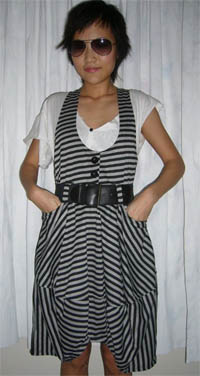
There are all sorts of bubble skirt pinafores around at the moment. Here's one I found on eBay.


The seller was billing it as 'vintage', but its unevenly gathered skirt and the grey and black diagonal stripe look very contemporary to me. That's the thing with the nouveau pinafore: it's a stylistically ambiguous garment. Whereas past pinafores had pedigrees -- the dungaree dress from workman's overalls; the tailored pinafore from school uniforms -- it's hard to know what to make of a soft, draped pinafore made from t-shirt fabric:


Or one that looks like a stretch miniskirt with an attached bib (this one's from Alice McCall's spring/summer 2006 collection):


The bib brings me to the issue that pinafores are hard for grown-arse women to wear. The braces have to go around the breasts, while the bib sits awkwardly on top of them. And while you'd imagine them being forgiving for the squidgy, they're not. About a month ago I spotted a grey pinafore dress at Supre with an empire (aka "babydoll") line and a very low-cut scoop neckline. I bought it on impulse, even though I thought the colour was quite dull, because I hadn't seen the style anywhere else and because I thought the cut would skim right over my roll of midriff fat.

Unfortunately it's turned out to be the kind of dress that makes my mother ask when the baby is due. Making you look fatter than you are seems to be a common problem here. Maybe it's the silhouette? FashionTribes has a problem with the bulky look of the Jaunty Pussy pinafores on Peter Som's Fall 2006 collection and the bubble shapes at Vera Wang, while another blogger worries that bubble skirts make you look like an egg.

The pinafore is reminiscent both of childhood and of the impossibility of returning to it. Its wearers look girlish -- but they also look like they're in costume as the little girls they used to be. And the fact that pinafores look good on so few people says a lot about the ultimate ephemerality of nostalgia. Perhaps that's why the most successful pinafores are the hybridised ones rather than the 'classics'. You can dress up in the past, but you must always return to the present.

Tuesday, June 27, 2006

The dandy is in the detail


Meccanoid website launch, Melbourne, 9 June 2006. Image from NowNow Pics.

Last week I was catching up on my reading and noticed that Roland Barthes was not in fact killed by a laundry truck in 1980, because he had written this article for The Age. But it turns out Barthes is freelancing from beyond the grave, as this is an extract from a new collected volume of essays entitled Roland Barthes: The Language of Fashion. I find it compelling and heartening that Barthes, the godfather of semiotics, was overwhelmed by the prospect of studying street style. As The Australian remarks:

Said Barthes: "Originally I had planned to study real clothing, worn by everyone in the street. I gave up." He protested that fashion was too complex - "it deploys a number of 'substances': the material, photography, language" - and the science of its analysis was too young.

And so this pioneer had decided to confine himself to the study of a single, pure substance: "fashion clothing as it is refracted through the written language of specialist magazines".

But I am interested in the subject of the Age extract: Barthes's thoughts on the phenomenon of the dandy art of dress. When we think of dandies, we think of a historical yet strangely a-historicised phenomenon. It's historical because there is a commonsense understanding that dandies are supposed to look 'old-fashioned'; yet it's a-historicised because people tend to associate dandyishness with an over the top, camp fashion aesthetic, when during the height of the dandy phenomenon in the late 18th and early 19th century, these OTT fellas were more likely to be fops.

But it's deliberate that I've including this picture of the spastic hipster looking what many people would call "dandyish". Because I want to mull over whether there is something dandyish about hipsters: in the way they fetishise aesthetic individualism; in the way the dandy was said to cultivate a detached and sceptical manner, much as hipsters are identified with a relentless irony. I was struck by the observation made by the novelist George Meredith, who once defined cynicism as "intellectual dandyism".

However, Barthes makes it clear that he is bracketing the rest of dandy culture and concentrating solely on the clothes. First, he talks about the notion of distinction and what it implies for the 'reading' of clothes.

A distinguished man is a man who marks himself off from the crowd using modest means, but it is a means whose power, which is a kind of energy, is immense. Since, on the one hand, his aim is to be recognised only by his peers, and on the other, this recognition relies essentially on details, the distinguished man adds to the uniform of his century a number of discreet signs (that is, those that are both barely visible and yet not in keeping with the outfit), which are no longer spectacular signs of a condition that is openly adopted but the simple signs of a tacit agreement. Indeed, distinction takes the signalling aspect of clothes down a semi-clandestine path: for, on the one hand, the group that reads its signs is a limited one, on the other the signs necessary for this reading are rare and, without a particular knowledge of the new vestimentary language, perceptible only with difficulty.
At first this reads like a very straightforward, Bourdieuian analysis (and bear in mind that Bourdieu was probably conducting his first Parisian fieldwork while Barthes was writing): a distinguished man distinguishes himself through the cultural capital that determines his tastes. But Barthes is gesturing towards a distinction that is a relation between insiders: one that "classifies the classifier" in the sense that only insiders can recognise the process of classification itself.

The dandy [...] is a man who has decided to radicalise the distinction in men's clothing by subjecting it to an absolute logic. Dandyism is not only an ethos but also a technique. The dandy is condemned to invent continually distinctive traits that are ever novel: sometimes he relies on wealth to distance himself from the poor, other times he wants his clothes to look worn out to distance himself from the rich - this is precisely the job of the "detail", which is to allow the dandy to escape the masses and never to be engulfed by them; his singularity is absolute in essence, but limited in substance, as he must never fall into eccentricity, for that is an eminently copyable form.

The dandy's clothes are based around a semiotic building block that Barthes calls the "detail". For the dandy continually strives not only to be "other" but also to be alone in his otherness (unlike a subculture, which aims for collective otherness). It is this "detail" that enables such pure distinction. And it is in the (at least theoretical) infinity of singularity that dandies can identify each other. They are recognising each other's thoughtful originality: the precision and subtlety of each other's sartorial signatures. They are not identifying with the other's stylistic similarities, but with the other's stylistic differences.

But in practice, writes Barthes, the "detail" was not absolutely singular, and the rise of ready-to-wear clothing struck dandyism a fatal blow.

But, more subtly, what ruined dandyism for good, was the birth of "original" boutiques; these boutiques sold clothes and accessories that were not part of mass culture; but because this exclusivity was part of commerce, albeit within the luxury sector, it become itself normative: by buying a shirt, a tie or cufflinks at X or at Z, one was conforming to a certain style, and abdicating all personal (one might say narcissistic) invention of singularity.
I am interested in Barthes's insistence that "once limited to the freedom to buy (but not to create), dandyism could not but suffocate and die". He's suggesting that the creativity in consumption is not sufficient to sustain the extreme singularity required by dandyism.

What really interests me is Barthes's specific example of the boutique. Boutiques perform a weird balancing act between originality and homogeneity. There are the high-end boutiques specialising in prestigious ready-to-wear labels, like Le Louvre in Melbourne. The advantage of going to such places is the personalised service and the access to exclusive high-end merchandise not available elsewhere. Then there are 'branded' boutiques that sell an idiosyncratic house style or label, like Biba and SEX/World's End, or to give some Melbourne examples, Quick Brown Fox and Frauhaus. These seem to have their own signature: a certain kind of 'look' that is homogenous.

Then there are the most interesting sort (and the most relevant to hipsters), which are effectively a collection of niches: they source small-run artisanal labels that would otherwise be hard to buy unless you went straight to the designer. Melbourne examples include Fat, Alice Euphemia and Bobby's Cuts. Now these places also offer a kind of stylistic consonance: in the past I've condemned Alice Euphemia for selling "sheltered workshop clothes"; and Bobby's Cuts specialises in a more tailored kind of rock-star wear featuring skinny ties, vests, what have you.

So, does this mean that someone who shops at such boutiques is not a dandy? Well, yes and no. Of course more than one hipster will take a liking to the same "detail", and they might even (quelle horreur!) spot each other at a record label launch wearing the same "detail". But I think that, rather than destroy originality, this inevitability creates a baroque style. When I talk about the 'baroque', I mean the intricate and detailed repetition of a particular stylistic motif such that it becomes something distinct from the original. And I think it's this baroqueness, rather than the absolute singularity of his or her clothing, that marks a hipster.


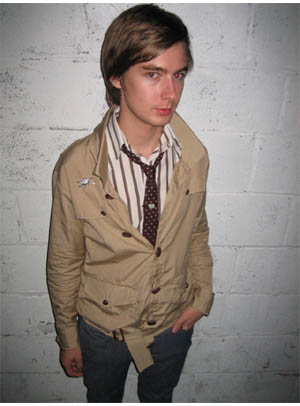
These two fellows were photographed at Misshapes in New York on 10 and 17 June 2006. They are wearing essentially the same outfit: boxy casual jacket; dress shirt; skinny tie; subtle jewellery (badges, necklaces); skinny jeans. But they've managed enough variations on the outfit to make the look their own. And importantly, the constituent elements of the look are not stylistically consonant. There is no way they can have obtained the entire outfit from the one store: it requires bricolage.


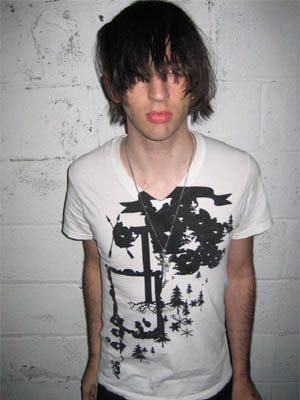
I included these two because of the startling similarity of their outfits. Fitted V-necked t-shirt in which the neckline cuts into the print; necklace on a long dangly chain; Mick Jagger rock hair and stagey posing. Their baroqueness is of the crudest and laziest kind; but nevertheless they are performing the same process of subcultural distinction that Barthes describes. The tiny differences between their outfits and those of a man who's bought his entire outfit from a high-street chain like Industrie or General Pants "are both barely visible and yet not in keeping with the outfit". There is just enough detail (the necklaces, the t-shirt prints) to mark them as hipsters, and to enable them to recognise each other as hipsters.

Ultimately, I don't think this post answers the question of whether hipsters are contemporary dandies. But I think it's valuable to be able to identify what it is about someone's clothing -- someone who isn't necessarily dressed in a spectacular, subcultural way -- that nevertheless allows us to categorise them. I also think Barthes's theory of the detail gives us a point of access into the processes by which we all assert our individuality. Perhaps the hipster has more perceived individuality at stake than most of us. And perhaps that's an interesting perspective itself: the idea of the hipster as a person disaffected with the death of dandyism, and attempting to reassert its lost singularity in the baroque ways that are enabled by contemporary consumer culture.

Monday, June 26, 2006

Time to get pragmatic

As I posted recently on my personal blog, the field of commercial blogging is growing exponentially, and bloggers are increasingly being viewed as 'content providers', much as television has always been a content provision exercise that delivers audiences for advertisers. As I've argued, the trouble begins when bloggers aren't adequately recognised and remunerated, and I see syndication agencies such as ScooptWords as a dangerous development.

This is because they notice and exploit a culture in blogging in which bloggers are amateurs who are not equipped or not inclined to deal personally with editors wishing to republish their work. Indeed, new business ventures driven by the growth in so-called "citizen journalism" rely on an amateurised (as opposed to a professionalised) market of "content providers" who are willing to provide their work anonymously and to have it edited with impunity. All because they are happy just to see their words in print, under the aegis of a 'respectable' media masthead.

I argue that this is a patronising attitude. It may work for some people for whom blogging is a hobby. Indeed, I run a number of personal blogs for which I wouldn't expect to get paid. But as a working journalist and cultural critic, I would like to earn a living from my research, my innovative ideas, my authoritatively argued opinions and my analytical abilities. These are my tools of trade. And I believe that bloggers writing this sort of material should learn to put a dollar value on the work they publish.


This is why I am adding this button to my sidebar. I'll keep posting here for free, but I will ask for a reasonable pay rate if any editors should be interested either in republishing my posts or in commissioning stories from me. I believe that if enough bloggers are polite but firm about this, there is no reason that bloggers can't be content providers. And this more equal industrial relationship ought to be the future of online content provision.